
⚡ Quick answer
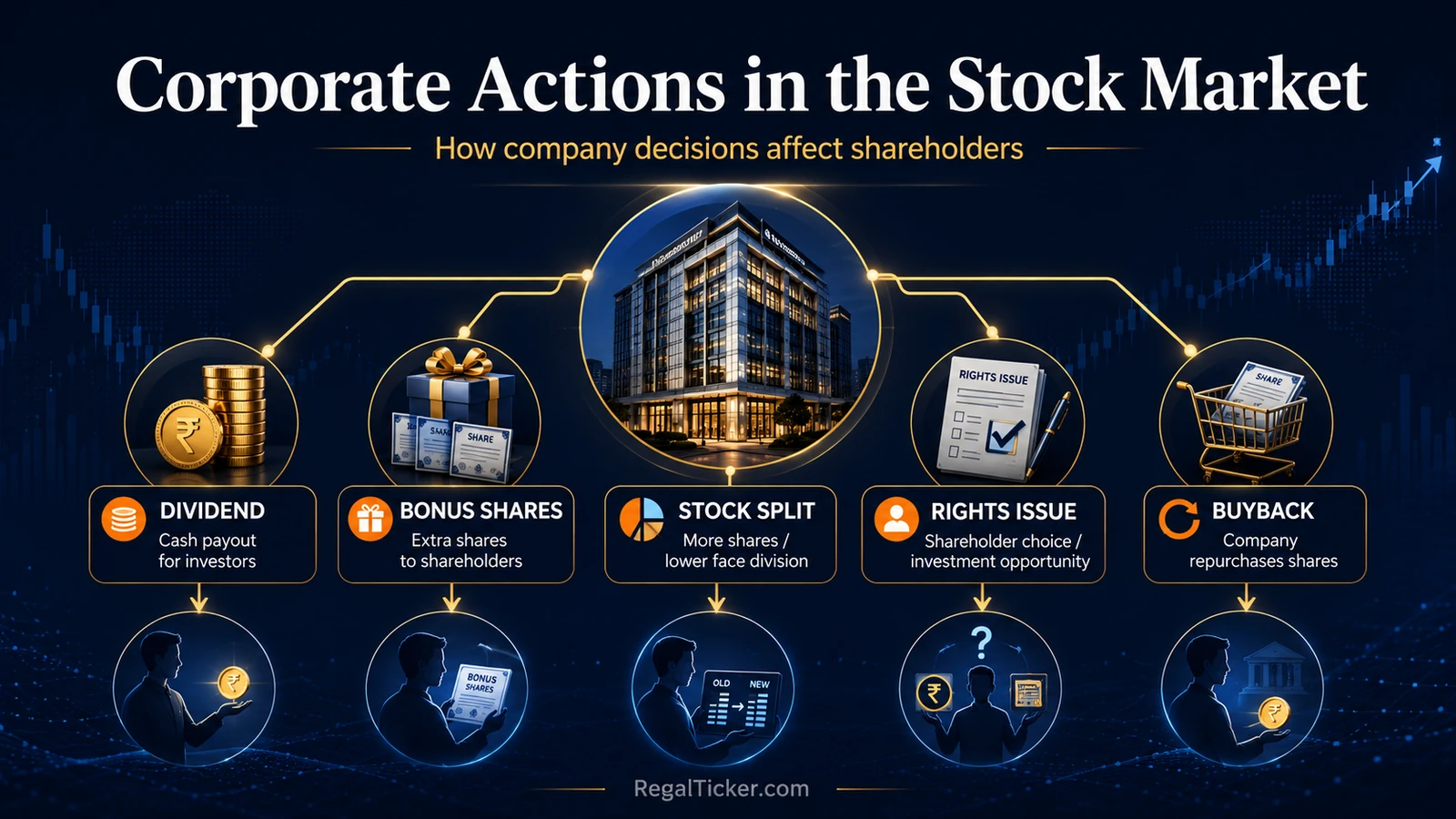
A corporate action in the stock market is a formal company-led event that directly changes a security or a shareholder entitlement. Common examples are dividends, bonus shares, stock splits, rights issues, share buybacks, demergers, amalgamations and spin-offs. Depending on the action, you may receive cash, receive more shares, invest fresh money, tender shares, or end up owning securities in a reorganised business. Some actions are processed automatically for eligible holders, while others require a decision before a deadline. The official company and stock-exchange filing is the final source for the ratio, price, eligibility and dates.
Key takeaways
A corporate action is a company-led event that can change cash, share quantity, ownership, cost records or shareholder rights.
Common corporate actions include dividends, bonus shares, stock splits, rights issues, buybacks, demergers, amalgamations and spin-offs.
More shares do not automatically mean more wealth; bonus issues and stock splits mainly change the form of the holding.
Rights issues and tender buybacks require an investor decision and can involve important deadlines.
Demerger, amalgamation and spin-off can change what securities you own and may affect acquisition-cost records.
Similar-looking ratios can mean very different things: a 1:1 bonus, 1:1 rights issue and 1:1 share-exchange ratio are not the same event.
Always verify the official company and stock-exchange filing before using a ratio, price, record date or entitlement in a calculator.
Evaluate the business reason and shareholder outcome, not just attractive words such as bonus, discount, premium or free shares.
Types of Corporate Actions With Examples
This is the simplest way to learn the subject: connect each corporate action with a real shareholder outcome.
| Corporate action | Simple example | What changes for the shareholder |
|---|---|---|
| Dividend | ₹5 per eligible share | Cash is received |
| Bonus shares | 1:1 bonus | Share quantity increases |
| Stock split | Face value ₹10 split to ₹2 | One old share becomes five smaller units |
| Rights issue | 1 new share for every 5 held at ₹120 | Investor gets a choice to invest more |
| Share buyback | 120 shares accepted at ₹1,500 | Cash is received for accepted shares |
| Demerger | One business separated into another company | Investor may receive another holding |
| Amalgamation | 3 new shares for every 10 old shares | Existing shares may be exchanged |
| Spin-off | A business becomes an independent company | Investor may receive shares in the separated business |
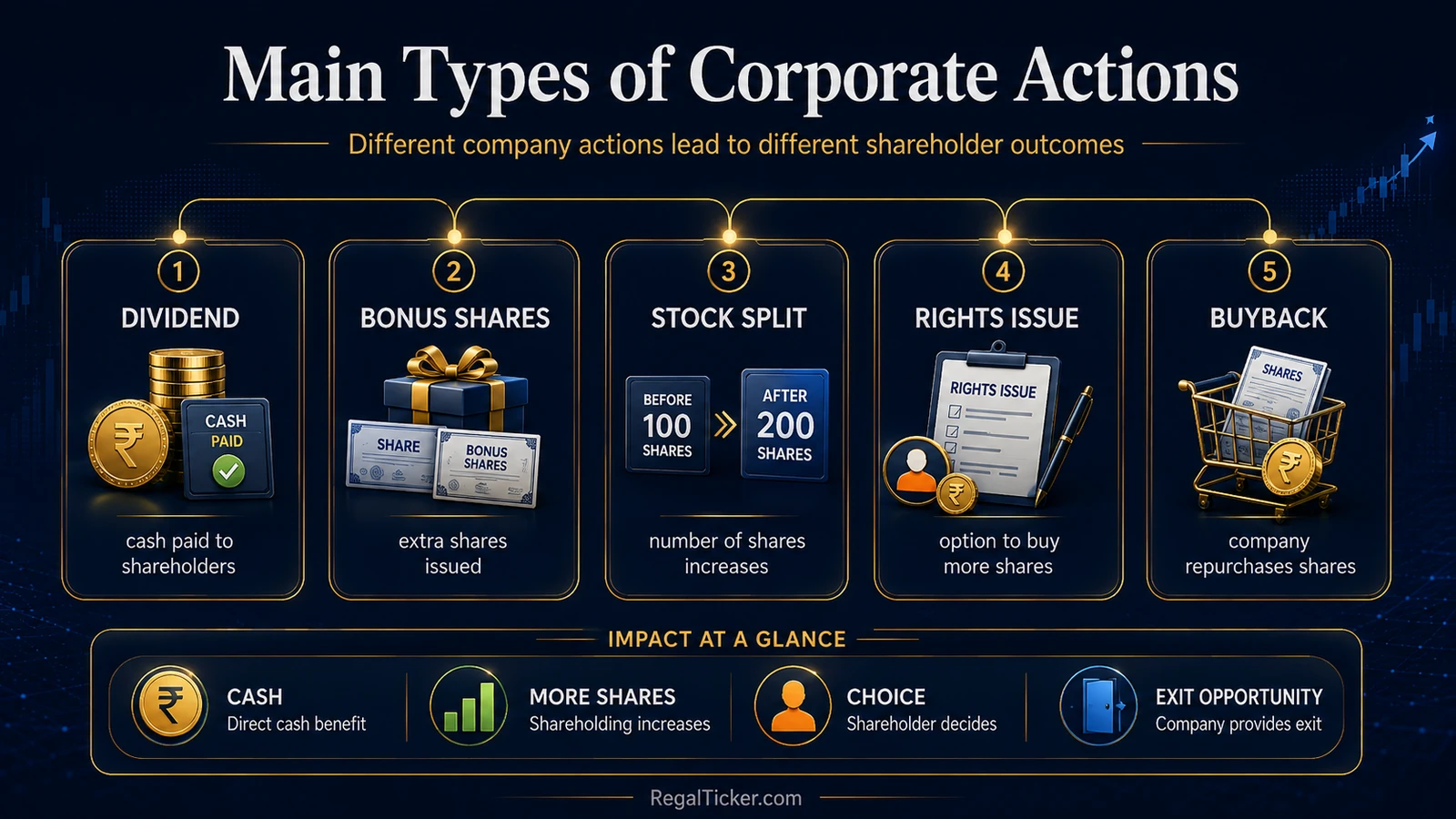
The table gives you the map. The five examples below show how the most common actions actually work with numbers.
Dividend Example: Cash Is Distributed
A dividend is a cash distribution to eligible shareholders. It can provide income without selling shares, but the payment comes from the company’s resources rather than appearing from nowhere.
💡 Real example
₹5 dividend on 300 eligible shares
You hold 300 eligible shares and the company declares a dividend of ₹5 per share.
Gross dividend = 300 × ₹5 = ₹1,500.
What this means for you: the company distributes ₹1,500 gross against your eligible holding. The final credit can differ because of applicable deductions or investor-specific tax treatment, and the market price can adjust when the share trades without the upcoming dividend entitlement.
For the complete concept, read What Is a Dividend? or use the Dividend Calculator after confirming the declared amount.
Bonus Shares Example: Your Share Count Increases
A bonus issue gives eligible shareholders additional shares without requiring a subscription payment for those bonus shares.
💡 Real example
1:1 bonus on 200 shares
You hold 200 shares and the company announces a 1:1 bonus.
You receive 200 bonus shares, so the post-bonus holding becomes 400 shares.
What this means for you: your share count doubles, but the business has not automatically doubled in value. The theoretical market price adjusts because the same company is represented by more shares.
For detailed mechanics, read What Are Bonus Shares? and use the Bonus Share Calculator.
Stock Split Example: One Share Becomes Several Smaller Units
A stock split subdivides an existing share and normally reduces face value in the same proportion.
💡 Real example
Face value ₹10 split to ₹2
A company changes the face value of each share from ₹10 to ₹2.
Mathematically, each old share becomes 5 post-split shares. If you held 100 shares, you would hold 500 shares after the split, subject to the official terms.
If the pre-split market price were ₹600, a simple theoretical post-split price would be around ₹120 per share before normal market movement.
What this means for you: the unit count changes; the split itself does not make the underlying business five times more valuable.
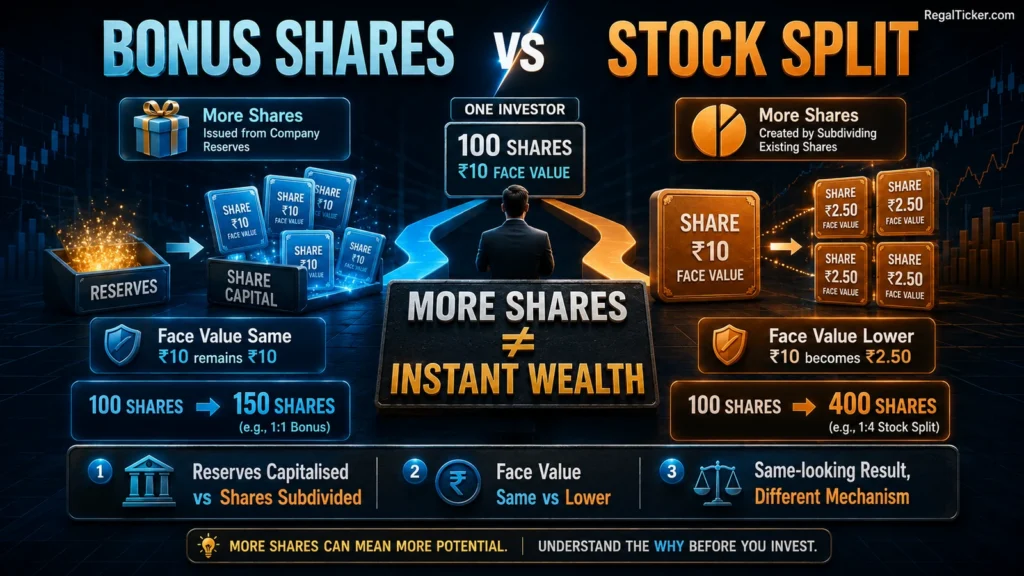
Bonus shares and stock splits can produce a similar-looking result—more shares and a lower theoretical price per share—but they work differently inside the company. A bonus issue normally capitalises eligible reserves while keeping face value unchanged, whereas a stock split subdivides existing shares and reduces face value proportionately. See the full comparison with numerical examples in Bonus Shares vs Stock Split: Differences, Examples and Investor Impact.
Rights Issue Example: You Must Make a Choice
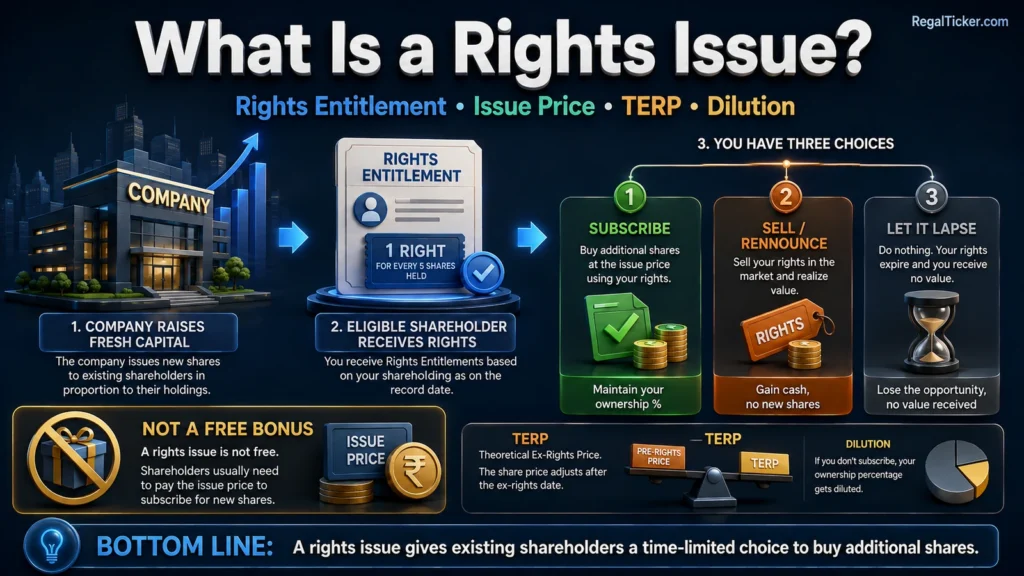
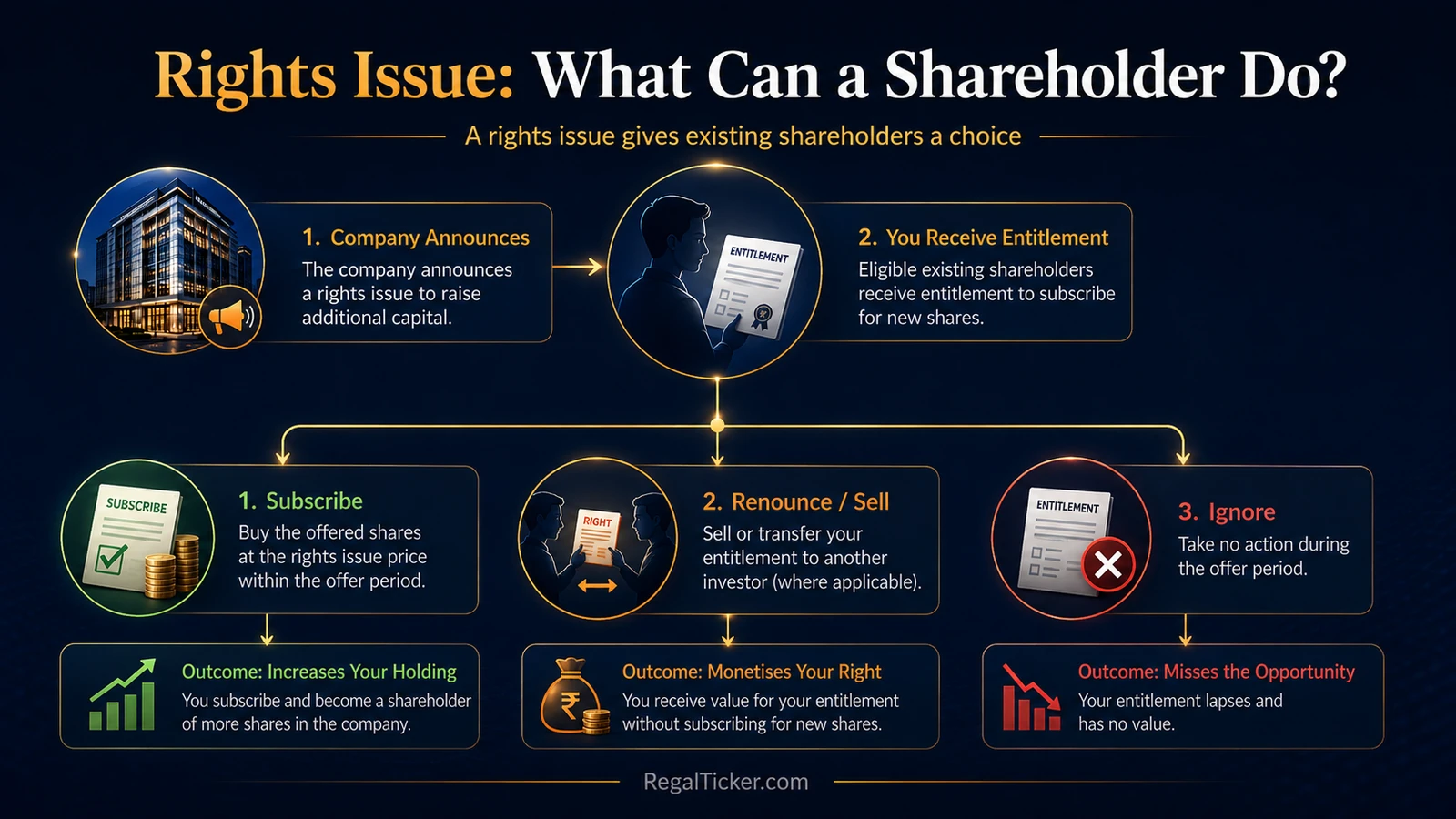
A rights issue raises fresh capital by offering additional shares to eligible existing shareholders in a stated ratio and at a stated issue price.
SEBI’s investor guidance explains that participation is voluntary. Depending on the issue terms, an eligible investor may subscribe, sell or renounce the Rights Entitlement where permitted, or ignore the offer. Ignoring the offer can lead to dilution if new shares are issued and the investor does not participate proportionately.
💡 Real example
1:5 rights issue at ₹120
You hold 500 shares and the company offers 1 rights share for every 5 shares held at ₹120 per share.
Your mathematical entitlement is:
500 × 1 ÷ 5 = 100 rights shares.
If you subscribe to all 100, the additional investment is:
100 × ₹120 = ₹12,000.
What this means for you: the arithmetic tells you the entitlement and cash required, but it does not tell you whether subscribing is a good investment. You still need to understand why the company is raising money, how it plans to use the funds, and whether you want greater exposure to that business.
Read What Is a Rights Issue? or model the mechanics with the Rights Issue Calculator.
Share Buyback Example: Tendered Is Not the Same as Accepted
In a tender buyback, the company offers to repurchase shares from eligible shareholders. A beginner-friendly mistake is to assume that every tendered share will be bought.
💡 Real example
120 of 400 tendered shares are accepted
You hold 400 shares and tender all 400 into a buyback.
Suppose the company finally accepts 120 shares at ₹1,500 per share.
Cash received = 120 × ₹1,500 = ₹1,80,000.
Shares remaining = 400 − 120 = 280 shares.
What this means for you: the tender quantity and the final accepted quantity are separate numbers. SEBI’s investor guidance specifically notes that not all tendered shares are necessarily accepted.
Read What Is a Share Buyback? and test different acceptance scenarios with the Buyback Acceptance Ratio Calculator.
Restructuring Examples: Demerger, Amalgamation and Spin-Off
These actions change the structure of the business rather than simply paying cash or changing the number of units.
| Action | Example | What the investor should focus on |
|---|---|---|
| Demerger | A consumer business is separated from an industrial business | Which entity you receive shares in and how acquisition cost is allocated |
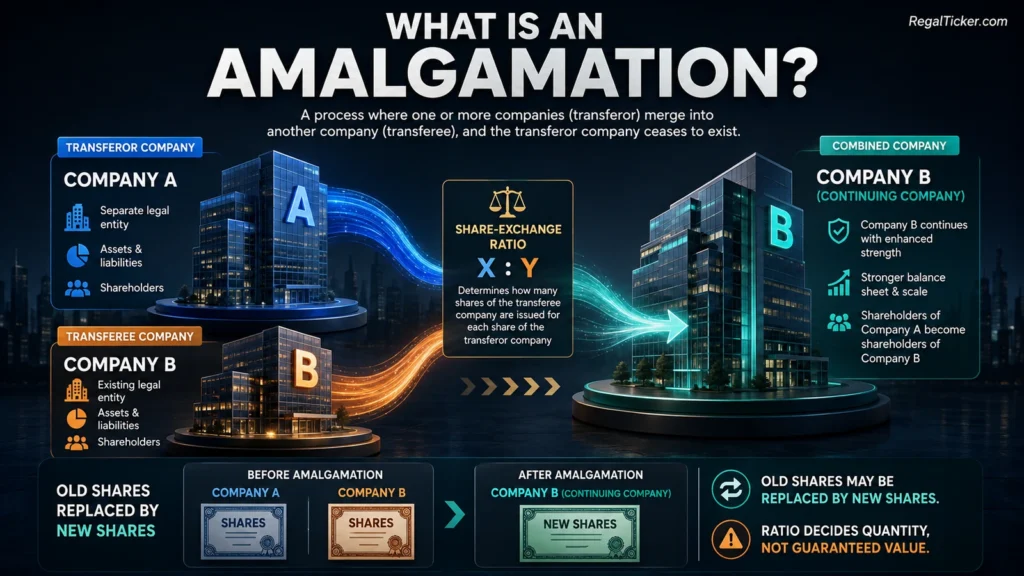
| Amalgamation | 3 shares of the combined company for every 10 old shares | Share-exchange ratio, effective date and the business being received |
| Spin-off | A subsidiary or division becomes an independent company | Entitlement, cost allocation and the economics of each resulting business |
When an amalgamation replaces old shares with shares of another company, use the final sanctioned ratio—not an announcement headline—to calculate the expected quantity. After verifying the scheme, use the Share Exchange Ratio Calculator to calculate exact entitlement, whole shares and any mathematical fractional remainder.
For the complete investor explanation, read What Is an Amalgamation? Meaning, Share-Exchange Ratio, Accounting, Tax and Examples.
What Exactly Is a Corporate Action?
📖 Definition
Corporate action
A corporate action is a formal event or decision initiated by a company that directly affects its securities, capital structure, or the rights and entitlements of security holders.
For an equity investor, the result can appear as cash in the registered bank account, additional shares in the Demat account, a different face value, a Rights Entitlement, shares accepted in a buyback, an old security exchanged for another security, or a new holding after a restructuring.
Not every company announcement is a corporate action. Quarterly results, a factory expansion, a management appointment or a new product can move a stock price, but they do not necessarily alter the security or the shareholder’s entitlement.
How a Corporate Action Reaches the Investor
A corporate action is not completed the moment a headline appears. There is normally a chain between the company decision and the final investor outcome.
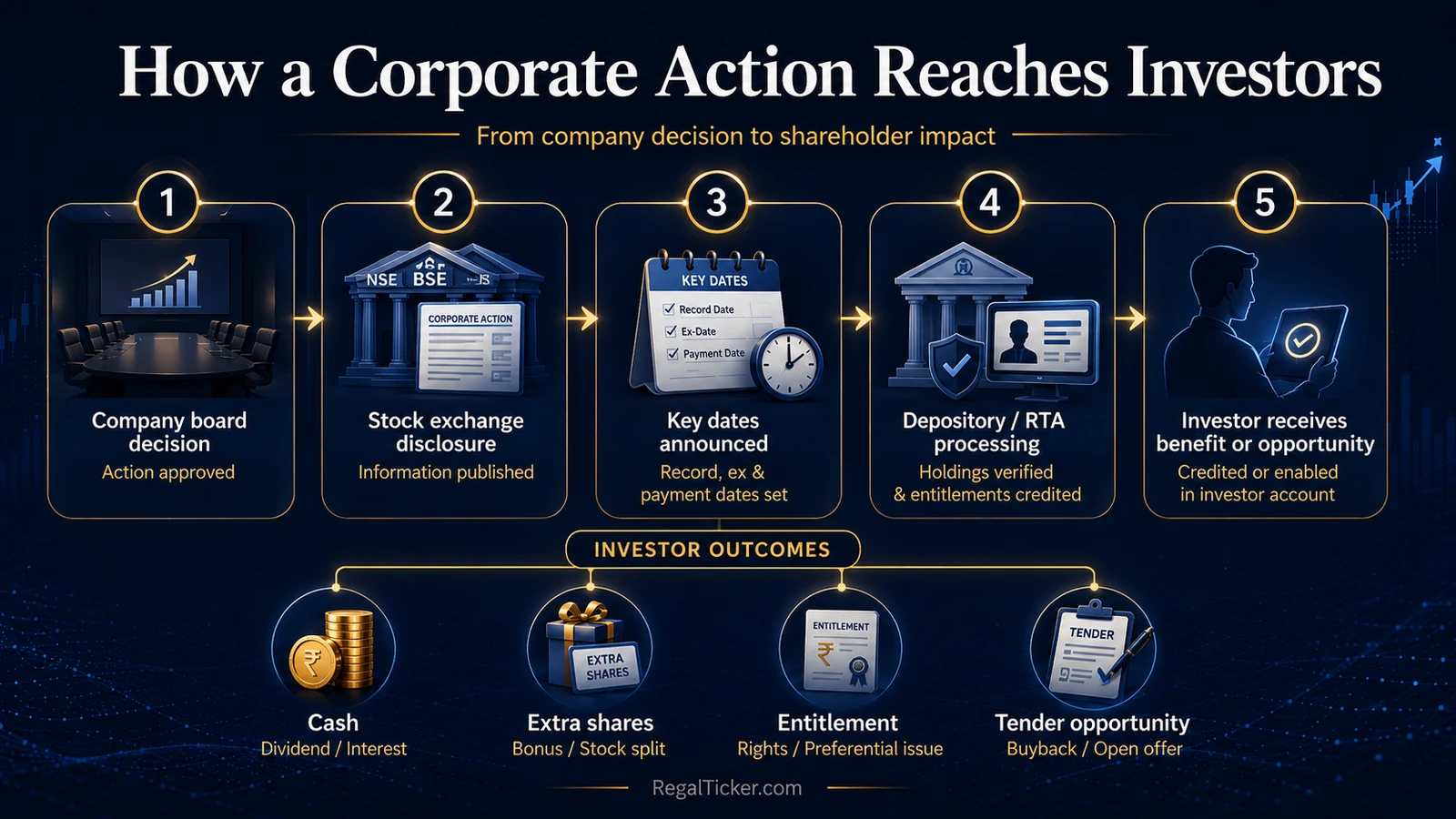
1
Company decision
The board, shareholders or another approving authority takes the required decision or approval.
2
Exchange disclosure
The company communicates the action and its terms through the stock exchange.
3
Eligibility and timetable
The relevant record date, offer window or other action-specific timetable is established.
4
RTA and depository processing
Beneficiary records, entitlements, allotments, debits or credits are processed.
5
Investor outcome
Cash, shares, an entitlement or an election opportunity reaches the eligible investor.
CDSL maintains separate corporate-action procedures for bonus issues, rights issues, subdivisions, amalgamations, demergers, schemes and buybacks. That is a useful reminder that one generic rule should not be applied blindly to every action.
Why Do Companies Announce Corporate Actions?
Corporate actions are tools of capital allocation and business restructuring. The purpose matters more than the headline.
| Company objective | Typical action | Useful investor question |
|---|---|---|
| Distribute cash | Dividend | Can the company afford the payout without weakening future investment? |
| Change share structure | Bonus shares or stock split | Is economic value changing, or mainly the share count and price per share? |
| Raise fresh capital | Rights issue | Why is new money needed and what happens if I do not participate? |
| Return capital | Buyback | How much cash is being used and how many shares may actually be accepted? |
| Reorganise the business | Demerger, amalgamation or spin-off | What businesses, assets, debt and securities will I own afterwards? |
Risk
A positive headline can hide weak economics
A bonus, split, dividend, rights discount or buyback premium can attract attention, but the corporate action itself does not make a weak business strong. Judge the event together with earnings, cash flow, debt, capital needs, valuation and management’s reason for taking the action.
Mandatory vs Voluntary Corporate Actions
The classification tells you whether you normally need to make an election.
| Participation style | What it means | Common examples |
|---|---|---|
| Automatic for eligible holders | No individual application is normally required after eligibility is established | Dividend, bonus shares, stock split and many scheme-driven actions |
| Voluntary | Investor chooses whether or how to participate | Rights issue, tender buyback and some offers |
| Mandatory with choice | The action applies, but the investor may choose between stated alternatives | Scheme-specific cash or security elections |
How Corporate Actions Can Affect Your Portfolio
A useful way to analyse any action is to separate the mechanical effect from the business effect.
| Area affected | Possible effect | Example |
|---|---|---|
| Cash | Money enters or leaves the portfolio | Dividend received; money paid to subscribe to rights |
| Share quantity | Number of shares changes | Bonus, split, accepted buyback |
| Price per share | Theoretical price can adjust | Dividend, bonus, split, rights issue |
| Ownership percentage | Stake can be diluted or concentrated | Rights non-participation; buyback |
| Per-share figures | EPS, book value per share or cost per share can change mechanically | Buyback, bonus, split |
| Portfolio structure | One security can become several or be replaced | Demerger, amalgamation, spin-off |
| Records | Acquisition cost and security details may need updating | Split, demerger, share exchange |
Corporate Action Dates in India
A single action can contain several dates, and they answer different questions.
| Date | What it tells the investor |
|---|---|
| Announcement or approval date | What the company has proposed, recommended or approved |
| Ex-date | When the security trades without the specified upcoming entitlement |
| Record date | Date used to identify eligible holders in the relevant records |
| Offer opening and closing dates | Period in which the investor can subscribe, tender or make another election |
| Payment, allotment or credit date | When cash or securities are delivered |
| Effective or trading date | When certain reorganised or newly credited securities become effective or tradable |
How to Evaluate Any Corporate Action
A people-first decision process starts with understanding, not predicting whether the share price will rise.
Corporate Action Investor Checklist
- Identify the exact action.
- Open the current company and stock-exchange filing.
- Check whether the action is proposed, approved, conditional or already effective.
- Verify the exact ratio, amount, issue price or offer price.
- Mark the relevant record date, ex-date, offer deadline and payment or credit date.
- Decide whether the action is automatic or requires an election.
- Calculate the mechanical effect using verified inputs.
- Ask why the company is taking the action and what happens to cash, debt, dilution and future business value.
- Keep company, RTA and Demat records when acquisition cost or entitlement matters.
- Confirm the final cash or securities credit after completion.
Use the calculator
Calculate only after you verify the filing
RegalTicker has calculators for dividends, bonus shares, stock splits, rights issues, buybacks, demerger cost allocation and share-exchange ratios. Use them to reduce arithmetic mistakes after you have confirmed the official inputs. A calculator cannot confirm eligibility or decide whether participating is suitable for you.
Common Mistakes Beginners Should Avoid
The most common mistakes come from reacting to the headline instead of the economics:
- “Bonus shares are free profit.” More shares do not automatically mean more total value.
- “The stock became cheap after a split.” A lower price per share is not the same as a lower valuation.
- “A rights issue is at a discount, so subscribing must be profitable.” The company and the market price can still perform poorly.
- “Every share I tender in a buyback will be accepted.” Final acceptance can be lower than the tendered quantity.
- “The record date alone tells me when to buy.” Entitlement depends on the action’s current timetable and settlement mechanics.
- “A demerger gave me free shares.” Business value and acquisition cost can be redistributed across resulting holdings.
- “My broker alert is enough.” Use the company and exchange filing as the final reference.
Quick Knowledge Check
🎯 Quiz yourself
A company gives one additional share for every share held without asking you to pay a subscription price. Which action is this?
A 1:1 bonus issue. Your share quantity increases, but the action itself does not automatically double the economic value of the holding.
A company offers one new share for every five shares you hold at a stated issue price and gives you a deadline to decide. Which action is this?
A rights issue. It is a capital-raising action in which eligible shareholders decide whether to participate under the issue terms.
A company reduces face value from ₹10 to ₹2 and your 100 shares become 500 shares. Which action is this?
A stock split. The number of units increases while face value per share reduces proportionately.
Final takeaway
Four questions are enough to start
Whenever you see a corporate-action announcement, ask: What is changing? Why is the company doing it? Do I need to act before a deadline? What will my holding look like after completion?
Verify the filing first, understand the shareholder effect second, calculate the mechanics third, and judge the business impact after that. This sequence is more useful than reacting to words such as “bonus”, “discount”, “premium” or “free shares”.
Frequently asked questions
Do corporate actions always increase shareholder wealth?
No. A bonus or stock split can increase share quantity while the theoretical price adjusts. A dividend moves cash from the company to eligible shareholders. A rights issue requires fresh investment to participate. The economic result depends on the terms and the underlying business.
What is the difference between mandatory and voluntary corporate actions?
An automatic or mandatory action is normally processed for eligible holders without an individual election. A voluntary action requires the investor to decide whether or how to participate, such as subscribing to a rights issue or tendering shares in a buyback.
Where should investors verify corporate actions in India?
Start with the company’s current NSE or BSE filing. For rights issues, buybacks or restructuring, also read the applicable offer document, scheme document, RTA communication and relevant depository or regulator information.
Verify through official sources
Official references
- NSE — FAQs on Corporate Action, July 2026 — Current NSE guidance on corporate-action filing and record-date requirements.
- SEBI Investor — Rights Issue of Shares — Retail-investor explanation of rights issues, Rights Entitlement and participation choices.
- SEBI Investor — Buyback of Shares — Investor guidance on buybacks, tendering and acceptance.
- CDSL — Documentation for Corporate Action — Operational documentation for multiple corporate-action types.
Educational disclaimer: This article is for investor education and general information only. It is not investment advice, personalised financial advice, tax advice, legal advice, a research recommendation or a solicitation to buy or sell securities. Corporate-action rules, dates, tax treatment, settlement procedures and company terms can change. Verify material details through the current company filing, stock-exchange disclosure, offer or scheme document, RTA communication and applicable official sources before acting. ARTICLE END