

NAV is one of the first numbers an investor sees while checking a mutual fund.
A scheme may show a NAV of ₹11.20, ₹25.80, ₹103 or ₹587. This often leads beginners to assume that a lower NAV means a cheaper fund and a higher NAV means an expensive fund.
That assumption is wrong.
NAV does not tell you whether a mutual fund is cheap, expensive, better, worse, safer or more suitable. It mainly tells you the net value of one unit of a mutual fund scheme on a particular date.
Understanding NAV matters because it helps you answer practical questions such as:
- how many units you receive when you invest;
- what your current investment is worth;
- how redemptions are processed;
- why direct and regular plans have different NAVs;
- why the growth and IDCW options behave differently;
- why a new fund offer at ₹10 is not automatically a bargain;
- why a SIP does not get one fixed NAV forever;
- why a high NAV does not reduce future return potential.
In other words, NAV is an accounting and transaction concept. It is essential for understanding mutual funds, but it should not be used as the main reason for selecting a scheme.
If you are new to the topic, first read What Is a Mutual Fund? Meaning, How It Works, Types and Risks. You can also review Types of Mutual Funds in India to understand the difference between equity, debt, hybrid, life cycle and passive schemes.
Understanding NAV in Mutual Funds
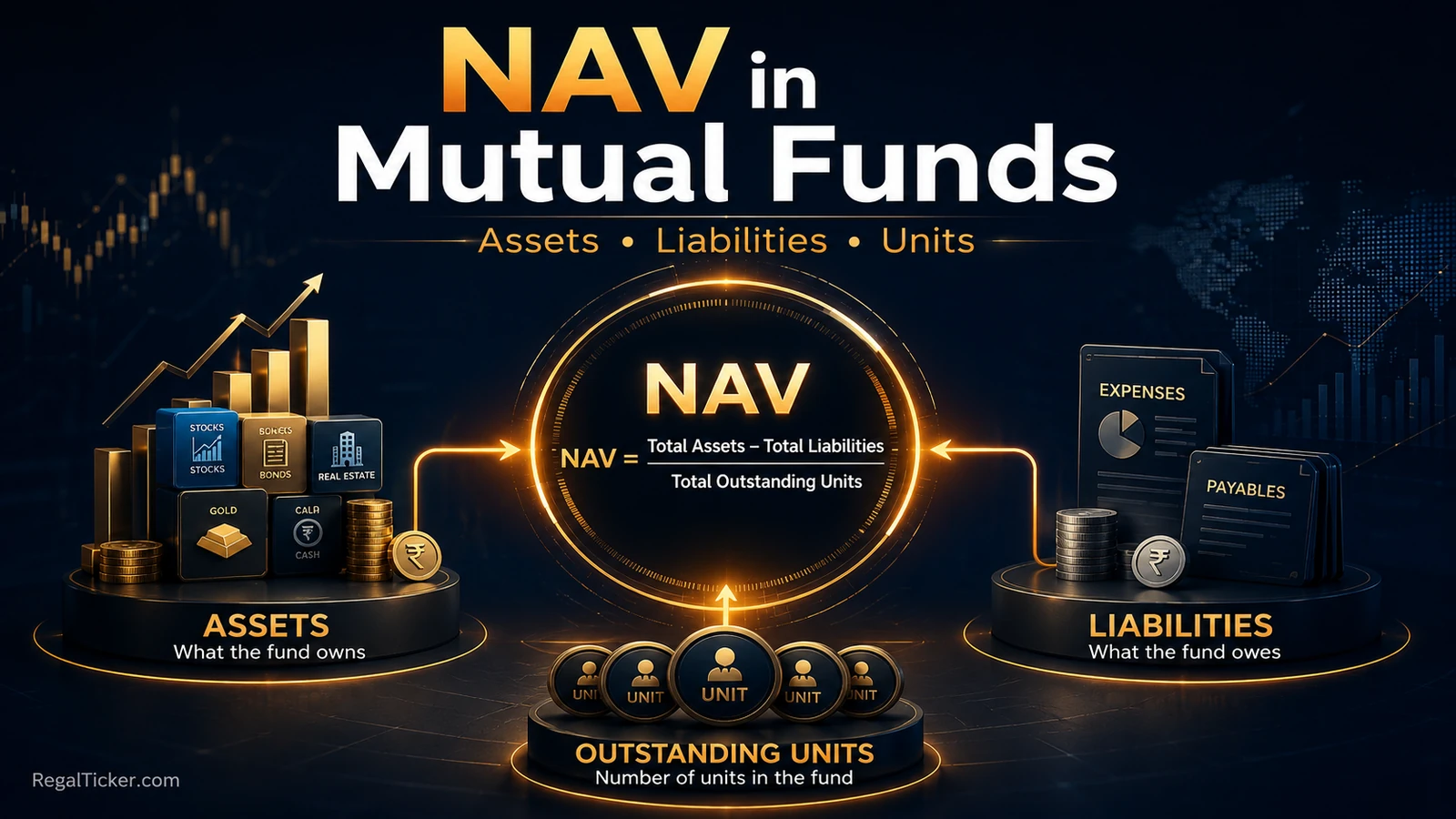
NAV stands for Net Asset Value.
In mutual funds, NAV generally means the net value of a scheme expressed on a per-unit basis.
A mutual fund scheme owns assets such as shares, bonds, money-market instruments, cash and accrued income. It may also have liabilities such as expenses payable, custodial charges, transaction costs and other obligations.
After subtracting liabilities from assets, the remaining amount belongs economically to the unitholders. When this net value is divided by the number of outstanding units, the result is the NAV per unit. SEBI Investor’s NAV guide explains NAV as the per-unit value of a mutual fund portfolio after deducting its liabilities.
So, NAV answers a basic question:
What is the net value of one unit of this mutual fund scheme today?
How Is Mutual Fund NAV Calculated?
The conceptual formula is simple:
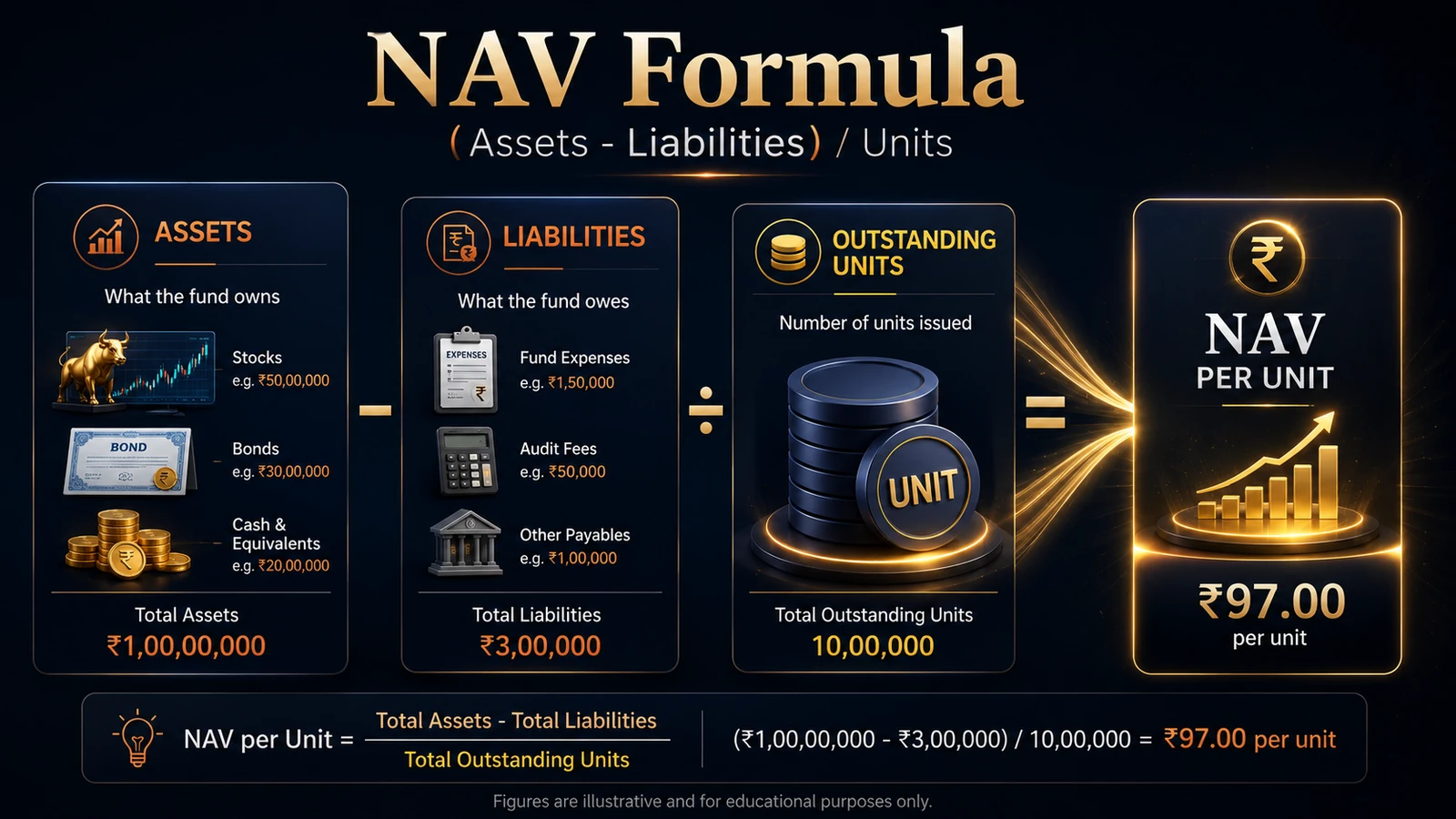
NAV per unit = (Total value of scheme assets − Total liabilities) ÷ Total units outstanding
A more detailed version can be written as:
NAV per unit = (Market value of investments + cash + accrued income + receivables − expenses and other liabilities) ÷ number of outstanding units
That sounds technical, but the logic is straightforward.
What Is Included in Scheme Assets?
Depending on the type of fund, the assets may include:
- market value of shares held by the scheme;
- corporate bonds, government securities or money-market instruments;
- cash and bank balances;
- accrued dividend or interest income;
- money receivable from securities sold;
- units of underlying schemes;
- permitted derivative positions;
- other scheme assets allowed under regulation.
What Is Included in Liabilities?
Liabilities may include:
- fund management expenses payable;
- registrar and transfer-agent charges;
- custodian charges;
- audit and administrative expenses;
- brokerage and transaction-related liabilities;
- money payable for securities purchased;
- statutory charges;
- other accrued obligations.
Once liabilities are subtracted from assets, the remaining value is the scheme’s net asset value in total. Dividing that number by total units gives the per-unit NAV. You can review the industry explanation in AMFI’s guide to Net Asset Value.
Simple NAV Calculation Example
Suppose a mutual fund scheme has the following position at the end of a business day:
| Particular | Amount |
|---|---|
| Market value of investments | ₹48 crore |
| Cash and receivables | ₹2 crore |
| Total assets | ₹50 crore |
| Expenses and other liabilities | ₹1 crore |
| Net assets | ₹49 crore |
| Outstanding units | 2 crore units |
Now calculate the NAV:
NAV = ₹49 crore ÷ 2 crore units
NAV = ₹24.50 per unit
This means each unit of the scheme represents ₹24.50 of the scheme’s net assets at that time.
It does not mean the scheme “costs” ₹24.50 in the same way a product costs ₹24.50. It means one unit is worth ₹24.50 based on the scheme’s assets and liabilities.
How Units Are Allotted in a Mutual Fund
When you invest in a mutual fund, you usually buy units.
The simplified formula is:
Units allotted = Net investment amount ÷ Applicable NAV
Suppose you invest ₹10,000 in a scheme and the applicable NAV is ₹24.50.
Units allotted = ₹10,000 ÷ ₹24.50
Units allotted = 408.163 units approximately
Your account will therefore show around 408.163 units, subject to the scheme’s rounding rules.
If NAV Rises Later
Suppose the NAV rises from ₹24.50 to ₹26.95.
Then your investment value becomes:
408.163 × ₹26.95 = approximately ₹11,000
If NAV Falls Later
If the NAV falls from ₹24.50 to ₹22.05:
408.163 × ₹22.05 = approximately ₹9,000
This shows why NAV is important. The market value of your investment depends on:
- how many units you own; and
- what the current NAV is.
NAV Is Not the Same as a Share Price
A mutual fund unit is not the same as a stock share.
A listed share represents ownership in one company. Its market price changes continuously on the stock exchange based on demand and supply.
A mutual fund unit represents a proportional interest in an entire portfolio. The NAV is calculated by valuing the portfolio and then dividing the net value by units outstanding.
A Share Price
A share price:
- changes throughout the trading day;
- directly reflects market demand and supply;
- represents one company;
- can be overvalued or undervalued relative to business fundamentals.
A Mutual Fund NAV
A mutual fund NAV:
- is generally calculated after the market closes;
- reflects the net value of the scheme’s portfolio;
- is expressed per unit;
- is used to process purchases and redemptions under applicable rules.
This is why comparing a stock’s market price and a mutual fund’s NAV as if they are the same thing creates confusion.
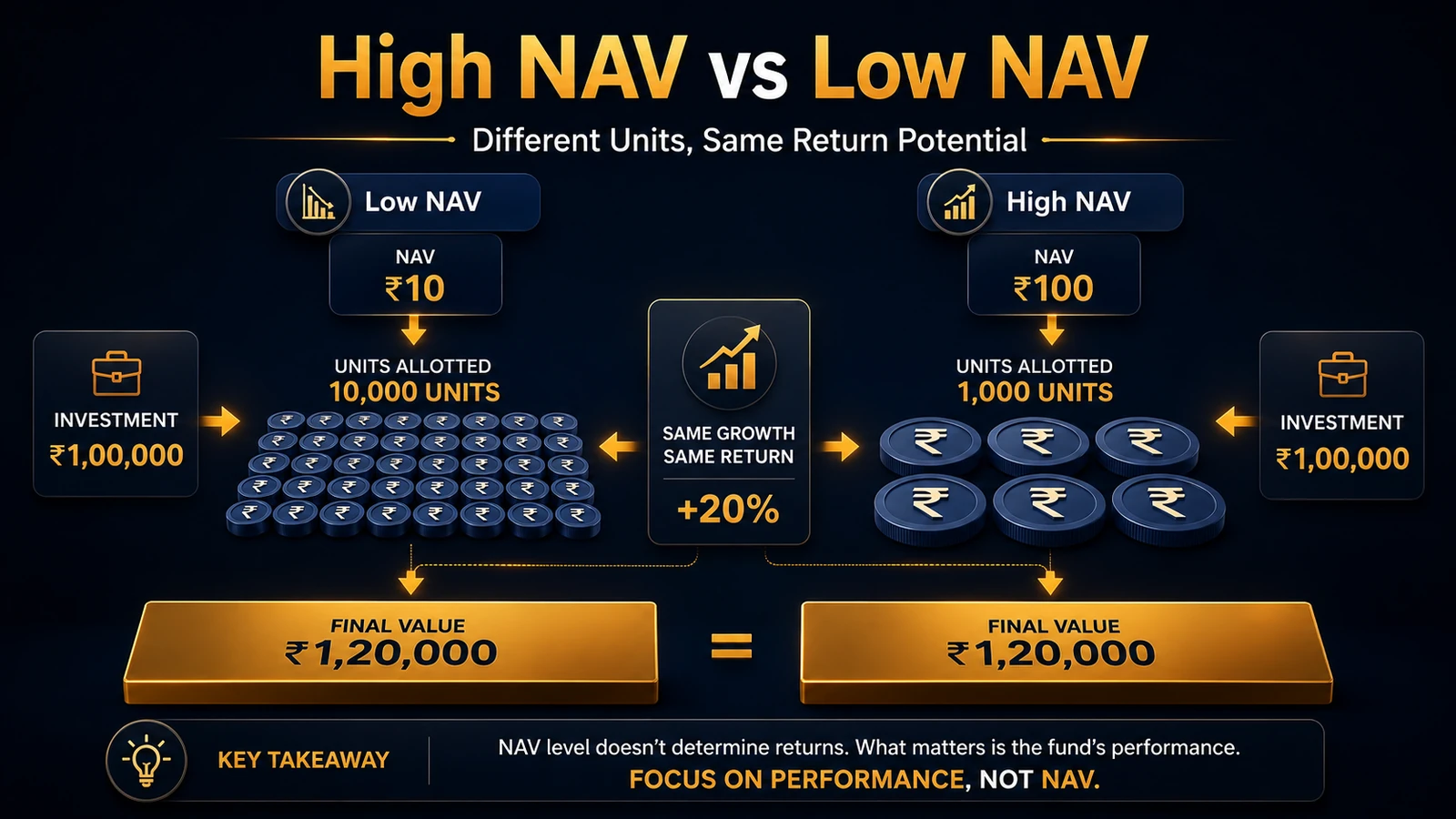
Is a Lower NAV Better Than a Higher NAV?
No.
A lower NAV does not make one mutual fund cheaper than another.
Let us compare two funds.
Fund A
- NAV = ₹10
- Investment = ₹10,000
- Units received = 1,000
Fund B
- NAV = ₹100
- Investment = ₹10,000
- Units received = 100
Now suppose both funds generate the same 10% return.
After Growth
Fund A’s NAV rises from ₹10 to ₹11. Your value becomes:
1,000 × ₹11 = ₹11,000
Fund B’s NAV rises from ₹100 to ₹110. Your value becomes:
100 × ₹110 = ₹11,000
The number of units is different, but the final value is the same because both portfolios grew by the same percentage.
This is the most important idea beginners must understand:
A lower NAV gives more units, not better returns.
Why Do Some Mutual Funds Have High NAVs?
A mutual fund that has existed for many years may have seen its portfolio value grow steadily. If gains remain invested and expenses are deducted over time, the NAV may gradually rise from an original level such as ₹10 to ₹50, ₹100, ₹300 or more.
A high NAV may simply indicate:
- the scheme has been around for a long time;
- the portfolio has appreciated over time;
- the plan has lower expenses than another plan;
- the scheme did not frequently distribute value through IDCW;
- the accumulated gains remain reflected in the NAV.
A high NAV does not mean the scheme has less future upside.
Future returns depend on future portfolio performance, not on whether the NAV is ₹10 or ₹500 today.
Is an NFO at ₹10 Cheaper?
No.
This is one of the most common beginner myths.
A new fund offer often begins with a face value like ₹10 per unit. That makes many investors feel the fund is cheap compared with an existing scheme whose NAV may already be ₹100 or ₹250.
But that comparison is misleading.
Suppose you invest ₹10,000:
- at NAV ₹10, you receive 1,000 units;
- at NAV ₹100, you receive 100 units;
- at NAV ₹250, you receive 40 units.
In each case, the starting value of your investment is ₹10,000.
The number of units changes, but the amount you invested does not.
An NFO should not be judged by its starting NAV. It should be judged by:
- whether the category is useful;
- the benchmark and investment mandate;
- the quality of the process;
- overlap with existing schemes;
- expenses and structure;
- whether a similar established fund already exists.
Do not invest in an NFO only because it starts at ₹10. SEBI Investor’s New Fund Offer guide explains that the initial ₹10 price is the offer price used during the subscription period, after which transactions occur at the prevailing NAV.
What Is Applicable NAV?
The applicable NAV is the NAV that will actually be used for your transaction.
This is important because the NAV shown when you start a purchase is not always the NAV you ultimately get.
For most mutual fund purchases, the applicable NAV depends on factors such as:
- when the valid transaction is submitted;
- when the complete funds become available for use by the scheme;
- whether the transaction was before or after the cut-off;
- whether the day is a business day;
- the type of scheme.
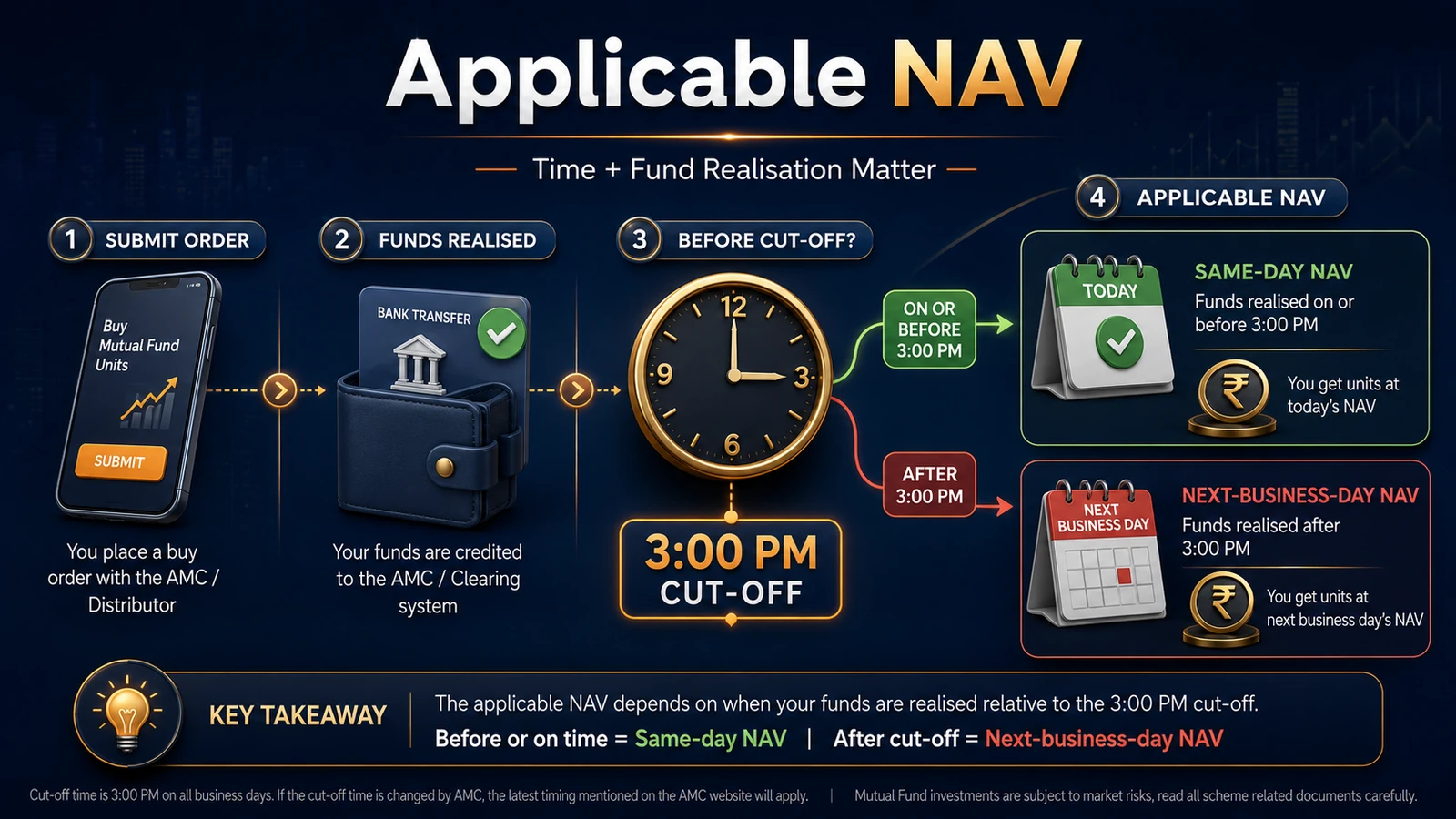
In simple terms, submitting a purchase request before the cut-off does not automatically guarantee the same-day NAV. Fund realisation also matters. AMFI’s applicable NAV and cut-off guide provides the transaction-wise rules for purchase, SIP, switch and redemption requests.
The 3:00 PM Cut-Off Concept
For many mutual fund categories other than liquid and overnight funds, the 3:00 PM cut-off is a key transaction reference point.
Same-day NAV usually requires both:
- a valid purchase transaction before the prescribed cut-off; and
- the investment money to be available for use by the mutual fund before that cut-off.
If the transaction is submitted before 3:00 PM but the money reaches the scheme only after the cut-off, the same-day NAV may not apply.
This is why applicable NAV depends on time plus fund realisation, not only the time of clicking the “invest” button.
Example 1: Same-Day NAV
Suppose you submit a valid purchase request at 1:00 PM on a business day.
If the money also becomes available to the scheme before 3:00 PM, the same-day closing NAV generally applies.
Example 2: Next-Business-Day NAV
Now suppose you submit the same order at 1:00 PM, but the money reaches the mutual fund only at 4:30 PM.
The transaction was timely, but the money missed the cut-off. In that situation, the applicable NAV generally shifts to the next eligible business day.
Example 3: Transaction Submitted After Cut-Off
If you place the order after the cut-off, then the same-day NAV usually does not apply, and the next eligible business-day NAV becomes relevant based on the transaction and fund-realisation rules.
SIP Installments Also Use Applicable NAV
A SIP does not give one fixed NAV for all months.
Each installment is treated as a fresh transaction. So every SIP installment gets the NAV applicable to that specific date and the realisation of funds.
When NAV is lower, the same SIP amount generally buys more units. When NAV is higher, the same SIP amount buys fewer units.
That is one reason SIP investing naturally creates rupee-cost averaging.
Use the SIP Calculator to estimate how a recurring contribution may grow over time under different return assumptions. The calculator estimates the future value of the contributions. It does not predict the actual NAV of future installments.
How NAV Works During Redemption
NAV is also used when units are redeemed.
The simplified formula is:
Gross redemption value = Units redeemed × Applicable NAV
Suppose you redeem 500 units and the applicable NAV is ₹30.
Gross redemption value = 500 × ₹30 = ₹15,000
That gives the gross value.
If an exit load applies, the final amount received may be lower.
Example With Exit Load
Suppose:
- Units redeemed = 500
- Applicable NAV = ₹30
- Exit load = 1%
Gross value:
500 × ₹30 = ₹15,000
Exit load:
1% of ₹15,000 = ₹150
Net redemption value before taxes:
₹15,000 − ₹150 = ₹14,850
This is why investors should look beyond the NAV and check:
- exit load;
- tax impact;
- holding period;
- scheme category.
Use the Capital Gains Tax Calculator as an educational estimate when reviewing a redemption. Actual taxation depends on the type of fund, your holding period, the date of sale and the prevailing tax law.
Does Investing or Redeeming Change NAV?
A regular purchase or redemption does not automatically make existing investors richer or poorer merely because units are created or cancelled.
When New Money Enters
When an investor buys units:
- the scheme receives new assets;
- it issues a matching number of new units at the applicable NAV.
So assets and units both rise proportionately.
When Units Are Redeemed
When an investor redeems:
- the scheme pays out assets;
- the corresponding units are cancelled.
So assets and units both fall proportionately.
This means the NAV itself should not change just because someone invested or redeemed, except for effects from:
- market movements;
- transaction costs;
- portfolio adjustments;
- liquidity conditions;
- pricing impact.
Why Does NAV Change Every Day?
NAV changes because the value of the scheme’s net assets changes.
Several factors cause this.
1. Portfolio Prices Change
An equity fund’s NAV changes when the share prices in the portfolio move.
A debt fund’s NAV changes when bond prices, yields, credit spreads or interest-rate expectations change.
A passive fund’s NAV changes with the underlying index.
2. The Scheme Earns Income
A portfolio may earn:
- dividends;
- interest;
- money-market income;
- other permitted income.
That income contributes to scheme assets, subject to expenses and distributions.
3. Expenses Are Accrued
Every scheme has costs. These can include:
- management fees;
- registrar charges;
- custody expenses;
- administrative costs;
- audit expenses.
These expenses reduce scheme assets and therefore affect the NAV.
4. The Fund Manager Buys or Sells Securities
When the portfolio changes, the scheme may book profits or losses. Brokerage, transaction charges and other portfolio costs may also affect overall value.
5. Foreign Assets and Currency May Change
International mutual funds may also be affected by:
- overseas market changes;
- currency fluctuations;
- differing market hours;
- international valuation adjustments.
6. IDCW Is Paid
If an IDCW distribution is declared, the NAV of that option typically adjusts downward by the distribution amount and related effects, because value is leaving the scheme.
How Expenses and Plan Choices Affect NAV
The total expense ratio is the annual cost charged to the scheme for operating it.
Investors are not usually sent a separate bill every month. Instead, the cost is reflected through the scheme’s NAV over time.
Suppose two plans hold the same underlying portfolio:
- Direct Growth Plan
- Regular Growth Plan
Both plans have the same investments. But the regular plan typically has a higher expense ratio because it includes distribution-related costs.
As time passes, that cost difference is reflected in the NAV.
What This Means in Practice
If both plans start with the same portfolio value:
- the direct plan may gradually show a higher NAV because fewer expenses are deducted;
- the regular plan may show a somewhat lower NAV because more expenses are deducted.
This does not mean the direct plan holds better stocks or bonds. It means it has a lower cost structure. SEBI Investor’s regular and direct mutual fund comparison explains that the underlying portfolio is the same while cost structures differ.
That is why a lower regular-plan NAV is not an advantage. It can partly reflect higher expenses.
Direct Plan NAV vs Regular Plan NAV
This is a very common point of confusion.
Imagine two versions of the same scheme:
- Direct Plan – Growth
- Regular Plan – Growth
They share:
- the same scheme;
- the same portfolio;
- the same fund manager;
- the same benchmark.
But the expense ratio differs. Therefore, over time, the NAV differs too.
Important Takeaway
When comparing direct and regular plans, do not ask:
“Which one has the lower NAV?”
Instead ask:
- Which one has the lower expense ratio?
- What service am I getting in exchange for the cost difference?
- Which route suits my needs?
Growth NAV vs IDCW NAV
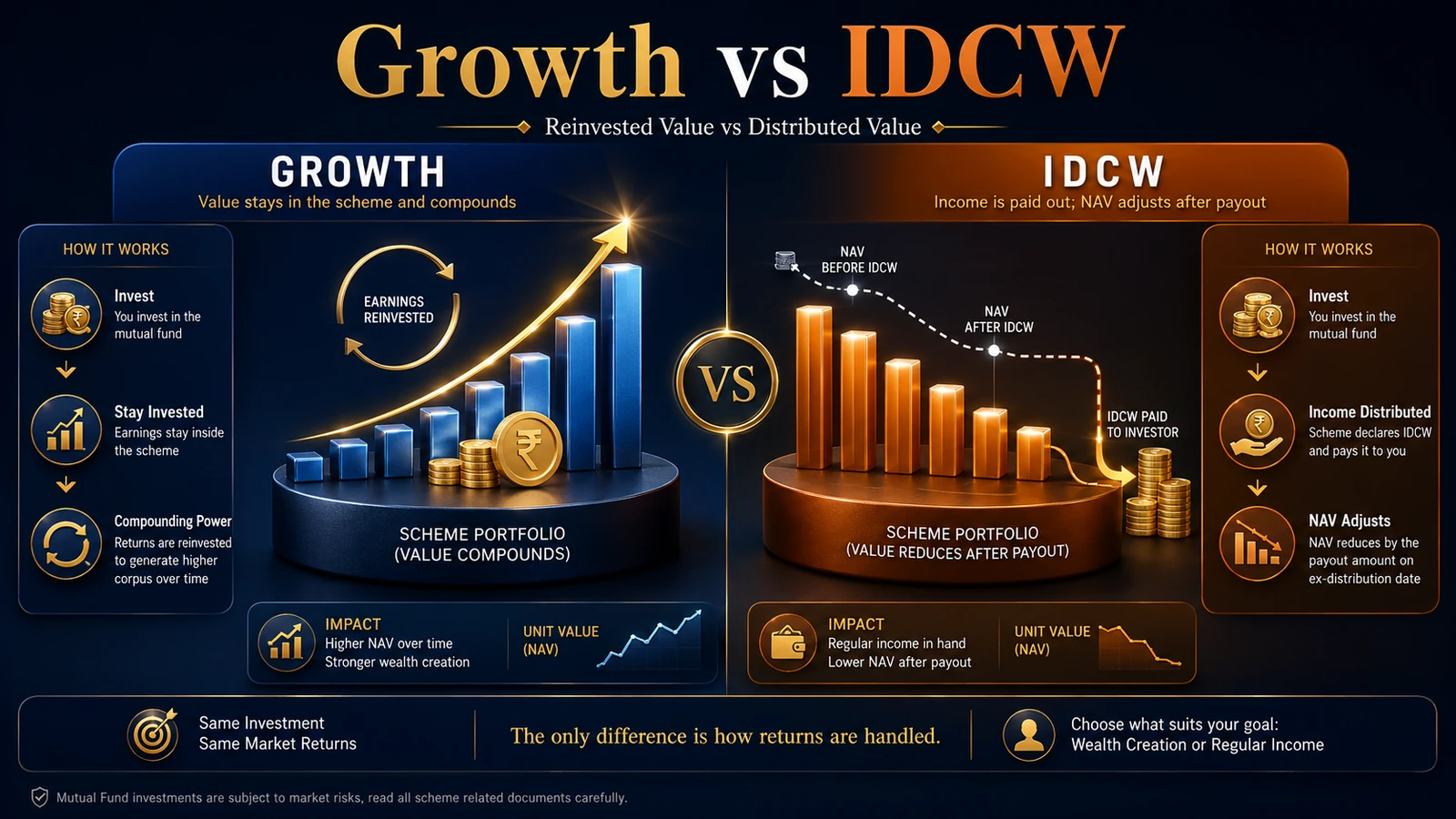
Growth and IDCW are different options under the same scheme.
Growth Option
Under the growth option:
- gains stay inside the scheme;
- income remains invested;
- there is no regular payout promise;
- the effect of compounding is reflected in the NAV.
IDCW Option
Under the IDCW option:
- the scheme may declare a distribution from distributable surplus;
- value is paid out to the investor;
- the NAV generally reduces after the payout;
- the distribution amount and frequency are not guaranteed.
Suppose an IDCW option has a NAV of ₹25 and declares an IDCW of ₹2 per unit.
After the distribution, the NAV may move to around ₹23, subject to market movement and applicable adjustments.
So the investor receives ₹2, but the scheme’s value per unit reduces by a corresponding amount.
That is why IDCW is not “extra” return over and above an unchanged NAV.
Which One Is Better?
Neither option is universally better.
It depends on your objective.
The growth option may suit investors focused on long-term compounding and wealth creation.
The IDCW option may appeal to investors who want periodic distributions, though they must understand that the payout is not free money and is not guaranteed.
The important thing is to choose based on the goal, not the headline NAV.
NAV and Mutual Fund Returns
NAV is necessary for calculating returns, but the absolute NAV itself is not the return.
Absolute Return
If NAV rises from ₹20 to ₹25:
Absolute return = (25 − 20) ÷ 20 × 100 = 25%
The scheme has delivered a 25% change over that period.
CAGR
If a one-time investment grows over multiple years, CAGR is more useful than just the total change.
Use the CAGR Calculator to convert beginning value, ending value and duration into an annualised growth rate.
CAGR is most useful when there is one starting investment and one ending value with no irregular intermediate cash flows.
XIRR for SIPs and Multiple Cash Flows
SIPs, top-ups, additional purchases and redemptions occur on different dates. So simply looking at the first NAV and the current NAV does not properly measure investor return.
That is where XIRR becomes useful.
Use the XIRR Calculator when analysing:
- monthly SIPs;
- irregular investments;
- partial redemptions;
- multiple dated cash flows.
Lumpsum Projection
When you want to estimate how a one-time investment may grow, use the Lumpsum Calculator. It is useful for planning, but its output is only a projection, not a guarantee of NAV or future return.
NAV vs AUM and ETF Market Price
NAV and AUM are different concepts.
NAV
NAV is the net value of one unit.
AUM
AUM means assets under management. It refers to the total value of assets managed by the scheme or fund house.
A scheme can have:
- high AUM and low NAV;
- low AUM and high NAV;
- high AUM and high NAV;
- low AUM and low NAV.
There is no rule that a bigger fund must have a higher NAV.
Example
Fund A:
- Net assets = ₹10,000 crore
- Units outstanding = 1,000 crore
- NAV = ₹10
Fund B:
- Net assets = ₹1,000 crore
- Units outstanding = 2 crore
- NAV = ₹500
Fund A has far larger AUM but a lower NAV. Fund B has lower AUM but a higher NAV.
This shows why AUM and NAV should not be confused.
NAV vs ETF Market Price
An ETF is a special case because it has:
- an underlying NAV; and
- an exchange-traded market price.
ETF NAV
The NAV reflects the value of the ETF’s underlying assets.
ETF Market Price
The market price is the price at which ETF units trade on the exchange.
The market price can differ from NAV because of:
- demand and supply;
- liquidity;
- bid-ask spread;
- trading activity;
- temporary premium or discount.
An open-ended mutual fund transaction is generally done at the applicable NAV. An ETF transaction is done at the market price available on the exchange.
What NAV Tells You—and What It Does Not
NAV is useful because it helps you:
- calculate units allotted;
- calculate current investment value;
- calculate gross redemption value;
- compare value across dates;
- track the effect of growth and IDCW options;
- see the effect of expenses over time;
- understand direct vs regular plan differences;
- identify the transaction value used in purchases and redemptions.
What NAV Does Not Tell You
NAV alone does not tell you:
- whether the fund is undervalued;
- whether it is expensive;
- whether the portfolio is high quality;
- whether the strategy is suitable for your goal;
- whether the risk is high or low;
- whether the expense ratio is attractive;
- whether a debt fund has credit risk;
- whether an equity fund has concentration risk;
- whether the scheme will outperform in future.
A fund with NAV ₹500 can still be an excellent long-term scheme. A fund with NAV ₹10 can still be unsuitable.
This is why investors should not select a fund mainly on the basis of NAV.
Using NAV Correctly: Mistakes, Checklist and Calculators
1. Buying the Lowest-NAV Fund
A low NAV is not a discount.
2. Avoiding a High-NAV Fund
A high NAV does not mean future returns are capped.
3. Believing ₹10 NFO Means Cheap
The starting NAV is only an initial accounting base.
4. Comparing Direct and Regular Only by NAV
Cost structures differ. Compare expenses and outcomes.
5. Treating IDCW as Extra Return
A distribution generally reduces the option’s NAV.
6. Assuming the Displayed NAV Is Guaranteed
Applicable NAV depends on cut-off rules and fund realisation.
7. Measuring SIP Return by Looking Only at NAV Change
A SIP creates multiple dated cash flows. XIRR is usually more appropriate.
8. Ignoring Exit Load
Redemption proceeds can be lower than units multiplied by NAV.
9. Comparing Different Categories by NAV
A liquid fund and a small-cap fund should not be compared just because one NAV looks lower.
10. Using NAV as a Quality Score
NAV is not a shortcut for quality, suitability or risk.
Practical NAV Checklist
Before acting on a scheme’s NAV, check the following:
- Am I looking at the correct scheme?
- Is this the direct or regular plan?
- Is this the growth or IDCW option?
- What is the date of the latest declared NAV?
- What transaction cut-off applies?
- Has the complete investment money been realised?
- Is the scheme a liquid or overnight fund with different rules?
- Is there an exit load?
- Am I comparing percentage returns instead of absolute NAV?
- Am I comparing schemes from the same category?
- Does the category suit my goal and time horizon?
- What is the expense ratio?
- Is this an NFO that only looks attractive because of ₹10 NAV?
- Should I use CAGR or XIRR to evaluate my result?
- Have I checked the latest scheme documents?
Use RegalTicker Calculators With NAV Concepts
NAV becomes much more useful when you connect it to real investor decisions.
For SIP Investors
Use the SIP Calculator to estimate how monthly contributions may grow over time.
For One-Time Investors
Use the Lumpsum Calculator to estimate the projected future value of a single investment.
For Goal-Based Planning
If you know your target amount and time frame, the Goal SIP Calculator helps estimate how much SIP may be required.
For Return Measurement
Use the CAGR Calculator for single starting and ending values, and the XIRR Calculator for SIPs and irregular cash flows.
For Withdrawal Planning
If you want to study periodic withdrawals from a corpus, use the SWP Calculator.
For Redemption and Tax Awareness
Use the Capital Gains Tax Calculator as an educational estimate before making a sale decision.
Frequently Asked Questions
What is NAV in mutual funds?
NAV is the net asset value of a mutual fund scheme per unit. It is broadly calculated by subtracting total liabilities from total assets and dividing the result by units outstanding.
What is the full form of NAV?
NAV stands for Net Asset Value.
What is the mutual fund NAV formula?
NAV per unit = (Total scheme assets − Total liabilities) ÷ Total outstanding units.
Is a lower NAV better?
No. A lower NAV only means you get more units for the same amount. It does not automatically mean higher returns.
Is a mutual fund with NAV ₹10 cheaper than a fund with NAV ₹100?
No. The ₹10 fund gives more units, but an equal investment can still generate the same final value if both portfolios earn the same percentage return.
Why do NFOs start at ₹10?
₹10 is often just the initial face value for allotment. It does not mean the NFO is undervalued or cheaper than an existing scheme.
Applicable NAV is the NAV used for your actual purchase or redemption transaction. It depends on transaction validity, timing, cut-off rules and the realisation of funds.
Does SIP get the same NAV every month?
No. Each SIP installment gets the NAV applicable to that specific transaction date and fund-realisation condition.
Why are direct and regular plan NAVs different?
Both plans usually share the same portfolio, but their expense ratios differ. That cost difference is reflected in NAV over time.
Why does the IDCW option’s NAV fall after a payout?
Because the distribution comes out of the scheme’s value. Once value is paid out, the NAV generally adjusts downward by the corresponding amount, subject to market movement and applicable adjustments.
Does a high NAV mean lower future return potential?
No. Future returns depend on how the underlying portfolio performs in the future, not on the absolute NAV level.
Can NAV be negative?
In normal mutual fund structures, NAV is not expected to become negative because investor liability is typically limited to the invested amount. However, the NAV can fall significantly if underlying assets lose value.
How can I check mutual fund NAV?
NAV can be checked through the AMC’s official website and AMFI’s official latest NAV facility.
Final Takeaway
NAV is the net value of one mutual fund unit.
It is calculated by subtracting a scheme’s liabilities from its assets and dividing the result by its outstanding units.
NAV helps you calculate how many units you receive, what your investment is worth and how redemptions work. But the absolute NAV does not tell you whether a scheme is cheap, expensive or suitable.
A lower NAV only gives you more units. A higher NAV only means the same money buys fewer units.
The real questions to ask are:
- What category is the fund?
- Does it suit my goal?
- What are the risks?
- What is the expense ratio?
- What is the benchmark?
- Is the plan direct or regular?
- Is the option growth or IDCW?
- What return should I expect over time, not what NAV is printed today?
Use NAV to understand transactions and performance measurement. Do not use the NAV level as the main reason to invest.
Official Sources
- SEBI Investor: Net Asset Value
- AMFI: Net Asset Value
- AMFI: Cut-Off Timings and Applicable NAV
- SEBI Investor: New Fund Offer
- SEBI Investor: Regular and Direct Mutual Funds
- SEBI: Master Circular for Mutual Funds, March 20, 2026
- Scheme Information Document and Key Information Memorandum of the relevant fund
Educational disclaimer: This article is for education and information only. Regal Ticker is not a SEBI-registered investment adviser and does not provide personalised investment advice. Mutual fund investments are subject to market risks. Read all scheme-related documents carefully before investing.