

RegalTicker Learning
A practical UAE-based checklist for choosing NRE/NRO banking, preparing KYC, handling document certification, opening the account through the right channel and connecting it to an investing setup.
⚡ Quick answer
Can you open an NRE or NRO account from the UAE without visiting India?
Yes. Several Indian banks provide UAE-based or remote account-opening channels, but there is no single universal process. Depending on the bank, you may apply through a UAE representative office or branch, an assisted digital journey, a partner banking channel, courier documents to an Indian branch, or complete the process during a visit to India. The core documents usually establish your identity, UAE residence/status, overseas address and tax identity; some non-face-to-face routes also require certified copies. Confirm the exact checklist with the chosen bank before you get anything notarised, attested or couriered.
Key takeaways
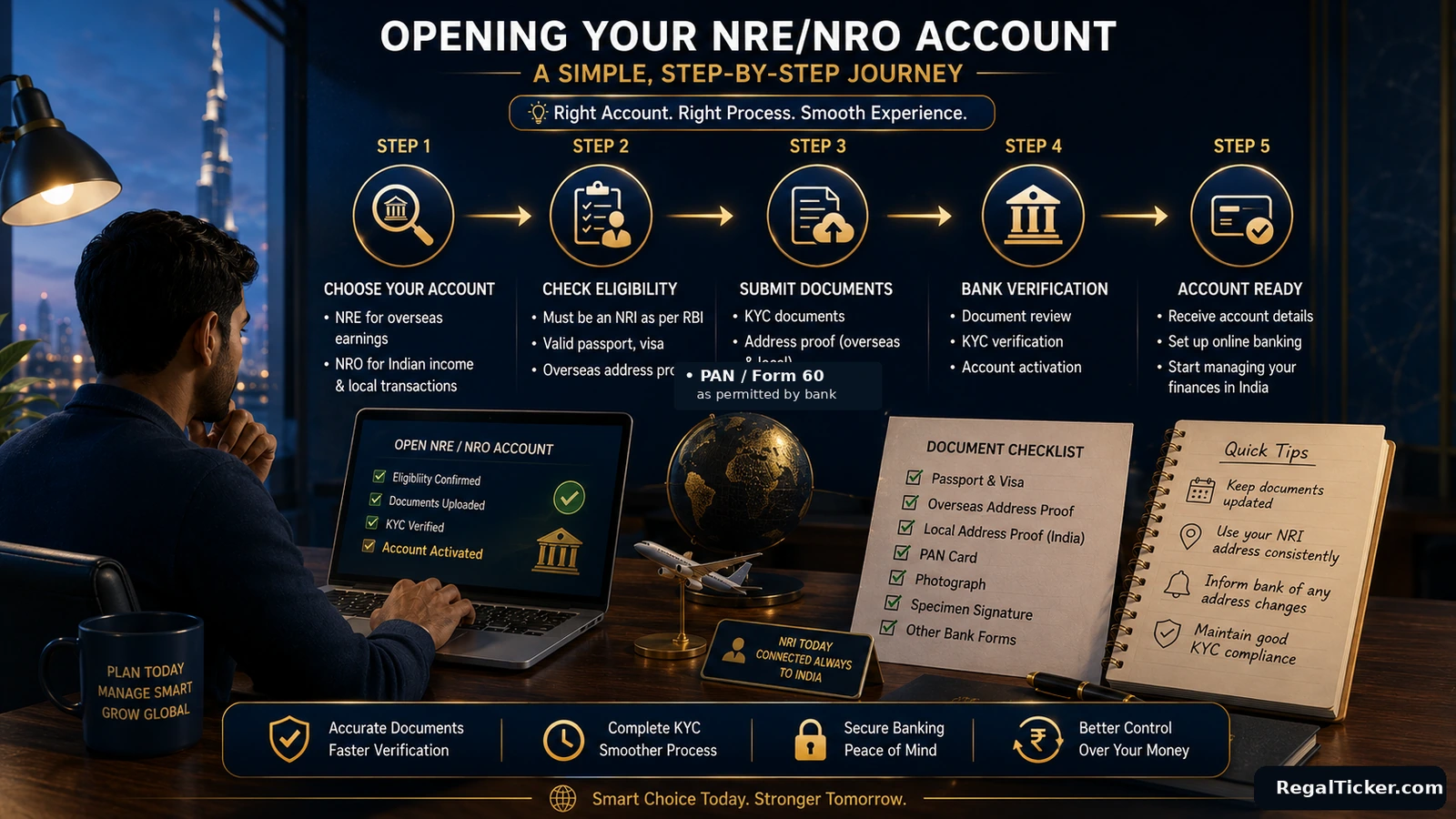
Choose NRE vs NRO first; the UAE application process should come after the account decision.
Do not assume that every copy needs consular attestation. Certification requirements depend on the bank and whether originals are seen in person.
Do not assume the process is fully digital or always paper-based. Both models exist.
There is no honest universal “10–17 day” timeline for UAE NRI accounts; processing varies by bank, channel, document scrutiny and activation requirements.
SBI currently publishes a UAE-specific instant-account facility through its Dubai and Abu Dhabi representative offices, with activation stated as 2–3 working days after submission; that is an SBI-specific channel, not an industry-wide promise.
PAN requirements can depend on the account/channel, but PAN is especially important if you will invest in Indian securities; ICICI currently states PAN is mandatory for its non-face-to-face NRI account opening.
A Tax Residency Certificate or Form 10F is not a universal bank-account-opening document. Those are tax/treaty documents used when relevant, not baseline NRE/NRO KYC for everyone.
If you already have a resident Indian savings account after becoming non-resident, review and redesignate/close it as required instead of simply opening another account and ignoring the old one.
If your objective is investing, opening NRE/NRO banking is only step one; your Demat, trading, KYC and PIS/non-PIS route must also be set up correctly.
Compare current charges and balance requirements on official bank schedules rather than relying on a static “best bank” ranking.
Start with the account decision, not the paperwork
The biggest mistake in NRI account opening is starting with a document checklist before deciding what the account is for.
An NRE and an NRO account are both Indian-rupee accounts for non-residents, but they solve different money-flow problems.
If most of the money you want to bring to India is earned outside India and you want eligible funds to remain repatriable, the NRE route is often relevant.
If you receive legitimate rupee income in India — for example rent, pension, dividends, interest or other permitted receipts — the NRO route is usually important.
Many NRIs need both because overseas earnings and Indian income are different pools of money.

NRE account — the overseas-funds side
- Common use — eligible funds remitted from abroad and other permitted credits.
- Currency — maintained in Indian rupees.
- Repatriation — generally repatriable under the applicable RBI framework.
- Interest — generally exempt from Indian income tax when the statutory conditions are satisfied.
- Typical UAE use case — transferring part of salary or savings from the UAE into India for eligible savings or investment use.
NRO account — the India-income side
- Common use — legitimate rupee income and other permitted receipts in India.
- Currency — maintained in Indian rupees.
- Repatriation — follows a separate RBI framework; eligible balances/assets can fall within the USD 1 million per financial year facility subject to conditions.
- Interest — taxable in India under the applicable tax rules.
- Typical UAE use case — receiving rent, dividend, pension, interest or other Indian receipts while living in the UAE.
Investor note
Living in the UAE does not automatically mean “use NRE only”
Your country of residence tells the bank where you live; it does not by itself tell the bank where every rupee comes from. Choose the account structure around the source of funds, purpose and repatriation need.
What changes when you open the account from the UAE?
The Indian banking rules are the foundation, but the application logistics are shaped by where the bank can verify you.
A UAE-based applicant can encounter several routes:
- a bank’s UAE representative office or local branch;
- an authorised local partner/relationship channel;
- an assisted online journey with document upload and later verification;
- a non-face-to-face application that requires certified copies and courier;
- direct courier to the chosen Indian branch; or
- in-person opening during a visit to India.
The route matters because it changes how identity documents are verified.
A bank that sees your original passport and UAE residence documents in person may be able to verify them directly.
A bank receiving only copies from abroad may require those copies to be certified by an accepted authority.
That is why the statement “all NRI documents must be attested” is too broad.
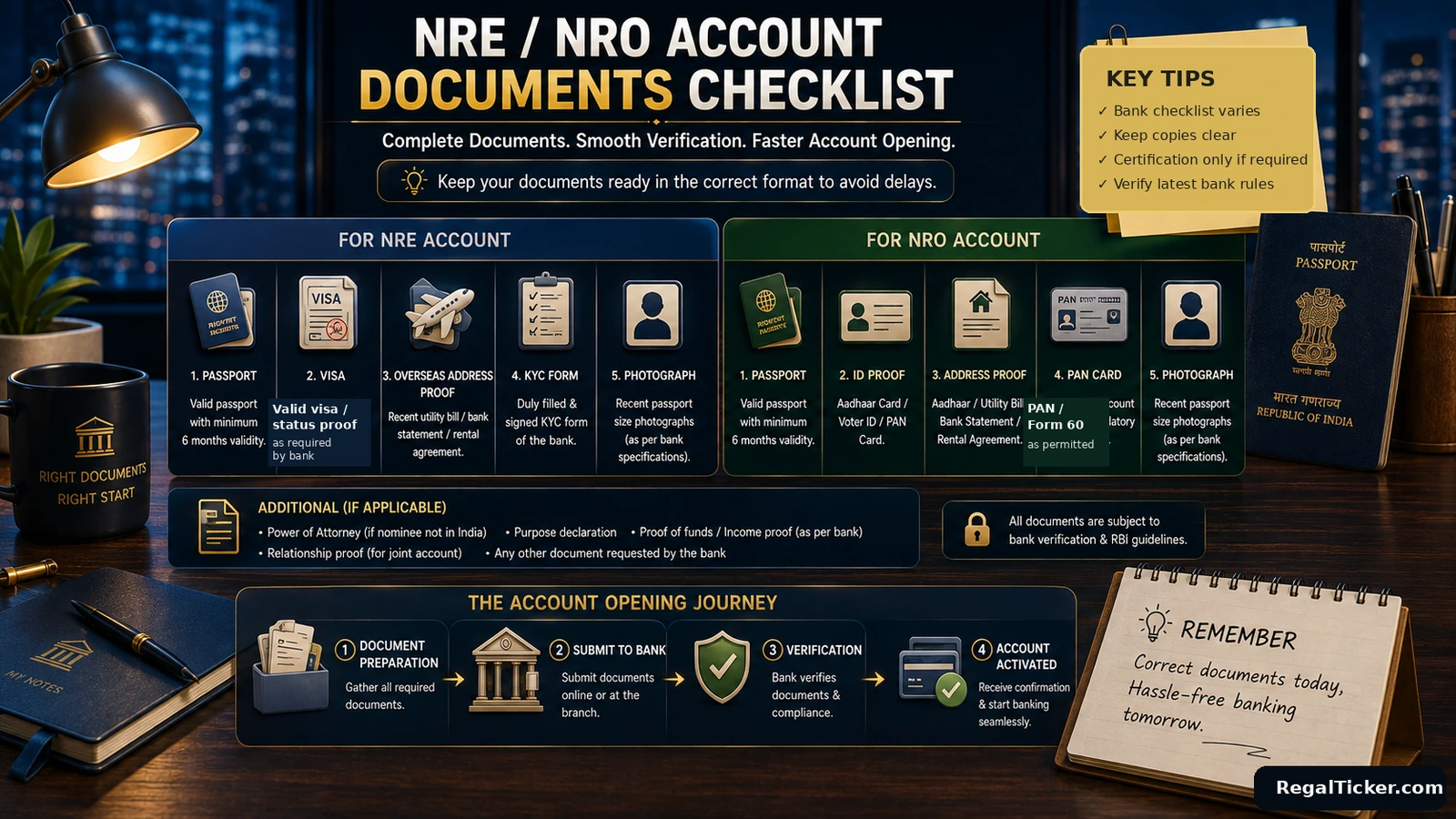
The core UAE NRI document kit
Start with the documents that establish who you are, where you live and your non-resident status.
The exact bank list can change, but the following core set is a sensible preparation kit.
Identity and NRI status
Checklist before you act
- Valid Indian passport, or overseas passport plus OCI documentation where applicable.
- Valid UAE residence visa, work permit or residence-status evidence appropriate to your case.
- Emirates ID where the UAE-facing bank channel requests it.
- Recent photograph in the format requested by the bank.
- PAN or Form 60 where permitted by the bank/account process.
- Existing Indian bank-account details if a resident account needs redesignation.
- FATCA/CRS and other tax-residency declarations requested by the bank.
Address and financial profile
- Current UAE address proof accepted by the bank, such as an eligible utility bill, tenancy/Ejari document, bank statement or other approved proof.
- Indian/permanent address information where requested.
- Recent overseas bank statement when the bank requires source-of-funds or relationship evidence.
- Salary certificate, payslip, employment evidence or other income proof if requested for the account/channel.
- Nominee/joint-holder details where applicable.
What is not automatically part of the core bank-opening checklist?
A Tax Residency Certificate (TRC) and Form 10F can matter when you later claim treaty treatment for eligible Indian income.
They should not be presented as mandatory NRE/NRO account-opening documents for every UAE NRI.
Likewise, a bank may ask for additional information based on occupation, source of funds, risk profile, citizenship/OCI status, political exposure or the specific product.
The safe approach is:
prepare the core KYC kit → choose the bank/channel → download that bank’s current checklist → certify only what that channel actually requires.
Do your documents need attestation or certification?
Sometimes yes. Not always.
For example, ICICI Bank currently states that copies used for its NRI account-opening documentation can be certified by accepted authorities such as:
- authorised officials of overseas branches of scheduled commercial banks registered in India;
- overseas banks that have relationships with Indian banks;
- a notary public abroad;
- a court magistrate or judge; or
- the Indian Embassy/Consulate General in the country where the applicant resides.
ICICI also states that PAN is mandatory for its non-face-to-face NRI account-opening mode.
SBI’s current procedure says that when an application is sent directly to an SBI branch in India, it should be accompanied by attested copies of the selected KYC documents. If the applicant visits an SBI branch in India, originals can instead be presented for cross-verification.
These examples show the correct principle:
certification depends on the application channel.
What about the Indian Embassy or Consulate in the UAE?
The Embassy of India in Abu Dhabi and the Consulate General of India in Dubai provide general attestation/notarial services.
But do not assume there is a universal “bank-account attestation counter” that every bank requires you to use.
Use consular attestation only when it is an accepted route for the particular document and your chosen bank wants certified copies.
Caution
Do not attest an entire document pack before choosing the bank
Unnecessary certification wastes time and money. First confirm the bank’s current requirements and accepted certifiers, then certify only the copies that need it.
Is the UAE process fully online?
There is no universal yes or no.
Some banks provide digital or assisted digital application journeys. Others still require a printed form, certified copies, courier, in-person verification or a combination of digital and physical steps.
For example, ICICI currently offers assisted NRI account opening and describes digital form/document steps, but its self-service DIY journey is not universally available in every country. SBI’s published process includes foreign-office submission, courier to India and in-person India-branch routes. Bank of Baroda UAE currently allows UAE customers to initiate NRE account opening through its website or visit a UAE branch.
So avoid articles that say:
“NRI account opening is now 100% online for everyone in the UAE.”
The accurate question is:
“Does this bank offer a fully digital UAE journey for my citizenship, residence status and account type today?”
Four practical ways to open the account from the UAE
Route 1: UAE representative office or local branch
This can be the cleanest route when the bank has a UAE presence that is authorised to collect/verify the application.
A current example is SBI. SBI states that its Dubai and Abu Dhabi representative offices offer an instant NRI account facility where the account number can be provided at the UAE office when the application is submitted, with activation stated as 2–3 working days.
That is useful information, but it should be presented exactly for what it is:
an SBI-specific published facility, not a universal benchmark for every bank.
Bank of Baroda UAE also currently lets customers approach its UAE branches/NRI desks for NRI banking services.
Route 2: bank-assisted digital application
Some banks allow you to start online, receive relationship-manager assistance and submit documents digitally before final verification.
This can reduce paperwork, but the final KYC method and certification rules still depend on the bank.
Route 3: courier to an Indian branch
This remains a valid route for banks that accept non-face-to-face applications.
The important part is not whether DHL, Emirates Post or another courier is “best.” The important part is that:
- the application is complete;
- the bank has confirmed the destination branch/address;
- only the required certified copies are sent;
- no original passport is couriered unless the bank explicitly and lawfully requires an original document (which should be verified very carefully); and
- you retain tracking and copies of the full submission.
Route 4: open/complete during a visit to India
If you are travelling to India anyway, an in-person branch visit can simplify document verification because you can present originals.
But do not build the article around an assumption that India travel is always faster. Processing and activation still depend on the bank, account type and KYC scrutiny.
There is no universal NRI account-opening timeline
The previous version of this guide used fixed ranges such as 10–17 days remote and 2–5 days in person.
Those numbers should not be presented as general facts.
A bank can open a straightforward application quickly, while another application can take longer because of:
- unclear NRI status;
- certification defects;
- address mismatch;
- PAN/KYC mismatch;
- additional source-of-funds checks;
- joint-holder documentation;
- compliance review;
- incomplete resident-account redesignation; or
- courier delays.
The only timeline worth quoting as a firm example is one published by the bank for a specific channel.
At present, SBI says its UAE representative-office instant facility provides the account number at submission and activates the account within 2–3 working days.
Other banks should be checked individually.
Investor note
Treat processing time as a bank-specific service fact
Do not choose an account purely because a blog promises a faster number. Correct status, funding route, ongoing service, charges and investing compatibility matter more than shaving a few days off onboarding.
Compare application channels, not “the best bank”
A static best-bank ranking ages badly.
Instead, compare the factors that matter to your situation.
What to compare before applying
- Does the bank have a UAE branch/representative/partner channel?
- Can it verify documents in the UAE?
- Is a non-face-to-face application supported for your profile?
- What are the current balance requirements and account charges?
- How is the account activated/funded?
- How easy is it to convert an existing resident account to NRO?
- Does the bank support the NRI investing route you need?
What not to rely on
- “Fastest bank” claims without a current official source.
- Old minimum-balance figures from comparison blogs.
- A fixed account-opening time across all banks.
- “No attestation needed” or “all documents need attestation” as universal rules.
- A bank choice based only on deposit interest rate.
- An assumption that the bank account automatically includes Demat/trading/PIS.
Current UAE access examples
Without ranking them, current official sources show several different UAE paths:
- SBI publishes UAE representative-office account collection and its instant NRI account facility.
- Bank of Baroda UAE provides NRI services through its UAE presence and allows application/branch contact.
- ICICI Bank is available to UAE customers through NRI servicing/partner channels and publishes detailed certification rules for non-face-to-face documentation.
- HDFC Bank NRI services are currently promoted through Emirates NBD’s UAE banking packages.
These are examples of access, not recommendations.
Fees, eligibility, account variants and balance requirements should be checked on the current official bank page immediately before applying.
Existing resident account? Fix that before opening a new structure
If you moved from India to the UAE and still have an ordinary resident savings account, do not simply leave it untouched.
RBI’s non-resident account framework requires the banking relationship to reflect your changed residential status.
SBI’s current account-opening instructions explicitly state that a resident Indian domestic account should be converted to an NRO account or closed before a new NRE/NRO relationship is opened with SBI.
Other banks have their own redesignation procedure.
The key lesson is broader:
becoming NRI changes existing accounts; it is not only about opening new ones.
A practical conversion checklist
- Inform the existing bank of the residential-status change.
- Ask for its resident-to-NRO redesignation process.
- Update overseas address/contact details.
- Complete re-KYC where required.
- Review mandates/joint holders/nomination.
- Update linked deposits and other products.
- Review Demat/trading status separately if you invest.
If you want to invest, the bank account is only step one
An NRE or NRO account does not by itself let you buy Indian listed shares.
For market investing, you normally need the full chain:
NRE/NRO bank account → NRI KYC → Demat account → trading account → correct PIS/non-PIS or other permitted investment route → funding → investing
Keep the names and status aligned
Your PAN, bank, Demat and trading records should use consistent identity information.
If one layer still shows resident status while another shows non-resident status, onboarding and transaction problems can appear later.
PIS vs non-PIS is a separate decision
Do not treat PIS as another bank-account type.
PIS/non-PIS describes the investment route/operational setup used for certain securities transactions.
Read NRE vs NRO vs PIS for NRIs before choosing the broker/bank combination.
Do not open the account because a broker told you one route is “standard”
Ask:
- Which bank account funds the trading account?
- Is the setup repatriable?
- Does this broker require PIS for the route I want?
- Where are sale proceeds credited?
- Which market segments are supported?
- What are the bank and brokerage charges?
- What happens if I later change my country of residence?
Funding and activation: use your own permitted account route
After account opening, many banks require an initial funding/activation step.
For example, ICICI describes activation through the first fund transfer from the applicant’s own overseas account in its NRI opening journey.
That is a good practical rule generally:
maintain a clean source-of-funds trail.
Avoid casually funding a new NRI account from unrelated third-party accounts just because the transfer is convenient.
The bank may need to understand the source and purpose of funds under KYC/AML rules.
Repatriation: decide before you invest
NRE and NRO funds have different remittance characteristics.
RBI’s current NRI account guidance describes NRE balances as repatriable under the applicable rules.
NRO remittance follows a different framework. Eligible NRIs/PIOs can remit qualifying NRO balances and specified assets up to USD 1 million per financial year, subject to conditions, documentation and tax compliance.
That does not mean every NRO rupee can automatically be sent abroad.
The authorised dealer bank must be satisfied that the remittance qualifies.

Tax and repatriation are separate
The tax question is:
what Indian tax is due on the income or gain?
The repatriation question is:
can this money be remitted abroad under FEMA/RBI rules, and what documents does the bank require?
Paying the tax does not automatically answer the remittance question.
For listed-share taxation, read NRI Capital Gains Tax on Indian Shares.
What about PAN, TRC and Form 10F?
These documents solve different problems.
PAN
PAN is central to Indian tax reporting and securities-market investing.
Even where a particular bank account can be opened under an alternative tax-ID procedure, an NRI who intends to invest in Indian securities should expect PAN to be important.
ICICI currently states that PAN is mandatory for its non-face-to-face NRI account-opening mode.
Tax Residency Certificate and Form 10F
TRC and Form 10F relate to claiming treaty benefits where applicable.
They are not universal NRE/NRO opening requirements.
Do not delay a simple bank-account opening because a generic checklist told you to obtain tax-treaty documents you may not need for the account itself.
When you later receive taxable Indian income and intend to claim DTAA treatment, confirm the current tax documentation for that income and tax year.
What about UAE tax?
This article is about opening an Indian NRI banking relationship from the UAE, not opening a local UAE bank account and not a complete UAE tax guide.
Your UAE residence affects:
- local identity/address evidence;
- which bank offices/partners are available;
- how KYC is completed;
- how overseas funds are transferred to India; and
- your broader tax-residency/treaty position.
It does not replace Indian FEMA, banking or income-tax rules for the Indian account.
If you need treaty analysis, use the dedicated NRI tax/DTAA material rather than assuming that living in the UAE automatically changes the Indian tax treatment of every investment.
If you live elsewhere in the Gulf, use this guide carefully
Saudi Arabia, Qatar, Oman, Kuwait and Bahrain should not simply be treated as “the same as UAE.”
The Indian-side NRE/NRO concepts remain relevant, but local onboarding can differ because of:
- different residence IDs;
- different address-proof formats;
- different Indian-bank presence;
- different accepted certification channels; and
- different courier/in-person options.
So this UAE guide can help you understand the structure, but the local document and verification steps must be confirmed for your actual country.
This is one reason the NRI Specialist Academy should eventually maintain country-specific guides rather than one generic Gulf page.
After the account opens: activation checklist
Do not stop at the account number.
- Confirm the account type is correctly shown as NRE or NRO.
- Confirm your UAE address, email and mobile number.
- Complete the first funding/activation step required by the bank.
- Confirm net/mobile banking access.
- Add/verify nominee and joint-holder instructions.
- Confirm international debit-card settings only if you actually need them.
- Redesignate/close old resident accounts where required.
- If investing, complete NRI Demat/trading KYC separately.
- Confirm PIS/non-PIS and repatriation route before the first stock purchase.
- Save the account-opening form, KYC acknowledgment and bank correspondence.
- Review current service charges and minimum-balance rules.
- Keep tax and remittance records from the first transaction onward.
Common UAE NRI account-opening mistakes
Mistake 1: collecting documents before choosing NRE vs NRO
The account purpose affects the setup. Decide the money flow first.
Mistake 2: assuming all documents need consular attestation
Some non-face-to-face routes need certified copies; some in-person channels verify originals. Confirm the actual bank rule.
Mistake 3: assuming self-attestation is always enough
The opposite mistake is just as risky. If the bank requires certified copies because it cannot see the originals, self-attestation alone may not satisfy that route.
Mistake 4: using an old processing-time promise
Bank processes change. Treat the current bank’s published journey as the source of truth.
Mistake 5: choosing a bank because an article called it “fastest”
Service needs differ. Compare UAE access, ongoing charges, investing compatibility and support.
Mistake 6: treating TRC/Form 10F as core KYC
They are tax/treaty documents, not universal bank-opening documents.
Mistake 7: forgetting the old resident account
Your status change affects existing banking relationships too.
Mistake 8: opening a bank account but ignoring Demat/trading status
If you invest, all layers should correctly reflect your NRI status.
Mistake 9: assuming NRO means money can never go abroad
NRO is not freely repatriable like NRE, but eligible remittance routes exist subject to RBI conditions.
Mistake 10: sending originals by courier without necessity
Confirm the bank’s requirement. Identity-document originals should not be put at unnecessary loss risk.
A UAE NRI account-opening plan that works
💡 Real example
Arjun moves to Dubai and wants to invest in India
Arjun moved from India to Dubai for employment. He still has an old resident savings account and wants to transfer part of his UAE salary to India for long-term investing.
He does not start by applying for a new trading account.
First, he informs his existing Indian bank of the status change and completes the resident-to-NRO redesignation process.
Second, because he wants to remit eligible UAE salary/savings to India with repatriation flexibility, he evaluates an NRE account as well.
Third, he shortlists banks based on their current UAE verification channel, charges and investing compatibility — not a blog ranking.
Fourth, he downloads the chosen bank’s current UAE/non-face-to-face document list. He prepares his passport, UAE residence/status evidence, Emirates ID where requested, address proof, PAN and bank/income evidence. He certifies copies only where the bank’s selected route requires certification.
Fifth, after the NRE/NRO relationship is active, he completes NRI Demat and trading KYC and confirms the appropriate PIS/non-PIS arrangement before funding the broker.
The result is a clean chain:
UAE income → correct NRE/NRO banking → NRI Demat/trading → eligible investments → tax records → repatriation documentation
That is a more durable setup than opening the first account advertised as “fast.”
Frequently asked questions
Can I open an NRI account from Dubai without visiting India?
Yes. Current bank options include UAE representative/branch channels, assisted application journeys and non-face-to-face/courier routes. The exact process depends on the bank.
Is document attestation mandatory for every UAE NRI account?
No universal rule says every document copy must be consularly attested. Non-face-to-face channels can require certified copies, while in-person channels can verify originals. Follow the chosen bank’s current checklist.
Can the Indian Embassy or Consulate certify documents?
The Embassy of India in Abu Dhabi and Consulate General of India in Dubai provide attestation/notarial services. Whether that is the right certification route for your NRI account depends on what the chosen bank accepts.
How long does NRI account opening from UAE take?
There is no reliable universal timeframe. One current bank-specific example is SBI’s UAE representative-office instant facility, where SBI states that an account number is provided on submission and activation follows within 2–3 working days. Other banks/channels can take different amounts of time.
Which bank is the fastest for NRI account opening in UAE?
There is no defensible universal ranking. Compare the current official UAE process of the banks you are considering. SBI publishes a specific instant-facility timeline for its UAE representative offices, but that does not prove it is always the fastest option for every applicant.
Do I need PAN for an NRE account?
Requirements vary by bank and application mode. ICICI currently states PAN is mandatory for its non-face-to-face NRI account opening. If you intend to invest in Indian securities, PAN is a core part of the investing/KYC setup.
Do I need Emirates ID?
A UAE-facing bank or branch commonly uses Emirates ID as local identity/residence evidence, but the exact NRI account checklist is bank/channel-specific. Confirm before applying.
Do I need a Tax Residency Certificate or Form 10F to open the account?
Not as a universal rule. TRC/Form 10F are relevant to treaty/tax claims where applicable, not baseline NRE/NRO KYC for every customer.
Can I keep my old resident savings account after becoming NRI?
Do not keep an ordinary resident account unchanged after your residential status has changed. Ask the bank to redesignate it to NRO or follow the applicable closure/conversion process.
Can I invest in Indian shares immediately after my NRE/NRO account opens?
Not through the bank account alone. You also need the appropriate NRI Demat/trading/KYC setup and the correct investment route for the products you want to trade.
Can NRO money be repatriated to the UAE?
Eligible NRO balances/assets can fall within RBI’s remittance facility of up to USD 1 million per financial year, subject to the applicable conditions, tax compliance and authorised-dealer documentation.
Verify through official sources
Official references
- Reserve Bank of India — Accounts in India by Non-residents
- State Bank of India — NRE/NRO Account Opening Procedure
- ICICI Bank — Documents Required for NRI Account Opening
- ICICI Bank — NRI Accounts and Application Journey
- Bank of Baroda UAE — NRI Services
- Bank of Baroda UAE — NRE Savings Account
- Embassy of India, Abu Dhabi — Attestation Services
- Consulate General of India, Dubai — Attestation Services
- Emirates NBD — ICICI Bank NRI Services in UAE
- Emirates NBD — HDFC Bank NRI Services in UAE
Investor note
Important point
This guide explains account-opening logistics for education. Banks can change accepted documents, KYC channels, charges and processing methods without changing the underlying RBI account rules. Before paying for attestation, couriering documents or transferring money, confirm the current requirements directly with the bank or its authorised UAE channel.
Final takeaway
Choose the structure first, then use the UAE channel that verifies you cleanly
Opening an NRI account from the UAE does not need to be complicated, but it should not be reduced to a fixed checklist or timeline. Decide whether you need NRE, NRO or both; obtain the chosen bank’s current KYC list; certify copies only where that application route requires it; clean up old resident accounts; and, if you intend to invest, connect the bank relationship to a correctly classified NRI Demat/trading setup. The best process is the one that is current, documented and compatible with your actual money flow.