

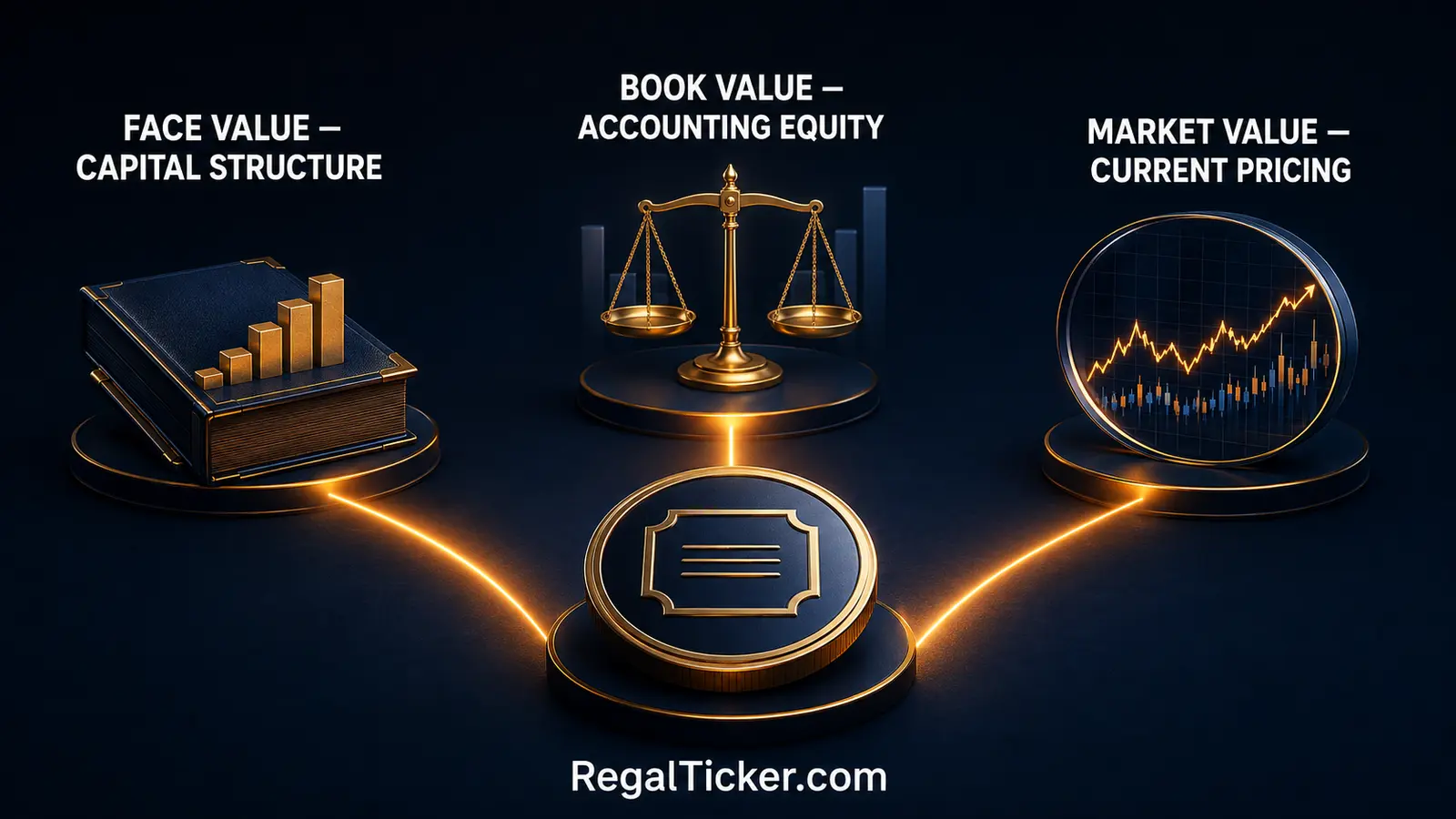
Face value book value and market value are three different numbers that can belong to the same share at the same time. Face value is a nominal amount used in the company’s share-capital structure. Book value is derived from the accounting equity reported in the financial statements. Market value is the price investors currently assign to the share through trading.
Suppose a fictional listed company has a face value of ₹10 per share, a book value per share of ₹60 and a market price of ₹240. None of these figures replaces the others. They come from different sources and answer different questions.
- Face value: What nominal amount is assigned to one share in the company’s capital structure?
- Book value per share: How much reported accounting equity is attributable to each ordinary share?
- Market value per share: At what price is the share currently being valued in the market?
Confusing the three can produce serious beginner mistakes. A ₹10 face value does not mean the share should trade near ₹10. A ₹60 book value does not guarantee that shareholders would receive ₹60 if the business closed. A ₹240 market price does not prove that the share is worth ₹240 in every investor’s analysis.
This second lesson in the Market Terminology learning hub builds on Stock Market Terminology: 50 Essential Terms. It explains the formulas, statement connections, corporate-action effects and interpretation limits behind these three values.
Face Value Book Value and Market Value: Quick Comparison
The fastest way to separate the three values is to identify who produces the number and why it exists.
| Value | Simple meaning | Main source | Does it change daily? | Common use |
|---|---|---|---|---|
| Face value | Nominal value assigned to one share | Company’s capital structure and disclosures | No | Share capital, stock splits, issue terms and some dividend announcements |
| Book value per share | Accounting equity attributable to each ordinary share | Balance sheet and share count | No, but it changes as accounts and share count change | Financial position and price-to-book analysis |
| Market value per share | Current price assigned through market trading | Exchange orders and executed trades | Yes, when the market is open | Buying, selling, portfolio value and market capitalisation |
The same fictional share can therefore show:
- Face value: ₹10
- Book value per share: ₹60
- Market value per share: ₹240
The ratios between these figures are not automatically good or bad. Their meaning depends on profitability, asset quality, debt, growth, accounting choices, market expectations and risk.
The Three Questions Test
When you encounter a value, ask:
- Capital structure question: Is this a nominal amount attached to the share? That points to face value.
- Accounting question: Is this derived from assets, liabilities and shareholder equity? That points to book value.
- Pricing question: Is this the price at which market participants currently transact or quote the share? That points to market value.
The SEBI investor guide to shares identifies face value as a feature of a share. SEBI’s securities-market glossary separately describes book value as a value shown in the books and market price as the reported sale price for an exchange-traded security. Those distinctions are the foundation of this lesson.
What Is Face Value of a Share?
Face value, also called nominal value or par value, is the amount assigned to each share in the company’s capital structure. It is not the current trading price and it is not a valuation estimate.
For a simple fully paid equity structure:
Paid-up equity share capital = Face value per share × Number of paid-up equity shares
Suppose a company has:
- 10 crore fully paid equity shares; and
- face value of ₹10 per share.
Its paid-up equity share capital is:
₹10 × 10 crore shares = ₹100 crore
This ₹100 crore is only the share-capital component. The company may also report securities premium, retained earnings and other reserves within total equity. That is one reason face value is normally much smaller than book value per share or market price.
Face Value Is Not the Issue Price
A company can issue a share at face value, at a premium to face value or under other permitted terms.
Suppose a new share has:
- Face value: ₹10
- Issue price: ₹100
In a simplified example, ₹10 is credited to equity share capital and ₹90 is treated as securities premium, subject to the applicable accounting and legal treatment. The face value remains ₹10 merely because the investor paid ₹100.
SEBI’s primary-market material explains that securities may be issued at face value, at a premium or at a discount in applicable contexts. An issue price and a face value must therefore never be treated as synonyms.
Face Value and Dividend Percentage
Some companies announce a dividend as a percentage of face value. This percentage is not the same as dividend yield.
If a share has:
- Face value: ₹10
- Dividend announced: 50% of face value
The dividend amount is:
50% × ₹10 = ₹5 per share
If the market price is ₹240, the simple dividend yield based on that one annual amount is:
₹5 ÷ ₹240 × 100 = 2.08%
The announcement percentage is 50%, but the yield is about 2.08%. Calling it a “50% return” would be incorrect. Dividends are also not guaranteed and may change.
Face Value and Stock Splits
A stock split subdivides each existing share and proportionately reduces face value. For example, a split from ₹10 face value to ₹2 face value creates a factor of five:
Split factor = Old face value ÷ New face value = ₹10 ÷ ₹2 = 5
An investor holding 100 shares would generally hold 500 shares after implementation, while the theoretical per-share price would adjust to about one-fifth before considering market movement.
The total economic value does not multiply merely because the share count increases. SEBI’s share-and-debenture-holder guide uses the same basic principle when explaining a split from ₹10 to ₹1 face value.

What Face Value Does Not Tell You
Face value does not tell you:
- the current market price;
- whether the company is profitable;
- how much accounting equity belongs to each share;
- whether the share is cheap or expensive;
- the amount shareholders would receive in liquidation; or
- the company’s total equity market value.
A ₹1 face-value share can trade at ₹1,500, while a ₹10 face-value share can trade below ₹10. The difference does not by itself prove quality or value.
What Is Book Value of a Share?
Book value broadly represents the accounting value of net assets attributable to shareholders. At company level, a simplified starting point is:
Book value or shareholder equity = Total assets − Total liabilities
For ordinary shareholders, book value per share is more useful:
Book value per share = Equity attributable to ordinary shareholders ÷ Outstanding ordinary shares
The exact calculation may require adjustments for preference claims, non-controlling interests or the share class being analysed. Investors must also decide whether they are using standalone or consolidated financial statements.
Book Value Per Share Worked Calculation
Suppose Alpha Limited reports:
- Total assets: ₹1,500 crore
- Total liabilities: ₹900 crore
- Equity attributable to ordinary shareholders: ₹600 crore
- Outstanding ordinary shares: 10 crore
Company-level book value is:
₹1,500 crore − ₹900 crore = ₹600 crore
Book value per share, or BVPS, is:
₹600 crore ÷ 10 crore shares = ₹60 per share

This ₹60 is based on recorded accounting amounts. It does not mean that each shareholder owns a separate ₹60 bundle of company property or that the company must pay ₹60 to anyone who sells a share.
Where Book Value Appears
The balance sheet normally reports assets, liabilities and equity at a particular date. Shareholder equity can include:
- equity share capital;
- securities premium;
- retained earnings;
- general and other reserves;
- accumulated gains or losses; and
- other equity items required by the applicable accounting framework.
To understand where these items come from, read How to Read a Balance Sheet. It explains why assets equal liabilities plus equity and why retained profit can increase equity over time.
Book Value Is Not Cash
Book value is not the company’s cash balance. Assets may include factories, equipment, inventory, receivables, investments, goodwill and other recorded items. Some may be difficult to sell quickly or may realise less than their carrying amount.
Liabilities may include borrowings, payables, provisions and other obligations. The accounting difference between assets and liabilities is therefore not a cash reserve waiting to be distributed.
Book Value Is Not Guaranteed Liquidation Value
If a company closes, assets may sell above or below their recorded carrying values. Closure costs, taxes, employee claims, secured creditors and other obligations can reduce what remains. Ordinary shareholders generally rank after creditors and prior claims.
Book value is therefore a statement-based measure—not a promise of liquidation proceeds.
Tangible Book Value
Some analysts calculate tangible book value by excluding goodwill and certain other intangible assets:
Tangible book value = Shareholder equity − Relevant intangible assets
Tangible BVPS = Tangible book value attributable to ordinary shareholders ÷ Outstanding ordinary shares
The measure may be useful for some asset-heavy or financial businesses, but it can understate the economic importance of brands, software, licences, customer relationships or intellectual property. No one version of book value suits every industry.
Can Book Value Be Negative?
Yes. If liabilities exceed assets, or accumulated losses severely reduce equity, book value can become negative. In that case, a conventional price-to-book ratio may be meaningless or difficult to interpret.
A negative book value is a serious signal to investigate, but it still does not describe every aspect of the business. Investors should study solvency, cash flow, debt terms, asset quality and the reason equity became negative.
What Is Market Value of a Share?
Market value per share is the price the market currently assigns to one share. In everyday use, people may refer to the latest traded price, current quoted price or closing price, depending on the context and time of measurement.
Unlike face value and book value, market value can change continuously during market hours. Buyers submit bids, sellers submit offers and transactions occur when compatible orders are matched under exchange rules.
How Are Share Prices Decided? explains order matching and price discovery in detail. For this lesson, the key point is that market price reflects what buyers and sellers are currently willing to accept—not the value printed in company accounts.
What Can Move Market Value?
Market value can change because participants revise expectations about:
- revenue, profit and cash flow;
- future growth;
- interest rates and liquidity;
- industry conditions;
- management and governance;
- regulation and taxation;
- competition;
- corporate actions;
- economic and geopolitical risk; and
- the return investors demand for uncertainty.
The market can price a company above book value when investors expect strong future profitability or value unrecorded economic assets. It can price the company below book value when asset quality is doubtful, returns are weak, debt is heavy or governance risk is high.
Market Value Per Share vs Market Capitalisation
Market value per share concerns one share. Market capitalisation concerns all applicable outstanding equity shares.
Market capitalisation = Current market price per share × Outstanding equity shares
Using Alpha Limited:
- Market price: ₹240
- Outstanding shares: 10 crore
Market capitalisation is:
₹240 × 10 crore shares = ₹2,400 crore

The company does not receive ₹2,400 crore in cash merely because its market cap is ₹2,400 crore. That number represents the market value assigned to its outstanding equity. The complete market capitalisation guide explains why share price alone cannot measure company size.
Market Value Is Not Intrinsic Value
Market value is observable from trading. Intrinsic value is an analyst’s estimate of what the business or share may be worth based on future cash flows, assets, risk and assumptions.
Two careful analysts can estimate different intrinsic values for the same company. The current market price can also move above or below either estimate. Never treat “market price” and “fair value” as interchangeable terms.
One Share, Three Values: Worked Example
Consider Alpha Limited with the following simplified data:
| Item | Amount |
|---|---|
| Face value per share | ₹10 |
| Outstanding shares | 10 crore |
| Paid-up equity share capital | ₹100 crore |
| Total assets | ₹1,500 crore |
| Total liabilities | ₹900 crore |
| Equity attributable to ordinary shareholders | ₹600 crore |
| Book value per share | ₹60 |
| Current market price per share | ₹240 |
| Market capitalisation | ₹2,400 crore |
The calculations are:
Share capital = ₹10 × 10 crore = ₹100 crore
Book value = ₹1,500 crore − ₹900 crore = ₹600 crore
BVPS = ₹600 crore ÷ 10 crore = ₹60
Market cap = ₹240 × 10 crore = ₹2,400 crore
Why Is the Market Price Four Times Book Value?
The simple price-to-book ratio is:
P/B ratio = Market price per share ÷ Book value per share
₹240 ÷ ₹60 = 4.0
The market is valuing Alpha’s equity at four times its reported book value. That fact alone does not prove overvaluation. The premium might reflect high return on equity, strong growth, valuable unrecorded intangibles or optimism. It could also reflect excessive expectations.
The ratio starts a question; it does not finish the analysis.
Why Is Face Value Only ₹10?
Face value records the nominal amount assigned to each share. Most of Alpha’s ₹600 crore equity may sit in retained earnings, securities premium or other reserves rather than equity share capital. The ₹10 face value has no requirement to rise to ₹60 or ₹240.
What Happens If the Market Price Falls to ₹120?
If the business accounts and share count are unchanged at that moment:
- face value remains ₹10;
- book value per share remains ₹60 until accounting figures change;
- market value becomes ₹120; and
- market capitalisation becomes ₹1,200 crore.
Market value can change quickly while face value stays fixed and book value updates more slowly through accounts and corporate events.
How Corporate Actions Change These Values
Corporate actions can change one, two or all three per-share figures. The direction depends on the action and its terms.
Stock Split: Face Value and Per-Share Numbers Adjust
Assume Alpha splits its shares from face value ₹10 to ₹2.
- Split factor: 5
- Old shares: 10 crore
- New shares: 50 crore
- Old market price: ₹240
- Theoretical adjusted market price: ₹48
- Old BVPS: ₹60
- Theoretical adjusted BVPS: ₹12
- New face value: ₹2
Immediately on a purely proportional basis:
- total paid-up share capital remains ₹100 crore;
- total book equity remains ₹600 crore;
- theoretical market capitalisation remains ₹2,400 crore; and
- the investor’s proportional ownership remains unchanged.
Actual prices can move because of trading. Use the Stock Split Calculator to convert a face-value announcement into revised shares, theoretical price and cost per share.
Bonus Issue: Face Value Usually Stays the Same
Assume Alpha announces a 1:1 bonus issue while face value remains ₹10.
- Shares increase from 10 crore to 20 crore.
- Theoretical market price changes from ₹240 to ₹120.
- Theoretical BVPS changes from ₹60 to ₹30 if total equity remains ₹600 crore.
- Face value per share remains ₹10.
The company capitalises eligible reserves into share capital, so the composition of equity changes while total equity is broadly unchanged by the issue itself. Learn the complete mechanics in What Are Bonus Shares?.
Rights Issue: New Money Can Change Book Value
A rights issue adds shares and raises new equity capital when shareholders subscribe. Its effect on BVPS depends partly on the issue price relative to existing BVPS and on costs and accounting treatment.
An issue above existing BVPS can raise BVPS, while an issue below existing BVPS can dilute it. The market price also adjusts for the value of the right and fresh information. Face value per share generally remains the stated nominal amount unless another capital action changes it.
Buyback: Fewer Shares, but Equity Also Changes
A buyback reduces the number of outstanding shares when accepted shares are purchased and cancelled. Cash or other resources leave the company, so equity also changes.
BVPS may rise or fall depending on the buyback price, existing BVPS, costs and accounting treatment. It is incorrect to assume that fewer shares automatically increase every per-share value.
Dividend: Face Value Helps State the Amount, but Book Equity Can Fall
A declared dividend may be stated as a percentage of face value, but the cash distribution reduces company resources and retained equity after recognition and payment under the applicable accounting treatment. The market price may also adjust when the share trades ex-dividend.
The action therefore connects all three ideas differently:
- face value may determine the announced dividend amount;
- book value may decline as equity is distributed; and
- market value may adjust as the right to the dividend separates from the share.
How Investors Should Interpret the Three Values
The three figures become useful only when matched with the right analytical question.
Use Face Value for Capital-Structure Interpretation
Face value helps you understand:
- paid-up equity share capital;
- stock-split ratios;
- the nominal amount of a share;
- issue disclosures; and
- dividends expressed as a percentage of face value.
Do not use face value to decide whether a listed share is cheap.
Use Book Value with Asset Quality and Profitability
Book value is often more informative in asset-heavy or balance-sheet-driven businesses. Even there, investors should examine:
- return on equity;
- asset quality;
- loan losses or provisions for financial companies;
- hidden or overstated asset values;
- debt and contingent liabilities;
- tangible versus intangible assets;
- consolidated versus standalone accounts; and
- multi-year BVPS growth.
SEBI’s fundamental-analysis overview places valuation ratios alongside earnings, leverage and other business metrics. That broader context matters because P/B alone cannot distinguish a high-quality compounder from an expensive stock or a weak company from a genuine bargain.
Use Market Value for Current Pricing, Not Certainty
Market value tells you what the market currently pays. It is essential for:
- calculating the current value of a holding;
- measuring market capitalisation;
- placing orders;
- calculating unrealised gains or losses; and
- comparing price with earnings, book value, cash flow or other measures.
It does not guarantee future return. A liquid market price can still reflect excessive optimism, fear or incomplete information.
Compare the Values, but Do Not Rank Them
Face value is not “less accurate” because it is low. Book value is not automatically “true value” because it comes from accounts. Market value is not automatically “correct forever” because trades occur at that price.
Each number is correct for its own purpose when the underlying data is correct and current.
Common Mistakes with Share Values
Mistake 1: Calling a Share Cheap Because Price Is Near Face Value
A stock trading at ₹12 with face value ₹10 may still be expensive if the business is losing money, assets are impaired or equity is being destroyed. Distance from face value is not a valuation method.
Mistake 2: Treating a Dividend Percentage as Yield
A 100% dividend on ₹2 face value is ₹2 per share. If the market price is ₹500, the simple yield from that dividend is only 0.4%.
Mistake 3: Assuming Market Price Should Return to Face Value
Market price has no automatic pull toward face value. A stock can trade hundreds of times above face value or below it depending on business value and market expectations.
Mistake 4: Treating Book Value as Cash Available to Shareholders
Book value includes recorded net assets. It is not a bank balance and is not guaranteed liquidation proceeds.
Mistake 5: Assuming Price Below Book Value Is Always a Bargain
A discount can reflect bad loans, obsolete assets, low returns, high debt, governance concerns or expected losses. The market may be questioning the quality of the book value.
Mistake 6: Assuming Price Above Book Value Is Always Overvalued
High-quality businesses can create value using limited recorded assets. Brands, software, networks and human capability may not be fully reflected in book value. The premium still needs to be justified by future performance, but it is not automatically irrational.
Mistake 7: Comparing Standalone Price with Consolidated Book Value Carelessly
Financial websites can use different statement bases and share counts. Verify whether BVPS is standalone or consolidated, whether preference equity or non-controlling interest is included, and whether recent corporate actions have been reflected.
Mistake 8: Ignoring the Measurement Date
Market price may be current, while book value may come from the last quarter or financial year. Combining values from different dates can produce a misleading P/B ratio.
Beginner Checklist and Frequently Asked Questions
Before using face value, book value or market value, check:
- Which value am I looking at?
- Is the figure per share or for the whole company?
- What is the measurement date?
- Is the share count current after splits, bonus issues, rights issues or buybacks?
- Is BVPS calculated from equity attributable to ordinary shareholders?
- Are the figures standalone or consolidated?
- Does book value contain significant goodwill or questionable assets?
- Am I confusing a dividend percentage with dividend yield?
- Am I treating market price as guaranteed fair value?
- Have I verified the data in the latest company and exchange disclosures?
What is face value of a share in simple words?
Face value is the nominal amount assigned to one share in the company’s capital structure. It helps determine share capital and is relevant to stock splits, issue terms and some dividend announcements. It is not the live market price.
What is book value per share?
Book value per share is the accounting equity attributable to ordinary shareholders divided by the applicable number of outstanding ordinary shares. It is commonly abbreviated as BVPS.
Market value is the price currently assigned to a share through market trading. Depending on context, a source may show the last traded price, closing price, bid, ask or another quoted market price.
Why is market value higher than face value?
Face value is only a nominal capital-structure amount. Market value reflects expectations about profitability, growth, risk, assets, management and many other factors. There is no rule requiring the two values to be close.
Is book value the real value of a company?
No. Book value is an accounting measure based on recorded assets and liabilities. It is not automatically fair value, intrinsic value, market value or liquidation value.
How is book value per share calculated?
The basic formula is equity attributable to ordinary shareholders divided by outstanding ordinary shares. Investors should verify the share count, statement basis and any preference or non-controlling claims.
Is a stock below book value always undervalued?
No. A low price-to-book ratio can reflect poor asset quality, weak profitability, high debt, governance risk or expected losses. It requires business and sector context.
Does a stock split reduce book value per share?
Yes, book value per share adjusts proportionately because the same equity is spread across more shares. Total book equity does not fall merely because of the split itself.
Does a stock split change face value?
Yes. A split divides the old face value into a smaller face value and increases share count proportionately. A bonus issue normally increases share count without changing face value per share.
Where can I verify these values?
Check the company’s latest financial statements, capital-structure disclosures and exchange announcements. Use official SEBI and exchange investor material for definitions. Do not rely only on an unverified social-media post or a financial-data screenshot.
Conclusion
Face value book value and market value describe three separate layers of one share:
- Face value belongs to the capital structure.
- Book value comes from reported accounting equity.
- Market value comes from current market pricing.
The most important beginner habit is to stop asking which number is the “real” one without first defining the purpose. Face value helps interpret share capital and certain corporate actions. Book value helps analyse accounting net worth. Market value tells you the price assigned by market participants now.
Use the numbers together, but never turn any one of them into a guaranteed buy, sell or fair-value signal.
The next Market Terminology lesson will explain bid price, ask price, last traded price and bid–ask spread—the live price terms that appear on an order screen.
Official References
- SEBI Investor — Understanding Shares
- SEBI Investor — Securities Market Glossary
- SEBI Investor — Primary Market Guide
- SEBI Investor — Share and Debenture Holders
- SEBI Investor — Technical Analysis vs Fundamental Analysis
Educational disclaimer: This article is for investor education and general information only. It is not investment advice, a research recommendation, an invitation to trade, an offer to buy or sell securities, or a guarantee of returns. Accounting figures, market prices, share counts and regulatory requirements can change. Verify current information through official company, exchange and regulatory sources before acting.