

One Tap. Many Market Roles.
The stock market can look deceptively simple from a phone screen. You choose a share, tap Buy, see an order confirmation and later see the security in your Demat holdings.
Behind those few taps is a much larger regulated ecosystem.
A company has issued the share. A stock broker gives you market access. A stock exchange matches compatible orders. A clearing corporation manages clearing and settlement obligations. Depositories maintain electronic securities records, while Depository Participants (DPs) connect investors to the depository system. Banks, custodians, RTAs and other intermediaries support different parts of the process, while SEBI regulates the securities-market framework.
The app is only the visible front end. Behind it is a network of specialised institutions performing different jobs.
Understanding these roles is one of the most useful foundations a beginner can build because it prevents common confusion such as:
- Broker ≠ Stock Exchange
- Demat Account ≠ Trading Account
- Depository ≠ Depository
- Participant Company ≠ seller in every trade
- SEBI ≠ daily share-price setter
These roles are connected, but they are not interchangeable.
⚡ Quick answer
The main participants in India’s stock market include companies and other issuers, retail investors, traders, institutional investors, stock brokers, stock exchanges, clearing corporations, depositories, Depository Participants, custodians, clearing banks, RTAs and SEBI.
The easiest way to understand the system is by role. Issuers create securities. Investors and traders provide capital, demand and liquidity. Brokers and other intermediaries connect participants to market services. Stock exchanges, clearing corporations and depositories form the core Market Infrastructure Institutions (MIIs). SEBI regulates the securities-market framework and registered entities.
Key takeaways
The stock market is an ecosystem, not a single institution.
A company can raise capital in the primary market, but it does not receive money every time its listed share changes hands in the secondary market.
Retail investors, traders and institutions can all influence demand and supply, but no single category permanently controls market prices.
A stock broker gives clients access to the market; the broker is not the stock exchange.
Stock exchanges, clearing corporations and depositories are classified by SEBI as Market Infrastructure Institutions (MIIs).
A depository holds securities records electronically; a Depository Participant provides the investor-facing Demat service.
Clearing corporations manage clearing and settlement obligations after exchange trades are matched.
SEBI regulates the market framework, but it does not select stocks for investors or set the daily price of each share.
NSE and BSE are the best-known equity exchanges, but it is inaccurate to say India has only two recognised stock exchanges.
After you tap Buy, several regulated systems can be involved before the security is finally reflected in your Demat holdings.
Always verify brokers and other intermediaries through official SEBI or exchange records rather than trusting an app name, social-media profile or advertisement.
The Stock Market Ecosystem at a Glance
The market works because different participants perform different jobs.
A useful beginner model is:
| Layer | Main participants | Core job |
|---|---|---|
| Capital seekers / issuers | Listed companies and other issuers | Issue securities, raise capital and make required disclosures |
| Capital providers / market users | Retail investors, traders, institutions, NRIs/OCIs where permitted | Buy, sell, invest, trade and provide market demand/liquidity |
| Access and specialist intermediaries | Brokers, DPs, custodians, RTAs, merchant bankers, research/advisory entities | Connect clients and issuers to specific market services |
| Market infrastructure | Stock exchanges, clearing corporations, depositories | Trading, clearing, settlement and securities-record infrastructure |
| Regulator | SEBI | Protect investors, regulate the securities market and promote its development |
📖 Definition
Market Infrastructure Institutions (MIIs)
Market Infrastructure Institutions are the core institutions that make organised securities-market trading, clearing, settlement and electronic ownership possible.
In India, the three principal MII categories are:
Stock Exchanges Clearing Corporations Depositories
SEBI’s investor-education material specifically groups stock exchanges, clearing corporations and depositories as Market Infrastructure Institutions.
That distinction matters. A broker may be the company whose app you use every day, but the broker does not become the exchange, depository or regulator.
Investor note
The app is only the visible front end
A polished trading app can make the stock market look like one company is doing everything. In reality, your broker interface can connect you to exchange, clearing, banking and depository systems operated by different regulated entities.
Companies and Other Issuers: Where Securities Begin
Companies are one starting point of the equity-market ecosystem because they issue shares representing ownership.
If you are still learning what ownership means, first read What Is a Share? and Types of Shares in India.
Primary market: when the issuer is raising or offering securities
A company may come to the public market through an Initial Public Offering (IPO). It may later use routes such as a follow-on public offer, rights issue or other permitted issuance mechanism.
In a fresh issue, money raised from investors can flow to the company according to the terms of the offer.
The detailed IPO process belongs in What Is an IPO?.
Secondary market: when investors trade with other investors
Once shares are listed and available for exchange trading, ordinary secondary-market transactions generally occur between market participants.
Suppose Priya sells 100 shares of a listed company and Arjun buys those shares through the exchange system.
The company itself does not normally receive Arjun’s purchase amount merely because its share changed hands.
That distinction is fundamental:
Primary market = creation/distribution of new issue securities or permitted offers.
Secondary market = trading of existing listed securities between market participants.

What does the company do after listing?
A listed company still remains a critical market participant because it must communicate information that can affect shareholder decisions.
Its responsibilities can include:
- financial results;
- material-event disclosures;
- shareholder meetings;
- corporate-governance disclosures;
- dividend decisions;
- bonus, rights, split, buyback or other corporate-action information;
- annual reports and other required filings.
Those disclosures can change investor expectations and therefore affect demand and supply, but the company does not manually set the continuous market price.
Retail Investors and Traders
Retail investors
A retail investor is an individual participating with personal capital rather than managing a large institutional pool.
Retail investors can have very different objectives:
- long-term wealth creation;
- retirement or education goals;
- dividend income;
- diversified investing;
- direct stock selection;
- shorter-term market participation.
Retail investors should not be treated as one single behaviour group.
Two individuals can buy the same share at the same time, yet one may plan to own it for years while the other may exit within days.
Traders
A trader generally enters a position to benefit from a price move under a defined trading process.
Depending on strategy, the trader may study:
- price;
- volume;
- trend;
- volatility;
- liquidity;
- order flow;
- news or catalysts;
- entry;
- stop-loss;
- target;
- position size.
The difference between investing and trading is therefore not simply “retail investor versus trader.” A retail participant can invest, trade or do both.
The dedicated guide Investing vs Trading explains that decision framework in detail.

NRI and OCI participants
NRIs and OCIs can also participate in Indian securities markets, subject to the applicable account classification, banking, FEMA, KYC and investment rules.
They should not assume that a resident Indian setup can continue unchanged after residency status changes.
For that separate framework, use the NRI Investing in the Indian Stock Market Guide.
Institutional Investors: Large Pools of Capital, Different Mandates
Institutional investors manage money under a formal mandate rather than simply investing one individual’s personal savings.
Depending on context, institutional capital can include:
- mutual funds;
- insurance companies;
- pension or provident funds;
- banks;
- Alternative Investment Funds;
- foreign portfolio investors;
- sovereign or other large professional pools of capital.
Institutions often have dedicated research, risk, dealing, operations and compliance teams.
Their orders can be large enough to affect liquidity and market price, especially in securities where normal trading volume is limited.
But three beginner myths should be avoided.
Myth 1: Institutions are always right
They are not.
Institutions can make poor investment decisions, enter at expensive valuations, underestimate risk or operate under mandates that force them to buy or sell for reasons unrelated to your own objective.
Myth 2: All institutions act together
They do not.
One mutual fund can buy a company while another fund sells it. A foreign investor can reduce exposure while a domestic institution increases exposure.
The term institutional flow describes aggregated activity. It does not prove that every professional investor has reached the same conclusion.
Myth 3: Retail investors are automatically weak participants
Institutions typically have greater resources, but individuals can have advantages too:
- smaller positions;
- greater flexibility;
- no benchmark-tracking requirement;
- ability to stay away from a security entirely;
- longer decision windows.
Market participation is not a competition in which one category is permanently “most important.”
What matters for price is the interaction of actual orders, liquidity and expectations.
Investor note
Large orders can influence price without “controlling” the market
An institutional order may move a thinly traded share more than a small retail order, but the market still contains multiple buyers, sellers, strategies and time horizons. “Institutions bought” is information, not a complete investment thesis.
Stock Brokers and Trading Members
A retail investor does not normally connect directly to an exchange’s matching engine.
The investor places an order through a registered stock broker, also called a trading member in the relevant exchange context.
A broker can provide:
- account opening and client onboarding;
- a website, app or trading terminal;
- order entry and routing;
- pre-trade risk checks;
- contract notes;
- trading-ledger records;
- transaction statements;
- segment activation;
- grievance support.
SEBI maintains a searchable registry of registered stock brokers, and investors should verify the legal entity rather than relying only on the brand name displayed in an app store or advertisement.
Broker ≠ exchange
This is one of the most common beginner confusions.
Stock Broker
- Provides the investor-facing trading account and platform
- Performs client and order-level checks
- Routes eligible orders to the market
- Provides contract notes, statements and client support
Stock Exchange
- Operates the organised electronic marketplace
- Matches compatible buy and sell orders
- Provides market data and surveillance
- Enforces exchange trading rules
A broker does not independently decide the fair price of the share.
Read How Are Share Prices Decided? for bids, asks, order matching and price discovery.

Read How Are Share Prices Decided? for bids, asks, order matching and price discovery.
Broker app ≠ trading account
The app is an interface.
The underlying trading account is the regulated client relationship through which eligible orders are submitted.
The next learning path after Stock Market Basics is the Demat & Trading Academy. Start with What Is a Trading Account? when you are ready to understand order-access infrastructure in detail.
Caution
Verify the intermediary, not just the interface
Fraudulent apps, look-alike websites and social-media accounts can imitate legitimate market brands. Verify registration details and official domains before entering PAN, bank details, passwords, OTPs or transferring money.
Market Infrastructure Institutions: The Core Market Plumbing
SEBI uses the term Market Infrastructure Institutions (MIIs) for the infrastructure that supports securities-market transactions.
The three core MII categories are:
- Stock Exchanges
- Clearing Corporations
- Depositories
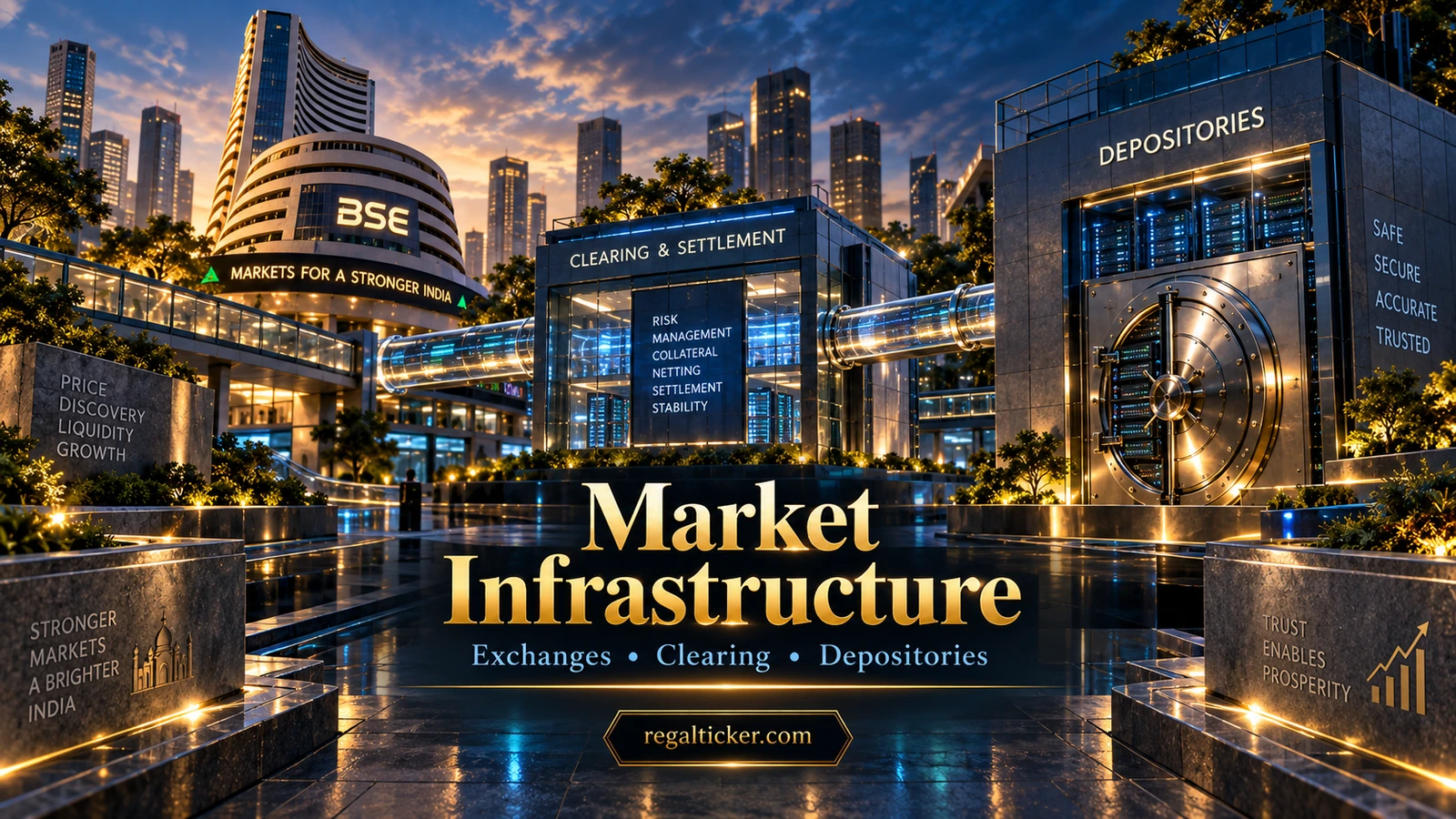
These institutions perform different roles but together make modern electronic securities markets possible.
Stock exchanges: where eligible orders meet
A stock exchange provides the organised electronic venue in which eligible securities can be traded under defined rules.
Its functions can include:
- listing and trading infrastructure;
- order matching;
- market-data dissemination;
- trading rules;
- member supervision;
- surveillance;
- investor-grievance mechanisms;
- market integrity controls.
NSE and BSE are the best-known equity exchanges in India, and beginners can compare them in NSE vs BSE.
❌ Myth
India has only two stock exchanges — NSE and BSE.
✅ Fact
NSE and BSE dominate everyday Indian equity-market discussion, but SEBI’s recognised stock-exchange list is broader. They should not be taught as the only recognised exchanges in India.
Clearing corporations: what happens after the trade is matched
A matched order is not the end of the transaction.
The market still has to determine:
- who owes securities;
- who owes funds;
- how obligations are netted or processed;
- whether margin and risk requirements are satisfied;
- how pay-in and payout are completed.
Clearing corporations perform the clearing and settlement function and apply market-risk controls.
SEBI’s investor booklet describes their core role as ensuring settlement of trades executed on stock exchanges.
Depositories: the electronic securities-record system
Depositories hold securities in electronic or dematerialised form within the depository system and facilitate transfer and record-keeping.
For mainstream Indian securities-market holdings, beginners will repeatedly encounter NSDL and CDSL.
An investor normally does not open a retail Demat account directly with the central depository.
Instead, the investor uses a Depository Participant (DP).
Depository
- Maintains the core electronic securities infrastructure
- Records securities in dematerialised form
- Supports electronic transfer and settlement
- Works through authorised Depository Participants
Depository Participant (DP)
- Provides investor-facing Demat-account services
- Helps open and service eligible Demat accounts
- Handles statements and account-related requests
- Connects the investor to the depository system
This is explained in depth in What Is a Demat Account?.
Depository Participants, Custodians, Clearing Banks and RTAs
Not every important participant fits neatly into “investor, broker or exchange.”
Several specialist entities support ownership, settlement, issuer records and institutional operations.
Depository Participant (DP)
A DP is the investor-facing intermediary through which Demat services are provided.
A DP may help with:
- opening and maintaining a Demat account;
- demat statements;
- debit and credit instructions;
- pledge-related services;
- nomination;
- freezing or unfreezing eligible account functions;
- service requests.
A stock broker can also be a DP, which is why the two functions may appear inside one app.
But the legal roles are still different.
Broker role: market orders and trading access.
DP role: Demat-account services.
Custodian
Custodians provide safekeeping, settlement and asset-servicing functions, particularly for institutional or professional investors.
A custodian is not simply a larger version of a retail broker.
Clearing bank
Banks can support movement of settlement funds within clearing arrangements.
The bank is part of the money side of the process; it is not the exchange matching engine or depository holding system.
Registrar and Transfer Agent (RTA)
RTAs support issuer-related records and investor servicing.
Depending on the security and corporate event, an RTA may support functions relating to:
- investor records;
- corporate actions;
- allotment-related processing;
- transfer or service requests;
- communication between issuers and security holders.
In an IPO or rights issue, RTAs and merchant bankers can become more visible because primary-market processing requires different specialist roles from an ordinary secondary-market trade.
SEBI: Regulator of the Securities Market
SEBI — the Securities and Exchange Board of India — is the securities-market regulator.
Its statutory objectives include:
- protecting the interests of investors;
- promoting development of the securities market;
- regulating the securities market.
SEBI regulates and supervises market institutions and intermediaries under the applicable legal framework.
Its responsibilities include areas such as:
- intermediary registration and supervision;
- market-infrastructure oversight;
- disclosure standards;
- surveillance and enforcement;
- investor protection;
- grievance frameworks;
- prevention of unfair market practices;
- market-development policy.
SEBI’s Market Regulation Department specifically supervises MIIs such as stock exchanges, depositories and clearing corporations.

What SEBI does not do
SEBI does not:
- select which share you should buy;
- promise that a registered product will make money;
- decide the daily continuous-market price of every share;
- guarantee that every listed company is a good investment;
- turn a social-media stock tip into regulated advice.
A regulated market can still contain risky securities and losing investments.
The purpose of regulation is to provide and enforce a framework — not to remove investment risk.
If an intermediary is SEBI registered, SEBI recommends its investments or guarantees its returns.
SEBI registration means the entity operates under an applicable regulatory framework. It does not mean SEBI recommends every product, strategy or security associated with that entity, and it does not guarantee investment performance. For broader investor-safety checks, read the Stock Market Risk Checklist.
What Happens After You Tap Buy?
This is where the ecosystem becomes easier to remember.
Consider a simplified delivery purchase of a listed share.
Step 1: You place an order
You enter:
- security;
- exchange;
- quantity;
- order type;
- price or trigger conditions where applicable.
The instruction goes through your stock broker.
Step 2: The broker performs checks
The broker’s systems apply relevant client, funds, margin, product and risk checks before forwarding an eligible order.
Step 3: The order reaches the exchange
The stock exchange places the eligible order into its electronic market.
If a compatible opposite order is available under the exchange’s matching rules, a trade can occur.
Step 4: Price discovery occurs through orders
The exchange does not simply invent a price.
Buyers and sellers submit orders, and compatible instructions create trades.
This is why How Are Share Prices Decided? is a prerequisite concept.
Step 5: Clearing and settlement obligations are created
The clearing corporation calculates and manages settlement obligations and associated risk controls.
Clearing members and banking arrangements support the settlement process.
Step 6: Securities move through the depository system
For an eligible delivery purchase, the security is ultimately reflected in the buyer’s Demat holdings through the depository/DP system after settlement.
The exact operational process can involve multiple regulated entities even though the retail interface shows only one app.

💡 Real example
One Buy Order, Several Regulated Roles
Suppose Ananya buys 20 shares of a listed company.
Ananya is the investor.
Her stock broker accepts and routes the eligible order.
The stock exchange matches it with compatible selling interest.
The clearing corporation manages the clearing and settlement obligations.
Banking arrangements support the funds leg of settlement.
The depository and Depository Participant system records the securities after settlement.
The issuing company remains the company whose shares are being traded, but it did not personally match Ananya with the seller.
One tap on a phone can therefore involve several specialised institutions working together behind the scenes.
Who Actually Moves Share Prices?
The most accurate beginner answer is:
Orders move prices. Participants create those orders.
Retail investors, traders, mutual funds, insurers, FPIs, proprietary trading desks, algorithmic strategies, market makers where applicable and other participants can all create buying or selling interest.
Company results, interest rates, regulation, global markets and news influence expectations.
Those expectations become:
- bids;
- asks;
- order cancellations;
- market orders;
- limit orders;
- large institutional transactions;
- hedging activity;
- short-term trading activity.
The interaction of those instructions determines executable prices.
Can institutions move the market?
Yes, a sufficiently large order can affect price and liquidity.
But that does not mean institutions set a permanent “correct price.”
Another institution may take the opposite side. Retail participants may react differently. New information may arrive. Algorithms may adjust quoting behaviour.
Does the company control its share price?
Not in normal secondary-market trading.
The company influences expectations through business performance, disclosures, corporate actions and communication, but the continuous market price is discovered through market orders.
Does SEBI control share prices?
SEBI regulates the market framework and can take regulatory or enforcement action.
It does not normally decide that a listed share must trade at a particular daily market price.
Investor note
Follow flows, but do not outsource your thesis
Institutional buying, retail activity, foreign flows and market-volume data can add context. None of them automatically tells you whether a security is fairly valued, suitable for your goal or likely to rise next.
Participants Beginners Commonly Confuse
| Participant | Main role | Do not confuse it with |
|---|---|---|
| Company / issuer | Issues securities and makes required disclosures | The counterparty to every secondary-market trade |
| Retail investor | Uses personal capital to invest or trade | A separate market institution |
| Institutional investor | Manages large pools of capital under mandates | One unified group with one market view |
| Stock broker | Provides market access and routes orders | Stock exchange |
| Stock exchange | Operates organised trading and order matching | Broker or Demat holder |
| Clearing corporation | Clears and settles exchange transactions | Bank, broker or depository |
| Depository | Electronic securities record-keeping infrastructure | Depository Participant |
| Depository Participant | Provides Demat services to clients | Central depository itself |
| RTA | Issuer record and investor-service functions | Broker or exchange |
| Custodian | Safekeeping/settlement services for asset owners | Retail Demat account provider |
| SEBI | Regulates the securities market | Stock picker, broker or price setter |
| Social-media finfluencer | Publishes content or opinions | Registered intermediary/adviser unless separately authorised |
That last row deserves attention.
A large follower count does not create a regulated status.
Before relying on an intermediary, adviser, analyst or securities-market service, verify the legal entity and registration through official sources.
⭐ Pro tip
Verify the Legal Entity Before You Trust the Brand
Before opening an account, transferring money or sharing personal information, verify the intermediary’s legal name, SEBI registration where applicable, exchange or depository membership, official website and grievance details.
A familiar app name, advertisement or social-media profile is not enough by itself.
For a broader safety framework, use the Stock Market Risk Checklist.
A Beginner Safety Checklist
Understanding participants is useful only if you can verify who you are actually dealing with.
Before opening an account, transferring money or following a securities-market service:
- Verify the legal entity.
Check the registered name, not only the brand or app name.
- Check registration and exchange membership where applicable.
Use SEBI and recognised-exchange directories.
- Confirm the official website and application.
Avoid links sent through unsolicited messages.
- Understand which role the entity performs.
Broker, DP, adviser, research analyst, RTA and exchange are not interchangeable.
- Read the tariff and service terms.
Registration does not mean every service is free.
- Never share passwords, OTPs or sensitive account credentials.
- Do not rely on guaranteed-return claims or hot tips.
- Keep contract notes, statements, exchange alerts and relevant communications.
- Use formal grievance channels.
Contact the intermediary first and use the applicable exchange/depository/SEBI escalation route if unresolved.
- Separate access from advice.
A broker gives you market access; that does not mean every screen, notification or idea shown in the app is suitable for your portfolio.
SEBI’s investor guidance specifically advises dealing with registered intermediaries, understanding documents and charges, protecting credentials and avoiding hot tips.
Where Stock Market Basics Ends — and What to Learn Next
This lesson completes the Stock Market Basics sequence.
At this point you should understand:
- what the stock market is;
- what a share represents;
- how NSE and BSE fit into the market;
- what NIFTY 50 and SENSEX measure;
- how share prices are discovered;
- what market capitalisation means;
- the main share classes;
- bull, bear and sideways markets;
- investing versus trading;
- the participants and infrastructure that make the system work.
The natural next learning path is Demat & Trading, because that academy explains the accounts and operational infrastructure you actually use to participate.
Start with:
Understanding the participants first makes those account guides easier because you now know who the broker, exchange, DP, depository and regulator are before learning how your own account connects to them.
Frequently asked questions
Who are the main participants in the Indian stock market?
The main groups include companies and issuers, retail investors, traders, institutional investors, stock brokers, stock exchanges, clearing corporations, depositories, Depository Participants, custodians, clearing banks, RTAs and SEBI.
What is a market participant?
In a broad sense, a market participant is a person or institution taking part in securities-market activity. For beginners, it is useful to distinguish market users such as investors and traders from intermediaries and Market Infrastructure Institutions that make transactions possible.
Is a stock broker the same as a stock exchange?
No. A broker provides clients with market access and routes eligible orders. A stock exchange operates the organised electronic marketplace and matches compatible orders under its rules.
Is a depository the same as a Depository Participant?
No. A depository provides the central electronic securities-record infrastructure. A Depository Participant, or DP, provides investor-facing Demat-account services through the depository system.
Are NSE and BSE the only stock exchanges in India?
No. NSE and BSE are the best-known exchanges for everyday Indian equity-market trading, but SEBI’s recognised stock-exchange list is broader. It is therefore inaccurate to say that India has only two recognised stock exchanges.
Who decides the price of a share?
No single ordinary participant decides the continuous market price. Share prices emerge as buy and sell orders interact under exchange matching rules. Investors, traders and institutions influence demand and supply through the orders they place.
Can institutional investors control the stock market?
Large institutional orders can influence liquidity and price, especially in less-liquid securities, but institutions have different mandates and often take opposing positions. Institutional activity is important information, but it does not mean one group permanently controls the market.
Does the company receive money whenever I buy its shares?
Usually no in an ordinary secondary-market transaction. Your purchase is generally matched with selling interest from another market participant. A company receives capital through relevant primary-market or issuance transactions according to their terms.
What does a clearing corporation do?
A clearing corporation manages clearing and settlement after exchange trades are executed. It determines settlement obligations and applies risk-management processes so the securities and funds can move through the market infrastructure.
What is SEBI’s role in the stock market?
SEBI protects investors’ interests, regulates the securities market and promotes its development. It oversees market institutions and registered intermediaries under the applicable framework, but it does not choose investments for you or set every share’s daily market price.
Can a retail investor trade directly on NSE or BSE without a broker?
A normal retail investor generally accesses exchange trading through a registered stock broker or trading member rather than connecting directly to an exchange’s matching engine.
What should I verify before choosing a stock broker or market intermediary?
Verify the legal entity, SEBI registration where applicable, exchange or depository membership, official website, charges, grievance contacts and the exact service being offered. Do not rely only on a brand name, social-media profile, advertisement or app-store listing.
Verify through official sources
Official references
- SEBI Investor — Securities Market Booklet: Market Infrastructure Institutions and Intermediaries
- SEBI — Market Regulation Department: Market Infrastructure Institutions
- SEBI — Intermediaries / Market Infrastructure Institutions
- SEBI — Details of Recognised Stock Exchanges
- SEBI — List of Clearing Corporations
- SEBI — Registered Stock Brokers in Equity Segment
- SEBI Investor — Investor Charter
- SEBI Investor — Do’s and Don’ts of Investing in Securities Market
Educational disclaimer: This article is for investor education and general information only. It is not investment advice, a research recommendation, a trading strategy or an assurance of returns. Market structure, intermediary registrations, exchange recognition, settlement processes and regulations can change. Verify current information through SEBI, recognised exchanges, depositories and registered intermediaries before acting.