

A ceasefire headline matters only if the economics start to change
For the first time in months, the Russia–Ukraine war has produced a development that markets can plausibly treat as more than diplomatic theatre. Russia and Ukraine have agreed to a temporary ceasefire around Oleshky from 27 October to allow humanitarian access and civilian evacuations, while technical-level talks involving Ukraine, Russia and the United States are expected in the first half of November.
That is still a long way from a peace agreement. The hardest questions—territory, security guarantees, sanctions, military support and the future of Donbas—remain unresolved. Fighting has also continued around the diplomatic process, which is a useful reminder that negotiations and escalation can coexist.
For investors, however, the relevant question is not whether a headline says “peace talks.” It is whether a credible negotiating path begins to change the price of risk embedded in oil, Black Sea trade, grain, fertiliser logistics, European defence spending and currencies. India sits inside several of those transmission channels at once.
⚡ Quick answer
What could Russia–Ukraine peace talks mean for Indian markets?
A credible ceasefire could ease some pressure on Black Sea shipping, grain flows, fertiliser logistics and the geopolitical risk premium attached to Russian energy. That would generally be helpful for an import-dependent economy such as India. But it would not automatically mean cheaper crude, a stronger rupee or weaker defence stocks. Brent is currently being driven heavily by a separate Middle East supply shock, while Europe’s defence build-up has become structural rather than dependent on one battlefield. Indian investors therefore need to separate a genuine change in war risk from a simplistic “peace trade.”
Key takeaways
Russia and Ukraine have agreed to a temporary Oleshky ceasefire from 27 October for humanitarian access.
Technical-level Russia–Ukraine–U.S. talks are expected in the first half of November, with Abu Dhabi among the proposed venues.
The negotiations remain fragile because territory, security guarantees, sanctions and military support are unresolved.
A durable ceasefire could improve Black Sea logistics and reduce some grain and fertiliser risk, but the effect would depend on port access and sanctions.
Oil may not fall sharply even if the Ukraine war cools because Middle East supply risk currently has Brent near six-month highs.
European defence spending is already on a multi-year upward path, so peace would not automatically reverse the sector’s structural investment cycle.
India’s direct exposure runs through crude imports, the rupee, fertilisers, edible oils, freight and risk appetite.
The right investor framework is conditional
watch evidence from shipping, sanctions, commodity prices and company disclosures rather than trading the word “ceasefire.”
1. What actually changed in the Russia–Ukraine war?
The most concrete development is narrow but real. Russia and Ukraine agreed to a temporary ceasefire in the Russian-occupied town of Oleshky, effective 27 October, to allow humanitarian deliveries and civilian evacuation corridors.
Reuters reported that roughly 1,700–2,000 people remain in the town, many of them elderly and facing shortages of basic supplies. This is not a national ceasefire and it does not freeze the frontline. Its importance is that both sides have accepted a limited operational arrangement while a broader diplomatic track is restarting.
Ukrainian President Volodymyr Zelenskiy has also said Ukrainian, Russian and U.S. negotiators expect technical-level talks during the first half of November. Abu Dhabi has been identified as a possible venue, while Switzerland has also been discussed.
The agenda could include a comprehensive ceasefire or narrower agreements covering areas such as energy infrastructure and maritime operations. That is relevant to markets because shipping and energy are two of the war’s clearest economic transmission mechanisms.
Yet the gap between a working-level meeting and an actual settlement remains large. Ukraine is seeking strong security guarantees and long-term military support. Russia’s territorial demands remain a central obstacle. Recent missile attacks also show that diplomatic engagement has not ended the military campaign.
That combination—talks reopening while fighting continues—is why the next market move should depend on evidence, not optimism.
2. Why this matters to markets more than another peace headline
Financial markets have been exposed to Russia–Ukraine diplomacy many times since the war began. Most headlines fade because they do not alter the physical flow of energy, food, ships or capital.
A durable ceasefire would be different if it changed those flows.
The key channels are practical:
| Channel | What war disruption changes | What a credible ceasefire could improve |
|---|---|---|
| Energy | Sanctions, refinery attacks, shipping risk and supply uncertainty | Lower risk premium, easier trade and potentially more stable product flows |
| Black Sea agriculture | Port restrictions, damaged infrastructure and expensive logistics | Higher export capacity and more predictable freight |
| Fertilisers | Energy costs, sanctions, shipping and payment complexity | Better supply reliability and possibly lower logistics premiums |
| European industry | High energy/security costs and weak confidence | Better visibility for manufacturing and investment |
| Defence | Emergency procurement and rapid capacity expansion | Less immediate battlefield urgency, but not necessarily lower long-term spending |
| Currencies and risk assets | Safe-haven demand and commodity inflation | Improved risk appetite if the settlement is credible |
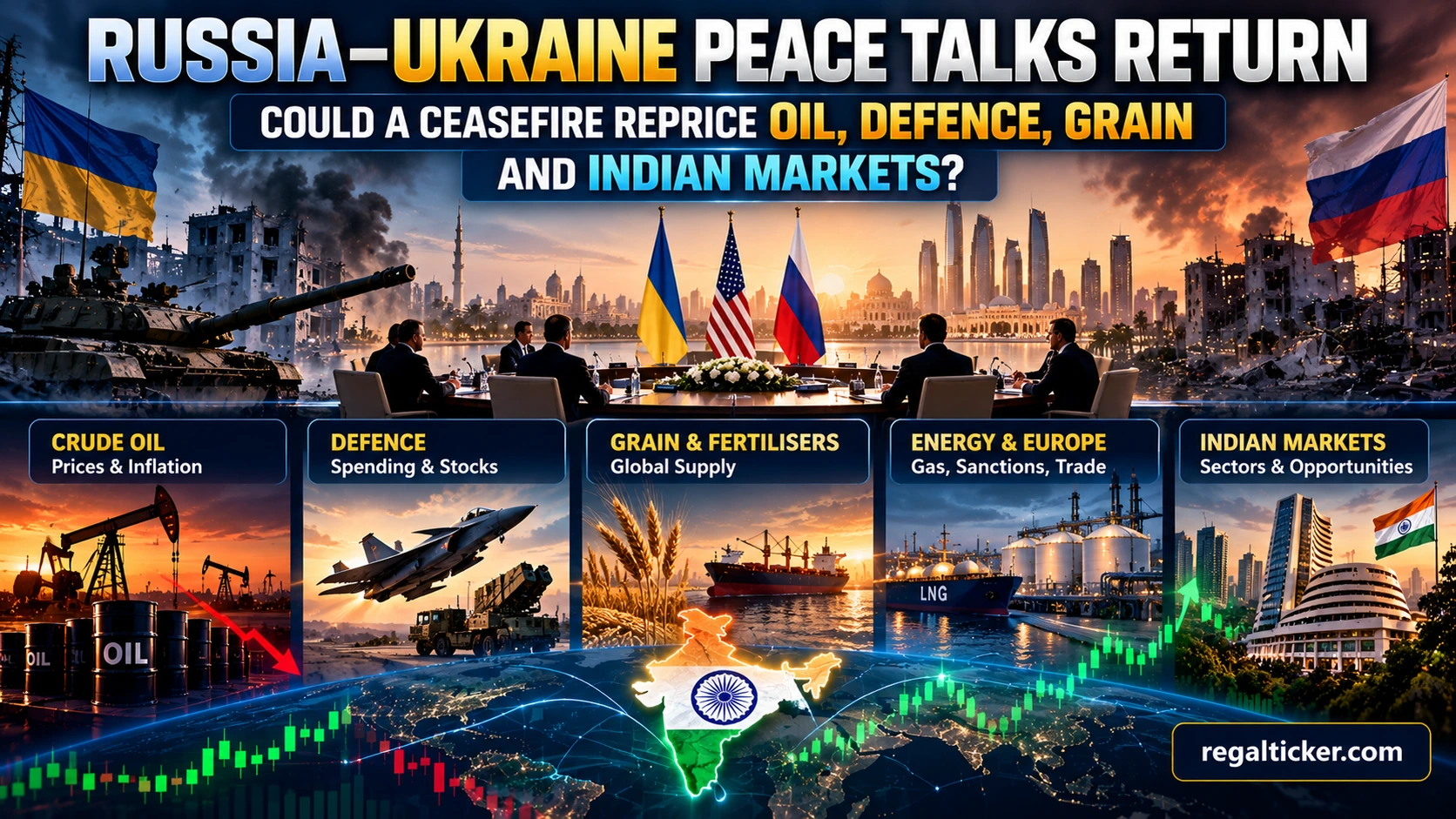
The word “credible” matters. A ceasefire that lasts several days but leaves ports blocked and sanctions unchanged may have little effect on earnings or inflation. A negotiated framework that improves maritime access, reduces attacks on energy infrastructure and changes sanctions enforcement could matter much more.
That is the distinction investors should keep in mind throughout this story.
3. Oil could react—but Ukraine is no longer the only oil war
The most obvious market reaction to a Russia–Ukraine peace breakthrough would be lower energy risk. Russia remains a major producer and exporter, while sanctions and attacks on energy infrastructure have repeatedly affected diesel, crude and refined-product flows.
For India, that matters because energy is one of the largest links between overseas geopolitics and domestic inflation.
But the current oil market makes this more complicated than the usual “peace means cheaper crude” narrative.
Brent settled at about $116.72 a barrel on 23 October, its highest close in nearly six months, after a fresh wave of Middle East supply fears. Houthi attacks on Saudi Arabia, concern around regional energy infrastructure and maritime incidents have been driving prices higher even as the Russia–Ukraine diplomatic track improves.
In other words, there are now at least two major geopolitical risk premia in the oil market.
A Russia–Ukraine ceasefire could remove part of one premium while the Middle East keeps another firmly in place.
That distinction is especially important for Indian investors. Our earlier analysis of the Hormuz shipping shock and Indian stocks explains why the relevant number is not just the headline Brent quote. Freight, insurance, the rupee, crude grades and refinery economics all affect the delivered cost.
A peace breakthrough in Europe would be helpful if it improved Russian supply reliability or reduced refined-product stress. It would not neutralise a separate disruption in the Gulf.
Investor note
Do not trade one geopolitical headline as if it controls the whole oil market
Oil can fall on a Russia–Ukraine peace development and still remain historically expensive if Middle East risk, shipping costs or refinery constraints persist. For Indian companies, the useful question is what happens to the landed energy cost over several procurement cycles—not whether Brent moves sharply for one session.
4. India’s Russian energy relationship makes the outcome unusually relevant
India’s economic relationship with Russia expanded sharply after the war changed global trade flows.
Government data show bilateral trade reached $68.7 billion in FY2024–25, with Indian imports from Russia at $63.8 billion. Crude oil and petroleum products were among the largest components.
The Government of India has also repeatedly said that refiners make crude-purchasing decisions on commercial and techno-economic grounds rather than through a fixed government allocation by country.
That matters under a peace scenario.
If sanctions are eased, shipping becomes simpler or payment friction falls, Russian barrels may become easier to move through the global system. But easier trade does not necessarily mean India receives the same discounts it received during periods when Russian crude had fewer buyers.
The economics could therefore shift in two directions at once:
- global supply conditions may improve;
- but India’s relative bargaining advantage on discounted Russian barrels could narrow.
For refiners, that means the correct analysis is not “peace good” or “peace bad.” Investors have to look at the relationship between crude acquisition costs, product prices, refining margins, freight and inventory.
That company-level approach is more useful than a geopolitical label. Our fundamental-analysis guide explains how to connect an external cost change with margins, cash flow and return on capital rather than stopping at the macro story.
5. Black Sea grain may be the cleaner peace trade
The agricultural channel is arguably more straightforward.
Ukraine’s government said that by 15 October the country had exported about 1.125 million tonnes of agricultural products since the start of the month—roughly half the expected volume for that period. Officials said logistics were operating near their physical limits.
That is a direct war-economy constraint.
Black Sea access matters because Ukraine is a major exporter of grain and oilseeds. When maritime capacity is restricted, more volume has to move through slower or more expensive routes. That affects freight, farm economics and eventually global pricing.
A durable maritime ceasefire could therefore matter even before a full political settlement.
For India, the transmission is not only through wheat prices. India imports edible oils from several countries, including sunflower oil from Russia and Ukraine. Better Black Sea shipping can improve the reliability of those flows and reduce freight pressure even when domestic food policy remains the larger driver of retail prices.
The key evidence to watch would be actual port throughput, insurance conditions and export volumes—not simply diplomatic statements.
If Ukrainian seaborne exports begin to rise consistently, that would tell investors more than another round of optimistic comments from negotiators.
6. Fertiliser is another quiet India connection
Fertiliser receives less attention than oil, but it is a meaningful link between geopolitics, farm costs and public finances.
India has deliberately diversified fertiliser sourcing and signed long-term supply arrangements with several producing countries. Government data for 2025–26 included arrangements for roughly 30.10 lakh tonnes of DAP/NPKs from Russia, alongside large agreements with Saudi Arabia, Morocco and other suppliers.
Those arrangements reduce the risk of depending on one source, but they do not eliminate global price and logistics exposure.
A Russia–Ukraine peace process could help through:
- more predictable shipping;
- lower insurance and freight costs;
- reduced payment friction;
- improved availability of energy-intensive fertiliser products;
- lower uncertainty around Russian exports.
However, fertiliser economics also depend heavily on natural gas, ammonia, phosphate and potash markets. A ceasefire alone cannot determine the final landed cost.
For Indian investors, the larger point is that geopolitical easing can show up in farm-input economics before it becomes obvious in an equity index.
7. Defence stocks are not a simple “peace loser”
Defence is where the headline interpretation is most likely to be wrong.
If a credible peace agreement reduced battlefield urgency, some investors might immediately assume defence stocks should fall. Short-term sentiment could certainly move that way.
But Europe’s rearmament cycle is much bigger than the next ceasefire headline.
The European Defence Agency expects EU member-state defence expenditure to reach about €454 billion in 2026, up from €418 billion in 2025. Defence investment itself is projected near €163 billion. NATO members have also committed to substantially higher long-term defence and security spending.
Those budgets reflect several strategic changes that are unlikely to disappear overnight:
- depleted ammunition inventories;
- drone and counter-drone requirements;
- air-defence gaps;
- maritime security;
- supply-chain resilience;
- the need to rebuild industrial capacity;
- a broader reassessment of European dependence on the United States.
A Russia–Ukraine settlement could change the mix and urgency of procurement. It would not necessarily reverse the whole cycle.
For Indian defence companies, the more relevant questions are order visibility, export opportunities, margins, execution capacity and valuation. A peace headline can change sentiment quickly; long-duration order books move more slowly.
The same principle applies to space and surveillance infrastructure. The war has demonstrated the strategic value of satellites, resilient communications and geospatial intelligence. India’s emerging private-space ecosystem, discussed in our Skyroot, Pixxel and Agnikul feature, sits inside that broader structural trend.
8. What a peace breakthrough could mean for the rupee and Indian equities
The rupee is where several channels converge.
On 23 October, the currency ended near ₹94.94 per U.S. dollar after rising oil prices erased earlier gains. That move illustrates why India’s external balance remains sensitive to energy.
A credible Russia–Ukraine settlement could support the rupee indirectly if it:
- lowers some energy and freight costs;
- improves global risk appetite;
- reduces safe-haven dollar demand;
- eases inflation expectations;
- improves foreign-investor appetite for emerging markets.
But none of those effects is automatic.
If Middle East oil risk remains high, the energy benefit could be modest. If the U.S. dollar strengthens because of interest-rate expectations, currency pressure could persist. If global investors use a peace rally to rotate into Europe rather than emerging markets, India may receive less of the capital-flow benefit than the headline suggests.
That is why an investor should separate the national macro effect from the individual-stock effect.
| Indian exposure | Potential benefit from credible peace | What could offset it |
|---|---|---|
| Airlines | Lower fuel/freight pressure | Middle East crude shock, weak pricing power |
| Paints, tyres, chemicals | Lower oil-linked inputs | Currency weakness, demand slowdown |
| OMCs/refiners | Easier sourcing/logistics | Lower Russian discounts, margin changes |
| Fertiliser/agri inputs | Better supply reliability | Gas and global commodity prices |
| FMCG | Lower freight/input inflation | Weak rural/urban demand |
| Banks | Better inflation/growth mix | Credit cycle and rate changes |
| IT exporters | Better European confidence | Strong rupee, weak tech spending |
| Defence | Less immediate war premium | Structural European/Indian spending remains strong |
| Shipping | Lower risk/insurance costs | Lower crisis freight premiums |
This is a framework, not a prediction of next week’s stock returns.
9. Why a failed negotiation could move markets in the opposite direction
The peace path also creates a new downside risk: disappointment.
Markets often price diplomatic progress before the underlying issues are resolved. If investors begin to expect a ceasefire and the talks then collapse, the reversal can be fast.
The unresolved issues are substantial.
Ukraine is seeking long-term security guarantees and continued military funding. Russia’s territorial objectives remain incompatible with Kyiv’s stated position. Europe wants a role in any durable settlement. Sanctions policy is politically difficult, and attacks on energy infrastructure can quickly destroy confidence.
The practical warning sign would be a gap between diplomacy and behaviour.
If talks are announced while missile attacks intensify, ports remain constrained and energy infrastructure continues to be hit, the economic case for a “peace trade” weakens.
That is why investors should follow verification rather than rhetoric. RegalTicker’s guide on how to verify market news and announcements is useful here even though this is geopolitical news: separate what was formally agreed, what was proposed, what was reported by an unnamed source and what actually changed on the ground.
10. The evidence that would make the peace trade more credible
The next stage should be judged through observable developments.
Stronger evidence
- the Oleshky ceasefire begins on 27 October and holds;
- the early-November technical meeting takes place as planned;
- negotiators establish a mechanism for broader ceasefire monitoring;
- attacks on energy infrastructure decline;
- Black Sea port activity improves;
- sanctions or shipping restrictions are formally changed;
- prisoner exchanges and humanitarian corridors continue;
- leader-level talks become more than an aspiration.
Weaker evidence
- talks are repeatedly delayed;
- the ceasefire breaks immediately;
- battlefield escalation accelerates;
- maritime attacks or port restrictions continue;
- the parties publicly retreat from previously discussed terms;
- territorial demands harden;
- Europe and the U.S. diverge sharply over guarantees or sanctions.
The market impact will depend on which column starts accumulating evidence.
11. What Indian investors should watch next
The first thing to watch is not a defence stock or an oil stock. It is the sequence of evidence.
Start with the ceasefire itself. Does it hold on 27 October? Then watch whether the technical-level meeting happens in early November. After that, observe physical indicators: Black Sea exports, shipping insurance, Russian energy flows and sanctions changes.
For India, four market variables deserve particular attention:
- Brent crude and refined-product prices;
- USD/INR;
- freight and insurance costs;
- sector-level earnings commentary from energy users and producers.
Our Market hub and weekly reviews can help separate those completed-session signals from the geopolitical narrative.
Investors should also be careful with concentration. A geopolitical thesis can be directionally correct while the chosen stock still performs badly because valuation, execution or balance-sheet risk overwhelms the macro benefit. The Risk Management learning path is the better framework for deciding how much exposure a theme deserves.
Investor note
Keep the portfolio record separate from the geopolitical story
A peace agreement, sanctions change or commodity move can alter a company’s outlook without changing your acquisition history. For corporate-action holdings, keep tax-lot records and allocation evidence separately. RegalTicker’s Demerger Cost Basis Calculator is designed for that record-keeping task rather than for predicting market direction.
Frequently asked questions
Have Russia and Ukraine agreed to a full ceasefire?
No. They agreed to a temporary ceasefire around Oleshky beginning 27 October for humanitarian access and civilian evacuation. It is not a nationwide ceasefire.
When are the next Russia–Ukraine peace talks expected?
Technical-level talks involving Ukraine, Russia and the United States are expected during the first half of November 2026, with Abu Dhabi among the proposed venues.
Would peace automatically push crude oil lower?
No. A settlement could reduce some Russia-related risk, but oil is also being driven by separate Middle East supply and shipping risks. Brent closed near $116.72 on 23 October despite the improving Ukraine diplomatic backdrop.
Would Indian refiners benefit from sanctions easing on Russia?
Easier trade could improve supply and logistics, but India could also lose part of the discount advantage that existed when Russian crude had fewer buyers. Refining margins, freight and product prices would still matter.
Could a ceasefire lower food inflation?
Better Black Sea logistics could support grain and edible-oil supply, but Indian food inflation depends on domestic production, weather, policy, inventories and many other global prices. The effect would not be one-for-one.
Are defence stocks likely to fall if peace talks succeed?
Short-term sentiment could weaken, but European and NATO defence spending has become a multi-year strategic programme. Company order books, execution and valuations matter more than one diplomatic headline.
Why does the Russia–Ukraine war matter to Indian fertiliser supply?
India imports significant fertiliser volumes and has long-term supply arrangements with Russia and other producers. War-related logistics, energy costs and payment restrictions can influence availability and landed costs.
What is the main signal investors should watch next?
Whether the local ceasefire holds, whether the early-November talks actually occur, and whether physical trade indicators such as Black Sea exports, energy flows and shipping conditions begin to improve.
Verify through official sources
Official references
- Reuters — Russia and Ukraine agree Oleshky ceasefire and November talks — Details of the local ceasefire, humanitarian corridor and planned technical-level negotiations.
- Reuters — Zelenskiy says negotiators to meet in early November — Details on Abu Dhabi talks, security guarantees and negotiating scope.
- Reuters — Russia–Ukraine diplomatic and military timeline — Context on continuing attacks, sanctions and U.S.–Ukraine tensions.
- Reuters — Brent closes at $116.72 amid Middle East supply risk — Current oil-market context showing why Ukraine peace does not control the whole crude price.
- Reuters — Rupee ends near ₹94.94 as oil pressure returns — India currency context and the transmission from oil to the external balance.
- Ukraine Cabinet of Ministers — Agricultural exports under logistics constraints — Official October export volumes and logistics constraints.
- PIB — India fertilizer availability and long-term import agreements — Official data on Russian and other long-term fertilizer supply arrangements.
- European Defence Agency — EU defence spending projected at €454 billion in 2026 — Evidence that European rearmament is structural and multi-year.
- PIB — India–Russia trade and defence cooperation — Official bilateral trade composition and strategic relationship context.
- Department of Commerce — India crude sourcing is a commercial refiner decision — Government position on commercial crude procurement and diversification.
Final takeaway
Peace would change some prices, not every price
A durable Russia–Ukraine settlement would matter for markets because the war sits inside real flows of energy, grain, fertiliser, shipping and defence spending. India would benefit from lower global logistics and commodity pressure if those improvements actually materialise.
But the clean “peace trade” is already complicated by a second war-driven oil shock in the Middle East and by a European defence build-up that has become strategic rather than temporary.
That leaves Indian investors with a more useful question than “Will peace be bullish?”
Watch whether diplomacy changes physical trade. If ships move more freely, sanctions ease, grain exports recover and energy infrastructure stops being attacked, the economic impact becomes measurable. Until then, the ceasefire is an important development—but still a beginning, not a conclusion.
Educational disclaimer: This article is for education and general information only. It is not investment advice, a trading signal or a recommendation to buy or sell any security. Diplomatic negotiations can change quickly, commodity prices are volatile, and reported proposals may not become agreements. Verify current developments and company disclosures before making financial decisions.


