

⚡ Quick answer
A demerger is a corporate restructuring in which one or more undertakings, businesses, assets and related liabilities of a company are transferred to another company under an approved scheme. Eligible shareholders of the demerged company may receive shares of the resulting company according to a stated entitlement ratio. The investor can therefore end up holding shares in two or more separately valued companies instead of only the original combined business.
Investor note
Key Takeaways
A demerger separates a business undertaking from an existing company. The original company is commonly called the demerged company. The company receiving the transferred undertaking is called the resulting company. Eligible shareholders may receive resulting-company shares according to the approved ratio. The record date identifies investors entitled to receive those shares. A demerger does not automatically create instant wealth. The market value of the original company usually adjusts after the separated business leaves it. The original purchase cost must be allocated between the demerged and resulting-company shares. The company or scheme normally publishes the official cost-allocation percentage. A demerger can unlock value, but it can also create weaker standalone businesses or execution risk. Use the Regal Ticker Demerger Cost Basis Calculator only after verifying the official allocation percentage and entitlement ratio.
A demerger is more complex than a dividend, bonus issue or stock split because it changes the legal and economic structure of the business itself.
This is Lesson 8 in the Regal Ticker Corporate Actions Learning Hub. Review What Are Corporate Actions in the Stock Market? and Corporate Action Dates Explained before analysing a real scheme.
What Is a Demerger?
📖 Definition
Demerger
A demerger is a restructuring in which an undertaking of one company is transferred to another company under a scheme, usually together with the related assets, liabilities, employees, contracts and operations specified in that scheme.
The company transferring the undertaking is the demerged company.
The company receiving it is the resulting company.
Simple Meaning
Imagine a listed company operating two businesses:
- consumer products;
- renewable energy.
Management decides that the two businesses should operate independently.
Under a demerger:
- the renewable-energy undertaking is transferred to another company;
- eligible shareholders of the original company receive shares in the resulting renewable-energy company;
- the original company continues with the consumer-products business;
- both businesses can later be valued and traded separately if the resulting company is listed.
Demerger Under a Scheme of Arrangement
Listed-company demergers are commonly implemented through a scheme of arrangement under Sections 230–232 of the Companies Act, 2013.
The process can involve:
- board approval;
- stock-exchange and SEBI review;
- creditor and shareholder approval;
- National Company Law Tribunal approval;
- effectiveness of the scheme;
- record date;
- share allotment;
- listing of resulting-company shares.
The exact process varies by scheme.

Why Do Companies Demerge Businesses?
Unlock Separate Business Value
A combined company may contain businesses with very different growth rates, margins, capital requirements, risk profiles and valuation multiples. A demerger allows investors to value each business independently.
Improve Management Focus
Separate management teams can focus on their own strategy, capital allocation, operations, hiring and performance goals.
Improve Capital Allocation
A high-growth business and a mature cash-generating business may need different financial policies. After separation, each company can make its own decisions about debt, dividends, expansion, acquisitions and working capital.
Simplify the Corporate Structure
A complex group structure can make it difficult for investors to understand performance. A demerger can create clearer financial reporting.
Prepare a Business for Listing or Strategic Partnership
A company may separate an undertaking before independent listing, strategic investment, merger, joint venture, sale or capital raising.
Separate Risks
A regulated, cyclical or highly leveraged business may be separated from a stable business. This can improve transparency, but risk does not disappear—it is simply placed in a different legal entity.
⚠ Important warning
A demerger does not guarantee value unlocking
The separated businesses still need strong management, cash flow, governance and competitive advantages. Two weak companies do not become strong merely because they are separately listed.
How a Demerger Works
1. Board Approves the Scheme
The board approves a draft scheme describing the undertaking being transferred, assets and liabilities, appointed date, effective date, resulting company, share-entitlement ratio, accounting treatment and approvals required.
2. Valuation and Fairness Review
Independent valuers may recommend the share-entitlement ratio. A fairness opinion may be obtained according to the applicable listed-entity process.
3. Stock-Exchange and SEBI Process
Listed entities submit the draft scheme and required disclosures to the designated stock exchange. The scheme can be reviewed under the applicable SEBI and listing framework.
4. Shareholder and Creditor Approval
The NCLT may direct meetings or voting for affected members and creditors.
5. NCLT Sanction
The National Company Law Tribunal considers the scheme. After sanction and filing of the order, the scheme can proceed toward effectiveness subject to its conditions.
6. Effective Date
The scheme becomes effective after the stated conditions are met and required filings are completed. The appointed date and effective date can be different.
7. Record Date
The company fixes a record date to identify eligible shareholders. Only eligible holders receive the resulting-company shares under the scheme.
8. Allotment and Credit
The resulting company allots shares according to the entitlement ratio. The shares are credited to eligible demat accounts.
9. Listing and Trading
If the resulting company is to be listed, trading begins only after the necessary approvals and exchange notice. There may be a gap between credit and active trading.
Caution
Credit Does Not Always Mean Immediate Trading
Resulting-company shares can appear in the Demat account before exchange trading begins. Verify the official listing notice instead of assuming the shares can be sold immediately.
Demerger Share Entitlement Ratio
The entitlement ratio states how many resulting-company shares an eligible investor receives for a specified number of demerged-company shares.
Entitlement Formula
FORMULA: Resulting-company shares = Eligible demerged-company shares × New shares in ratio ÷ Existing shares in ratio
💡 Real example
Simple example
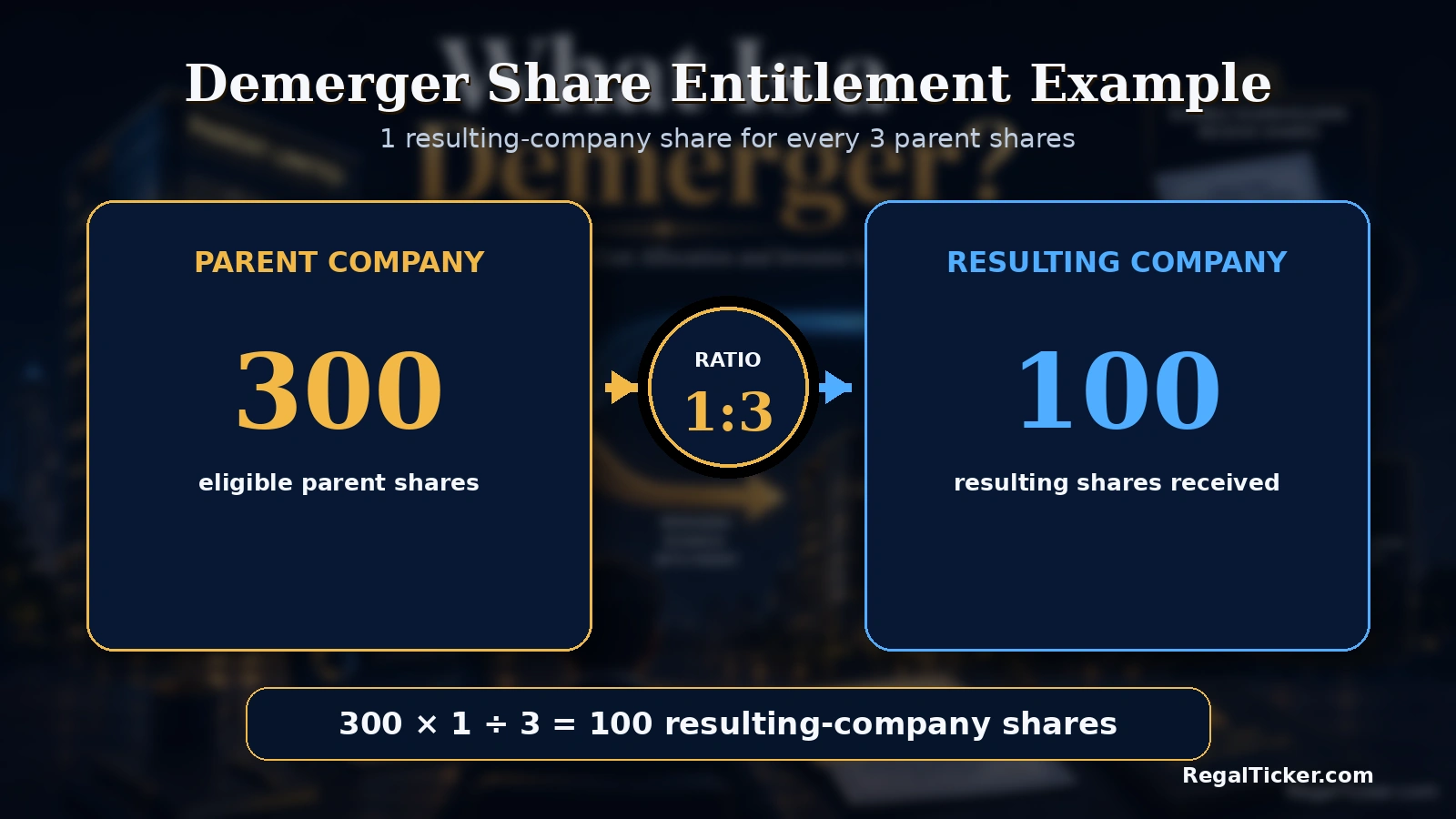
Eligible parent shares = 300 Entitlement ratio = 1:3
Resulting-company shares = 300 × 1 ÷ 3 = 100 shares
Fractional Entitlements
An investor may not hold an exact multiple of the entitlement ratio. The scheme may provide for aggregation of fractions, sale by a trustee, cash distribution, rounding or another specified treatment. Never assume fractional treatment.
What Happens to the Original Company’s Share Price?
The original company no longer owns the transferred undertaking after the demerger becomes effective. Its market value therefore normally adjusts.
FORMULA: Post-demerger value of original company + Value of resulting company ≈ Pre-demerger combined value
This is only a theoretical starting point. Actual trading depends on investor demand, debt allocation, earnings outlook, management quality, sector valuations and market conditions.
Does a Demerger Create Free Shares?
The investor may receive resulting-company shares without making a fresh payment. However, they are not economically free.
Part of the value that previously existed inside the original company has moved into another company. That is why the original share price may adjust and the original purchase cost must be divided.
⚠ Important warning
More securities do not automatically mean more wealth
After a demerger, you may hold two securities instead of one. Judge the combined value, cost basis and future business performance—not only the number of shares.
Cost Basis After a Demerger
Cost allocation is one of the most important investor tasks after a demerger.
The original purchase cost of the demerged-company shares must be divided between the continuing demerged-company holding and the resulting-company shares received.
Official Allocation Percentage
The company often publishes a cost-allocation communication after the scheme.
For example:
- 78% of original cost allocated to the demerged company;
- 22% allocated to the resulting company.
Investors should use the official percentage, not estimate it from the first trading price.
Cost Allocation Formula
FORMULA: Cost allocated to resulting company = Original total cost × Official resulting-company allocation percentage
FORMULA: Cost retained in demerged company = Original total cost − Cost allocated to resulting company
Worked Cost-Basis Example
Suppose an investor bought 300 parent-company shares at ₹800 per share. Total original cost is ₹2,40,000.
The company publishes:
- resulting-company allocation: 22%;
- demerged-company allocation: 78%.
FORMULA: Resulting-company cost = ₹2,40,000 × 22% = ₹52,800
FORMULA: Demerged-company cost = ₹2,40,000 × 78% = ₹1,87,200
If the investor receives 100 resulting-company shares:
FORMULA: Cost per resulting-company share = ₹52,800 ÷ 100 = ₹528
FORMULA: Adjusted cost per continuing parent share = ₹1,87,200 ÷ 300 = ₹624
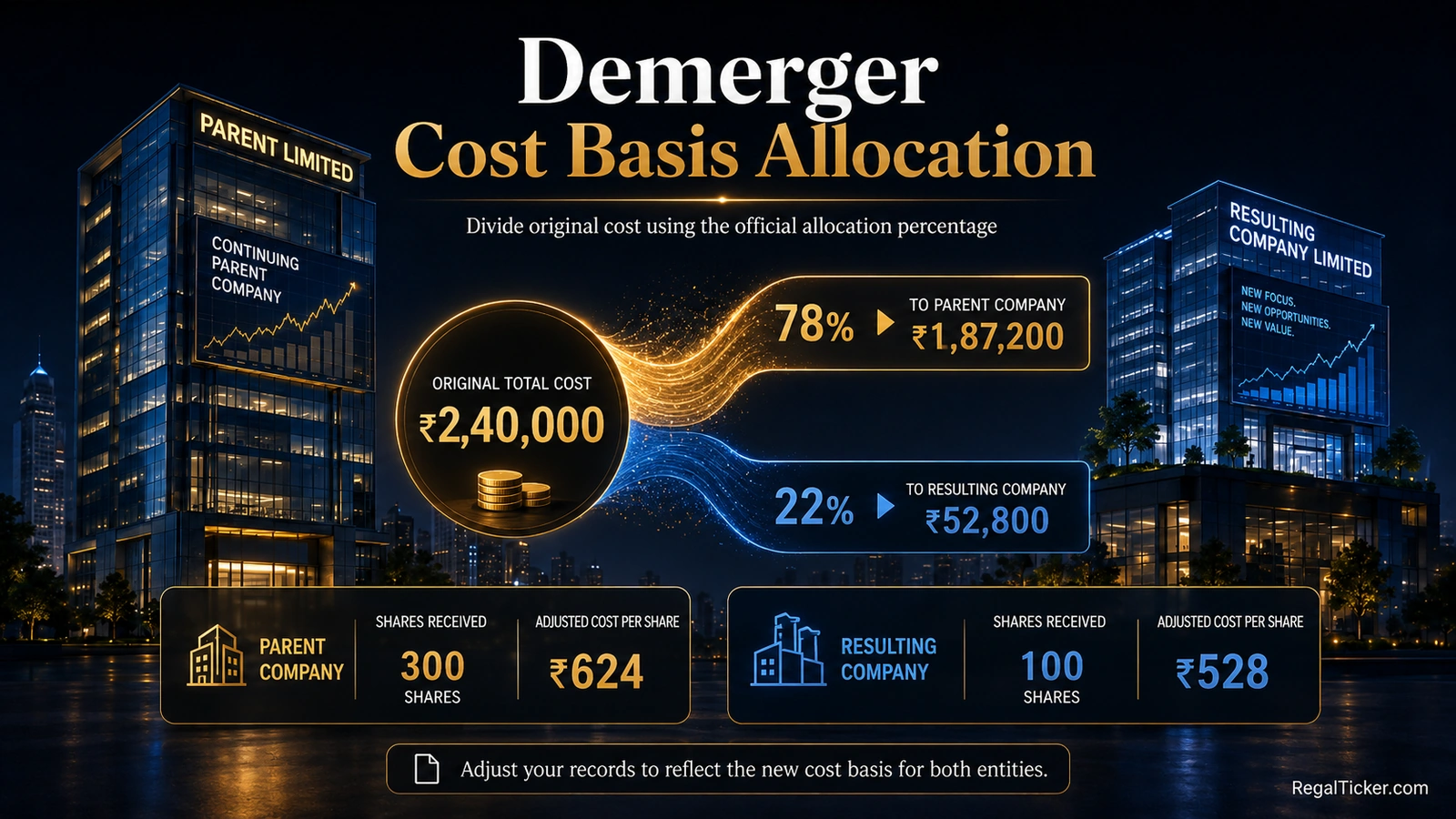
| Holding | Quantity | Allocated total cost | Adjusted cost per share |
|---|---|---|---|
| Demerged company | 300 shares | ₹1,87,200 | ₹624 |
| Resulting company | 100 shares | ₹52,800 | ₹528 |
| Combined | — | ₹2,40,000 | — |
Use the calculator
Calculate Your Demerger Cost Basis
Once the company publishes the official cost-allocation percentage and share-entitlement ratio, use the Regal Ticker Demerger Cost Basis Calculator to divide your original acquisition cost between the continuing demerged-company shares and the resulting-company shares. Do not estimate the allocation from listing-day or current market prices.
Holding Period and Tax Treatment
Under the Income-tax Act, 2025, a qualifying demerger can receive tax-neutral treatment when the statutory conditions are satisfied. Section 70 covers specified demerger transactions that are not regarded as transfers, including the issue or transfer of shares by the resulting company to shareholders of the demerged company as consideration for the demerger. For the investor’s later capital-gains calculation, Section 73 allocates part of the original cost of the demerged-company shares to the resulting-company shares based on the net book value of assets transferred relative to the net worth of the demerged company immediately before the demerger; the remaining cost continues with the original shares. Actual tax treatment depends on the scheme and the investor’s facts, so use the company’s official cost-allocation communication and current tax rules rather than relying only on a broker’s displayed average price.
The practical investor records should include original purchase date, original quantity, original total cost, entitlement ratio, resulting-company quantity, official allocation percentage and adjusted cost per holding.
Investor note
Preserve the Scheme and Company Tax Communication
Do not rely only on the broker’s average price. Keep the company’s cost-allocation communication, scheme document, Demat statement and original contract notes for future cost-basis and tax records.
What Happens in the Demat Account?
After allotment, the investor may see original-company shares continuing under the existing ISIN and resulting-company shares under a new ISIN.
The broker may show zero cost for resulting-company shares or retain the full original cost under the parent. The investor should compare the broker display with the official allocation.
Demerger vs Other Corporate Actions

| Point | Demerger | Stock split | Bonus shares | Business sale |
|---|---|---|---|---|
| Corporate structure changes | Yes | No | No | Possibly |
| New company shares may be received | Yes | No | Additional shares in same company | Usually no |
| Fresh investor payment | Usually no | No | No | No |
| Face value changes | Not necessarily | Yes | Usually no | No |
| Original business value moves | Yes | No | No | Business is sold for consideration |
| Cost allocation needed | Yes | Adjust existing cost per share | Adjust cost over larger quantity | Usually not in the same way |
| Investor may hold two listed companies | Yes | No | No | Not automatically |
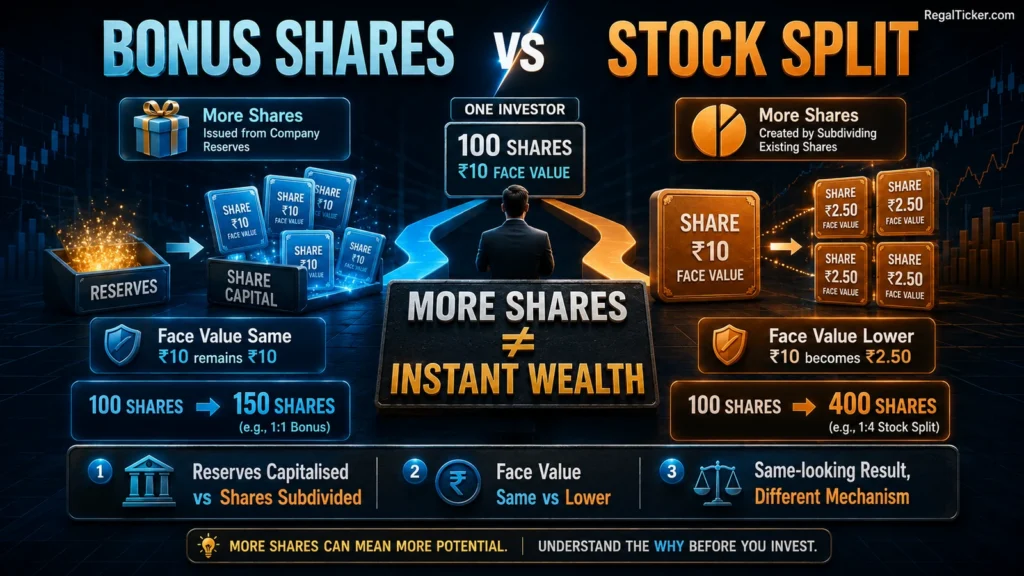
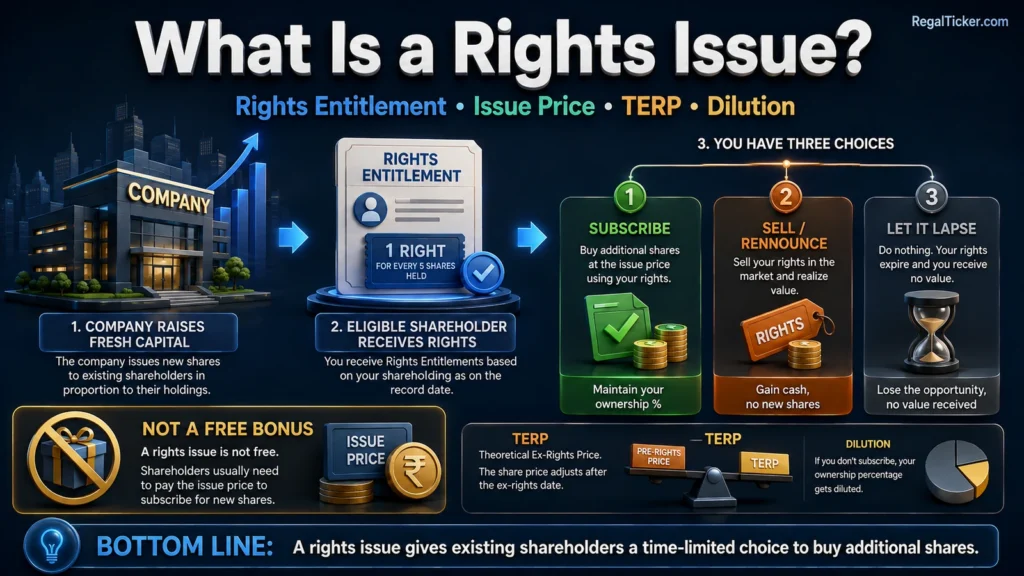
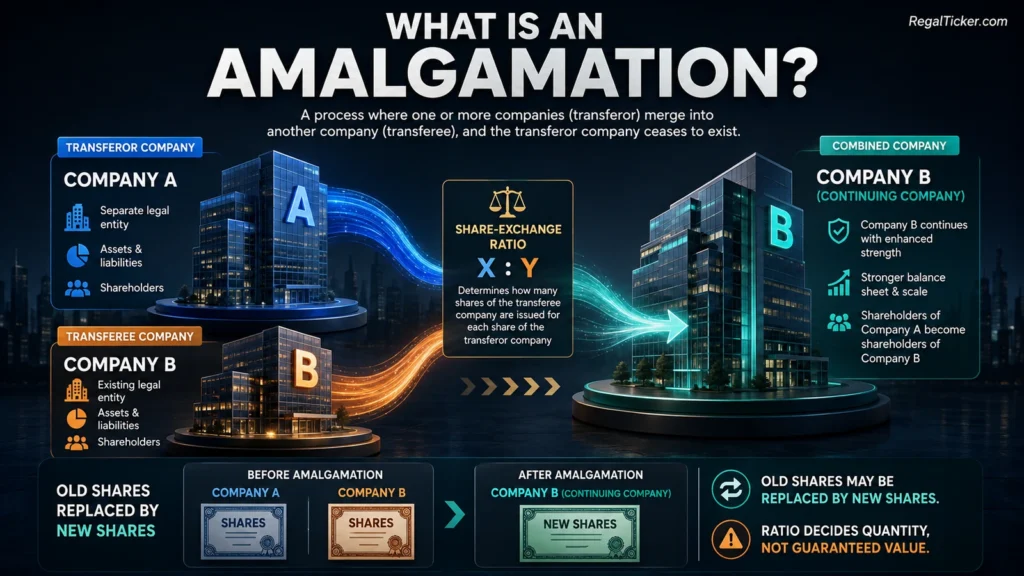
A demerger and an amalgamation move in opposite structural directions. A demerger separates an undertaking into another company, while an amalgamation combines companies or businesses under one continuing structure. Both can change what appears in an investor’s Demat account, but an amalgamation commonly replaces old shares using a share-exchange ratio. For the complete investor explanation, read What Is an Amalgamation? Meaning, Share-Exchange Ratio, Accounting, Tax and Examples.
Demerger vs Stock Split
A stock split divides existing shares into more shares of the same company. A demerger separates a business and may give shares of another company.
Demerger vs Bonus Shares
Bonus shares increase the share count in the same company. A demerger can create a separate resulting-company holding.
Demerger vs Business Sale
In a business sale, the company receives consideration for selling the undertaking. Shareholders do not automatically receive shares in the buyer.
Advantages of a Demerger
Potential advantages include clearer business focus, separate management accountability, independent capital allocation, better investor transparency, sector-specific valuation and strategic flexibility.
Risks of a Demerger
Execution Risk
The separation can involve complex systems, contracts, employees and financing.
Duplicate Costs
Two standalone companies may each need management, boards, compliance, technology and finance teams.
Weak Standalone Economics
A business that benefited from group support may struggle alone.
Debt Allocation Risk
The scheme may assign more debt to one entity.
Listing and Liquidity Risk
The resulting company may face delayed listing, low liquidity and volatile price discovery.
Cost-Basis Errors
Incorrect allocation can distort returns and taxes.
⚠ Important warning
Analyse both companies after the separation
Do not judge the scheme only by the original company’s story. Study the balance sheet, management, debt, cash flow and valuation of each standalone entity.
How to Evaluate a Demerger
1. Identify the Undertaking Being Transferred
Understand its revenue, profit, assets, liabilities, employees and growth prospects.
2. Study the Entitlement Ratio
Check the valuation report, fairness opinion and explanatory statement.
3. Review Debt and Cash Allocation
A demerger can look attractive until one entity receives excessive debt.
4. Check Related-Party Arrangements
Look for brand licensing, shared services, supply agreements, loans and guarantees.
5. Estimate Standalone Earnings
Ask what each company may earn after removing inter-company support and costs.
6. Track the Record Date and Listing Date
Eligibility and tradability are separate events.
7. Save the Official Cost Allocation
This is essential for portfolio and tax records.
Regal Ticker Demerger Workflow
Step 1: Read the Scheme
Identify the demerged company, resulting company, undertaking, entitlement ratio, effective date, record date and fractional treatment.
Step 2: Confirm Eligible Quantity
Use the demat holding on the applicable record date.
Step 3: Calculate Resulting Shares
Apply the entitlement ratio.
Step 4: Wait for Official Cost Allocation
Do not invent the percentage.
Step 5: Use the Calculator
Open the Demerger Cost Basis Calculator.
Step 6: Verify Demat Credit
Confirm the resulting-company quantity.
Step 7: Track Listing Approval
Do not assume immediate trading.
Step 8: Update Portfolio Records
Allocate the original cost between both holdings.
Step 9: Evaluate Each Business Separately
Do not keep both holdings automatically.
Common Demerger Mistakes
Mistake 1: Calling Resulting-Company Shares Free
The value came from the original combined business.
Mistake 2: Ignoring the Parent-Share Price Adjustment
The original company loses the transferred undertaking.
Mistake 3: Using the First Trading Price for Cost Allocation
Use the official allocation percentage.
Mistake 4: Assuming Credit Means Immediate Listing
Trading can begin later.
Mistake 5: Ignoring Fractional Treatment
The scheme controls fractions.
Mistake 6: Keeping the Full Original Cost Under the Parent
The cost must be divided.
Mistake 7: Trusting the Broker Display Without Checking
Broker cost fields can be incomplete.
Mistake 8: Ignoring Debt Allocation
Standalone debt can change the investment case.
Demerger Investor Checklist
Before and after a demerger, verify the undertaking being transferred, the entitlement ratio, record date, effective date, fractional treatment, allotment date, listing date, debt allocation, official cost allocation and broker update.
Conclusion
A demerger separates an undertaking from an existing company and transfers it to a resulting company under an approved scheme.
For investors, the important steps are to verify eligibility, apply the share-entitlement ratio, track demat credit and listing, understand the value adjustment, allocate original cost correctly and evaluate each standalone business.
Use the Regal Ticker Demerger Cost Basis Calculator only after obtaining the official ratio and cost-allocation percentage.
Frequently asked questions
What does a 1:3 demerger ratio mean?
It means an eligible shareholder receives one share of the resulting company for every three eligible shares held in the demerged company, subject to the final scheme and fractional-entitlement rules.
How is the original share cost divided after a demerger?
The original acquisition cost is allocated between the demerged-company shares and resulting-company shares using the official cost-allocation percentage applicable to the scheme. Investors should use the company’s official communication rather than the first trading price or a broker’s temporary average cost.
Why can resulting-company shares appear in Demat before they can be sold?
Share credit and exchange listing are separate events. The shares may reach the Demat account before the resulting company receives final listing and trading approval, so investors should verify the official exchange notice.
Does receiving shares in a demerger automatically create profit?
No. Part of the economic value that was previously inside the combined company moves to the resulting company. The original company’s market value can adjust, and the eventual investment outcome depends on the value, debt, earnings and performance of both standalone businesses.
Verify through official sources
Official references
- India Code — Companies Act, 2013, Sections 230–232 — statutory framework for compromises, arrangements, mergers and demergers.
- SEBI — Master Circular for LODR Compliance, January 30, 2026 — current consolidated listed-company compliance framework relevant to schemes of arrangement.
- NSE India — Corporate Filings: Scheme Documents — verify the actual company scheme, complaint reports, observation letters and implementation disclosures.
- Income Tax Department — Income-tax Act, 2025, Section 70 — current provisions covering specified demerger transactions that are not regarded as transfers when statutory conditions are satisfied.
- Income Tax Department — Income-tax Act, 2025, Section 73 — current cost-of-acquisition rules for shares received in the resulting company and the corresponding cost remaining with the demerged-company shares.
- Regal Ticker — Demerger Cost Basis Calculator — calculate the cost allocation only after confirming the official entitlement and cost-allocation inputs.
Educational disclaimer: This article is for investor education and general information only. It is not investment, legal, accounting or tax advice. Demerger ratios, cost-allocation methods, tax treatment, record dates, listing dates and fractional-entitlement rules vary by scheme. Always verify the approved scheme, company filings, stock-exchange notices, official cost-allocation communication and current tax law before taking action.