
⚡ Quick answer
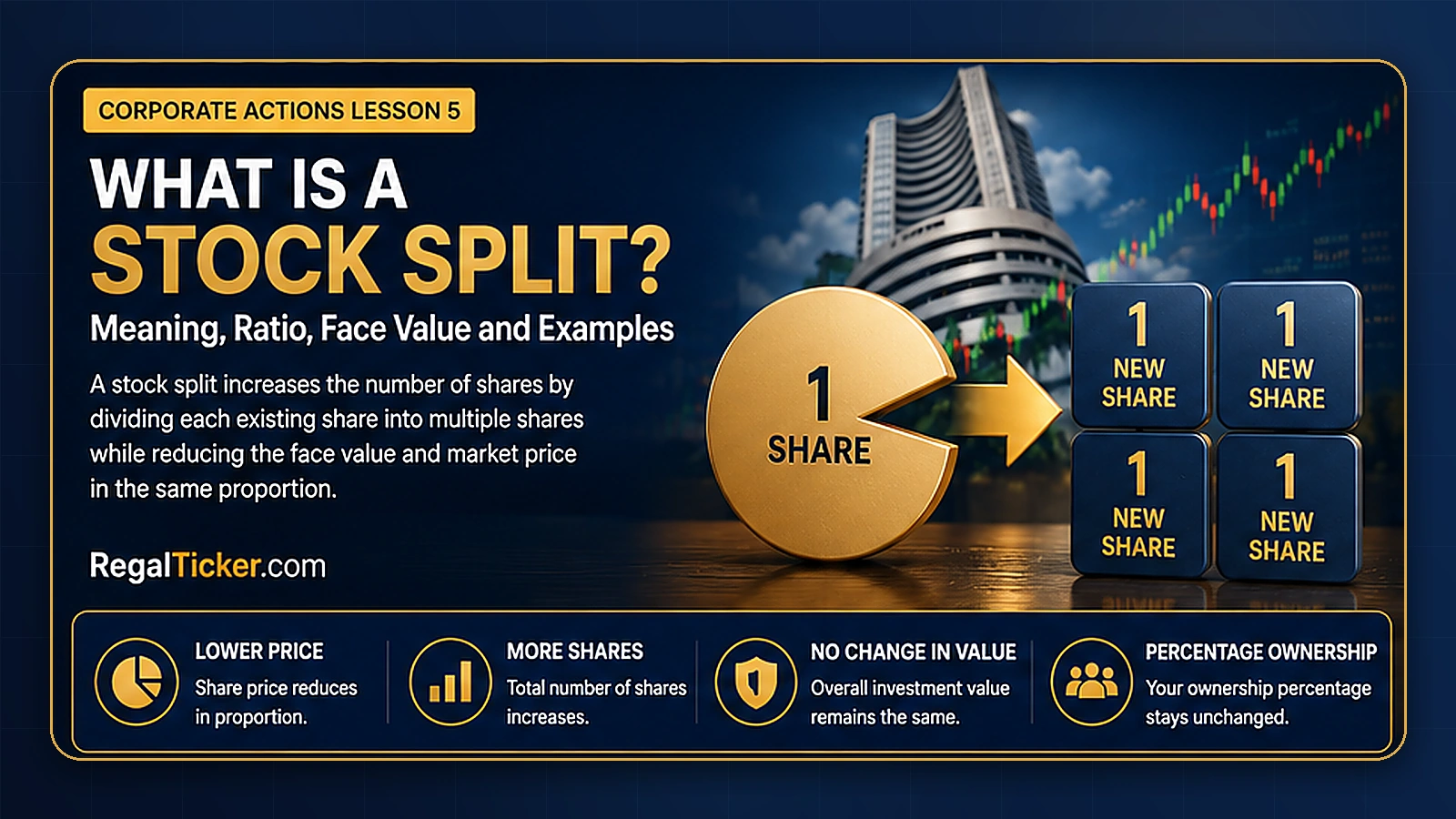
A stock split is a corporate action in which a company subdivides each existing share into a larger number of lower-face-value shares. In a 2:1 split, one share becomes two; in a 5:1 split, one share becomes five. The investor’s proportional ownership does not increase merely because the number of shares rises. The market price, face value, earnings per share and other per-share figures normally adjust to reflect the larger share count.
Key takeaways
A stock split increases the number of shares while reducing the face value per share in the announced ratio.
A 2-for-1 split doubles the share count; a 5-for-1 split multiplies it by five.
If face value changes from ₹10 to ₹2, each old share becomes five new ₹2 face-value shares.
The theoretical market price adjusts proportionately after the split, so the action does not create instant wealth.
Your percentage ownership normally remains unchanged because every eligible share is adjusted using the same split factor.
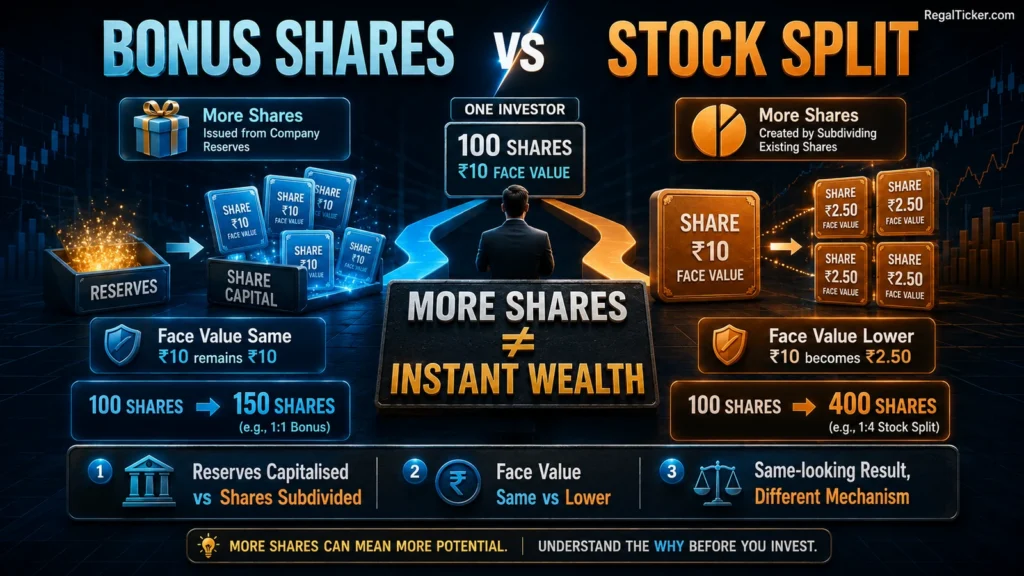
A stock split is different from a bonus issue: a split subdivides existing shares, while a bonus issue creates additional shares by capitalising eligible reserves.
Your total acquisition cost normally remains the same, but that cost is spread across the larger number of post-split shares.
Always verify the official face-value change, ex-date and record date before calculating the adjusted share count or cost per share.
Use the Stock Split Calculator for a single split and the Bonus & Split Adjusted Return Calculator when a holding has undergone multiple corporate actions.
What Is a Stock Split?
📖 Definition
Stock Split
A stock split is a subdivision of existing shares into a larger number of shares with a proportionately lower face value. The company’s total share capital is divided into smaller units. Existing shareholders receive the adjusted number of shares according to the announced ratio.
India’s Companies Act allows a limited company, subject to its constitutional documents and required approval, to sub-divide shares into shares of a smaller amount while preserving the same proportion between paid and unpaid amounts.
Simple Meaning
Suppose a company has one equity share with a face value of ₹10.
If it announces a 5:1 stock split:
- one existing share becomes five shares;
- face value per share becomes ₹2;
- the total face value represented by the original holding remains ₹10;
- the shareholder’s ownership percentage normally remains unchanged.
The split changes the unit size, not the underlying business.
Want to check your own split quickly? Enter your pre-split shares and the company’s old and new face values in the Stock Split Calculator to calculate the revised share quantity, theoretical adjusted price and comparable cost per share.
Stock Split Formula
FORMULA: New number of shares = Existing shares × Split factor
FORMULA: New face value per share = Old face value ÷ Split factor
FORMULA: Theoretical adjusted market price = Pre-split market price ÷ Split factor
💡 Real example
Simple example
Existing shares = 100 Split ratio = 5:1 Old face value = ₹10 Pre-split market price = ₹1,250
New shares = 100 × 5 = 500 shares
New face value = ₹10 ÷ 5 = ₹2
Theoretical adjusted price = ₹1,250 ÷ 5 = ₹250
The investor now holds 500 shares instead of 100, but the theoretical total market value remains around ₹1,25,000 before considering normal market movement.
Calculate the Split Impact
- Open the RegalTicker Stock Split Calculator.
- Enter the number of shares held before the split.
- Enter the old and new face values or the announced split ratio.
- Review the new share quantity.
- Check the theoretical adjusted market price.
- Verify the official record date and company announcement separately.
The calculator performs the arithmetic. It cannot confirm eligibility or predict the actual market price after trading resumes.
Why Do Companies Split Their Shares?
A company may split its shares for practical market reasons.
Make the Per-Share Price More Accessible
A very high quoted price can discourage smaller investors even though fractional ownership is economically possible through the market price.
A split reduces the quoted price per share. The company may believe that the lower price improves accessibility or market participation.
Improve Trading Liquidity
A larger number of lower-priced shares may improve:
- trading activity;
- order-book depth;
- participation by smaller investors;
- ease of buying or selling round quantities.
Improved liquidity is possible, not guaranteed. Business quality, public shareholding, market interest and overall conditions still matter.
Bring the Face Value to a Different Denomination
In India, companies commonly describe a split as a change such as:
- ₹10 face value to ₹5;
- ₹10 face value to ₹2;
- ₹10 face value to ₹1;
- ₹5 face value to ₹1.
The face value is an accounting and legal denomination. It should not be confused with the market price.
Signal Management’s View of Market Accessibility
Management may believe that a lower market price creates a more practical trading range.
However, a split announcement does not prove that the share is undervalued or that future returns will be positive.
⚠ Important warning
A lower post-split price does not mean the share became cheaper
Valuation depends on the business, earnings, cash flow, debt, growth and market expectations. A ₹500 share after a 2:1 split can represent the same economic value as a ₹1,000 share before the split.
Common Stock Split Ratios
A split ratio describes how many new shares replace each old share.
| Split ratio | Meaning | Example with 100 old shares |
|---|---|---|
| 2:1 | One old share becomes two shares | 200 shares |
| 5:1 | One old share becomes five shares | 500 shares |
| 10:1 | One old share becomes ten shares | 1,000 shares |
| 1:2 consolidation | Two old shares become one share | 50 shares |
| 1:5 consolidation | Five old shares become one share | 20 shares |
Forward Stock Split
A forward split increases the number of shares and reduces face value per share.
Examples include:
- 2:1;
- 5:1;
- 10:1.
Share Consolidation or Reverse Split
A consolidation combines several existing shares into a smaller number of higher-face-value shares.
For example, in a 1:5 consolidation:
- five old shares become one new share;
- face value per share increases proportionately;
- total face-value capital represented by the holding remains broadly unchanged;
- fractional entitlements may require special treatment under the official terms.
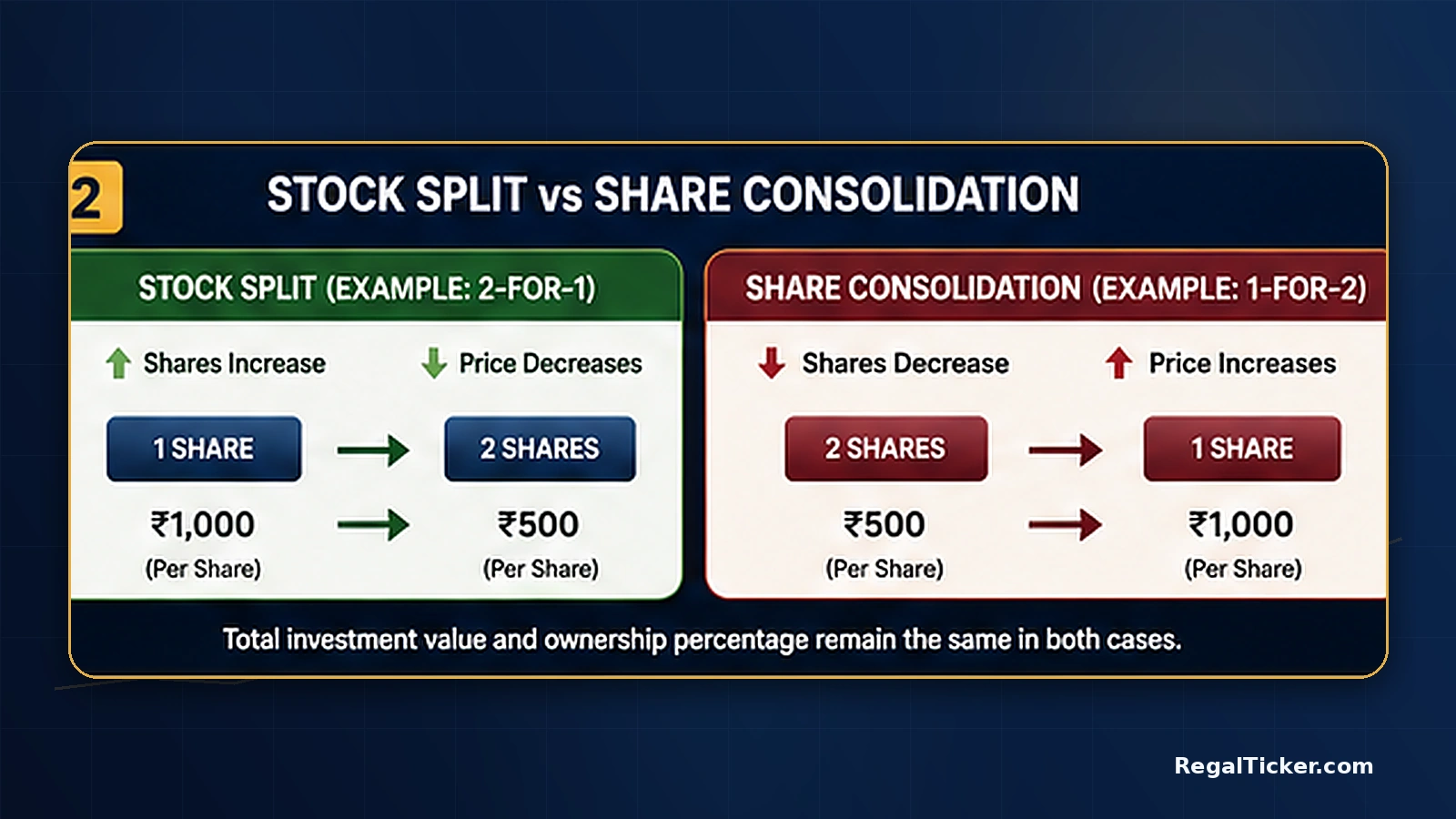
Consolidation and subdivision are opposite actions
A subdivision creates more smaller-denomination shares. A consolidation creates fewer larger-denomination shares. The official company resolution and exchange filing determine the exact ratio and treatment of fractions.
How a Stock Split Affects Your Investment
A split changes several per-share numbers while leaving other economic relationships broadly unchanged.
Share Quantity Increases
Your demat quantity is multiplied by the split factor.
A holder of 80 shares in a 5:1 split receives an adjusted total of:
80 × 5 = 400 shares
Face Value Decreases
If the old face value is ₹10 and the split ratio is 5:1:
₹10 ÷ 5 = ₹2 face value per new share
Market Price Normally Adjusts
If the market price before a 5:1 split is ₹1,500, the simple theoretical adjusted price is:
₹1,500 ÷ 5 = ₹300
The actual market price can differ because of demand, supply, market conditions, company news and normal volatility.
Market Capitalisation Does Not Rise Merely Because of the Split
FORMULA: Market capitalisation = Number of shares outstanding × Market price per share
When quantity rises and price adjusts proportionately, the theoretical market capitalisation remains similar.
A split can influence liquidity or investor attention, but it does not independently create operating profit or business value.
Ownership Percentage Normally Remains the Same
If you own 1% of the company before the split, you normally continue to own 1% after all shares are adjusted in the same ratio.
Earnings Per Share and Book Value Per Share Adjust
When the number of shares increases, per-share figures are recalculated.
A simplified illustration:
- earnings before split = ₹100 crore;
- shares before split = 1 crore;
- EPS before split = ₹100;
- 5:1 split increases shares to 5 crore;
- adjusted EPS = ₹20.
Total earnings remain ₹100 crore. Only the amount assigned to each share changes.
⭐ Pro tip
Compare historical charts and ratios on an adjusted basis
Data providers often adjust old prices, EPS and other per-share figures after a split. When comparing old annual reports or screenshots, confirm whether the figures are adjusted or unadjusted.
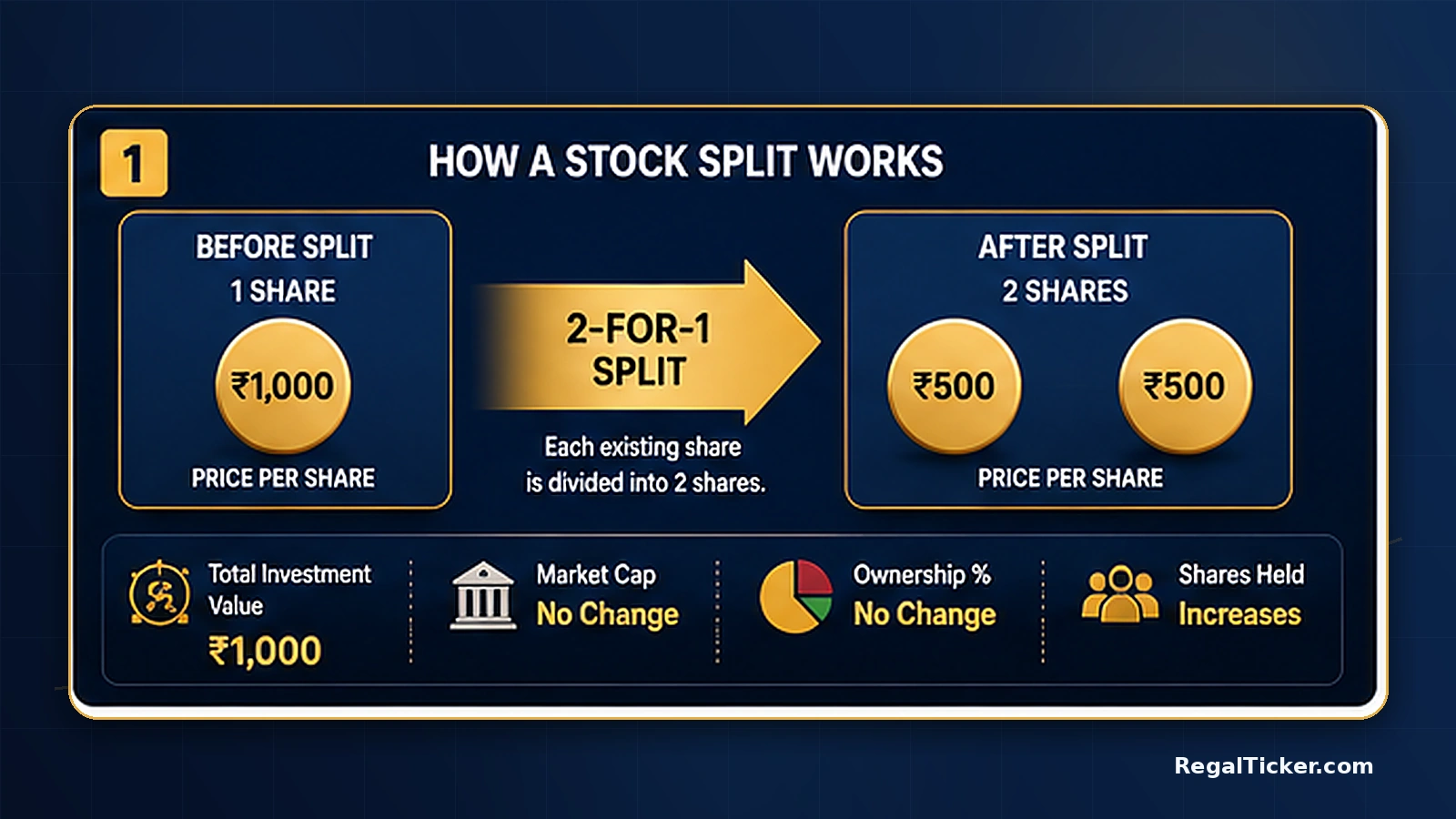
Worked Example: 2:1 Stock Split
Suppose an investor holds 100 shares.
Before the split:
- shares held: 100;
- market price per share: ₹1,000;
- face value per share: ₹10;
- total market value: ₹1,00,000.
The company announces a 2:1 split, meaning each old share becomes two new shares.
After the split:
- shares held: 200;
- theoretical price per share: ₹500;
- face value per share: ₹5;
- theoretical total market value: ₹1,00,000.
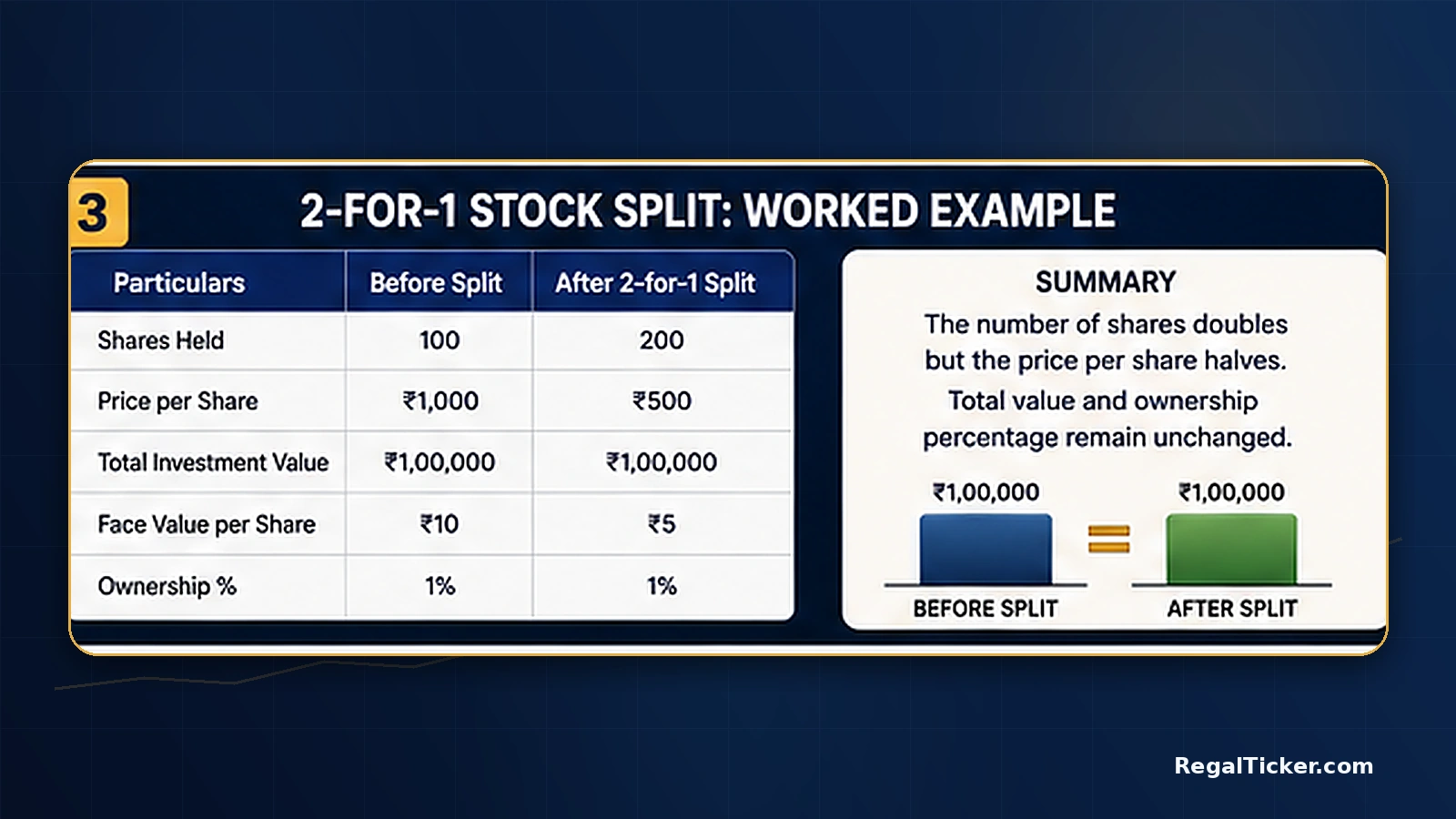
| Measure | Before 2:1 split | After 2:1 split |
|---|---|---|
| Shares held | 100 | 200 |
| Face value per share | ₹10 | ₹5 |
| Theoretical market price | ₹1,000 | ₹500 |
| Theoretical total market value | ₹1,00,000 | ₹1,00,000 |
| Ownership percentage | Unchanged | Unchanged |
Why the Actual Value Can Differ
The theoretical example assumes no other market movement.
The actual price can change because of:
- broader market direction;
- company results;
- investor expectations;
- liquidity;
- news released around the split;
- demand and supply;
- speculative interest.
A split does not guarantee a price rise after adjustment.
Stock Split vs Bonus Shares
A stock split and a bonus issue can both increase the number of shares, but the mechanism is different.
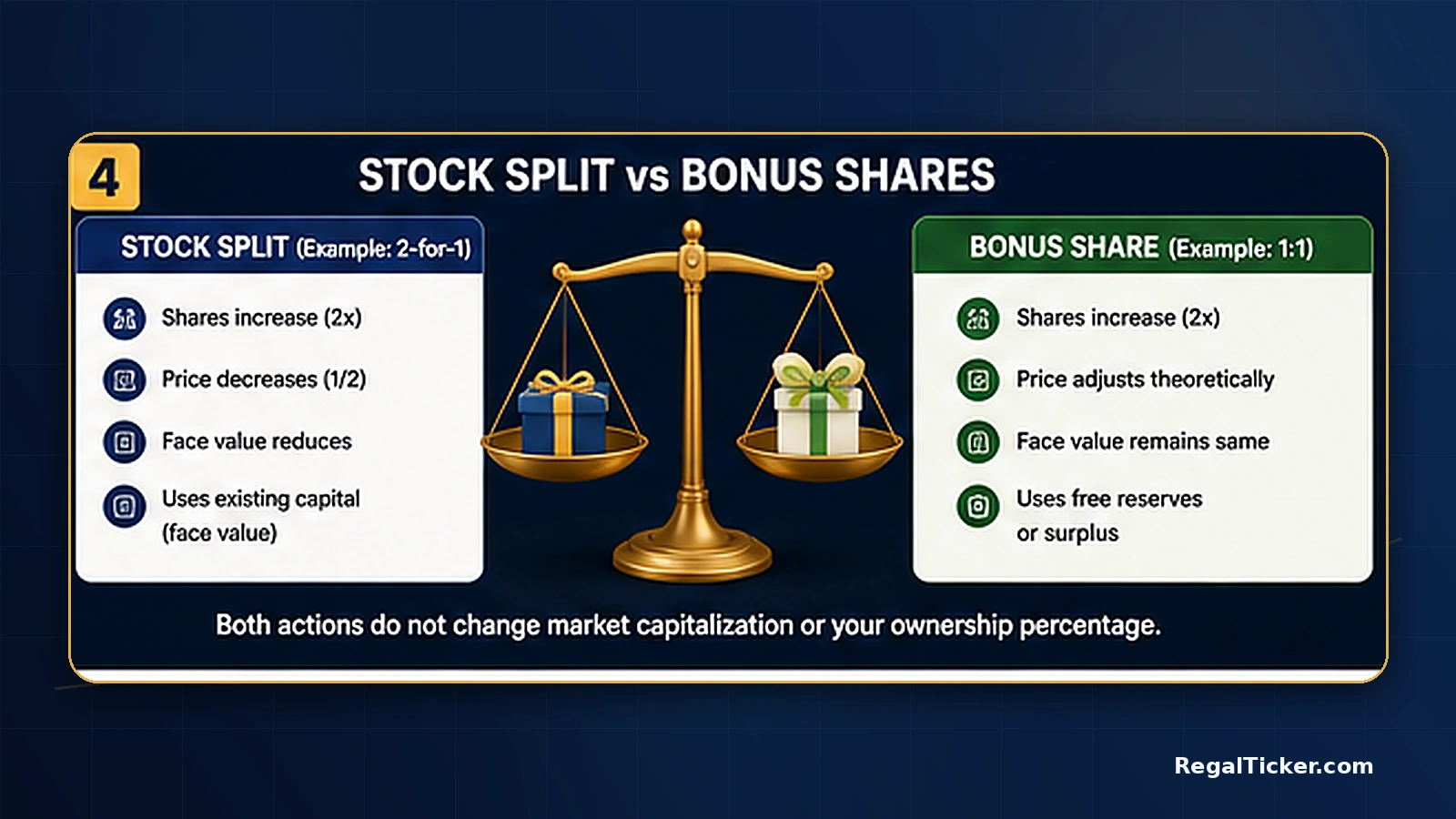
| Point | Stock split | Bonus shares |
|---|---|---|
| Basic mechanism | Existing shares are subdivided | Additional shares are issued |
| Face value | Changes proportionately | Usually remains unchanged |
| Reserves | Not capitalised merely because of the split | Reserves are capitalised |
| Paid-up share capital | Broadly unchanged | Increases |
| Share count | Increases | Increases |
| Immediate cash payment by investor | No | No |
| Economic value created automatically | No | No |
| Primary RegalTicker tool | Stock Split Calculator | Bonus Share Calculator |
A stock split and a bonus issue can produce a similar-looking increase in share count, but the mechanism is different. A stock split subdivides existing shares and reduces face value proportionately, while a bonus issue creates additional shares by capitalising eligible reserves and normally keeps face value unchanged. For a complete side-by-side 1:1 bonus vs 2-for-1 split example, read Bonus Shares vs Stock Split: Differences, Examples and Investor Impact.
Stock Split vs Dividend
A split does not distribute cash.
A dividend transfers cash or another declared benefit to eligible shareholders. Read What Is a Dividend? and use the Dividend Calculator for dividend-specific calculations.
Important Dates in a Stock Split
A split follows a formal corporate-action process.
Board or Company Approval
The company approves or proposes the subdivision according to its governance and legal requirements.
Shareholder Approval, Where Required
The proposal may require shareholder approval and alteration of the company’s constitutional documents.
Exchange Announcement
The company discloses:
- split ratio;
- old and new face value;
- approvals;
- record date;
- implementation details;
- treatment of physical or dematerialised holdings;
- any special terms.
Record Date and Ex-Date
The record date identifies eligible shareholders for adjustment.
The exchange publishes the ex-date and corporate-action information. Investors should verify the official filing because dates can be revised.
Credit and Trading of Adjusted Shares
Depository, registrar, exchange and company systems process the adjusted quantity.
The investor should check:
- demat balance;
- broker portfolio quantity;
- adjusted average cost display;
- corporate-action statement;
- official trading notice.
Read Announcement Date, Ex-Date, Record Date and Payment Date Explained for the complete date framework.
⚠ Important warning
Do not assume the broker display updates instantly
Portfolio quantity, average price and historical returns can temporarily appear unusual during processing. Verify the demat or depository record and official corporate-action notice before concluding that shares are missing.
What Happens in Your Demat Account?
A stock split is normally processed automatically for eligible dematerialised holdings.
The old quantity is adjusted and the new quantity appears according to the announced ratio.
Investors should retain:
- the company announcement;
- record-date notice;
- depository statement;
- broker statement;
- contract notes for original purchases;
- tax and cost records.
The broker’s display is a convenience interface. The demat account and depository statement are the formal securities records.
Cost Price and Return Calculation After a Split
A split does not change the total historical purchase cost merely because the quantity changes.
A simplified adjusted cost per share is:
FORMULA: Adjusted cost per share = Total historical purchase cost ÷ New number of shares
💡 Real example
Original purchase: 100 shares × ₹800 = ₹80,000 total cost
After 4:1 split: New shares = 400
Adjusted cost per share = ₹80,000 ÷ 400 = ₹200
The total cost remains ₹80,000 before considering charges, later purchases, sales or tax-specific rules.
Multiple Purchases and Corporate Actions
When the holding includes:
- several purchase lots;
- bonus shares;
- more than one stock split;
- partial sales;
- demerger allocations;
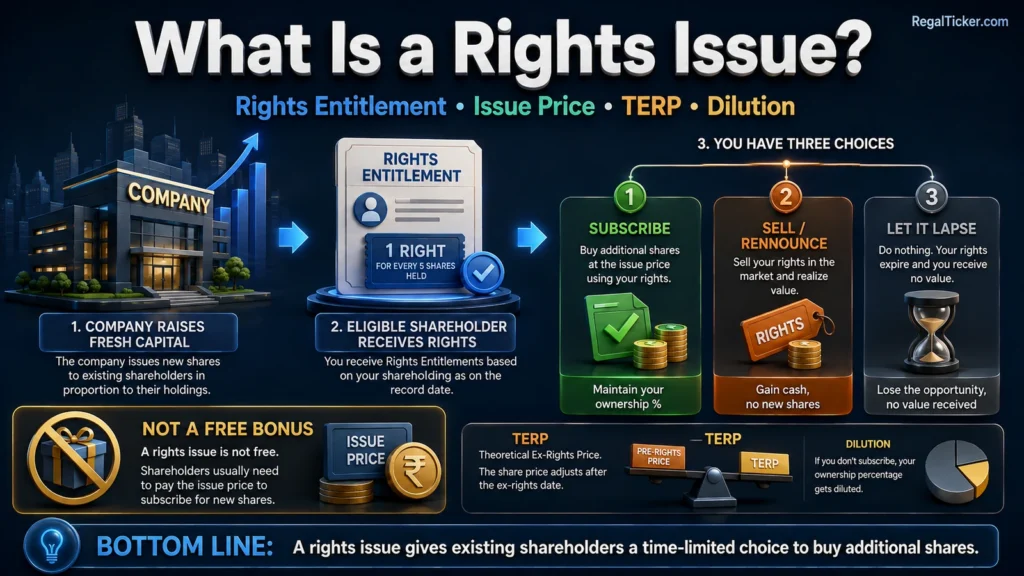
- rights shares;
the calculation becomes more complex.
Use the Bonus & Split Adjusted Return Calculator to model the mechanical adjustment, then compare the result with broker, depository and tax records.
Calculator output is an estimate
A calculator can model the ratio and adjusted quantity. It cannot replace transaction-level records, tax rules or professional advice for complex holdings.
Does a Stock Split Create Wealth?
No wealth is created merely by dividing one share into several shares.
A pizza cut into more slices does not become a larger pizza.
The split can still matter because it may:
- lower the quoted price;
- improve accessibility;
- increase trading activity;
- attract attention;
- change liquidity conditions;
- affect index or data presentation.
Long-term wealth depends on:
- business growth;
- profitability;
- cash flow;
- capital allocation;
- competitive strength;
- valuation;
- future market expectations.
A company with weak fundamentals does not become stronger because its share count increases.
⚠ Important warning
Do not buy only because a split was announced
Corporate-action excitement can create short-term speculation. Review the company’s results, balance sheet, cash flow, governance and valuation. A split changes the unit of ownership, not the quality of the business.
Use Regal Ticker Calculators
Stock Split Calculator
Use the Stock Split Calculator to calculate:
- new number of shares;
- old and new face value;
- split factor;
- theoretical adjusted price.
Bonus Share Calculator
Use the Bonus Share Calculator when additional shares are issued through a bonus ratio rather than a split.
Bonus & Split Adjusted Return Calculator
Use the Bonus & Split Adjusted Return Calculator when the same holding has experienced:
- one or more stock splits;
- bonus issues;
- sequential adjustments;
- a long holding period.
Stock Return Calculator
Use the Stock Return Calculator after adjusting the correct quantity, purchase cost and current value.
- Verify the official split ratio and old-to-new face value.
- Enter your eligible pre-split quantity in the Stock Split Calculator.
- Check the new quantity and theoretical adjusted price.
- Use the adjusted-return calculator if bonus issues or several splits also occurred.
- Compare the output with the demat statement.
- Calculate investment return only after the quantity and cost basis are correct.
Common Stock-Split Mistakes
Mistake 1: Thinking More Shares Mean More Wealth
The number of shares increases, but price and per-share values adjust.
Mistake 2: Confusing Market Price With Face Value
Face value is an accounting denomination. Market price is determined by trading and expectations.
Mistake 3: Treating the Post-Split Price as a Bargain
A ₹200 share after a 5:1 split can represent the same valuation as a ₹1,000 share before the split.
Mistake 4: Confusing a Split With Bonus Shares
The accounting mechanism, face value and reserve treatment differ.
Mistake 5: Ignoring Official Dates
Eligibility and processing depend on the official corporate-action announcement.
Mistake 6: Using Unadjusted Historical Prices
Old prices and per-share figures must be compared on a consistent adjusted basis.
Mistake 7: Panicking When the Portfolio Display Looks Wrong
Temporary quantity or average-price mismatches can occur while systems update.
Stock-Split Investor Checklist
Before acting on a split announcement, check:
- What is the split ratio?
- What are the old and new face values?
- Has the required approval been received?
- What is the record date?
- What is the exchange ex-date?
- How many eligible shares do I hold?
- What will the new quantity be?
- What is the theoretical adjusted price?
- Is the broker display using adjusted data?
- Have I preserved the original purchase records?
- Does the company remain fundamentally attractive?
- Am I reacting to business value or only to the headline?
Conclusion
A stock split divides existing shares into a larger number of lower-face-value shares. It can make the quoted share price more accessible and may improve liquidity, but it does not automatically increase the value of the company or the investor’s holding.
The most important relationships are:
- share quantity rises;
- face value falls proportionately;
- theoretical market price adjusts;
- proportional ownership normally stays the same;
- total value does not change merely because of the split.
Use the Stock Split Calculator for the first calculation. Use the Bonus & Split Adjusted Return Calculator when the holding includes several corporate actions.
Frequently asked questions
What is a stock split in simple words?
A stock split divides each existing share into multiple smaller-denomination shares. The number of shares increases, while face value and the theoretical market price per share decrease proportionately.
What does a 2:1 stock split mean?
Each one existing share becomes two shares. If you own 100 shares before the split, you hold 200 shares after it.
Does a stock split increase my investment value?
Not automatically. The share count increases, but the market price normally adjusts proportionately, so the theoretical total value remains similar.
What happens to face value after a stock split?
Face value is divided by the split factor. In a 5:1 split, a ₹10 face-value share becomes five shares of ₹2 face value each.
Is a stock split the same as bonus shares?
No. A split subdivides existing shares and changes face value. A bonus issue creates additional shares by capitalising reserves and usually leaves face value unchanged.
What happens to EPS after a stock split?
EPS is adjusted for the larger number of shares. Total company earnings do not change merely because of the split.
Do I need to apply for split shares?
Eligible dematerialised holdings are generally adjusted automatically through the corporate-action process. Investors should verify the official terms and demat statement.
How can I calculate the new number of shares?
Multiply your eligible old quantity by the split factor or use the Regal Ticker Stock Split Calculator.
Can a stock split guarantee a price rise?
No. Future price movement depends on the business, valuation, market conditions, liquidity and investor expectations.
Which records should I keep after a split?
Keep purchase contract notes, company announcements, record-date notices, demat statements, broker statements and cost records.
Verify through official sources
Official references
- India Code — Companies Act, 2013, Section 61: https://www.indiacode.nic.in/show-data?actid=AC_CEN_22_29_00008_201318_1517807327856&orderno=63§ionId=1251§ionno=61
- NSE — Corporate Actions: https://www.nseindia.com/companies-listing/corporate-filings-actions
- NSE — Corporate Action FAQ: https://nsearchives.nseindia.com/web/circular/2026-07/FAQs_on_Corporate_Action_20260708204832.pdf
- BSE — Corporate Actions: https://www.bseindia.com/corporates/corporate_act.aspx
- CDSL — Issuer and Corporate Action Procedures: https://www.cdslindia.com/issuer/issuer-procedures.html
Educational disclaimer: This article is for educational purposes only and does not constitute investment, tax or legal advice. Corporate-action ratios, dates and implementation terms can vary. Always verify the latest company filing, exchange notice and depository statement before making an investment decision. Investments in securities markets are subject to market risks.