

⚡ Quick answer
Bonus shares are additional fully paid shares issued by a company to eligible existing shareholders without requiring a subscription payment. The entitlement follows a declared ratio such as 1:1 or 1:2. The shareholder receives more shares, but the market price normally adjusts because the same business value is divided across a larger number of shares. A bonus issue therefore changes the share count and per-share figures; it does not automatically multiply wealth.
Key takeaways
A stock split increases the number of shares while reducing the face value per share in the announced ratio.
A 2:1 split means one existing share becomes two shares; a 5:1 split means one share becomes five.
If face value changes from ₹10 to ₹2, one old share effectively becomes five ₹2 face-value shares.
The theoretical market price and per-share figures adjust proportionately after the split; the action does not create instant wealth.
Your percentage ownership normally remains unchanged because all eligible shares are adjusted in the same ratio.
A stock split is different from a bonus issue: a split subdivides existing shares, while a bonus issue creates additional shares by capitalising eligible reserves.
The official record date, ex-date and exchange announcement determine the actual implementation timeline.
Use the Stock Split Calculator for a single split and the Bonus & Split Adjusted Return Calculator when the holding has experienced multiple bonus or split events.
What Are Bonus Shares?
Bonus shares are additional fully paid equity shares issued to eligible existing shareholders in a stated proportion. A company does not ask the shareholder to pay a subscription price for these shares.
Under Section 63 of the Companies Act, 2013, a company may issue fully paid bonus shares from permitted sources and subject to applicable conditions. The law also states that bonus shares cannot be issued in place of a dividend.
A bonus issue is sometimes described as a capitalisation issue because an eligible amount is transferred from reserves or another permitted account into paid-up share capital. The accounting classification changes, but no new outside cash enters merely because shares are issued.
Simple Meaning
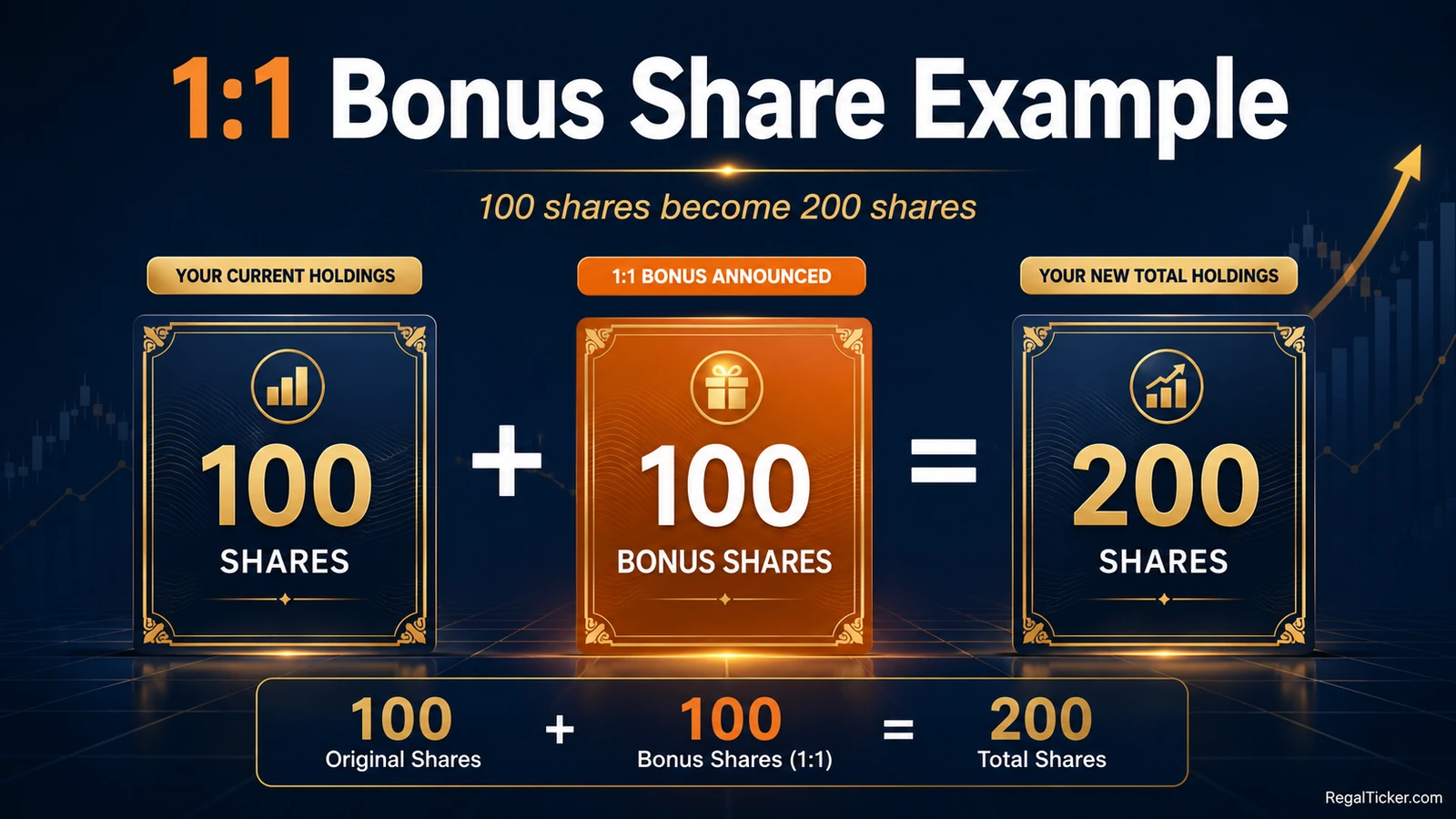
Suppose a company has announced a 1:1 bonus issue.
- You hold 100 eligible shares.
- The ratio grants one new share for every one existing share.
- You receive 100 bonus shares.
- Your revised holding becomes 200 shares.
The increased quantity is real, but it does not mean the economic value of the holding has doubled instantly.
What Does “Fully Paid” Mean?
A fully paid share does not require the shareholder to pay any remaining face-value amount to the company. Bonus shares are issued as fully paid shares, subject to the terms of the company’s announcement and applicable rules.
How Bonus Share Ratios Work
A bonus ratio expresses the number of new shares issued for a specified number of existing eligible shares.
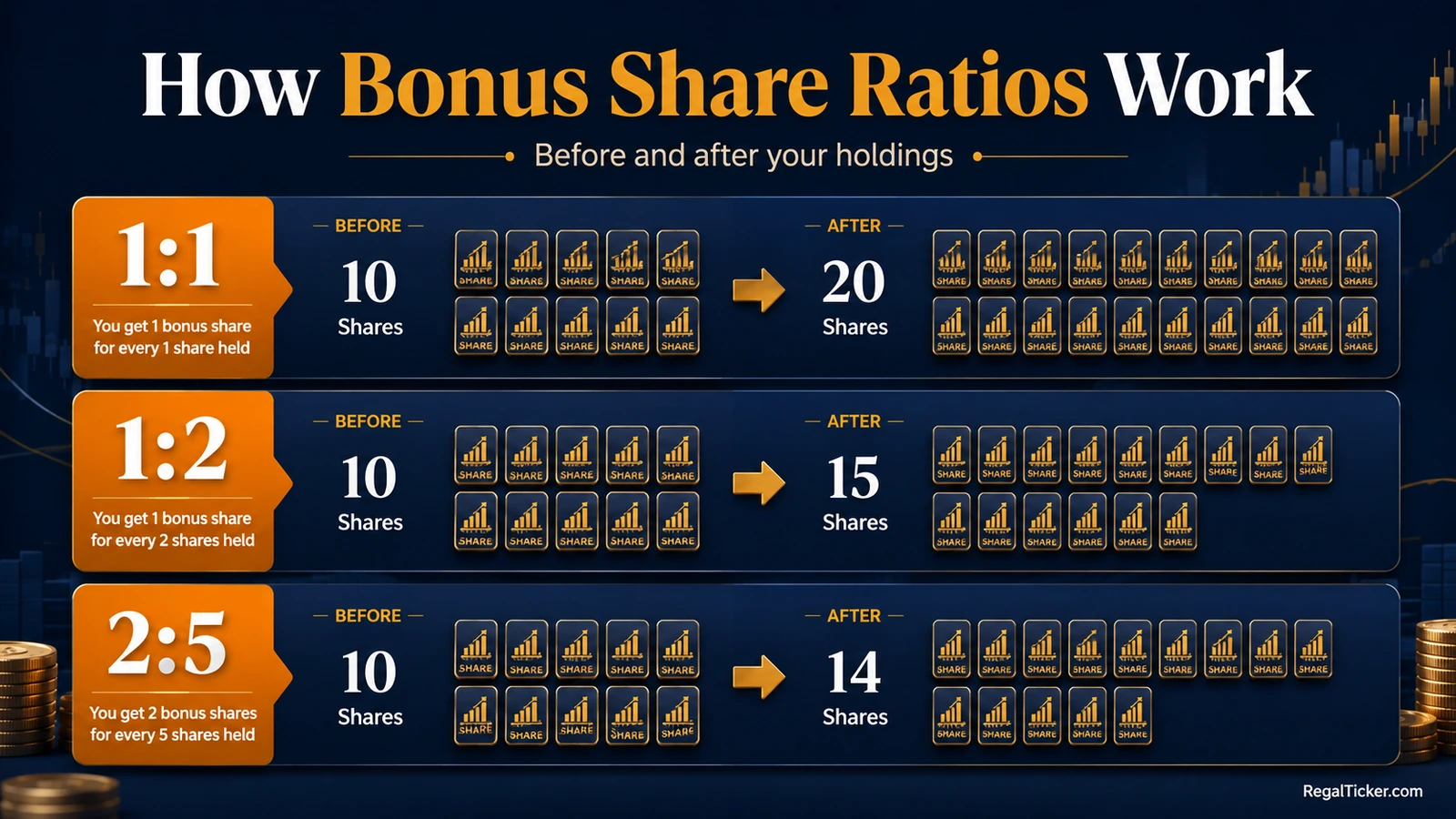
| Bonus ratio | Meaning | Shares before | Bonus shares | Total after bonus |
|---|---|---|---|---|
| 1:1 | One new share for every one existing share | 100 | 100 | 200 |
| 1:2 | One new share for every two existing shares | 100 | 50 | 150 |
| 2:5 | Two new shares for every five existing shares | 100 | 40 | 140 |
| 3:5 | Three new shares for every five existing shares | 100 | 60 | 160 |
💡 Real example
Calculating a 2:5 bonus issue
An investor holds 750 eligible shares. The company announces two bonus shares for every five existing shares.
Bonus entitlement:
750 × 2 ÷ 5 = 300 bonus shares
Revised holding:
750 + 300 = 1,050 shares
Use the RegalTicker Bonus Share Calculator after reading the exchange announcement. Enter the pre-bonus quantity, ratio and cum-bonus price to estimate the additional shares, revised holding and theoretical adjusted price.
Fractional Entitlements
Some ratios can produce a fractional mathematical entitlement. The treatment of fractions depends on the scheme, company announcement and applicable process. The calculator can show the mathematical result, but investors should read the official filing for the final treatment.
Why Do Companies Issue Bonus Shares?
A bonus issue can serve several capital-structure and shareholder-communication purposes. None of these reasons guarantees better future returns.
Capitalising Eligible Reserves
The company transfers an eligible amount from reserves or another permitted account into paid-up share capital.
A simplified illustration:
| Item | Before bonus issue | After illustrative capitalisation |
|---|---|---|
| Paid-up share capital | ₹100 crore | ₹200 crore |
| Eligible reserves | ₹400 crore | ₹300 crore |
| Combined amount | ₹500 crore | ₹500 crore |
Making the Per-Share Price More Accessible
When a share trades at a high nominal price, a bonus issue can reduce the theoretical per-share price by increasing the number of shares. A lower unit price may appear more accessible to smaller investors.
Accessibility is not valuation. A ₹300 adjusted share can remain expensive relative to earnings, cash flow or business quality.
Improving Market Liquidity
A larger number of shares can improve trading participation in some cases. Actual liquidity still depends on free float, ownership concentration, trading interest and market conditions.
Signalling Management Confidence
A company may use a bonus issue to signal confidence in its reserves and long-term position. Investors should treat this as one signal rather than proof of future performance.
⚠ Important warning
A bonus announcement is not a buy signal
A bonus issue does not improve revenue, operating profit, cash flow, debt quality or competitive advantage by itself. Analyse the business and valuation independently instead of buying only because the share count will rise.
Bonus Issue Timeline and Eligibility
A bonus issue moves through a formal process. The exact timetable can vary, so investors should verify each date in the company’s exchange filing.
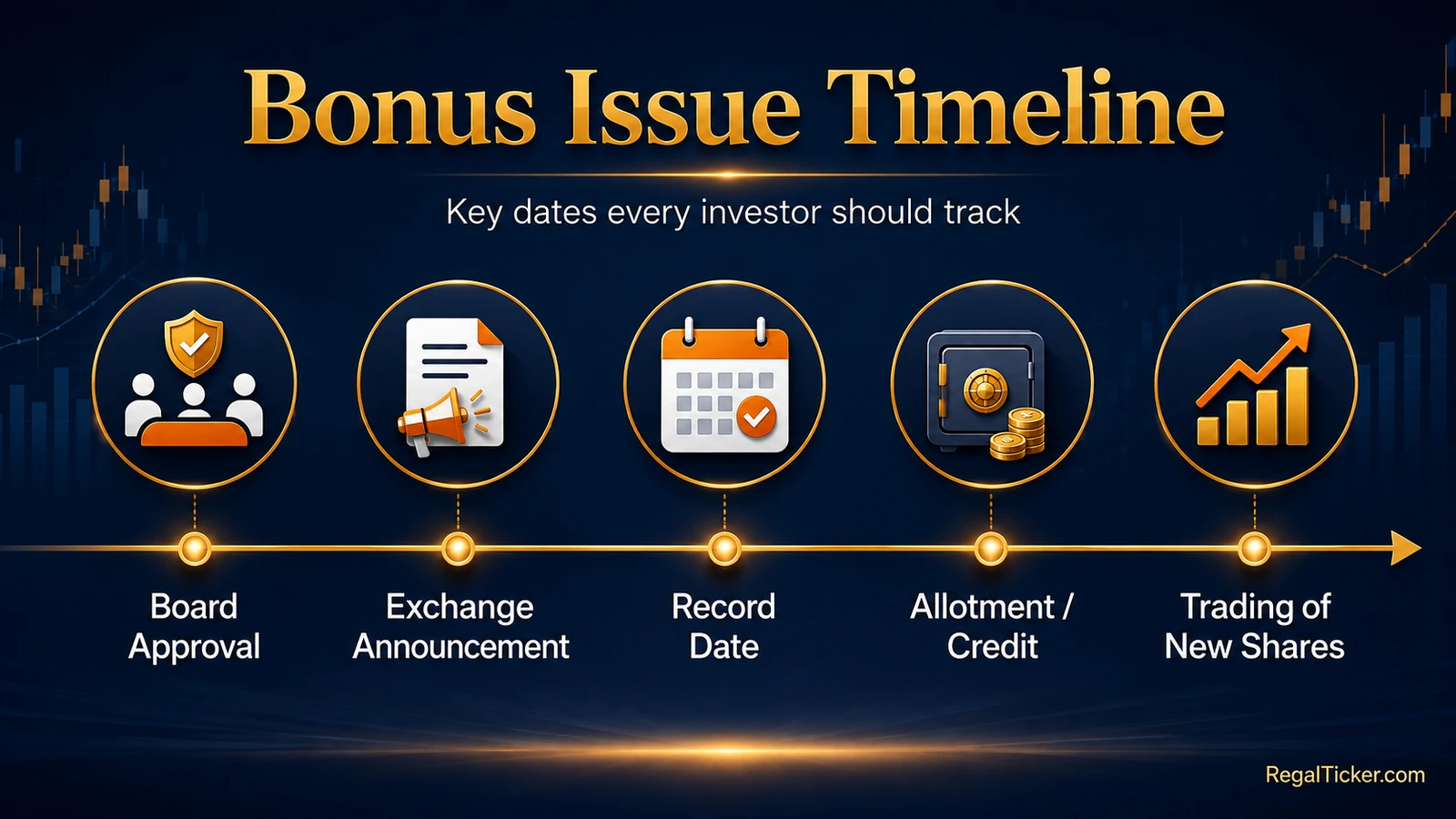
1. Board Approval
The board approves or recommends the bonus proposal and decides the proposed ratio, subject to the required approvals and conditions.
2. Exchange Announcement
The listed company informs the stock exchanges. The announcement may include the ratio, source of capitalisation, pre- and post-issue capital and expected timetable.
3. Shareholder Approval Where Required
The company may seek shareholder approval where required under its articles, authorised-capital position or applicable legal framework.
4. Record Date
The record date is the cut-off date used to identify eligible shareholders in the company’s records.
5. Ex-Date
The ex-date is the first trading date on which a buyer normally purchases the share without the announced bonus entitlement. Settlement cycles and exchange procedures matter, so use the exact exchange notice rather than an assumed date.
6. Allotment and Credit
After the eligibility and allotment process, bonus shares are credited to eligible demat accounts through the depository system.
7. Trading of New Shares
The newly allotted shares become available for trading after the applicable exchange and depository process is completed.
Investor note
Verify eligibility through official records
Do not rely only on a broker notification, social-media post or news headline. Read the company’s exchange announcement and confirm the record date, ex-date, ratio, allotment details and treatment of fractions.
How Bonus Shares Affect Your Holding
A bonus issue changes several per-share and capital-structure figures.
Share Count
The eligible shareholder receives additional shares according to the ratio.
Percentage Ownership
If every eligible shareholder receives the same proportional bonus and there is no selective issue, percentage ownership normally remains unchanged.
💡 Real example
Ownership percentage after a 1:1 bonus
An investor owns 1,000 of 10,00,000 shares, equal to 0.10%.
After a 1:1 bonus:
investor holding becomes 2,000 shares; total shares become 20,00,000; ownership remains 0.10%.
The number of shares doubles, but the ownership percentage does not automatically increase.
Face Value
In a normal bonus issue, the new shares generally carry the same face value as the existing shares of that class. This differs from a stock split, where the face value is subdivided.
Earnings Per Share and Other Per-Share Figures
When the number of shares increases, earnings per share, book value per share and similar measures are adjusted across the larger share base. Historical comparisons should use adjusted figures where appropriate.
Demat Records
The additional shares should appear in the eligible demat account after credit. Retain the company notice, depository alert, broker statement and consolidated account statement where available.
What Happens to the Share Price?
The theoretical price adjusts because the same pre-action value is divided across a larger number of shares.
For a bonus ratio expressed as new shares for existing shares:
Theoretical ex-bonus price = Cum-bonus price × Existing ratio ÷ (Existing ratio + New ratio)
💡 Real example
1:1 bonus issue with 100 shares
Assume:
shares before bonus: 100; cum-bonus market price: ₹800; bonus ratio: 1:1; pre-action holding value: ₹80,000.
Bonus entitlement:
100 × 1 ÷ 1 = 100 shares
Revised holding:
100 + 100 = 200 shares
Theoretical adjusted price:
₹800 × 1 ÷ 2 = ₹400 per share
Theoretical adjusted value:
200 × ₹400 = ₹80,000
The mathematical value is unchanged before market movement, taxes or other effects. Actual trading price can differ because demand, supply, company news and broader market conditions continue to influence the share.
Use the Bonus Share Calculator directly below this example to test the announced ratio with your own quantity and price.
Does a Bonus Issue Create Wealth?
Not by itself. Wealth changes when the underlying business value, profitability, cash generation, prospects or market valuation changes—not merely because each investor receives proportionately more shares.
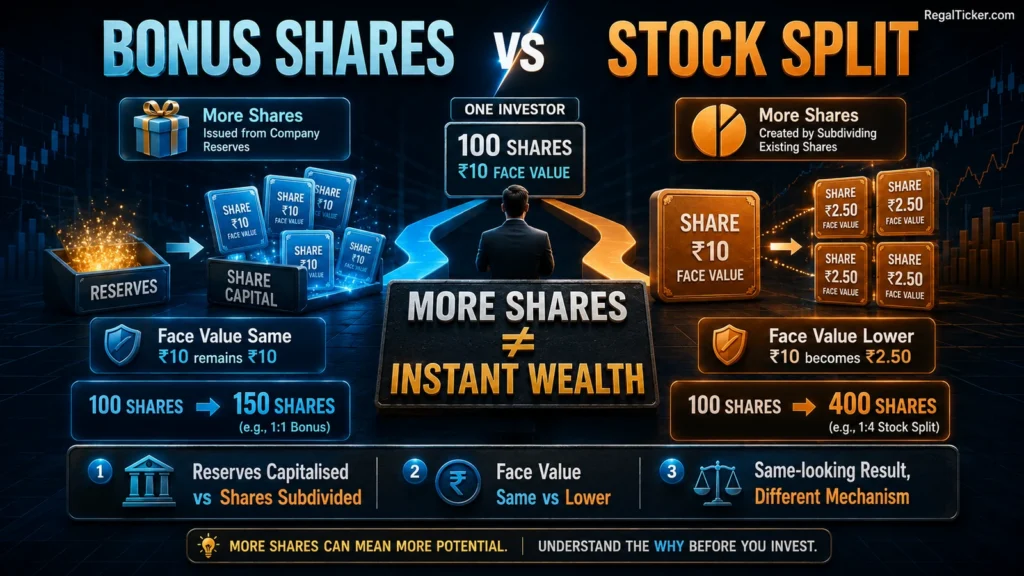
Bonus Shares vs Stock Split
Both actions increase the number of shares and reduce per-share figures theoretically, but their mechanics differ.
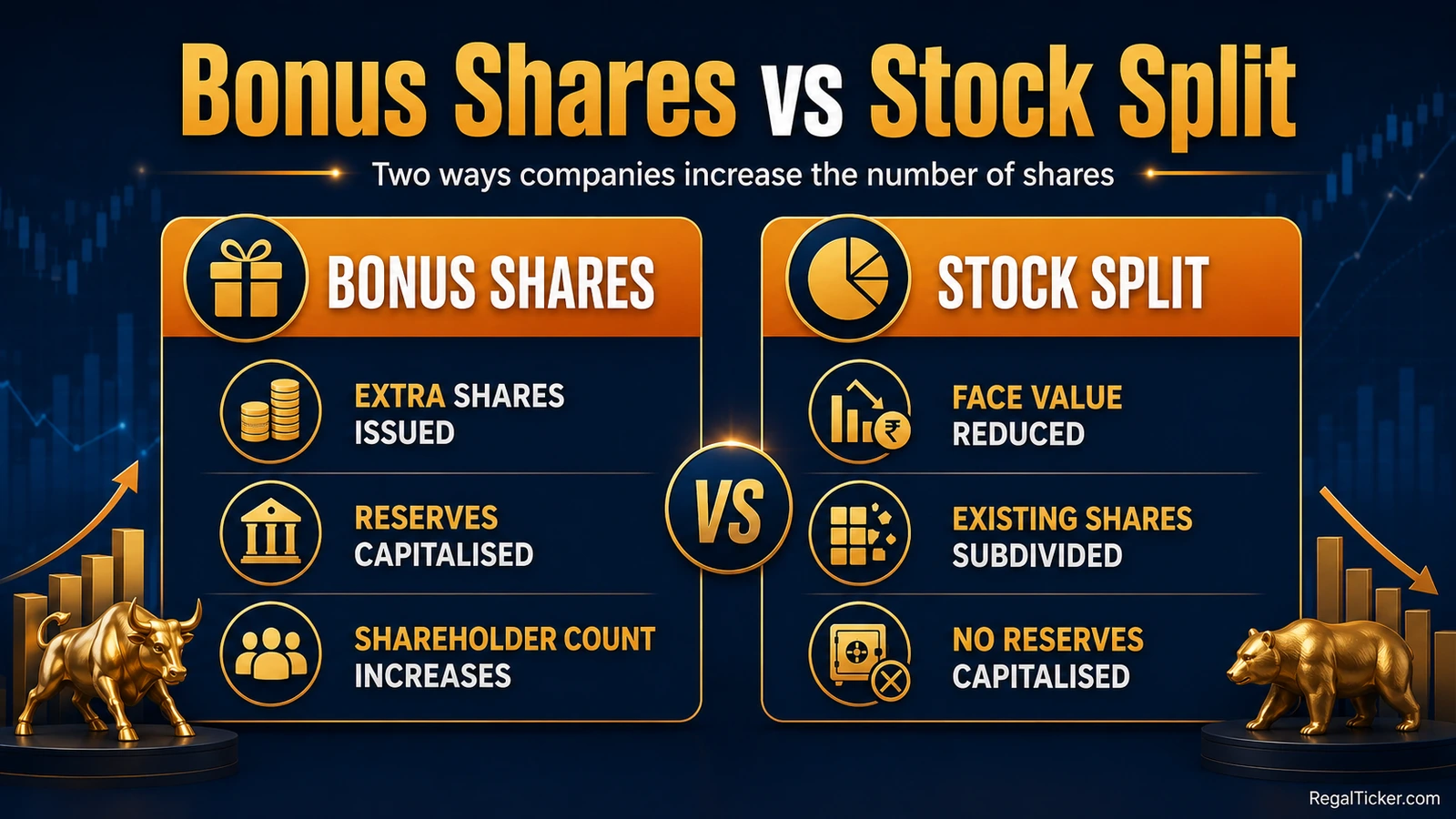
| Point | Bonus shares | Stock split |
|---|---|---|
| Core action | New shares are issued in a ratio | Existing shares are subdivided |
| Reserves | Eligible reserves are capitalised | No reserve capitalisation merely because of the split |
| Face value | Usually remains the same for the class | Reduced according to the split |
| Paid-up share capital | Increases | Normally remains unchanged in aggregate |
| Fresh investor payment | No | No |
| Immediate wealth creation | No | No |
| Primary calculator | Bonus Share Calculator | Stock Split Calculator |
A bonus issue and a stock split can produce a similar-looking increase in share count, but the company-level mechanism is different. A bonus issue capitalises eligible reserves and normally keeps face value unchanged, while a stock split subdivides existing shares and reduces face value proportionately. For a side-by-side 1:1 bonus vs 2-for-1 split example, read Bonus Shares vs Stock Split: Differences, Examples and Investor Impact.
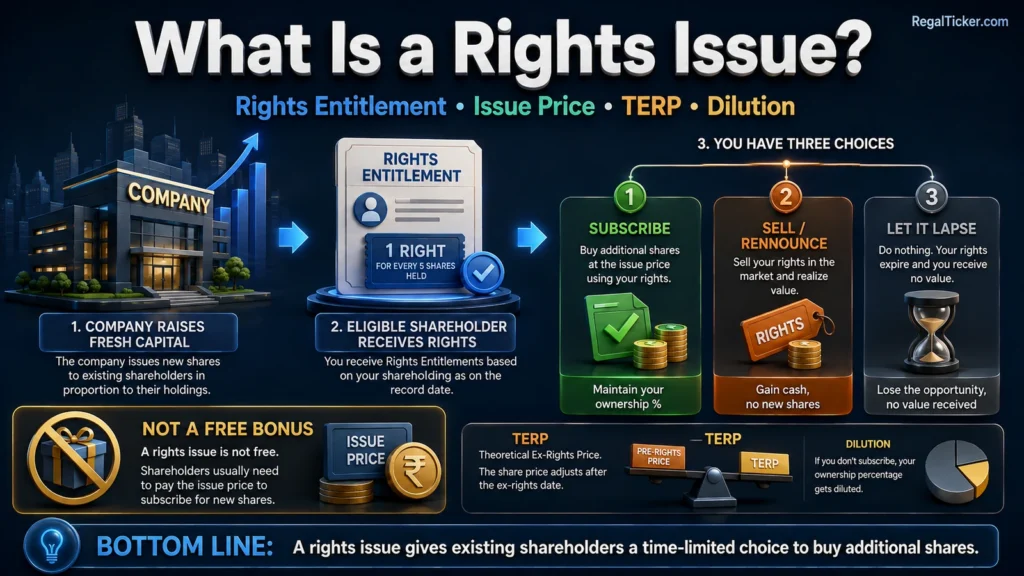
Bonus Shares vs Dividend and Rights Issue
A bonus issue should also be distinguished from other corporate actions.
| Point | Bonus issue | Cash dividend | Rights issue |
|---|---|---|---|
| What investor receives | Additional shares | Cash | Right or offer to subscribe for shares |
| Payment by investor | No | No | Yes, if applying |
| Cash leaves company | No direct cash payout | Yes | Cash enters company from subscribers |
| Share count | Increases | Usually unchanged | Can increase after allotment |
| Immediate income | No | Yes, if paid | No |
| Primary RegalTicker tool | Bonus Share Calculator | Dividend Calculator | Rights Issue Calculator |
Advantages and Limitations
Potential Advantages
- additional shares without a subscription payment;
- improved trading liquidity in some cases;
- a lower theoretical unit price;
- clearer capitalisation of accumulated reserves;
- possible positive signal from a financially strong company.
Important Limitations
- the issue does not create instant wealth;
- a lower adjusted price is not automatically a cheaper valuation;
- weak companies can also announce bonus issues;
- price volatility can remain high after the action;
- fractions, tax records and adjusted cost require careful documentation;
- the market may have already anticipated the announcement.
⚠ Important warning
More shares can create a misleading sense of gain
A portfolio screen may show twice as many shares after a 1:1 bonus, but the theoretical price is roughly halved. Compare total adjusted value and business fundamentals instead of celebrating the larger quantity alone.
Use the Right RegalTicker Calculator
Corporate-action calculations become confusing when several events occur over time. Use the calculator that matches the event.
For One Bonus Issue
Use the Bonus Share Calculator to calculate additional shares, revised holding and theoretical adjusted price.
For a Stock Split
Use the Stock Split Calculator when the announcement changes face value.
For Multiple Bonuses and Splits
Use the Bonus & Split Adjusted Return Calculator to reconstruct adjusted quantity and comparable cost after sequential actions.
Practical Workflow
- Read the official company and exchange announcement.
- Confirm the action type, ratio, ex-date and record date.
- Open the matching RegalTicker calculator.
- Enter the pre-action quantity and price or cost.
- Save the revised quantity and theoretical value.
- Verify the actual demat credit and broker adjustment.
- Retain records for return and tax calculations.
The RegalTicker Investor Tools hub contains the complete calculator directory.
Common Mistakes
Treating Bonus Shares as Free Profit
The shares are issued without a subscription payment, but the price adjusts theoretically.
Buying on or After the Ex-Date
A buyer who purchases too late may not become eligible for the announced bonus. Verify the exact exchange schedule.
Confusing a Bonus with a Stock Split
A bonus capitalises eligible reserves; a split subdivides face value.
Ignoring the Company’s Fundamentals
A corporate action cannot repair weak cash flow, excessive debt, poor governance or an unsustainable valuation.
Using Only the Broker’s Adjusted Cost
A platform display can be useful, but maintain original contract notes, statements and corporate-action records.
Ignoring Fractions
Ratios may produce non-whole entitlements. Read the official scheme for the treatment of fractions.
Bonus Share Investor Checklist
Before reacting to a bonus announcement, verify:
- Is the announcement available on NSE, BSE or the company’s investor-relations page?
- What is the exact bonus ratio?
- What are the ex-date and record date?
- Are shareholder or authorised-capital approvals required?
- What is the theoretical adjusted price?
- How many shares should be credited?
- How will historical per-share figures be adjusted?
- Does the business remain fundamentally sound?
- Have you used the correct RegalTicker calculator?
- Have you retained the official documents and demat records?
Conclusion
Bonus shares are additional fully paid shares issued to eligible existing shareholders in a declared ratio without a subscription payment. They increase the number of shares, but the theoretical market price and other per-share measures adjust because the company has not become more valuable merely through the issue.
Understand the ratio, ex-date, record date, accounting effect and difference from a stock split before acting. Use the Bonus Share Calculator for a single issue and the Bonus & Split Adjusted Return Calculator when several actions have occurred.
Frequently asked questions
What are bonus shares in simple words?
Bonus shares are additional fully paid shares issued to eligible existing shareholders without requiring a subscription payment.
What does a 1:1 bonus issue mean?
It means one new share is issued for every one eligible share already held. An investor with 100 eligible shares receives 100 bonus shares.
Do bonus shares double my investment value?
No. A 1:1 bonus doubles the share count, but the theoretical price adjusts to about half before normal market movement.
What is the record date for bonus shares?
The record date is the cut-off date used by the company to identify eligible shareholders in its records.
What is the ex-date in a bonus issue?
The ex-date is the first trading date on which a buyer normally purchases the share without the announced bonus entitlement. Verify the exchange notice for the exact schedule.
Are bonus shares the same as a stock split?
No. A bonus issue capitalises eligible reserves and issues new shares, while a stock split subdivides existing shares by reducing face value.
Can a company issue bonus shares instead of a dividend?
Section 63 of the Companies Act states that bonus shares cannot be issued in lieu of dividend.
Where are bonus shares credited?
Eligible bonus shares are normally credited to the shareholder’s demat account after allotment and the applicable depository process.
How do I calculate my bonus entitlement?
Multiply eligible shares by the new-share number in the ratio and divide by the existing-share number, or use the RegalTicker Bonus Share Calculator.
Does a bonus issue guarantee future returns?
No. Future returns depend on business performance, valuation, market conditions and investor demand, not merely the bonus announcement.
Verify through official sources
Official references
Educational disclaimer: This article is for investor education and general information only. It is not investment, legal or tax advice and is not a recommendation to buy, sell or hold any security. Corporate-action dates, eligibility, fractional treatment and tax consequences can vary. Verify the current company and exchange filings, maintain complete records and consult an appropriately qualified professional where necessary.