


This is a fertiliser project, a gas-infrastructure project and an Andhra Pradesh investment story at the same time
GAIL and KRIBHCO have signed a memorandum of understanding to explore a new gas-based urea plant in Andhra Pradesh.
The proposed investment is about ₹13,500 crore, or roughly $1.6 billion.
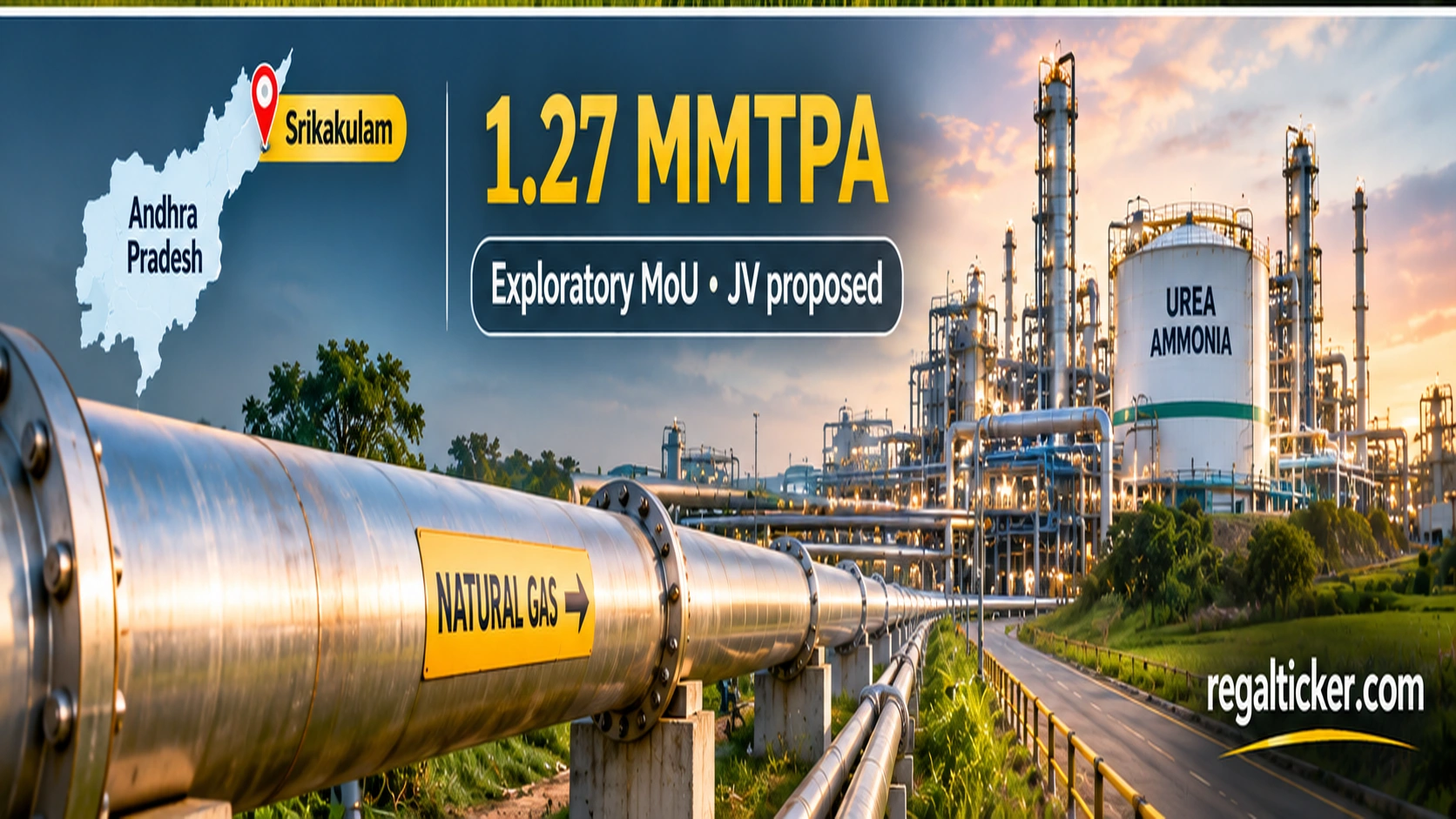
The plant is planned at Mulapeta in Srikakulam district with annual urea capacity of 1.27 million tonnes. GAIL and KRIBHCO intend to develop it through a joint venture.
That scale is important, but the location may matter even more.
The proposed site sits along GAIL’s Srikakulam–Angul Natural Gas Pipeline. For a gas-based fertiliser plant, access to reliable feedstock is one of the most important pieces of project economics.
The timing is also notable.
India has expanded domestic urea capacity substantially, yet the country still depends on imports when domestic production does not fully meet demand. Government data shows urea imports rose sharply during April–January 2025-26 compared with the previous year.
A new gas-based plant therefore fits two national priorities at once: strengthen fertiliser security and use domestic gas infrastructure more efficiently.
It also adds to a remarkable run of investment announcements in Andhra Pradesh, which has recently attracted large commitments in AI data centres, energy and manufacturing.
⚡ Quick answer
What are GAIL and KRIBHCO planning?
The two companies have signed an MoU to explore a 1.27 MMTPA gas-based urea plant at Mulapeta in Srikakulam district. The proposed project is estimated at about ₹13,500 crore and would be developed through a joint venture. It is still at the exploration and planning stage, so final investment, financing and construction timing have not yet been announced.
Key takeaways
GAIL and KRIBHCO signed an MoU on 12 November 2026 to explore a gas-based fertiliser project in Andhra Pradesh.
The proposed investment is about ₹13,500 crore.
The planned urea capacity is 1.27 million tonnes per year.
The proposed location is Mulapeta in Srikakulam district.
The site is along GAIL’s Srikakulam–Angul Natural Gas Pipeline.
GAIL and KRIBHCO plan to implement the project through a joint venture.
Reuters says the facility could create 300–400 direct jobs and around 1,000 indirect jobs.
The Andhra Pradesh government is expected to facilitate land, infrastructure and potential incentives.
India’s indigenous urea production capacity has increased to about 269.42 lakh tonnes per year.
Government data shows India still relies on imports to bridge the gap between domestic production and demand.
Urea imports during April–January 2025-26 reached 89.30 lakh tonnes, versus 48.70 lakh tonnes in the comparable previous period.
The project is strategic for GAIL because it connects natural-gas infrastructure with a large long-term industrial customer.
GAIL shares were broadly flat around ₹188 late Friday morning, suggesting the market is not yet treating the MoU as a near-term earnings catalyst.
1. The project is still an MoU, not a final investment decision
The first thing investors should understand is the stage of the project.
GAIL and KRIBHCO have signed a memorandum of understanding.
That is an important step, but it is not the same as financial closure or construction approval.
The companies are exploring the opportunity.
Detailed engineering, financing, project economics, environmental approvals and final joint-venture terms still have to be worked through.
That matters because a ₹13,500 crore headline can sound more certain than it really is.
At this point, the project is strategically credible but still conditional.
2. Why 1.27 million tonnes of urea capacity matters
The proposed plant would produce 1.27 million tonnes of urea every year.
That is a meaningful addition in a market where the government continues to balance domestic production with imports.
India has invested heavily in new urea capacity over the past decade.
The Department of Fertilisers says indigenous urea capacity has increased from about 207.54 lakh tonnes per year in 2014-15 to 269.42 lakh tonnes during 2026-27.
Even so, demand remains large enough that imports are still required.
A new 1.27 MMTPA plant does not eliminate that dependence.
It helps reduce the gap.
3. The pipeline location is one of the strongest parts of the proposal
Natural gas is a critical feedstock for modern urea production.
That makes location a major economic decision.
GAIL says the proposed Srikakulam plant would sit along the Srikakulam–Angul Natural Gas Pipeline.
That is important because pipeline connectivity can lower logistical complexity and give the plant a direct relationship with GAIL’s core business.
GAIL would not simply be an investor.
It could also be part of the feedstock infrastructure supporting the plant.
That integration is one reason the partnership with KRIBHCO makes strategic sense.
GAIL brings gas expertise.
KRIBHCO brings fertiliser manufacturing and distribution experience.
4. India still has a fertiliser import problem despite higher domestic capacity
India has made real progress in domestic urea production.
But self-sufficiency remains incomplete.
Government data for April–January 2025-26 showed domestic urea production of 251.26 lakh tonnes and imports of 89.30 lakh tonnes.
In the comparable previous period, imports were 48.70 lakh tonnes.
That sharp increase shows why policymakers remain focused on supply security.
Import dependence creates several risks.
International price volatility.
Shipping disruption.
Foreign-exchange pressure.
And geopolitical exposure.
The government has responded by commissioning new plants, securing global tenders and encouraging further domestic investment.
Investor note
More domestic urea does not mean imports disappear immediately
India’s fertiliser demand is large and seasonal. Domestic plants also face feedstock constraints and maintenance shutdowns. New capacity improves security, but investors should avoid assuming one new plant automatically makes India self-sufficient.
5. Why GAIL has an incentive to create new gas demand
GAIL is best known for moving and marketing natural gas.
A large fertiliser plant can become a stable industrial gas customer.
That is attractive because gas pipelines become more valuable when they carry larger, predictable volumes.
The proposed urea project therefore supports GAIL in two ways.
It creates potential equity exposure to a new industrial plant.
And it can increase utilisation of gas infrastructure in eastern India.
That is the more interesting GAIL angle.
The near-term financial contribution from an MoU is negligible.
The long-term value depends on whether the project reaches construction and how the gas-supply economics are structured.
6. Why KRIBHCO is a natural partner
KRIBHCO is one of India’s largest fertiliser cooperatives.
It already manufactures and markets urea and other crop nutrients.
That gives the partnership an obvious division of expertise.
GAIL understands gas supply and infrastructure.
KRIBHCO understands fertiliser production, farmer demand and distribution.
Large industrial projects often fail when partners bring only capital but not operating capability.
Here, the strategic fit is easier to understand.
That still does not guarantee attractive economics.
Natural-gas prices, plant efficiency and subsidy policy will remain important.
7. Andhra Pradesh is attracting investment across very different industries
The timing is difficult to ignore.
Reuters noted that the urea project comes during a wave of investment announcements in Andhra Pradesh.
Google is planning a large AI hub.
Reliance has proposed major data-centre capacity with partners.
Reliance has also outlined its underground coal-gasification plan in the state.
Kia has announced additional manufacturing investment.
Now GAIL and KRIBHCO are exploring a major fertiliser complex.
These projects are not directly connected.
But together they suggest Andhra Pradesh is becoming more aggressive in attracting large-scale industrial capital.
That can create a reinforcing effect.
Ports attract industry.
Industry supports power and pipeline infrastructure.
Infrastructure attracts more investment.
The Reliance Andhra Pradesh coal-to-gas analysis shows another part of the same investment cycle.
8. Srikakulam could become more important industrially
Srikakulam is not usually the first location investors associate with India’s largest industrial projects.
The proposed plant could change that gradually.
Reuters says the facility could create 300–400 direct jobs and around 1,000 indirect jobs.
Those numbers are useful, but the secondary effects may be more important over time.
A large fertiliser plant requires engineering services, logistics, maintenance, gas supply, water infrastructure and transport.
If the region attracts several related projects, the industrial base can deepen.
That is how smaller industrial locations become clusters.
9. The government’s new urea policy makes fresh investment more relevant
In July 2026, the government approved the National Investment Policy for Urea 2026.
The policy is intended to encourage fresh capacity and strengthen fertiliser security.
The government has already commissioned six new urea plants in recent years, adding 76.2 lakh tonnes of annual capacity.
That policy backdrop matters for the GAIL–KRIBHCO proposal.
A plant of this size is easier to justify if the regulatory and subsidy framework supports long-term investment.
But investors should still wait for detailed project economics.
Urea is a strategic commodity in India, and pricing is heavily influenced by government policy.
10. What does this mean for GAIL stock?
The immediate market reaction has been muted.
GAIL shares were trading around ₹188 late Friday morning, roughly flat on the day.
That makes sense.
An MoU does not change near-term earnings.
There is no final capex schedule yet.
There is no completed joint venture.
There is no construction timeline.
For GAIL shareholders, this is better understood as an option on future gas demand and downstream integration.
It becomes financially important only if the project moves from MoU to execution.
11. What could make the project attractive?
Several things need to line up.
Reliable natural-gas supply.
Competitive feedstock pricing.
Efficient plant technology.
Stable urea policy.
Land and infrastructure support.
Timely environmental approvals.
And disciplined construction costs.
A project of this size can create value if it operates at high utilisation with predictable gas economics.
It can destroy value if feedstock becomes too expensive or construction overruns become large.
That is why the Fundamental Analysis framework matters even for a strategically important project.
12. What should investors watch next?
First, watch for the formal joint-venture structure.
Second, watch the final investment decision.
Third, watch how the Andhra Pradesh government structures land and incentives.
Fourth, watch GAIL’s gas-supply agreement for the plant.
Fifth, watch whether project cost remains near ₹13,500 crore after detailed engineering.
Sixth, watch fertiliser-policy changes under NIPU-2026.
Finally, watch India’s urea import trend.
The strategic logic becomes stronger if import dependence remains elevated.
Frequently asked questions
What are GAIL and KRIBHCO planning in Andhra Pradesh?
They have signed an MoU to explore a gas-based urea plant at Mulapeta in Srikakulam district.
How much could the project cost?
Reuters reported an estimated investment of about ₹13,500 crore, or roughly $1.6 billion.
What would be the plant’s capacity?
GAIL says the proposed urea facility would have annual capacity of 1.27 million tonnes.
Is the plant already approved?
No. The companies have signed an exploratory MoU. Final investment, financing and project approvals still need to be completed.
Why was Srikakulam chosen?
One major advantage is access to GAIL’s Srikakulam–Angul Natural Gas Pipeline, which can support gas feedstock supply.
How many jobs could the project create?
Reuters reported an estimated 300–400 direct jobs and around 1,000 indirect jobs.
Does India still import urea?
Yes. Despite much higher domestic capacity, imports are still used to bridge the gap between production and demand.
How large were recent urea imports?
Government data showed 89.30 lakh tonnes of urea imports during April–January 2025-26, compared with 48.70 lakh tonnes in the comparable previous period.
Is this a major near-term catalyst for GAIL shares?
Not yet. The project is still at the MoU stage, and GAIL shares were broadly flat around ₹188 late Friday morning.
Verify through official sources
Official references
- Reuters — GAIL and KRIBHCO Andhra Pradesh Urea Project — Project cost, capacity, location, employment estimates and Andhra Pradesh investment context.
- GAIL — GAIL and KRIBHCO MoU — Official confirmation of the MoU, 1.27 MMTPA capacity, Mulapeta location, Srikakulam–Angul pipeline connection and proposed joint-venture structure.
- Press Information Bureau — Fertiliser Security and Domestic Capacity — Domestic urea capacity, production, global tenders and National Investment Policy for Urea 2026.
- Press Information Bureau — Fertiliser Imports — April–January domestic production, urea imports and sales data.
- Moneycontrol — GAIL Share Price — Intraday GAIL share-price context on 13 November 2026.
Final takeaway
The strongest part of the proposal is the integration
₹13,500 crore is the headline.
The more important detail is the structure behind it.
A fertiliser producer needs gas.
GAIL has gas infrastructure.
KRIBHCO understands urea.
And the proposed plant sits along a major pipeline.
That does not make the project automatically attractive.
It does make the industrial logic unusually clear.
For India, the project could add another 1.27 million tonnes of domestic urea capacity and reduce some import exposure.
For GAIL, it could create a large long-term customer for its gas network.
And for Andhra Pradesh, it adds another major project to an investment pipeline that is becoming difficult for markets to ignore.
The next step is not another announcement.
It is execution.
Educational disclaimer: This article is for education and general market information only. It is not investment advice or a recommendation to buy or sell GAIL or any fertiliser-related security. The GAIL–KRIBHCO project is currently at the MoU and exploration stage. Final project cost, ownership, financing, incentives, construction schedule and plant economics may change before a final investment decision.


