


Reliance is trying to turn a difficult coal reserve into a gas source
Reliance Industries is exploring one of the more unusual energy bets in India.
Reuters reported that the company plans to invest about ₹43,000 crore in a two-phase underground coal-gasification project in Andhra Pradesh.
The headline number is large, but the structure matters.
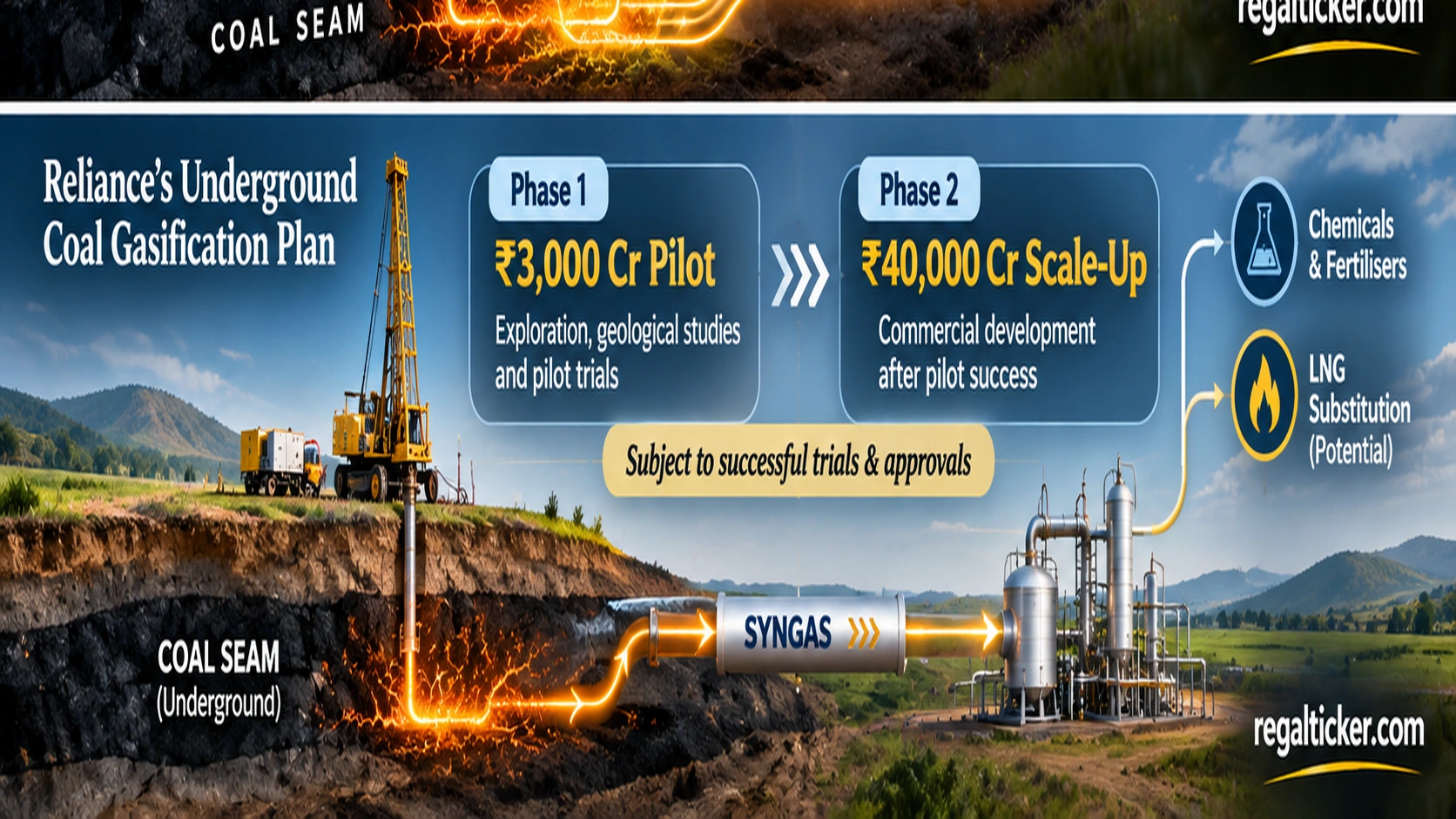
The first phase is much smaller: roughly ₹3,000 crore for exploration, geological studies and pilot trials. The commercial phase, estimated at around ₹40,000 crore, would proceed only if the pilot works and the project receives the required approvals.
Reliance secured the Recherla and Chintalpudi Sector A1 coal blocks in April through India’s first commercial coal-mine agreements carrying underground coal-gasification provisions.
Instead of mining the coal and bringing it to the surface, operators inject gases underground, heat the coal seam in place and draw out a combustible gas mixture known as syngas.
That syngas can potentially be used for industrial fuel, chemicals, fertilisers or synthetic natural gas.
For India, the attraction is obvious: use domestic coal that may be too deep or uneconomic to mine conventionally, and reduce dependence on imported LNG and chemical feedstocks.
The question is whether the economics and environmental controls can work at commercial scale.
⚡ Quick answer
What exactly is Reliance planning in Andhra Pradesh?
Reliance is planning a phased underground coal-gasification project using the Recherla and Chintalpudi Sector A1 coal blocks. Phase 1, around ₹3,000 crore, would test geology and pilot the technology. A much larger commercial phase of roughly ₹40,000 crore would follow only after successful trials and approvals. The goal is to convert underground coal into syngas that could support industry, chemicals and potential LNG import substitution.
Key takeaways
Reliance plans about ₹43,000 crore across two phases of underground coal gasification in Andhra Pradesh.
Phase 1 is roughly ₹3,000 crore for exploration, geological studies and pilot trials.
Phase 2 is initially estimated at around ₹40,000 crore and depends on successful trials and regulatory approvals.
Reuters says the wider investment potential could eventually reach about ₹2.7 lakh crore if later downstream stages proceed.
The project could create around 5,000 direct and 35,000 indirect jobs, according to the draft state agreement cited by Reuters.
Reliance secured the Recherla and Chintalpudi Sector A1 blocks in April 2026.
Those agreements were part of India’s first commercial coal-mine tranche with explicit underground coal-gasification provisions.
Reliance says UCG could convert uneconomic and low-quality coal into syngas and substitute imported LNG.
India is targeting 100 million tonnes a year of coal gasification capacity by 2030.
The government has introduced incentives and reduced auction costs for UCG projects.
UCG is still technically and environmentally challenging and has not yet been proven commercially at large scale globally.
Groundwater contamination, subsidence, emissions, well control and project economics are major risks to watch.
1. This is a pilot first, not a finished ₹43,000 crore plant
The biggest mistake would be to read the ₹43,000 crore headline as if all of that money is already committed.
It is not.
Reuters reported that the first phase would cost about ₹3,000 crore and cover exploration, geological work and pilot trials.
Only after that phase succeeds would Reliance move toward a commercial build estimated at around ₹40,000 crore.
That sequencing matters because underground coal gasification is not a routine refinery expansion.
The geology itself becomes part of the reactor.
If the seam behaves differently from models, the project economics can change dramatically.
That is why the pilot is not a formality.
It is the investment case.
2. How underground coal gasification actually works
Traditional coal mining brings coal to the surface.
UCG tries to leave it underground.
Operators drill injection and production wells into the coal seam.
Air, oxygen or steam is injected.
Part of the coal is ignited underground.
The heat and chemical reactions convert the surrounding coal into a mixture of gases, including hydrogen, carbon monoxide, methane and carbon dioxide.
The produced gas is then brought to the surface.
After treatment, it can potentially feed power plants, chemical facilities, synthetic natural gas systems or fertiliser production.
The attraction is that coal too deep, fragmented or expensive to mine may still have economic value.
3. Reliance already sees UCG as part of its energy strategy
Reliance told shareholders earlier this year that it was advancing underground coal gasification as part of its New Energy strategy.
The company said the technology could convert uneconomic and low-quality Indian coal reserves into syngas and substitute imported LNG.
That is an important clue to how Reliance sees the opportunity.
This is not simply a coal-mining project.
It is a feedstock project.
If Reliance can create a reliable domestic syngas stream, it could potentially support industrial fuel and downstream chemical economics.
That fits the group’s historical strength in integrated energy and chemicals.
4. Why Andhra Pradesh matters
Reliance already has a large energy footprint in Andhra Pradesh.
Its KG-D6 gas operations are located offshore the state, and the company is separately investing heavily in compressed biogas projects there.
Now UCG could add another layer.
The state also has deep coal resources that may be difficult to exploit through conventional mining.
Reliance secured the Recherla and Chintalpudi Sector A1 blocks under the 14th round of commercial coal auctions.
The Ministry of Coal said those agreements marked the first commercial auction tranche in India to include explicit provisions for underground coal gasification.
5. The real national argument is import substitution
India imports large volumes of LNG, fertiliser feedstocks and chemical intermediates.
That exposes the economy to global prices and currency movements.
Coal gasification is attractive to policymakers because it offers a way to convert a domestic resource into products that India would otherwise import.
The government says coal gasification can produce syngas, methanol, ammonia, urea, hydrogen and synthetic natural gas.
It has also estimated that projects under current gasification schemes could eventually support import substitution worth around ₹1.5 lakh crore annually.
Those are policy ambitions, not guaranteed savings.
But they explain why UCG is receiving regulatory support despite the wider transition toward renewables.
Investor note
Energy security and decarbonisation are not the same objective
A project can reduce LNG imports and improve energy security while still relying on coal. Investors should not treat “domestic” or “gasified” automatically as low-carbon. The environmental case depends on methane leakage, carbon intensity, groundwater control and whether carbon capture is eventually used.
6. Why the technology is still risky
The government itself has acknowledged that underground coal gasification has not yet been commercially proven globally at scale.
That is significant.
UCG has been studied for decades.
The engineering challenge is not simply generating gas.
It is controlling the underground reaction.
If the burn zone moves unpredictably, the operator can lose efficiency or damage surrounding geology.
Groundwater contamination is another concern because the underground process can create chemicals that need to remain isolated from aquifers.
Subsidence is also possible if large underground cavities develop.
And unlike a surface plant, the reaction chamber cannot simply be opened and repaired.
Those risks are exactly why the pilot stage deserves more attention than the headline investment number.
7. India has already started testing UCG elsewhere
The Ministry of Coal initiated India’s first UCG pilot at the Kasta block in Jharkhand in 2024.
The project is being pursued by Eastern Coalfields.
Government updates say Phase I has been completed and Phase II covers detailed engineering, directional drilling, injection wells, production wells and ignition systems.
That pilot is important for Reliance too.
India is building domestic operating experience with the technology rather than relying entirely on foreign design assumptions.
If Kasta produces useful technical data, it could reduce some of the uncertainty around larger commercial projects.
But one successful pilot would still not remove geological differences between sites.
8. Why Reliance may be better positioned than many companies to try this
UCG is a difficult business for a company with only mining expertise.
Reliance has a different mix of capabilities.
It operates one of the world’s largest refining and petrochemical complexes.
It has experience with gas production through KG-D6.
It already operates syngas assets.
And it can potentially integrate gasification output into downstream industrial uses.
That does not guarantee success.
It does mean Reliance has more ways to monetise syngas than a standalone coal miner might.
The India Refining and Jamnagar analysis is relevant here because Reliance’s competitive advantage has historically come from integration rather than from owning a single energy asset.
9. The ₹2.7 lakh crore number needs context
Reuters reported that the wider project could eventually attract investment of up to ₹2.7 lakh crore.
That is not the same as Reliance committing ₹2.7 lakh crore today.
The larger number includes potential future downstream development if the UCG project succeeds and the ecosystem expands.
That could include gas processing, chemicals, fertilisers, infrastructure and associated industrial capacity.
Investors should treat it as a long-term potential figure rather than near-term capex guidance.
The only credible way to evaluate the project today is phase by phase.
10. What this means for Reliance shareholders
In the short term, the project is not large enough to transform Reliance’s earnings.
Reliance is already a massive company with energy, telecom, retail and new-energy businesses.
The more interesting implication is strategic.
Reliance is building multiple routes to domestic energy molecules at the same time:
Conventional gas through KG-D6.
Compressed biogas.
Green hydrogen and green chemicals.
And now potentially underground coal-derived syngas.
That portfolio suggests the company is not betting on one technology replacing everything else.
It is trying to control multiple feedstock pathways.
That can improve resilience.
It can also make capital allocation harder to judge.
11. What would make the project attractive?
The pilot needs to prove several things.
Stable gas output.
Acceptable gas quality.
Predictable well behaviour.
No material groundwater contamination.
Manageable subsidence risk.
Competitive production cost.
Reliable surface treatment.
And a realistic downstream customer.
If those conditions are met, UCG could create value from coal resources that otherwise remain stranded.
If they are not, the project can become an expensive experiment.
That is the correct way to think about the ₹43,000 crore headline.
12. What should investors watch next?
First, watch the final agreement with Andhra Pradesh.
Reuters’ report is based on a draft agreement, so the final commitments and conditions matter.
Second, watch environmental and regulatory approvals.
Third, watch the geological results from Phase 1.
Fourth, watch India’s Kasta pilot for technical evidence.
Fifth, watch whether Reliance identifies a specific downstream use for the syngas.
Finally, watch capital allocation.
The Fundamental Analysis framework is useful because the key question is not whether the project sounds strategic.
It is whether the eventual return on invested capital can justify the risk.
Frequently asked questions
How much is Reliance planning to invest in the Andhra Pradesh UCG project?
Reuters reported about ₹43,000 crore across two phases, with roughly ₹3,000 crore for the pilot phase and around ₹40,000 crore for the commercial phase.
Is the full ₹43,000 crore already committed?
No. The larger commercial phase depends on successful pilot trials and regulatory approvals.
What coal blocks did Reliance secure?
Reliance secured the Recherla and Chintalpudi Sector A1 blocks in Andhra Pradesh.
What is underground coal gasification?
It is a process that converts coal into syngas while the coal remains underground, using injection and production wells rather than conventional mining.
What can syngas be used for?
Potential uses include industrial fuel, synthetic natural gas, chemicals, fertilisers and hydrogen-related downstream products.
Why does India want UCG?
The main policy arguments are energy security, better use of deep coal resources and reduced dependence on imported LNG and chemical feedstocks.
Is underground coal gasification proven commercially?
Not at large scale globally. The Indian government describes it as a technology still being tested through phased pilot projects.
What are the main environmental risks?
Groundwater contamination, subsidence, carbon emissions, methane leakage and control of the underground reaction are key risks.
Could the project eventually become larger than ₹43,000 crore?
Reuters reported potential wider investment of up to ₹2.7 lakh crore if downstream development proceeds, but that is a long-term potential figure rather than a current firm commitment.
Verify through official sources
Official references
- Reuters — Reliance Andhra Pradesh UCG Project — Draft project structure, ₹43,000 crore two-phase investment, wider investment potential and employment estimates.
- Reliance Industries — Chairman’s 2026 Statement — Reliance’s stated UCG strategy, syngas objective and LNG-substitution rationale.
- Reliance Industries — 49th AGM Statement — Management’s view of UCG as part of Reliance New Energy’s growth strategy.
- Press Information Bureau — First Commercial UCG Coal Agreements — Official confirmation that Reliance secured Recherla and Chintalpudi Sector A1 under India’s first commercial coal-mine agreements with UCG provisions.
- Press Information Bureau — 14th Commercial Coal Auction — Official auction framework introducing underground coal-gasification provisions.
- Press Information Bureau — India’s First UCG Pilot — Technical description and purpose of India’s first UCG pilot at Kasta.
- Press Information Bureau — UCG Technology Status — Government acknowledgement that UCG remains commercially unproven at scale and is being pursued through phased pilots.
- Press Information Bureau — Coal Gasification Framework — UCG auction incentives, downstream uses and import-substitution policy context.
Final takeaway
The pilot matters more than the headline capex
₹43,000 crore makes a strong headline.
The real investment question is much smaller and much harder.
Can Reliance prove that deep underground coal in Andhra Pradesh can be converted into stable, usable syngas without creating unacceptable environmental or economic risk?
If the ₹3,000 crore pilot works, the commercial opportunity could become large.
If it fails, the ₹40,000 crore scale-up may never happen.
That is why this project is interesting.
It sits at the intersection of India’s two competing energy goals: reduce imports and reduce carbon dependence.
Reliance may be able to help with the first.
Whether UCG can fit comfortably with the second is still an open question.
Educational disclaimer: This article is for education and general market information only. It is not investment advice or a recommendation to buy, sell or hold Reliance Industries. The reported Andhra Pradesh project is based partly on a draft agreement, and the larger commercial phase depends on pilot success, regulatory approvals, environmental clearances and project economics. Underground coal gasification carries technical and environmental risks that may materially change the project’s viability.


