
The rally paused without giving back the breakout
Indian equities ended Monday with modest gains after a volatile session, but the small benchmark move hid an important shift in tone.
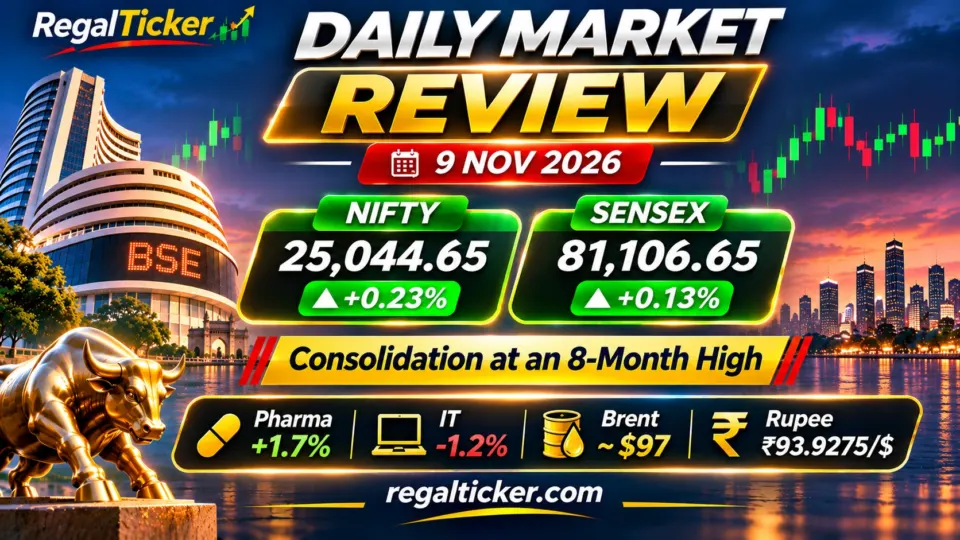
The Nifty 50 closed at 25,044.65, up 58.25 points or 0.23%, while the Sensex finished at 81,106.65, up 107.25 points or 0.13%. Both benchmarks ended at their highest closing levels since 27 February 2026.
That is very different from last week’s 2% daily surges.
The market is now digesting a seven-session rally of roughly 10.5% through Friday rather than chasing the index blindly higher. Thirteen of the 16 major sectors still ended in positive territory, but leadership rotated sharply: pharma gained about 1.7%, heavyweight financials rose around 0.8%, while information technology fell 1.2%.
Lower crude continued to help. Brent traded around $97 a barrel after President Donald Trump said renewed U.S. attacks on Iran were highly unlikely while peace talks continued. The rupee, however, finally ended its six-session winning streak, closing at 93.9275 per dollar after briefly touching a six-month high of 93.69.
The result was a constructive consolidation session: the market held the breakout, but investors became more selective.
⚡ Quick answer
Why did Nifty close higher on 9 November 2026?
Nifty finished 0.23% higher at 25,044.65 and Sensex rose 0.13% to 81,106.65 as lower crude oil, continued optimism around foreign inflows and strength in pharma and financials offset weakness in IT. The session looked more like consolidation after last week’s sharp rally than a fresh momentum burst. Thirteen of 16 major sectors advanced, but the market’s leadership narrowed and stock-specific earnings reactions became more important.
Key takeaways
Nifty 50 closed at 25,044.65, up 58.25 points or 0.23%.
Sensex closed at 81,106.65, up 107.25 points or 0.13%.
Both benchmarks ended at their highest closing levels since 27 February 2026.
Thirteen of the 16 major sector indexes finished higher.
Nifty Pharma gained about 1.7%.
Divi’s Laboratories rose 4.2%, extending its strong post-results move.
Gland Pharma gained 4.9% after upbeat quarterly results.
Heavyweight financials rose about 0.8%.
Nifty IT fell about 1.2%, making technology the main large-sector drag.
Midcaps gained around 0.6%, while smallcaps rose about 0.1%.
Brent traded around $97 per barrel as hopes for de-escalation in the Iran conflict improved.
The rupee closed at 93.9275 per dollar, ending a six-session winning streak.
Foreign investors have bought more than $4.1 billion of Indian equities so far in November.
Same-day 9 November provisional FII/DII cash data was not yet available when this review was prepared.
Citi raised its end-2027 Nifty target to 28,000, while HSBC upgraded India to overweight.
1. A small gain after a huge rally is not a weak session
Monday’s 0.23% Nifty gain looks ordinary compared with the previous week.
That is exactly why the session matters.
The market had already surged more than 10% over seven sessions through Friday. After a move of that size, one of the healthiest outcomes is not another vertical rise—it is the ability to hold gains without a sharp reversal.
Monday did that.
Nifty remained above 25,000, Sensex stayed above 81,000, midcaps remained positive and most sectors ended higher. The market also absorbed profit booking in technology without losing the broader breakout.
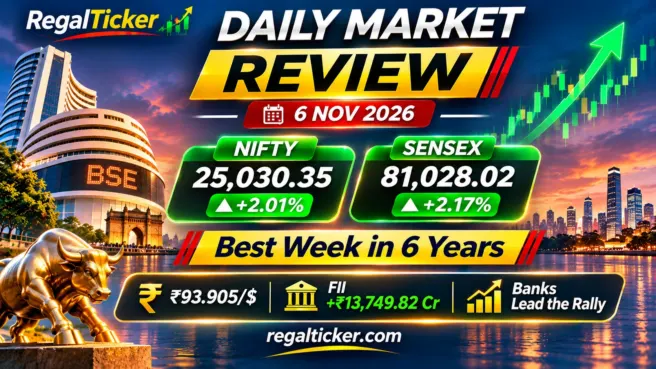
The 6 November Daily Market Review warned that Friday’s rally had become increasingly concentrated in banks and heavyweights. Monday did not completely solve that issue, but it showed the market can rotate leadership rather than simply depend on the same stocks every day.
2. Pharma became the clearest new leadership pocket
Pharma was the strongest major sector on Monday, rising about 1.7%.
Divi’s Laboratories gained 4.2%, adding to its strong post-results move, while Gland Pharma advanced 4.9% after upbeat quarterly results.
This is a useful change in leadership.
Last week’s rally was dominated by financials, Reliance and oil-sensitive sectors. Monday showed that earnings can still create stock-specific opportunities even when the index is no longer rising 2% a day.
That matters because the market is now entering a phase where company results may matter more than broad macro relief.
When an index has already re-rated sharply, the next leg often requires earnings confirmation.
3. IT remained the weak pocket
Information technology fell about 1.2%.
The weakness fits the global backdrop.
Technology-heavy markets suffered severe losses last week as investors questioned the returns from massive AI infrastructure spending, while higher U.S. interest-rate expectations made long-duration growth valuations more difficult to justify.
Indian IT services are not the same business as global semiconductor or hyperscale data-centre companies.
But they remain exposed to U.S. enterprise technology spending.
The key distinction is whether the AI selloff remains concentrated in expensive infrastructure names or turns into a broader slowdown in corporate technology demand.
For now, Indian IT is underperforming the domestic market rather than collapsing with it.
4. Financials continued to support the benchmark
Heavyweight financials rose about 0.8%.
That was important because technology weakness could otherwise have pulled the index lower.
Financials remain the central pillar of India’s November re-rating. They benefited from the return of foreign capital last week, lower crude, a stronger rupee and improving confidence in India’s macro outlook.
A healthy next phase would ideally involve banks holding their gains while other sectors—pharma, industrials, consumer stocks and selected midcaps—begin contributing more consistently.
That would reduce the benchmark’s dependence on a small group of heavyweight names.
5. Falling crude remained India’s biggest macro support
Brent crude traded around $97 per barrel on Monday.
The immediate catalyst was President Trump’s statement that renewed U.S. attacks on Iran were highly unlikely while talks to end the conflict continued.
A sustained fall in oil affects several parts of the economy at once: the import bill, current account, rupee, inflation, corporate margins and fuel-sensitive sectors.
Citi estimates that a $10-per-barrel decline in oil could reduce India’s current-account deficit by around 30–40 basis points, lower inflation by about 50 basis points and potentially lift Nifty earnings per share by roughly 2%.
Those estimates are not guaranteed outcomes. They show why the market reacted so strongly to lower crude last week.
Investor note
Oil below $100 helps, but geopolitical risk has not disappeared
Shipping attacks and Middle East tensions remain unresolved. A renewed escalation can quickly rebuild the oil risk premium. Investors should treat lower crude as a supportive variable, not as a permanently solved problem.
6. The rupee paused after six straight winning sessions
The rupee closed at 93.9275 per dollar, slightly weaker than Friday’s 93.9050.
During the session, it strengthened as far as 93.69—its best level in roughly six months.
The late reversal came as state-run banks bought dollars, potentially on behalf of the Reserve Bank of India.
The RBI may prefer to use stronger foreign inflows to rebuild reserves rather than allow the rupee to appreciate too quickly.
For equity investors, the bigger trend still matters more than one day. Lower oil and renewed foreign inflows have reduced pressure on the currency.
7. Foreign investors are back—but today’s cash number should not be guessed
Foreign inflows remain one of the strongest November themes.
Reuters reported that foreign investors have bought more than $4.1 billion of Indian shares so far this month.
That is already the largest monthly inflow since September 2024.
The turnaround is striking because India spent much of 2026 struggling with sustained foreign selling.
Lower oil, attractive relative valuations and the unwinding of crowded global AI trades have helped change that picture.
But this review does not assign a fresh 9 November FII/DII number because reliable same-day provisional cash data was not yet available when the article was prepared.
The latest monthly trend is clear. The exact daily flow should be added only after the exchange-level provisional figure is published.
8. Citi and HSBC added institutional support to the India re-rating
Two major global brokerages became more constructive on India.
Citi raised its end-2027 Nifty target to 28,000 and increased the forward earnings multiple used in its valuation framework from 17 times to 18 times.
HSBC upgraded India to overweight from neutral.
The reasons are familiar: lower oil, resilient earnings, bank-credit growth, rupee support and the possibility of capital rotating away from highly concentrated AI trades.
Investors should not treat brokerage targets as forecasts that must come true.
The important signal is that global institutions are reassessing India after months of underperformance.
9. Midcaps stayed stronger than smallcaps
Midcaps rose around 0.6%.
Smallcaps gained only about 0.1%.
That suggests risk appetite remains present, but investors are not buying every smaller stock indiscriminately.
After a very strong large-cap rally, that is probably healthier than a speculative surge across the entire market.
The next step is breadth.
If midcaps continue participating and smallcaps improve gradually, the rally becomes more balanced.
If the index keeps rising while the broader market weakens, concentration risk would increase again.
10. Global markets were calmer, but the AI risk has not disappeared
Asian markets rebounded on Monday after an exceptionally volatile technology week.
But global sentiment remains fragile.
Markets are waiting for results from AI-linked companies and trying to judge whether massive AI infrastructure spending can produce returns fast enough to justify the capital being committed.
That matters for India because the recent global rotation has favoured markets with less direct exposure to the most capital-intensive AI trades.
If technology stabilises without another liquidity shock, India can continue benefiting from relative allocation shifts.
If the AI correction spreads into a broad global risk-off event, India will eventually feel it too.
11. U.S. inflation is the next major global trigger
Strong U.S. jobs data increased expectations for another Federal Reserve rate hike in December.
Reuters reported futures pricing near an 81% probability.
That makes the upcoming U.S. CPI report important.
A hotter inflation print could lift Treasury yields and strengthen the dollar. That would pressure high-valuation technology stocks and could also challenge emerging-market currencies.
For India, the most favourable combination would be lower oil, stable global risk appetite, a softer dollar and continued foreign equity inflows.
12. What investors should watch next
The first signal is Nifty 25,000.
The index has now held above that level after a huge rally.
Second, watch IT. If technology stabilises while financials remain firm, the index becomes easier to sustain.
Third, watch pharma. Monday’s leadership becomes more meaningful if strong earnings continue translating into sector-wide participation.
Fourth, watch crude near $100. A sustained move below that level remains supportive for India.
Fifth, watch the rupee around 94. A stable currency would reinforce the foreign-flow story.
Sixth, watch confirmed FII/DII cash flows. The monthly trend is very strong, but continued daily buying would strengthen the re-rating argument.
Finally, watch breadth. After such a rapid seven-session advance, the next stage should ideally broaden rather than depend on a small group of heavyweights.
Frequently asked questions
Where did Nifty close on 9 November 2026?
Nifty 50 closed at 25,044.65, up 58.25 points or 0.23%.
Where did Sensex close?
Sensex closed at 81,106.65, up 107.25 points or 0.13%.
Was this another strong rally day?
No. The benchmarks ended only modestly higher. The session looked more like consolidation after the very sharp rally of the previous seven sessions.
Which sector led the market?
Pharma was the strongest major sector, gaining about 1.7%.
Which sector lagged?
Information technology fell about 1.2% and remained the main large-sector drag.
Which stocks stood out in pharma?
Divi’s Laboratories gained 4.2% and Gland Pharma rose 4.9%.
What happened to crude oil?
Brent traded around $97 per barrel as expectations of reduced U.S.-Iran escalation improved.
What happened to the rupee?
The rupee closed at 93.9275 per U.S. dollar, slightly weaker on the day after six consecutive gains, though it briefly touched a six-month high of 93.69.
Are FIIs still buying India?
Foreign investors have bought more than $4.1 billion of Indian equities so far in November, according to Reuters. Fresh 9 November provisional cash-market data was not yet available when this review was prepared.
What did Citi and HSBC say about India?
Citi raised its end-2027 Nifty target to 28,000, while HSBC upgraded India to overweight from neutral.
Verify through official sources
Official references
- Reuters — Indian equities — Final Nifty and Sensex closes, sector performance, foreign inflows and lower-crude catalyst.
- Reuters — Indian rupee — Rupee close at 93.9275, intraday six-month high, state-bank dollar buying and RBI context.
- Reuters — Citi and HSBC on India — Citi’s 28,000 Nifty target, HSBC overweight upgrade and oil/foreign-flow analysis.
- Reuters — Crude oil — Brent near $97 and de-escalation expectations around Iran.
- Reuters — Global markets — Asian market rebound, AI-sector risk, oil, dollar and upcoming U.S. inflation context.
Final takeaway
Holding the breakout may matter more than another 2% rally
Monday did not repeat last week’s dramatic gains.
That is not necessarily a weakness.
Nifty stayed above 25,000. Sensex closed at an eight-month high. Most sectors advanced. Pharma took over leadership while financials remained supportive. Lower crude kept the macro backdrop favourable.
The main weakness was IT, while the rupee finally paused after six consecutive gains.
The market has now moved from a momentum phase into a confirmation phase.
The next question is whether earnings, breadth and foreign flows can justify the higher index level.
If they do, the market does not need another explosive daily rally to remain constructive.
It only needs to keep the breakout intact while more sectors begin doing the work.
Educational disclaimer: This daily market review is for education and general market information only. It is not investment advice or a recommendation to buy, sell or hold any security, sector, commodity or currency. Institutional-flow figures may be revised after publication, and same-day cash-market data should be verified when official provisional numbers are released. Verify current exchange, regulator, company and market disclosures before making financial decisions.