
Oil relief turned into a full macro rally
Indian equities ended 5 November with one of their strongest sessions in months as the oil shock that had pressured India through much of the year suddenly reversed.
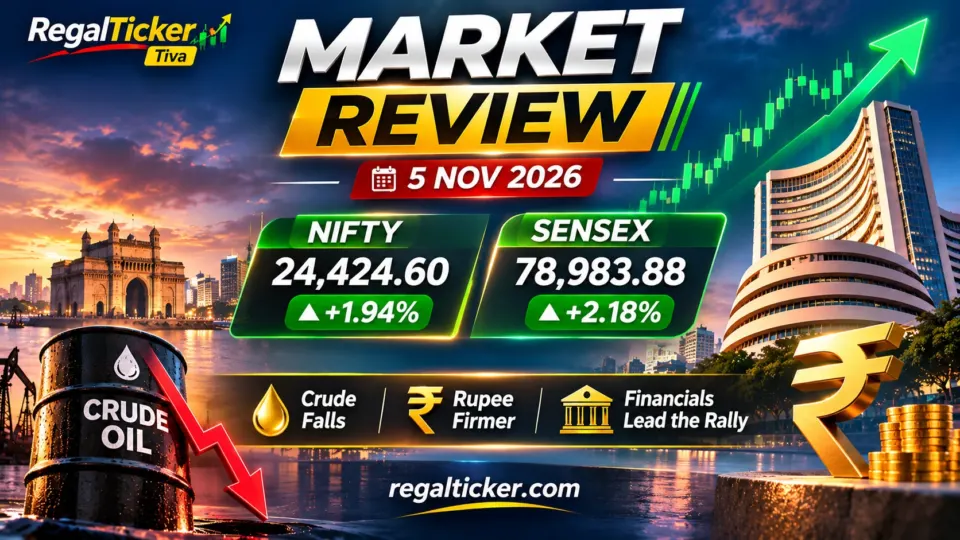
The Nifty 50 closed at 24,424.60, up 464.00 points or 1.94%, while the Sensex finished at 78,983.88, up 1,682.48 points or 2.18%. The move extended the benchmark winning streak to six sessions and took both indices back toward three-month highs.
The trigger was unusually clear. Brent crude had dropped 8.7% in the previous global session and traded near the mid-$90s on Thursday as investors interpreted the U.S. midterm result as reducing the probability of further escalation in the Iran conflict. For India, that is not simply an energy headline. Lower oil improves the import bill, inflation outlook, currency pressure, bond sentiment and margins for several fuel-sensitive sectors at the same time.
The rupee strengthened to 94.4750 per dollar, its best close in two weeks. Financials led the domestic rally, while autos, IT and consumer-facing names also participated. The one caution is that part of the move arrived through a large overnight gap, so the next test is whether foreign buying and lower crude remain in place after the initial relief trade.
⚡ Quick answer
Why did the Indian market jump on 5 November 2026?
Indian equities rallied because crude oil fell sharply after the U.S. midterm elections reduced fears of further Iran-war escalation, while foreign investors had already returned as strong buyers. Nifty closed 1.94% higher at 24,424.60 and Sensex rose 2.18% to 78,983.88. The rupee also strengthened to 94.4750 per dollar. Financials were the strongest large sector, while oil-sensitive stocks such as airlines, autos and paints benefited from the change in the energy backdrop.
Key takeaways
Nifty 50 closed at 24,424.60, up 464.00 points or 1.94%.
Sensex closed at 78,983.88, up 1,682.48 points or 2.18%.
The benchmarks extended their winning streak to six sessions.
Brent traded around the mid-$90s after an 8.7% fall in the previous global session.
The rupee closed at 94.4750 per dollar, its strongest close in two weeks.
Financials led the large-sector rally, with banking participation materially stronger than in the previous session.
Autos, IT and consumer-linked stocks also advanced as lower oil improved the domestic macro narrative.
Shriram Finance, IndiGo, Bajaj Finance and Asian Paints were among the prominent gainers during the session.
Healthcare and selected pharma names lagged the broader rally.
Foreign investors had bought about ₹7,284 crore in the previous session, their fourth consecutive day of net cash buying.
Domestic institutions sold about ₹3,712 crore on 4 November.
Fresh 5 November institutional cash-flow data was not yet available when this review was prepared.
Global markets remained split
U.S. and European equities rallied, while AI-sensitive Asian technology markets fell sharply.
Gold moved above $4,100 an ounce even as equities rose, reflecting lower yields and a softer dollar.
1. The index move was large, but the macro change was larger
A 1.94% Nifty gain is significant on its own.
What made Thursday more important was the number of variables moving in India’s favour at the same time.
Oil fell sharply.
The rupee strengthened.
Bond yields eased.
Foreign buying had already improved.
Financials rallied.
Oil-sensitive consumer and transport names gained.
That combination is different from a narrow earnings rally.
India imports most of its crude requirements, so the oil price works like a tax on the economy. When crude rises sharply, the transmission is usually negative: the import bill expands, dollar demand rises, inflation risk increases, the rupee comes under pressure and the market starts pricing a more difficult policy environment.
On 5 November, much of that chain moved in reverse.
That is why the market reaction was broader than a simple energy-sector trade.
The previous 4 November Daily Market Review showed that breadth had already improved even while IT lagged. Thursday added a stronger macro catalyst on top of that internal market recovery.
2. Crude below $100 changed the India risk calculation
Brent’s drop was the dominant external driver.
The oil benchmark fell 8.7% in the previous session and traded near $94–$95 on Thursday. Reuters reported that markets were reassessing the probability of continued U.S. escalation in the Iran conflict after Democrats gained control of Congress in the midterm elections.
Oil had been one of India’s biggest macro constraints through September and October.
That matters because expensive crude affects more than fuel companies.
It influences aviation turbine fuel, transport costs, paint and chemical inputs, inflation expectations, the current account, the fiscal position, corporate margins and household purchasing power.
The sharp rally in IndiGo and Asian Paints therefore had a logical macro connection. Airlines benefit from lower fuel costs, while paint companies are sensitive to crude-linked raw materials.
Autos also gained because lower energy costs improve the broader consumer and inflation backdrop even when the direct earnings effect varies by company.
The key point is that Thursday’s rally was not based on the assumption that $94 crude is permanent. It was based on the fact that the market’s oil-risk distribution changed abruptly.
Investor note
One day of oil relief does not erase geopolitical risk
The India-positive transmission from lower crude is powerful, but it can reverse quickly if the Iran conflict escalates again or supply disruptions return. Investors should treat the oil move as a macro tailwind that needs confirmation, not as a permanently solved risk.
3. The rupee finally received help from the same direction
The rupee closed at 94.4750 per dollar, up about 0.2% and at its strongest close in two weeks.
That move was modest compared with the equity rally, but it matters.
A stronger rupee reduces imported inflation pressure and improves foreign-investor returns when translated back into dollars. It can also reduce the need for defensive currency positioning if global energy prices stay lower.
Reuters noted that the currency was still held back by dollar demand from foreign and state-run banks, likely on behalf of clients. That is a useful reminder that lower oil does not automatically produce a straight-line rupee rally.
The currency still faces structural pressure from India’s external financing needs, global yields and the direction of foreign flows.
But Thursday was the first session in some time where oil, equities, bonds and the rupee all pointed toward the same improvement in India’s macro risk premium.
4. Financials became the strongest index engine
Financials were among the biggest beneficiaries of the session.
The banking and financial-services complex had already been participating in the November rebound, but Thursday’s move was stronger because the macro backdrop improved as well.
Lower oil can help banks indirectly through inflation, rates, currency stability and better corporate cash-flow expectations.
Moneycontrol’s closing market feed showed Bank Nifty up more than 2% and Nifty IT also nearly 2% higher.
Private banks such as ICICI Bank and Axis Bank were strong during the session, while financing names including Shriram Finance and Bajaj Finance were among the prominent gainers.
This matters because a sustainable Nifty rally is easier to maintain when banks participate. Financials carry substantial benchmark weight and are closely tied to domestic credit, consumption and investment conditions.
The next question is whether this becomes a multi-session re-rating or simply a relief response to lower energy prices.
5. Autos, airlines and paints were the cleanest oil-sensitive winners
The day’s stock leadership told the same story as the macro data.
IndiGo was among the strongest large-cap gainers as investors priced in lower aviation fuel costs.
Asian Paints also rose strongly because crude-linked inputs affect raw-material economics.
Autos gained as the market reassessed the inflation and household-spending environment.
Shriram Finance and Bajaj Finance reflected the financial-sector component of the trade.
The useful distinction is that lower crude does not help every company equally.
For airlines, fuel is a direct operating cost.
For paints, the transmission runs through petrochemical inputs.
For auto companies, the impact is more indirect through inflation, fuel affordability, household sentiment and interest-rate expectations.
Investors should therefore avoid treating “oil down” as a universal earnings upgrade. The size and timing of the benefit depend on each business model.
6. The rally was broad, but not perfectly uniform
Market breadth stayed strongly positive.
Late-session data showed roughly 2,800 advancing shares against around 600 declines, confirming that the move extended beyond the largest index weights.
Midcaps and smallcaps also traded higher.
But healthcare and parts of pharma lagged, while energy producers faced a less favourable price backdrop because lower crude can reduce upstream realisations.
That divergence is healthy.
A market where every stock rises for the same reason usually deserves more caution than a market where investors are distinguishing winners and losers from the same macro shock.
Thursday’s internal structure therefore looked constructive: financials and oil-sensitive users of energy benefited, while some producers and defensives lagged.
7. Foreign buying had already changed the tone before Thursday
Foreign investors bought about ₹7,284 crore of Indian shares in the cash market on 4 November.
Domestic institutions sold about ₹3,712 crore.
That was the fourth consecutive session of foreign net buying and took November’s early FII inflow above ₹17,000 crore in provisional cash-market data.
The contrast with October is important.
The October Monthly Market Review showed that FIIs sold roughly ₹45,000 crore during the month even as large-cap indices recovered.
November has started differently.
Foreign investors are buying while the rupee is improving and crude is falling.
Those three variables can reinforce each other.
However, 5 November’s FII/DII figures were not yet published when this review was prepared. The day’s price action should therefore not be presented as proof of fresh same-day institutional buying until the exchange data is available.
8. Global markets sent two different messages at once
The global backdrop was supportive for India, but not uniformly bullish.
U.S. markets rallied sharply after the midterm result. The Dow rose about 3%, while the S&P 500 gained roughly 1.6% and the Nasdaq advanced around 1.4%.
European equities also moved higher as lower oil, lower bond yields and reduced political uncertainty supported risk appetite.
Asia was much more divided.
South Korea’s KOSPI fell sharply and Taiwan also dropped as investors worried that Democratic gains in the U.S. could lead to tighter scrutiny of AI data-centre projects, power demand and local infrastructure costs.
That created an unusual cross-market rotation:
lower oil helped India and consumer-facing markets,
while political risk around AI infrastructure hurt semiconductor-heavy markets.
The lesson for Indian investors is that “global risk-on” is too simple a description of the day.
The real trade was a rotation away from some AI and energy exposures toward consumers, financials, autos, renewables and oil-importing economies.
9. Gold rising with equities is not a contradiction
Gold moved above $4,100 an ounce even while global equities rallied.
That can look contradictory, but the drivers were different.
Equities responded to lower oil and reduced political uncertainty.
Gold responded to lower Treasury yields and a weaker U.S. dollar.
This is why cross-asset signals should be read through their transmission channels rather than through a simple “risk-on versus risk-off” label.
For India, the combination of softer oil and a weaker dollar is particularly helpful because both can reduce pressure on the external balance.
10. The six-session rally has now repaired a large part of October’s damage
The Nifty’s rise to 24,424.60 means the index has gained roughly 7.6% from the 28 October close over the six-session winning streak.
That is a powerful rebound.
It has also changed the technical and behavioural backdrop.
Investors who were reducing risk during October are now seeing stronger benchmarks, better breadth, foreign buying and a more favourable oil environment at the same time.
But rapid rallies create their own risk.
Valuations can re-rate faster than earnings.
Short covering can amplify moves.
A large gap-up can pull forward returns.
And the market can become dependent on one external assumption—in this case, that lower crude and reduced Iran-war escalation will persist.
The latest weekly market review is useful context because it shows how quickly the market moved from late-October repair into a much stronger November rally.
11. What investors should watch next
The first variable is crude.
If Brent stays below $100, India’s macro backdrop improves materially. A rapid move back above $100 would challenge Thursday’s strongest narrative.
Second, watch the rupee.
A sustained move stronger than the recent 94.5–95 zone would reinforce the idea that foreign flows and lower oil are improving the external picture.
Third, watch financials.
The rally becomes more durable if private banks, financial services and credit-sensitive names continue participating.
Fourth, watch breadth.
A healthy continuation should keep midcaps and smaller companies involved without turning into indiscriminate speculation.
Fifth, watch official FII/DII data.
The four-session foreign-buying streak is already meaningful. Another large inflow would strengthen the case that global investors are rebuilding India exposure rather than merely covering shorts.
Sixth, watch Asian technology markets.
The sharp fall in Korean and Taiwanese semiconductor shares shows that global AI sentiment remains fragile even while Indian indices rally.
Finally, watch volatility.
The market has moved very quickly. A sharp rise in India VIX alongside higher indices would suggest investors are paying more for protection even as prices climb.
Frequently asked questions
Where did Nifty close on 5 November 2026?
Nifty 50 closed at 24,424.60, up 464.00 points or 1.94%.
Where did Sensex close?
Sensex closed at 78,983.88, up 1,682.48 points or 2.18%.
Why did the Indian market rally so strongly?
The biggest catalyst was the sharp fall in crude oil prices after the U.S. midterm result reduced fears of further Iran-war escalation. A stronger rupee, returning foreign buying and broad financial-sector strength reinforced the move.
What happened to the rupee?
The rupee strengthened to 94.4750 per U.S. dollar, its strongest close in two weeks.
Which sectors led the rally?
Financials were among the strongest large sectors. Autos, IT and several oil-sensitive consumer businesses also gained strongly.
Which stocks were among the major gainers?
Shriram Finance, IndiGo, Bajaj Finance and Asian Paints were among the prominent gainers during the session.
Did FIIs buy on 5 November?
Fresh 5 November cash-market institutional-flow data was not yet available when this review was prepared. The latest confirmed provisional data showed FIIs bought about ₹7,284 crore on 4 November while DIIs sold about ₹3,712 crore.
What is the biggest risk after today’s rally?
A reversal in crude oil, renewed escalation in the Iran conflict, weaker foreign flows or a sharp rise in volatility could challenge the rally after its rapid six-session advance.
Verify through official sources
Official references
- Moneycontrol — Closing benchmark, sector and cross-asset market feed for 5 November 2026.
- Reuters — Indian equities — Indian benchmark rally, crude-oil catalyst, foreign inflows and sector participation.
- Reuters — Rupee — Rupee close at 94.4750 per dollar, oil backdrop and foreign-flow context.
- Reuters — Global markets — U.S., European and Asian market rotation, oil, gold, dollar and AI/data-centre risk.
- Moneycontrol — Institutional flows — 4 November provisional FII and DII cash-market flows.
- HDFC Sky — Sector and stock-mover cross-checks during the 5 November session.
Final takeaway
The rally became a macro trade, not just an index rebound
The 5 November session changed the character of India’s November recovery.
The previous five sessions had already improved breadth, foreign flows and benchmark momentum. Thursday added the missing macro catalyst: a dramatic fall in crude oil.
That helped the rupee, financials, autos, airlines, paints and overall risk appetite at the same time.
The result was a 1.94% Nifty gain and a 2.18% Sensex jump, extending the winning streak to six sessions.
The bullish case is now stronger than it was a week ago, but it is also more dependent on oil staying lower and foreign flows remaining constructive.
That is the next test.
If Brent remains contained, the rupee stays firm and financials continue to lead, the rally has room to become more durable. If oil reverses sharply, Thursday’s strongest macro tailwind can disappear just as quickly as it arrived.
Educational disclaimer: This daily market review is for education and general market information only. It is not investment advice or a recommendation to buy, sell or hold any security, sector, commodity or currency. Market prices, institutional-flow figures and cross-asset levels may be revised after publication. Verify current exchange, regulator and company disclosures before making financial decisions, and consider valuation, liquidity, diversification and your own risk tolerance.