The rally shifted from earnings relief to a genuine foreign-flow recovery
Indian equities extended their rebound for a fourth consecutive session on 3 November, but the character of the move changed.
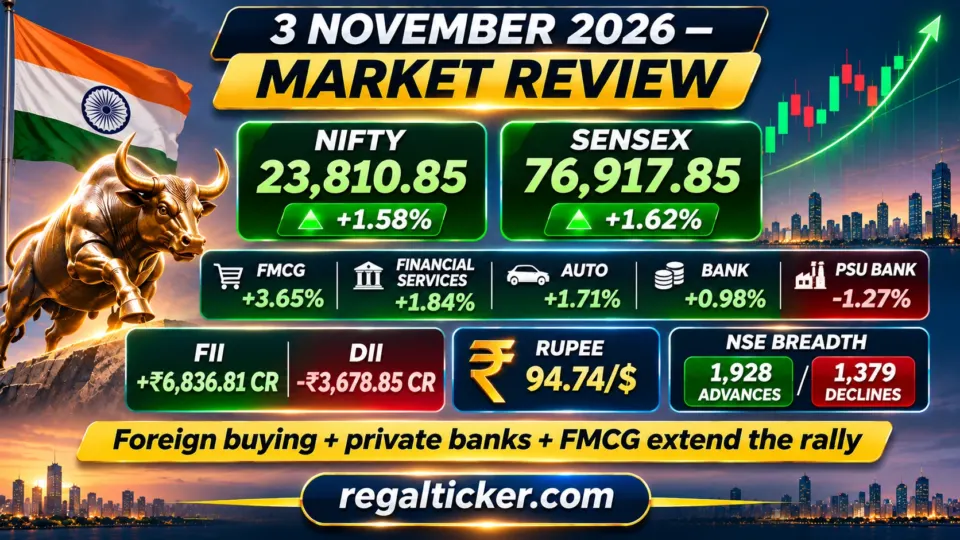
The Nifty 50 closed at 23,810.85, up 370.05 points or 1.58%, while the Sensex finished at 76,917.85, up 1,225.07 points or 1.62%.
Both benchmarks were about 5% higher over four sessions and reached two-month highs.
The most important development was institutional participation. Foreign institutional investors bought a net ₹6,836.81 crore in the cash market, while domestic institutions sold ₹3,678.85 crore.
That took November’s first two-session FII buying to roughly ₹9,951 crore, a sharp reversal from October, when foreign investors sold more than ₹45,000 crore.
The sector picture also improved. FMCG gained 3.65%, financial services rose 1.84%, auto gained 1.71%, and Bank Nifty advanced 0.98%. The main weak pocket was PSU banking, down 1.27%.
This was therefore more than another Reliance-led rebound.
It was a foreign-flow + private-bank + consumer-led continuation rally, with better breadth and a healthier mix of index contributors.
⚡ Quick answer
Why did the Indian market rise on 3 November 2026?
Indian equities rose because strong earnings, lower oil compared with late October, and returning foreign institutional buying improved risk appetite. FIIs bought ₹6,836.81 crore in the cash market, while private banks and FMCG stocks led the index higher. HDFC Bank rose about 3.6%, ICICI Bank about 2.7%, and FMCG was the strongest major NSE sector. Nifty closed 1.58% higher and Sensex 1.62% higher.
Key takeaways
Nifty 50 closed at 23,810.85, up 1.58%.
Sensex closed at 76,917.85, up 1.62%.
The benchmarks completed a fourth consecutive positive session.
Nifty and Sensex were roughly 5% higher over four sessions and reached two-month highs.
FIIs bought ₹6,836.81 crore in the cash market.
DIIs sold ₹3,678.85 crore.
November-to-date FII buying reached about ₹9,951 crore after only two sessions.
FMCG was the strongest major sector, up 3.65%.
Financial Services gained 1.84%.
Nifty Auto gained 1.71%.
Bank Nifty rose 0.98%.
Nifty Midcap 100 gained 1.06%.
Nifty IT rose 0.34%.
PSU Bank fell 1.27%, the main weak sector.
HDFC Bank rose about 3.6% and ICICI Bank about 2.7%.
Marico jumped about 10% after beating quarterly profit estimates.
The rupee strengthened to 94.74 per dollar from 94.90.
Brent traded near $106 per barrel after rebounding modestly from the previous session’s sharp fall.
NSE breadth remained positive at roughly 1,928 advances versus 1,379 declines.
1. Foreign buying became the biggest story of the session
The 3 November rally was important because the source of demand changed.
During October, foreign investors sold heavily while domestic institutions absorbed much of the pressure.
November opened differently.
FIIs bought ₹3,114.68 crore on 2 November and another ₹6,836.81 crore on 3 November.
That took the two-day total to ₹9,951.49 crore.
DIIs, meanwhile, were net sellers on both sessions:
- 2 November: -₹392.20 crore
- 3 November: -₹3,678.85 crore
That reversal matters.
A market rising while foreign institutions are buying is structurally different from a market being held up primarily by domestic absorption.
It can improve large-cap liquidity, banking-sector participation, rupee sentiment, index breadth and confidence that India is becoming competitive again versus other emerging markets.
The October FPI outflow analysis provides the contrast: oil, valuation and global yields had kept foreign investors cautious through much of the previous month.
2. Private banks finally became proper leaders
Banking participation was one of the confirmation signals missing from the 2 November rally.
That changed on Tuesday.
HDFC Bank rose about 3.6% and ICICI Bank about 2.7%.
Reuters reported that private banks gained around 2% as investors responded to stronger earnings expectations and improving loan-growth forecasts.
HSBC analysts raised their fiscal-2027 Indian bank-loan growth forecast to 18% from 14%, citing better earnings prospects and attractive valuations.
Bank Nifty itself gained 0.98% to 55,540.05.
That was not the strongest sector return of the day, but it was significant because financials carry large index weights.
When banks participate, benchmark rallies generally become less dependent on one stock or one defensive sector.
3. FMCG was the surprise sector leader
Nifty FMCG jumped 3.65%, making it the strongest major NSE sector.
The move was broad enough to include several household-consumption names.
Nestle India gained about 4.5%.
Tata Consumer rose about 4.3%.
Hindustan Unilever gained more than 3%.
Marico surged about 10% after quarterly profit beat market expectations.
That performance matters because FMCG had not been the obvious leadership trade during October.
The sector is now being supported by better festival demand, selective earnings upgrades, lower near-term crude-linked input pressure, defensive earnings visibility and rotation away from crowded technology trades.
But the sector is not risk-free.
Rural demand, commodity costs and weather-linked agricultural income still matter.
The 3 November move therefore looks more like a re-rating of selected consumer names than proof that every FMCG company has entered a new growth cycle.
4. Auto stayed strong as domestic cyclicals participated
Nifty Auto rose 1.71%.
That extended the positive tone from the previous session.
The sector benefited from healthy October vehicle-sales data, lower crude than late-October highs, strong festival demand and improving market risk appetite.
Eicher Motors and Bajaj Auto were among the stronger large-cap names.
The important point is that the rally was no longer confined to financials or defensive consumer stocks.
Autos, midcaps and other domestic cyclicals also participated.
That is a healthier pattern than the narrow IT-led recovery seen during much of October.
5. The broader market remained constructive
Nifty Midcap 100 gained 1.06%.
NSE breadth showed roughly 1,928 advancing stocks against 1,379 decliners.
That was positive, although not as strong as the exceptionally broad 2 November session.
So the correct interpretation is:
breadth remained supportive, but leadership became more concentrated in large private banks and consumer names.
This distinction matters.
A rally can remain healthy even if every stock does not rise.
What matters is whether enough sectors and market-cap segments are participating to prevent the index from being carried by one or two heavyweights.
The 2 November Daily Market Review showed the first broad improvement. The 3 November session added stronger institutional confirmation.
6. IT recovered modestly, but was no longer the market driver
Nifty IT gained 0.34%.
That was an improvement from the previous session’s decline, but the sector was clearly not the main source of Tuesday’s strength.
This is significant after IT’s spectacular 17.7% October gain.
The October Monthly Market Review showed how concentrated the previous month’s recovery had been in technology.
November is beginning differently.
Banks, FMCG and autos are doing more of the work.
That is positive for breadth because it reduces the market’s dependence on one sector.
At the same time, global AI-capex concerns remain capable of creating volatility in Indian IT because U.S. technology spending remains a major earnings driver.
7. PSU banks diverged sharply from private banks
Nifty PSU Bank fell 1.27% even as private banks rallied.
That was one of the most interesting divergences of the day.
It shows why “banks were strong” is too broad a description.
Private banks benefited from improving growth expectations and valuation support.
PSU banks faced profit-taking and more stock-specific reactions.
SBI, for example, fell roughly 1.8% even after reporting strong quarterly profit as investors assessed the quality of earnings and exceptional items.
That distinction is useful for investors.
Sector labels can hide very different earnings drivers, ownership structures and valuation expectations.
8. The rupee finally joined the risk-on move
The rupee strengthened to 94.74 per dollar from 94.90 in the previous session.
It briefly reached about 94.62 before paring part of the gain.
Lower oil relative to last week and improving equity flows supported the currency.
The move matters because the rupee had not fully participated in the 2 November equity rally.
Tuesday was different.
Foreign buying in equities and a more favourable oil backdrop improved the currency equation.
Still, the rupee remained sensitive to oil prices, U.S. political developments, importer dollar demand, central-bank intervention and global risk appetite.
So the currency move was constructive, not decisive.
9. Crude remained lower than October’s danger zone
Brent crude traded around $106 per barrel during the session.
It had fallen sharply in the previous session as markets priced in the possibility of diplomatic progress around Iran, then rebounded modestly on Tuesday.
The key fact for India is not whether Brent rose or fell one dollar intraday.
It is that crude remained materially below the near-$118 level seen at the end of October.
That relief supports the rupee, inflation expectations, transport costs, corporate margins and India’s external balance.
But geopolitical risk remains unresolved.
The Crude Oil and Hormuz analysis remains important because a renewed supply shock could quickly reverse this macro tailwind.
10. India outperformed a subdued global session
The 3 November rally stood out because Asian markets were not uniformly strong.
Reuters noted that India outperformed much of the region.
That strengthens the argument that domestic factors were driving the move: earnings, bank re-rating, consumer-sector strength, foreign institutional buying and lower oil than late October.
This is a better setup than a rally caused only by a global risk-on move.
It means India was attracting incremental capital on its own fundamentals.
The test is whether that relative strength can persist once global volatility rises again.
11. What investors should watch next
The first variable is foreign flows.
Two strong buying sessions have changed the November tone, but investors need to see whether FIIs continue buying after the market’s four-session rebound.
Second, watch private banks.
HDFC Bank and ICICI Bank were major contributors on 3 November. If banks remain strong, the rally has a better chance of broadening further.
Third, watch FMCG.
The sector’s 3.65% jump was large enough to raise expectations quickly.
Fourth, watch PSU banks.
Their divergence from private banks could widen if investors increasingly differentiate on earnings quality and return ratios.
Fifth, watch crude.
India still benefits materially from Brent staying closer to $105–$110 than $115–$120.
Sixth, watch breadth.
A healthy market should keep midcaps and smaller stocks participating even if leadership rotates.
Finally, watch the rupee.
A sustained foreign-flow recovery should eventually become visible in currency stability as well as equity prices.
Frequently asked questions
Where did Nifty close on 3 November 2026?
Nifty 50 closed at 23,810.85, up 370.05 points or 1.58%.
Where did Sensex close?
Sensex closed at 76,917.85, up 1,225.07 points or 1.62%.
How much did FIIs buy?
FIIs bought a net ₹6,836.81 crore in the cash market on 3 November.
What did DIIs do?
DIIs sold a net ₹3,678.85 crore.
Which sector performed best?
Nifty FMCG was the strongest major NSE sector, gaining 3.65%.
How did banks perform?
Bank Nifty rose 0.98%, while private banks were stronger. HDFC Bank gained about 3.6% and ICICI Bank about 2.7%.
Which banking segment lagged?
Nifty PSU Bank fell 1.27%, diverging sharply from private banks.
How was market breadth?
Roughly 1,928 NSE stocks advanced and 1,379 declined.
What happened to the rupee?
The rupee strengthened to 94.74 per dollar from 94.90 in the previous session.
What should investors watch next?
FII flows, private-bank leadership, FMCG follow-through, PSU-bank weakness, crude oil, market breadth and the rupee are the main variables.
Verify through official sources
Official references
- Reuters — Indian shares extend rally as earnings and cooling crude draw foreign buyers — Closing benchmark performance, four-session rally, sector participation, private-bank leadership and major stock moves.
- Moneycontrol — FII and DII cash activity — 3 November and November-to-date institutional cash-market flows.
- Moneycontrol — Indian market action — NSE breadth and closing index levels.
- Moneycontrol — Nifty Bank — Bank Nifty close at 55,540.05 and 0.98% daily gain.
- Business Standard — Sensex constituents — Sensex close and individual large-cap stock performance.
- Business Standard — Nifty constituents — Nifty close, sector data and major gainers.
- Reuters — Rupee closes at 94.74 — Rupee close, intraday range, oil rebound and currency-market drivers.
- Business Standard — Markets extend gains for fourth day — Sector leadership, FMCG strength and PSU-bank weakness.
Final takeaway
The 3 November rally finally had the confirmation October was missing
October’s recovery was narrow and depended heavily on IT.
The first November session broadened the rally.
The second added something even more important: foreign capital.
FIIs bought nearly ₹6,837 crore on 3 November, private banks became major leaders, FMCG surged and midcaps remained positive.
That is a healthier structure than a benchmark rally carried by one sector.
But the market has also risen about 5% in four sessions.
The next test is therefore not whether Nifty can rise another day.
It is whether foreign buying, bank leadership and positive breadth can survive the first meaningful bout of profit-taking.
Educational disclaimer: RegalTicker provides educational and informational content only. This daily market review is not investment advice or a recommendation to buy, sell or hold any security, sector or index. Market data, institutional-flow figures, commodity prices and currency levels can change or be revised. Verify current exchange, regulator and company disclosures before making financial decisions and consider valuation, liquidity, diversification and your own risk tolerance.