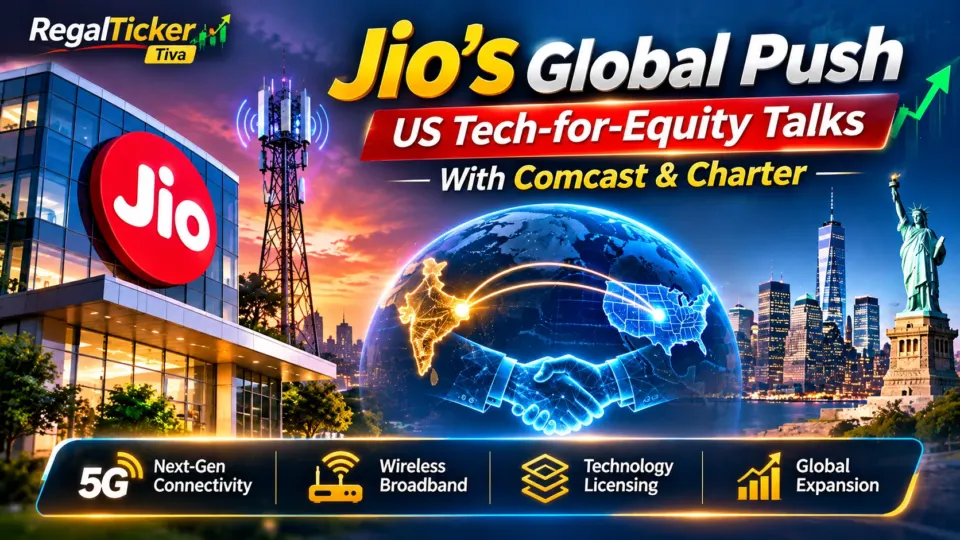
The story is bigger than a US broadband deal
Jio Platforms is reportedly exploring a different route to international expansion: export the technology, take an economic interest in the operator, and avoid the cost of building an overseas consumer network from scratch.
Reuters reported that Jio has discussed licensing its unlicensed-band radio, or UBR, broadband technology to Comcast and Charter Communications in the United States in exchange for possible equity stakes. The discussions are not a completed transaction, no timetable has been announced, and the companies declined to comment. That distinction matters.
For investors, however, the strategic question is already useful. If Jio can turn infrastructure and software developed for India into a repeatable licensing platform, part of its future growth could come from technology exports rather than only subscriber additions, tariff increases and domestic broadband expansion.
⚡ Quick answer
What could the reported Jio–Comcast–Charter talks mean?
The reported talks suggest Jio is testing a capital-light international model in which overseas operators could license Jio technology instead of Jio building networks abroad itself. If such partnerships are signed and scaled, they could create licensing income, strategic equity stakes and a new valuation narrative around Jio’s technology assets. But the talks remain preliminary, and investors should not price in a deal before binding agreements, economics and deployment milestones are disclosed.
Key takeaways
Reuters reported that Jio has discussed UBR technology licensing with Comcast and Charter in exchange for possible equity stakes.
The talks are not a completed deal, and no transaction timetable has been announced.
Jio’s UBR system uses unlicensed spectrum and tower or rooftop transmitters to deliver broadband without a traditional cable connection.
A licensing model could let Jio expand internationally with less capital than building and operating foreign consumer networks itself.
The investor test is not the headline partnership count; it is whether licensing produces durable revenue, cash flow and attractive returns on capital.
Jio’s recent listing makes any new global monetisation channel more relevant to public-market valuation.
1. What Reuters actually reported
The reported structure is unusual enough to deserve careful wording.
According to Reuters, Jio has held discussions with Comcast and Charter Communications about licensing its UBR broadband technology. In return, Jio could potentially receive equity stakes in the US operators rather than only cash licensing fees.
That does not mean either company has agreed to a final transaction. Reuters also reported that no deal timetable has been set and the companies declined to comment.
This is therefore a strategic-development story, not a completed corporate action.
The same report said Jio had previously explored a partnership with South Africa’s MTN, but those talks ended over valuation and licensing disagreements. That history is a useful reminder that international technology negotiations can fail even when the commercial logic looks attractive.
2. Why UBR matters to the business model
UBR is important because it changes the economics of the broadband discussion.
Traditional fixed broadband usually depends on extensive fibre or cable infrastructure reaching homes and businesses. Jio’s UBR approach uses unlicensed wireless frequencies and transmitters placed on towers or rooftops to deliver high-speed connectivity without requiring the same last-mile cable build.
That can make deployment faster or cheaper in some locations, although actual economics depend on spectrum conditions, network density, backhaul, equipment costs, interference, customer equipment and local regulation.
Reuters reported that Jio already has more than 6.5 million users on UBR-powered services. The number does not prove the technology will work equally well in US markets, but it gives Jio a domestic operating base from which to demonstrate scale.
For investors who want to separate a technology narrative from business economics, the Fundamental Analysis framework is more useful than treating every new market as automatic revenue.
3. Why Comcast and Charter would be strategically significant
Comcast and Charter are not random overseas names.
Both are major US broadband operators facing a market in which fibre networks and fixed-wireless offerings have increased competitive pressure. A technology that can extend broadband coverage without a full wired build could therefore be strategically interesting if it delivers the required speed, reliability and cost economics.
For Jio, the attraction is different.
Instead of spending heavily to establish a US retail brand, acquire customers, lease spectrum, build a full network and manage local operations, Jio could attempt to monetise its technology through an incumbent operator that already owns distribution, customer relationships and billing systems.
That is why the reported equity component matters. A successful technology-for-equity model could align Jio’s economics with the operator’s deployment success rather than limiting the relationship to a one-time equipment sale.
But equity consideration also creates complexity. Investors would need to understand the valuation at which any stake is received, restrictions on ownership, accounting treatment, liquidity and whether the equity is truly more valuable than cash licensing income.
4. Jio is trying to export technology, not recreate Reliance Jio abroad
Reuters reported that Jio wants to work with roughly 10 to 15 international partners rather than build foreign networks itself.
That is a materially different strategy from geographic expansion through direct ownership.
A direct telecom expansion is usually capital intensive. It can require spectrum purchases, towers, fibre, customer acquisition, regulatory approvals and years of operating investment before scale economics become visible.
A technology-licensing approach can shift more of that capital burden to the local operator.
If it works, Jio could potentially earn from software, network architecture, equipment integration, licensing, services or strategic stakes while keeping its own overseas capital commitment lower.
The strategic opportunity is therefore not simply “Jio enters America.” It is whether Jio can convert a system built for India into a repeatable telecom technology product for other markets.
Investor note
Capital-light does not automatically mean high-return
A licensing model can reduce capital requirements, but investors still need evidence on pricing, implementation costs, support obligations, revenue recognition and the value of any equity received. A lower-capex model is attractive only if it produces strong cash conversion and acceptable returns.
5. Why this matters more after Jio’s IPO
Jio is now being valued directly by public-market investors.
NSE data shows Jio Platforms listed on 28 October 2026 at an issue price of ₹1,119, with a strong first-day performance. That listing separated the Jio investment case from being only one part of Reliance Industries’ broader sum-of-the-parts story.
RegalTicker’s Jio Platforms IPO analysis covers the business scale, financial metrics and valuation questions behind the listing.
The US licensing story adds another possible growth layer to that framework.
Before the IPO, international technology exports could be viewed mainly as optionality inside a large private digital platform. After listing, investors can ask more directly whether such exports become a visible revenue line, improve return on invested capital or justify a higher long-term valuation multiple.
The market should still demand evidence. A reported discussion has almost no value by itself if it never becomes a signed contract.
6. What could change the valuation case
There are several ways a successful overseas licensing model could improve Jio’s investment case.
First, it could diversify growth beyond India’s subscriber and tariff cycle.
Second, it could monetise technology already developed for Jio’s domestic network.
Third, it could improve the mix of capital-light revenue if licensing and software economics are attractive.
Fourth, strategic equity stakes could create additional asset value if partner businesses grow.
Fifth, success with one major operator could make later international sales easier because telecom buyers prefer proven deployments.
But the reverse is equally important.
If partnerships require heavy customisation, large support costs, financing commitments or unattractive equity terms, the model may not be as capital-light as the headline suggests.
If local regulators or network conditions limit deployment, a technically successful Indian product may still struggle to scale abroad.
And if licensing revenue remains small relative to Jio’s core connectivity business, the strategic narrative may matter more than the financial contribution for several years.
7. What investors should watch next
The next useful evidence is not another rumour. It is documentation.
Watch for a signed commercial agreement, named technology scope, deployment geography, pilot size, licensing economics, ownership terms and any timeline for customer rollout.
Also watch how Jio reports international technology revenue after listing. A new segment, clearer disclosure or management guidance would make it easier to judge whether this is becoming a repeatable business line.
Finally, track whether Jio announces additional partners. Reuters reported an ambition to work with 10 to 15 international operators. One successful agreement would validate interest; several commercial deployments would begin to test whether Jio has a scalable export platform.
The Risk Management framework is relevant here because newly listed growth stories can attract valuation enthusiasm before the economics are proven. Investors should separate optionality from earnings already visible in the financial statements.
Frequently asked questions
Has Jio signed a deal with Comcast or Charter?
No completed deal has been publicly announced. Reuters reported that Jio has discussed licensing its UBR technology to Comcast and Charter in exchange for possible equity stakes, but no timetable has been set and the companies declined to comment.
What is Jio’s UBR technology?
UBR refers to an unlicensed-band radio broadband system that uses unlicensed wireless frequencies and transmitters on towers or rooftops to deliver high-speed connectivity without relying on a traditional last-mile cable connection.
Why would Jio prefer licensing instead of building networks abroad?
Licensing can potentially reduce the capital required for international expansion because the local operator already has customers, distribution, infrastructure and regulatory relationships. The actual economics still depend on contract terms and deployment costs.
Why is the equity component important?
If Jio receives shares rather than only cash fees, it could participate in the partner’s future value creation. That can also introduce valuation, liquidity, governance and accounting risks that investors would need to assess.
Does this change the Jio investment thesis immediately?
Not yet. The talks are preliminary. The investment thesis changes only when investors can evaluate signed contracts, economics, deployment progress and the resulting effect on revenue, cash flow and returns.
Verify through official sources
Official references
- Reuters — Report on Jio’s discussions with Comcast and Charter, UBR technology, international-partner strategy and the earlier MTN talks.
- SEBI — Official Jio Platforms red herring prospectus filing dated 15 October 2026.
- NSE IPO Tracker — Official listing record showing Jio Platforms’ 28 October 2026 listing, issue price and listing-day performance.
- NSE Issue Information — Official Jio Platforms IPO issue-period information.
Final takeaway
The real test is whether Jio can turn Indian network technology into a repeatable export business
The reported Comcast and Charter discussions matter because they point to a different kind of international expansion. Jio may not need to recreate its Indian telecom model country by country if it can license proven technology to operators that already own customers and infrastructure.
That could become a valuable, capital-light growth engine. It could also remain only strategic optionality if negotiations fail or overseas deployments never become financially meaningful.
For public-market investors, the evidence threshold should therefore stay high: signed agreements, transparent economics, measurable deployments and cash-generating revenue matter more than the number of partnership headlines.
Educational disclaimer: This article is for education and general market information only. It is not investment advice, a recommendation to buy or sell Jio Platforms or any other security, or a prediction that the reported discussions will become binding agreements. Commercial negotiations can change or end without a transaction. Verify current company, exchange and regulatory disclosures before making financial decisions.