
November began with a broad relief rally, but the trigger was concentrated
Indian equities started November on a strong note.
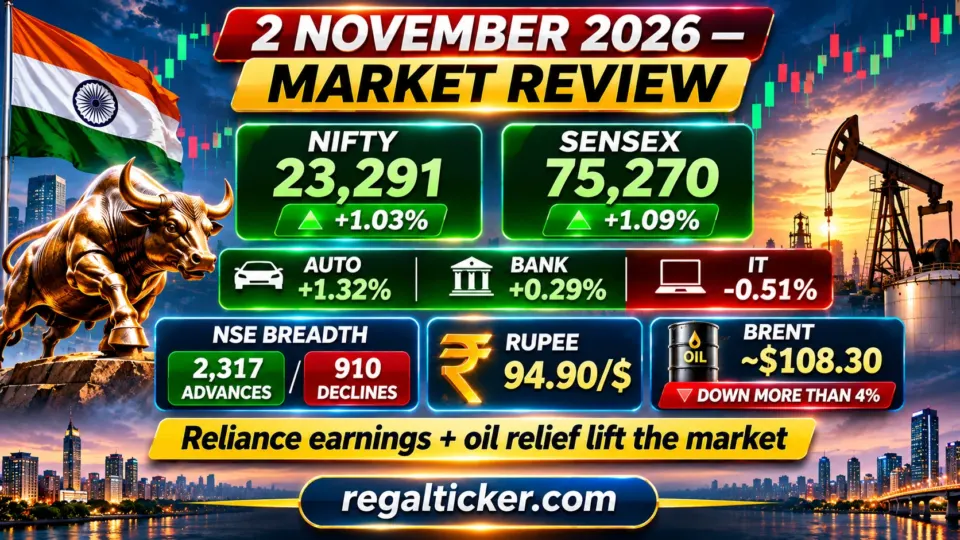
The Nifty 50 closed at 23,291.25, up 238.15 points or 1.03%, while the Sensex finished at 75,270.43, up 810.90 points or 1.09%.
The rally had two clear catalysts.
First, Reliance Industries delivered a strong September-quarter result, with net profit rising 40.6% year on year and refining and petrochemical margins improving sharply. Reliance became the biggest index support during the session.
Second, Brent crude fell more than 4% toward $108.30 per barrel as diplomatic efforts involving Iran and Qatar reduced some of the immediate geopolitical risk premium in oil.
That combination mattered particularly for India: stronger earnings from the country’s largest listed company arrived at the same time as a meaningful reduction in the market’s biggest macro risk.
The rally was also broad. Moneycontrol’s market breadth showed roughly 2,317 NSE advances against 910 declines.
But one important pocket lagged: the Nifty IT index fell 0.51%, reflecting pressure from Friday’s sharp global technology sell-off and renewed debate over the economics of AI spending.
⚡ Quick answer
Why did the Indian stock market rise on 2 November 2026?
Indian equities rose because strong Reliance Industries earnings lifted heavyweight sentiment while a sharp drop in Brent crude reduced near-term inflation and current-account risk for India. The move broadened beyond Reliance, with auto, metals, energy and several cyclical names participating. Nifty closed 1.03% higher and Sensex 1.09% higher, while IT was the main major-sector laggard.
Key takeaways
Nifty 50 closed at 23,291.25, up 1.03%.
Sensex closed at 75,270.43, up 1.09%.
NSE breadth was strong, with about 2,317 advances versus 910 declines.
Reliance Industries was the biggest index support after a strong Q2 result.
Brent crude fell more than 4% toward $108.30 per barrel.
The rupee closed nearly unchanged at 94.90 per dollar despite lower oil and a softer dollar.
Nifty Auto gained 1.32%.
Nifty Bank gained 0.29%.
Nifty IT fell 0.51%.
Metals and oil-linked stocks were among the strongest pockets.
India’s rally contrasted with Friday’s sharp U.S. technology sell-off.
The latest available institutional cash data remained 30 October: FII +₹3,598.54 crore and DII -₹817.51 crore.
Fresh 2 November FII/DII cash figures were not yet published when this review was prepared.
The next session’s main external risks are oil, U.S. political developments and global technology sentiment.
1. Reliance was the session’s anchor
Reliance Industries was the most important stock-specific driver.
The company reported September-quarter net profit of ₹25,548 crore, up 40.6% year on year.
The strength came primarily from the oil-to-chemicals business, where refining and petrochemical economics improved. Jio Platforms also delivered stronger profitability and subscriber growth.
That mattered because Reliance entered the result with weak year-to-date stock performance and low expectations relative to its historical influence on the index.
When a heavyweight with that index weight surprises positively, the effect travels well beyond one stock.
It improves benchmark momentum, energy-sector sentiment, earnings confidence, passive-flow demand and risk appetite in other large caps.
Reuters reported that Reliance was on track for its strongest session since January 2024.
The move also reinforces a point from RegalTicker’s Jio Platforms analysis: the group’s valuation debate now depends on several separate engines—energy, telecom, retail and new businesses—rather than one consolidated narrative.
2. Lower crude gave India a second reason to rally
Brent crude fell sharply from Friday’s six-month high near $118.
By the rupee close, Reuters reported Brent near $108.30 per barrel, down more than 4%.
The drop followed renewed diplomatic efforts around the Iran conflict.
No final agreement had been reached, so investors should not treat the oil-risk problem as solved.
But for India, even a short-term oil pullback can improve the market’s macro equation.
Lower crude can reduce imported inflation, the trade deficit, pressure on the rupee, fuel-sensitive corporate costs and the probability of tighter monetary policy.
That is why India can outperform global peers on days when oil falls sharply.
The crude-oil and Hormuz impact guide remains the key background: India’s market sensitivity to oil is structural, not merely a trading-day effect.
3. The rally was broader than Friday’s move
Friday’s 30 October gain was narrow.
Large-cap IT and pharma held the benchmark up while smaller stocks were weak.
Monday was different.
Moneycontrol’s breadth data showed about 2,317 advancing shares against 910 decliners on the NSE.
That is an important improvement.
A broad rally has better internal quality than a benchmark move driven almost entirely by one or two heavyweight names.
Mid-cap and small-cap gauges were also positive through much of the session, and cyclical sectors participated.
This does not prove a new broad bull phase has started.
But it is a healthier structure than the concentration seen through much of October.
The Risk Management guide remains relevant because breadth can improve quickly and reverse just as quickly when macro risk is still high.
4. Auto and cyclical sectors joined the recovery
Nifty Auto gained 1.32%.
Lower crude helped sentiment because energy costs affect transport, logistics and broader inflation expectations.
Strong October vehicle sales also supported the sector.
Metals were another strong pocket as investors rotated toward cyclicals and commodity-linked names.
Oil marketing companies also benefited from the combination of strong refining economics and lower crude input costs.
Indian Oil had already reported a strong quarterly result, with profit nearly tripling year on year.
This created a rare session where both energy-linked shares and oil-sensitive sectors could participate in the same rally.
The common factor was not simply “oil down.” It was earnings strength plus lower input-price risk.
5. Banks participated, but did not lead
Nifty Bank gained 0.29%.
That was positive, but far weaker than the headline Nifty and Sensex gains.
Bank of Baroda was one of the stronger individual names after reporting improved operating performance and raising loan-growth guidance.
Still, the banking index did not lead the day.
That tells investors something about the character of the rally.
The session was driven more by Reliance, energy, metals, auto and broad cyclical participation than by a classic financials-led risk-on move.
For a sustained market breakout, stronger participation from banks would normally improve the signal.
6. IT was the clear laggard
Nifty IT fell 0.51%.
That stood out because most major sectors were positive.
The weakness followed Friday’s U.S. technology sell-off, where the Nasdaq fell sharply as investors questioned AI-related capital spending and stretched valuations.
That global debate matters directly to Indian IT.
Indian software companies depend heavily on U.S. enterprise spending.
If global clients become more cautious about AI infrastructure budgets, discretionary technology spending can slow even if long-term AI adoption remains strong.
This is why RegalTicker’s AI-capex analysis should be read alongside October’s strong Nifty IT performance.
Indian IT had just rallied sharply through October.
That makes the sector more sensitive to any change in global AI sentiment.
7. The rupee did not fully follow the oil relief
The rupee closed at 94.90 per dollar, nearly unchanged.
That may look surprising given Brent crude fell more than 4%, the dollar index weakened and Indian equities rallied.
Reuters reported that traders remained cautious ahead of U.S. political events and that dollar demand in the non-deliverable forward market limited the rupee’s gains.
The RBI’s own forward position is also becoming an important currency-market factor.
So the rupee reaction was a useful reminder.
Lower oil helps, but currency pricing also reflects global dollar demand, hedging flows, central-bank intervention, reserve management and geopolitical risk.
The rupee did not confirm the equity rally with an equally strong move.
8. Institutional flows were supportive going into the session
The latest published cash-market data before Monday showed FIIs bought ₹3,598.54 crore on 30 October.
DIIs sold ₹817.51 crore that day.
That was important because October as a whole had been characterised by heavy foreign selling.
Late-month FII buying therefore improved the setup going into November.
However, fresh 2 November cash-flow data had not yet been published when this review was prepared.
That distinction matters.
The market should not be described as receiving confirmed FII buying today until the actual exchange-linked figures are available.
The October FPI outflow analysis remains useful background because one or two buying sessions do not automatically reverse a month-long foreign-flow trend.
Investor note
Do not infer today’s FII number from the index move
A strong market day can be driven by domestic funds, retail flows, derivatives or stock-specific earnings. Wait for the published cash-market figures before attributing the rally to FIIs.
9. The global setup remains mixed
India rallied despite a difficult global technology backdrop.
On Friday, the Nasdaq fell sharply as investors reassessed AI spending and several technology stocks sold off.
That creates a split global setup: lower crude helps India; weaker U.S. tech hurts Indian IT sentiment; a softer dollar can help emerging markets; and geopolitical risk remains unresolved.
This is exactly the kind of environment where India can outperform globally for one session while still facing external risk the next day.
The market is not trading one global factor.
It is balancing oil, rates, AI, earnings and geopolitical risk simultaneously.
10. What to watch next
The first question is whether Brent can stay near the lower end of Monday’s range.
If oil rebounds sharply, part of today’s macro relief can reverse.
Second, watch whether Reliance can hold the earnings-led breakout after the initial repricing.
Third, watch banks. A stronger market rally would look healthier if financials begin to participate more aggressively.
Fourth, watch IT. The sector was October’s major winner, but global AI-capex concerns could create more volatility.
Fifth, watch market breadth. Monday’s 2,317-versus-910 advance/decline picture was one of the strongest parts of the session.
Sixth, watch the rupee. If oil stays lower but the rupee still cannot strengthen, that would suggest other dollar-demand pressures remain important.
Finally, watch the next published FII/DII numbers rather than assuming institutional participation from price action alone.
The Market hub remains the place to follow how these factors evolve through the week.
Frequently asked questions
Where did Nifty close on 2 November 2026?
Nifty 50 closed at 23,291.25, up 238.15 points or 1.03%.
Where did Sensex close?
Sensex closed at 75,270.43, up 810.90 points or 1.09%.
Why did the Indian market rise today?
Strong Reliance Industries earnings and a sharp fall in Brent crude were the two biggest catalysts, while broad market participation strengthened the move.
How was market breadth?
Around 2,317 NSE stocks advanced while about 910 declined, indicating a broad positive session.
Which major sector performed best?
Auto was one of the stronger major NSE sectors, with Nifty Auto up 1.32%. Metals and oil-related shares also performed strongly.
Which sector lagged?
Nifty IT fell 0.51%, making technology the main major-sector laggard.
What happened to crude oil?
Brent crude fell more than 4% toward $108.30 per barrel as diplomatic efforts reduced some of the immediate Middle East risk premium.
What happened to the rupee?
The rupee closed nearly unchanged at 94.90 per dollar despite lower oil and a softer dollar.
Did FIIs buy today?
Fresh 2 November FII/DII cash figures were not yet published when this review was prepared. The latest available data showed FIIs bought ₹3,598.54 crore on 30 October.
What should investors watch next?
Oil prices, Reliance follow-through, banking participation, IT weakness, market breadth, the rupee and the next institutional-flow data are the key variables.
Verify through official sources
Official references
- Reuters — Indian shares rise on Iran talks and Reliance earnings — Session catalyst coverage including Reliance earnings, crude-oil relief and broad sector participation.
- Reuters — Reliance set for strongest session since January 2024 — Reliance Q2 earnings, refining and Jio drivers, and market reaction.
- Moneycontrol — Market action — Closing Nifty, Sensex, Bank Nifty, Nifty IT, Nifty Auto and NSE advance/decline data.
- Reuters — Rupee closes nearly unchanged — Rupee close at 94.90, Brent near $108.30 and currency-market drivers.
- Moneycontrol — FII/DII cash-market data — Latest available published FII and DII cash-market figures through 30 October.
- Reuters — Reliance Q2 results — Reliance’s September-quarter profit and business drivers.
Educational disclaimer: RegalTicker provides educational and informational content only. This daily market review is not investment advice or a recommendation to buy, sell or hold any security, sector or index. Intraday prices, commodity levels, market breadth and institutional-flow figures can change or be revised. Verify current exchange, regulator and company disclosures before making financial decisions and consider valuation, liquidity, diversification and your own risk tolerance.
Final takeaway
Today’s rally was healthier than Friday’s—but oil still controls the macro story
The 2 November rally had better internal quality than the previous session.
Reliance supplied heavyweight earnings support.
Crude oil moved sharply lower.
Auto, energy, metals and smaller stocks participated.
Breadth improved materially.
That is a stronger combination than an index gain driven by one defensive sector.
But the rally still depends on two things that can change quickly: geopolitics and oil.
IT weakness also shows that India is not insulated from the global reassessment of AI spending.
So the session improves the near-term tone, but it does not remove the need for confirmation.
The next confirmation would be broader financial-sector participation, continued strength in market breadth, stable crude and published institutional flows that support the price action.