

The largest crypto exchange just gave investors a live lesson in counterparty risk
Binance says a security incident affected roughly $6.3 billion in digital assets, making it the largest known crypto-exchange theft by value reported to date.
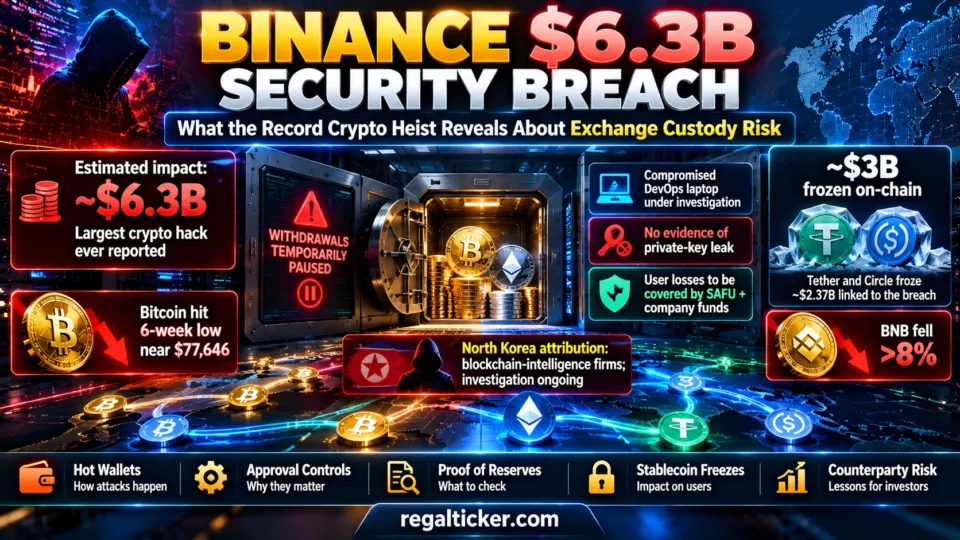
The exchange’s preliminary investigation says a compromised DevOps engineer’s laptop may have allowed an attacker to reach a service container and submit unauthorised withdrawal transactions. Binance says it has found no evidence that wallet private keys were leaked and that it will publish a technical post-mortem after the investigation is complete.
Around $3 billion of affected assets had been frozen on-chain with help from blockchain partners, while withdrawals were temporarily paused as Binance rebuilt and checked the withdrawal system. The exchange says user funds are safe and that losses will be covered using its Secure Asset Fund for Users, or SAFU, together with company funds.
The market reacted immediately. Bitcoin fell to a six-week low near $77,646, ether touched a two-month low around $2,239, and BNB dropped more than 8% over 24 hours in the initial reaction.
For investors, the important lesson is not that “crypto is unsafe.” It is that custody structure matters. When assets sit on a centralised exchange, the investor is exposed not only to coin-price risk but also to operational controls, hot-wallet design, withdrawal infrastructure, insider-access risk, recovery arrangements and the financial strength of the exchange itself.
That is the same principle behind RegalTicker’s broader Risk Management framework: price risk is only one part of total investment risk.
⚡ Quick answer
What happened in the Binance $6.3 billion security incident?
Binance says its preliminary investigation points to a compromised DevOps laptop that may have allowed unauthorised withdrawal transactions through internal service infrastructure. The exchange says no private-key leak has been identified so far. Roughly $3 billion of affected assets had been frozen on-chain, withdrawals were temporarily paused, and Binance said user losses would be covered through SAFU and company funds. Blockchain-intelligence firms including TRM Labs and Elliptic linked the attack to North Korea-associated actors, but that attribution is separate from Binance’s own technical investigation and remains subject to law-enforcement confirmation.
Key takeaways
Binance estimates the total impact of the incident at about $6.3 billion.
The exchange says the initial breach may have involved a compromised DevOps engineer’s laptop.
Binance says it has found no evidence of a wallet private-key leak so far.
Around $3 billion of affected assets had been frozen on-chain with ecosystem partners.
Withdrawals were temporarily paused while security checks and remediation continued.
Binance says user losses will be covered using SAFU and company funds.
The company later said it had set aside more than $6.34 billion to address the losses.
Bitcoin fell to a six-week low near $77,646; ether touched a two-month low; BNB fell more than 8% in the initial reaction.
Tether and Circle froze stablecoins linked to the incident, showing that some token issuers can stop transfers after a breach.
Native assets such as bitcoin cannot be frozen by an issuer in the same way.
TRM Labs, Chainalysis and Elliptic linked the attack to North Korea-associated actors; that is not the same as a final government finding.
The incident highlights hot-wallet risk, approval-control risk, exchange counterparty risk and the limits of “proof of reserves” as a complete safety test.
1. What Binance says happened
Binance’s initial public explanation focuses on an operational compromise rather than a leaked wallet key.
The exchange says a DevOps engineer’s laptop may have been compromised, giving the attacker access to a service container and the ability to submit unauthorised withdrawal transactions.
That distinction matters.
A private-key theft means the attacker obtains the cryptographic secret needed to sign transactions directly from a wallet.
An operational-control breach can be different: the attacker may exploit the systems that legitimately instruct or approve transfers without ever obtaining the underlying wallet key.
Binance has said it found no evidence of a private-key leak and that the full attack path is still under investigation. Later updates also indicated that additional breach points may have existed beyond the first compromised laptop theory.
Investors should therefore treat the current explanation as preliminary, not final.
The RegalTicker market-news verification guide is useful in situations like this because the correct sequence is to follow the original platform statement, then compare it with independent technical analysis and later law-enforcement findings.
2. Why hot wallets create a different risk from cold storage
Crypto exchanges need some assets available for customer withdrawals.
Those assets are usually held in hot wallets—wallets connected to operational systems so transactions can be processed quickly.
That convenience creates attack surface.
Cold wallets are generally isolated from live internet-connected infrastructure and therefore harder to compromise remotely, but they are slower and less convenient for daily withdrawal activity.
A centralised exchange therefore needs a balance between:
- enough hot-wallet liquidity to process customer requests;
- strong withdrawal controls;
- multi-person approval;
- transaction limits;
- anomaly detection;
- address whitelisting;
- hardware-key protection; and
- rapid emergency shutdown procedures.
The Binance incident shows why that architecture matters even if the private keys themselves remain secure.
A wallet can be cryptographically safe while the system allowed to instruct it is not.
3. Why the $3 billion freeze is important—and why it could not stop everything
Binance says roughly $3 billion of affected assets had been frozen on-chain.
Stablecoin issuers played a major role.
Tokens such as USDT and USDC are issued by companies that retain administrative controls allowing them to blacklist addresses and prevent certain tokens from being transferred.
That can be powerful during a theft.
If stolen stablecoins are identified quickly enough, issuers can freeze them before the attacker converts them into assets that are harder to stop.
But not every cryptoasset works this way.
Native bitcoin, ether and several other blockchain assets do not have a central issuer that can simply blacklist an address at the protocol level.
That creates a race after a major hack:
trace funds → notify issuers and exchanges → freeze controllable tokens → attacker swaps into non-freezable assets → funds move across wallets, DEXs, bridges or mixers.
Elliptic said a large share of the frozen amount consisted of stablecoins, while billions of dollars of assets remained outside issuer-controlled freeze mechanisms.
The freeze therefore demonstrates both the strength and the limits of centralised control inside crypto markets.
4. What “user funds are safe” actually means
Binance has said customer funds are safe and that it will cover losses.
That is reassuring, but investors should understand what the statement depends on.
The ability to make customers whole rests on:
- the amount of assets recovered or frozen;
- Binance’s own corporate liquidity;
- the size and usability of the SAFU reserve;
- token prices while the recovery takes place;
- withdrawal demand;
- legal or regulatory restrictions; and
- whether later investigation finds additional losses.
Binance later said it had set aside more than $6.34 billion in company resources to address the breach.
That financial backstop is important because the exchange is not relying only on asset recovery.
But it also reinforces the core counterparty lesson.
An exchange promise is strongest when the exchange itself has enough liquid capital and transparent reserves to honour it.
Investor note
“User funds are safe” is a balance-sheet statement as much as a security statement
Recovery after a hack depends not only on technical tracing but also on the exchange’s liquidity and ability to absorb losses. Investors should evaluate both cybersecurity and financial resilience.
5. What SAFU does—and what it does not prove
SAFU is Binance’s emergency reserve designed to protect users in extreme events.
A dedicated insurance-style reserve is better than having no contingency pool.
But an investor should not stop the analysis there.
Important questions include:
- What assets make up the reserve?
- How liquid are they?
- How volatile are they?
- Are the assets held separately?
- Can they be accessed quickly?
- Is the reserve large enough relative to exchange liabilities?
- Does it cover operational theft, insolvency, legal claims and all user jurisdictions?
Binance has said SAFU and company funds will together cover losses from this incident.
That is a stronger protection mechanism than relying on a single reserve pool.
Still, the incident shows why an insurance reserve cannot substitute for strong operational controls.
Compensation repairs the financial damage after an event. It does not prevent the event.
6. Proof of reserves is useful—but it is not proof of safety
Binance says it will publish updated proof of reserves after remediation.
Proof of reserves can help users verify that an exchange controls blockchain assets corresponding to customer balances.
But it is not a complete audit of the business.
A reserve snapshot does not automatically reveal:
- all liabilities;
- off-balance-sheet obligations;
- internal access controls;
- cyber vulnerabilities;
- legal claims;
- token concentration;
- operational dependencies; or
- the quality of corporate governance.
An exchange can be fully reserved at a point in time and still suffer an operational breach.
That is why proof of reserves should be treated as one control, not a universal safety certificate.
The same analytical habit applies in traditional finance: one balance-sheet ratio never tells the entire risk story.
7. Why the North Korea attribution needs careful wording
TRM Labs, Chainalysis and Elliptic have linked the attack to North Korea-associated actors based on transaction patterns, wallet connections and similarities with earlier attacks.
Elliptic said some stolen funds reached an address connected with proceeds from another exploit suspected to involve North Korea-linked operators.
Those findings matter because North Korea-associated hacking groups have repeatedly targeted cryptocurrency platforms.
But attribution should remain precise.
Binance’s public incident update does not itself say North Korea has been conclusively identified.
Blockchain-intelligence attribution is not the same as a final FBI, court or government determination.
The correct wording is therefore:
“Blockchain-intelligence firms have attributed or linked the attack to North Korea-associated actors.”
That is more accurate than treating attribution as legally settled.
8. Why bitcoin, ether and BNB fell even though user losses may be covered
Crypto prices reacted because the event changed perceived system risk.
Bitcoin fell to a six-week low near $77,646.
Ether fell to roughly $2,239, a two-month low.
BNB fell more than 8% during the initial reaction.
Those moves were not simply a calculation of how much Binance might reimburse.
A large exchange breach can affect:
- confidence in centralised custody;
- forced liquidations;
- withdrawal demand;
- market-maker risk;
- exchange-token sentiment;
- stablecoin liquidity;
- leverage; and
- the perceived probability of regulation.
The price reaction therefore reflects a risk-premium shock, not only the direct accounting loss.
The same principle appears in equity markets when a major operational event changes confidence before the final financial impact is known.
9. What the incident means for investors who use centralised exchanges
For ordinary investors, the most practical question is not whether Binance survives.
It is how much exposure should sit with any single exchange.
Useful checks include:
Custody concentration: Do all assets sit on one platform?
Withdrawal access: Can assets be moved on-chain when needed?
Cold-storage use: Are long-term holdings kept offline where appropriate?
Exchange reserves: Does the platform provide credible reserve information?
Liability transparency: Can users understand what the exchange owes?
Security controls: Does the platform disclose multi-signature, whitelisting, withdrawal delays or hardware-key controls?
Jurisdiction: Which entity legally holds the customer relationship?
Insurance / emergency funds: What actually covers customer losses?
Account security: Are strong passwords, hardware 2FA and withdrawal whitelists enabled?
This is not an argument that everyone should self-custody every asset.
Self-custody replaces exchange counterparty risk with private-key-management risk. Losing a seed phrase or signing a malicious transaction can be irreversible.
The correct choice depends on the investor’s knowledge, transaction frequency, asset size and operational discipline.
10. Why this matters beyond crypto
The Binance incident is also a case study in modern financial infrastructure.
Traditional banks, brokerages and exchanges are heavily regulated and generally separate custody, clearing, settlement and customer protection through multiple institutional layers.
Crypto platforms often combine several functions:
- exchange;
- custody;
- wallet infrastructure;
- lending;
- token issuance relationships;
- derivatives;
- staking; and
- settlement.
That concentration can create efficiency, but it also concentrates operational risk.
A technical failure can therefore affect trading, custody and withdrawals at the same institution.
This is one reason regulators increasingly focus on segregation of customer assets, capital adequacy, governance and operational resilience.
For investors, the lesson is transferable: whenever one platform performs many critical functions, its failure modes deserve extra scrutiny.
11. What to watch next
The next useful information will come from evidence, not speculation.
First, watch Binance’s technical post-mortem. It should clarify how the attackers moved from the compromised endpoint into authorised withdrawal infrastructure.
Second, watch whether withdrawals resume on schedule and whether users experience unusual delays.
Third, watch the updated proof of reserves.
Fourth, watch how much of the remaining affected assets are recovered or frozen.
Fifth, watch law-enforcement attribution. Blockchain-analysis firms have moved quickly; official government conclusions may take longer.
Sixth, watch the crypto market’s reaction after leverage is cleared. A security event can trigger an immediate sell-off without necessarily changing long-term network usage.
Finally, watch regulation. A theft of this scale is likely to intensify scrutiny of exchange reserves, hot-wallet limits, customer-asset segregation and operational controls.
The Risk Management guide remains the right framework: investors should manage risks they can control instead of assuming a large platform eliminates operational risk.
Frequently asked questions
How much was affected in the Binance hack?
Binance estimates the total impact at about $6.3 billion.
Were Binance private keys stolen?
Binance says it has found no evidence of a wallet private-key leak so far. Its preliminary investigation points to compromised internal infrastructure and unauthorised withdrawal transactions.
How much has been frozen?
Binance says roughly $3 billion of affected assets had been frozen on-chain with help from industry partners.
Are Binance customer funds safe?
Binance says user funds are safe and that losses will be covered using SAFU and company resources. Investors should continue monitoring the recovery, withdrawals and updated proof of reserves.
Who carried out the attack?
Blockchain-intelligence firms including TRM Labs, Chainalysis and Elliptic have linked the attack to North Korea-associated actors. That attribution is separate from a final government or court finding.
Why did bitcoin fall after the breach?
The incident increased perceived exchange and custody risk, triggered risk reduction and affected leverage and market confidence. Bitcoin fell to a six-week low during the initial reaction.
What is a hot wallet?
A hot wallet is connected to live operational systems so an exchange can process transactions quickly. That convenience creates more attack surface than cold storage.
Does proof of reserves prove an exchange is safe?
No. Proof of reserves can show that an exchange controls assets, but it does not by itself prove the absence of hidden liabilities, operational vulnerabilities or governance problems.
Is self-custody always safer?
Not necessarily. Self-custody removes exchange counterparty risk but creates private-key and seed-phrase management risk. Investors need to understand whichever custody model they use.
Verify through official sources
Official references
- Binance — Security Incident Update — Primary exchange statement on estimated impact, preliminary cause, no identified private-key leak, asset freezes, withdrawal suspension and user-loss coverage.
- Reuters — Binance record crypto heist — Current reporting on the $6.3 billion theft, industry freezes, market reaction and exchange response.
- Reuters — How the Binance heist unfolded — Current reconstruction of the attack and recovery timeline.
- Reuters — Binance sets aside $6.34 billion — Current reporting on company resources set aside to address the breach and proof-of-reserves plan.
- Reuters — TRM links North Korea to Binance theft — Current attribution by blockchain-intelligence firm TRM Labs.
- Elliptic — Binance hack analysis — Independent on-chain analysis of stolen assets, frozen funds, conversion activity and North Korea-linked indicators.
- Reuters — Crypto prices fall after Binance incident — Bitcoin, ether and BNB initial market reaction.
Final takeaway
The lesson is not “never use an exchange”—it is “know what risk the exchange is carrying for you”
The Binance breach is extraordinary because of its scale, but the core risk is familiar.
Investors outsource security when they leave assets on a centralised exchange. In return for convenience, liquidity and account recovery, they accept exposure to the exchange’s hot wallets, approval systems, employees, infrastructure, reserves and balance sheet.
Binance says user funds will be made whole and that around $3 billion of affected assets has already been frozen. That is evidence of significant recovery capacity.
It is not evidence that exchange risk has disappeared.
The practical lesson is diversification of custody, strong account security, reserve and liability scrutiny, and a clear understanding of what happens if withdrawals stop. In crypto, as in traditional markets, the asset you own and the institution holding it are two different risks.
Educational disclaimer: RegalTicker provides educational and informational content only. This article is not investment, cybersecurity, legal or custody advice and is not a recommendation to buy, sell, hold or withdraw cryptocurrency or use any specific exchange. The Binance investigation, asset-recovery totals, attribution and service status are evolving. Verify current platform statements, regulator notices and independent security information before acting, and consider your own knowledge, jurisdiction, custody setup, liquidity needs and risk tolerance.


