This is bigger than a scheme for making steel boxes
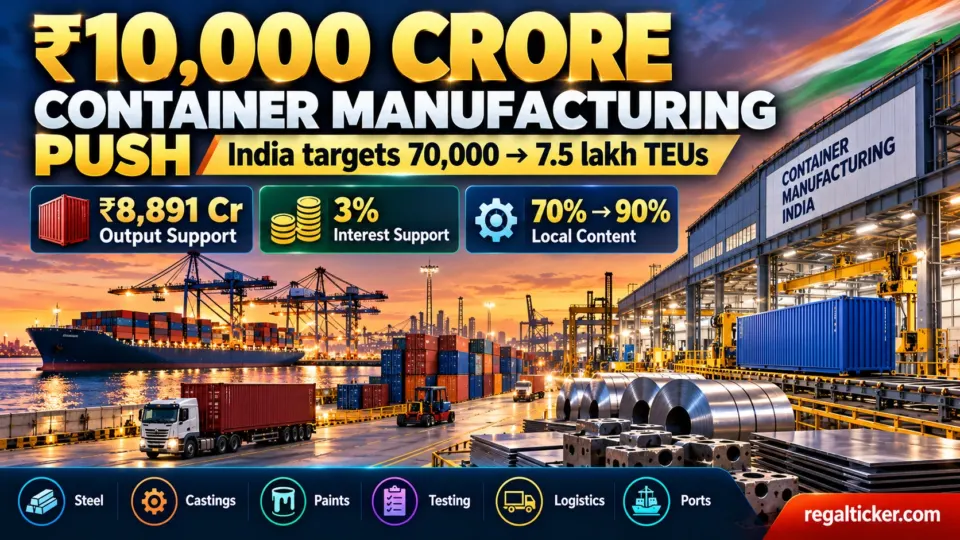
India’s Cabinet has approved a ₹10,000 crore Container Manufacturing Promotion Scheme, or CMPS, that runs through FY 2039-40. The headline target is striking: lift annual domestic container manufacturing capacity from roughly 70,000 TEUs today to as much as 7.5 lakh TEUs.
But the more important investor story sits underneath that number.
The government is not simply subsidising factories. Nearly ₹8,891 crore of the outlay is earmarked for operational support on eligible containers manufactured to global standards and sold by approved producers. Another ₹859 crore supports a 3% interest subvention on eligible term loans, while testing infrastructure, port-land support and rising domestic-content requirements are designed to build an entire local supply chain around the box itself.
That supply chain includes specialised steel, corner castings, wooden flooring and frames, industrial paints, testing, fabrication, rail-linked logistics and ports. It is the same kind of industrial transmission logic RegalTicker discussed in the India semiconductor build-out: government support can create an ecosystem opportunity, but it does not make every company near the theme an automatic beneficiary.
⚡ Quick answer
Which stocks could be affected by India’s ₹10,000 crore container scheme?
The clearest listed exposure is in companies that already manufacture ISO or specialised containers, such as Jupiter Wagons and DCM Shriram International. CONCOR and Shipping Corporation of India are part of the Bharat Container Shipping Line initiative, so they sit on the demand and logistics side rather than being direct manufacturing beneficiaries. Specialised-steel, coatings, castings and port businesses could gain indirectly if domestic container production scales, but no broad list of approved CMPS beneficiaries or supplier contracts has been announced yet. Investors should distinguish existing business exposure from a confirmed scheme award.
Key takeaways
The Cabinet approved the Container Manufacturing Promotion Scheme with a ₹10,000 crore outlay through FY 2039-40.
The scheme aims to raise domestic annual capacity from about 70,000 TEUs to as much as 7.5 lakh TEUs.
₹8,891 crore is allocated to operational expenditure assistance, making output and sales—not just factory announcements—the core of the support model.
₹859 crore is earmarked for a 3% annual interest subvention on eligible term loans.
Greenfield projects must target at least 1 lakh TEUs of annual capacity; eligible brownfield expansion must add at least 25,000 TEUs.
Local-content requirements rise from 70% through FY 2031-32 to 90% from FY 2032-33.
The government explicitly identifies specialised steel, corner castings, wooden frames and paints as ancillary industries that could benefit.
Jupiter Wagons already makes ISO marine and specialised containers; DCM Shriram International also describes shipping-container manufacturing as an operating capability.
CONCOR and SCI are participants in the Bharat Container Shipping Line initiative, which could become a demand anchor for domestically manufactured containers.
No listed stock should be described as a confirmed CMPS beneficiary until company disclosures or scheme approvals establish eligibility and economics.
1. What the Cabinet actually approved
The final Cabinet decision is more detailed than the original Budget announcement.
The scheme runs from FY 2027-28 to FY 2039-40. The government describes the structure as three years for setting up eligible facilities followed by ten years of production support.
The current allocation is:
| Scheme component | Outlay / support |
|---|---|
| Operational Expenditure Assistance | ₹8,891 crore |
| Interest Subvention Assistance | ₹859 crore |
| Testing and certification | ₹150 crore |
| Scheme management | ₹100 crore |
| Land at major ports | Leasing support at 25% of notified rate |
The operational component dominates the package. That matters because it changes how investors should read the policy.
A capex-only subsidy can encourage factories to be announced. An output-linked support structure forces the economic test further down the chain: eligible manufacturers need to build globally compliant containers and sell them.
The official backgrounder specifies indicative assistance of ₹49,500 for a 20-foot container, ₹86,625 for a 40-foot container and a range of ₹37,125 to ₹74,250 for certain specialised 20-foot containers. Final economics still depend on the scheme guidelines, eligibility, actual production mix and the cost structure of each manufacturer.
2. Why India wants a domestic container industry
Containers look simple because the basic product is familiar. Economically, they sit at a critical junction between manufacturing and trade.
A standard container can move from factory to truck, rail terminal, port and ship without unloading the cargo at every stage. That interoperability is why containers became one of the foundations of global supply chains.
India remains heavily exposed to imported containers. The government says the country currently has around 70,000 TEUs of annual manufacturing capacity and wants to raise that roughly tenfold. At the same time, container traffic is expected to expand sharply as ports, freight corridors and exports grow.
This is also about resilience. During global supply disruptions, a shortage of boxes can raise freight costs even when ships and ports are available. Domestic manufacturing cannot eliminate global freight volatility, but it can reduce dependence on imported equipment and give Indian shipping and logistics operators a larger local source of supply.
The policy therefore belongs in the broader Make-in-India story rather than being viewed as a niche shipping subsidy.
3. The real industrial transmission chain
The most useful way to analyse CMPS is to follow where the spending and production requirements can travel.
Policy support → greenfield/brownfield container plants → specialised steel and fabricated components → paints and flooring → testing/certification → domestic container sales → rail/road/port movement → shipping-line demand.
That chain creates several different types of exposure:
| Exposure | Connection to CMPS | Directness |
|---|---|---|
| ISO / marine container manufacturers | Manufacture the eligible end product | Highest |
| Specialised steel suppliers | Provide a major raw material input | Indirect |
| Corner castings / fabricated components | Required container hardware | Indirect |
| Industrial paints / coatings | Corrosion protection and finishing | Indirect |
| Testing facilities | Global shipping-standard certification | Direct ecosystem |
| CONCOR / intermodal logistics | Move containers and connect inland terminals with ports | Demand-side |
| Shipping lines | Use and replace container fleets | Demand-side |
| Ports | Container handling and possible manufacturing land support | Infrastructure-side |
The categories should not be confused. A logistics company can benefit from more containerised trade without receiving manufacturing assistance. A steel producer may sell more specialised steel without being a named scheme participant.
That distinction is exactly why RegalTicker’s guide to verifying market announcements is useful when a stock suddenly gets labelled a “beneficiary” after a policy headline.
4. Local content may be the most important long-term rule
The local-content requirement is one of the strongest parts of the scheme.
Eligible manufacturers must meet at least 70% domestic content through FY 2031-32. From FY 2032-33, that requirement rises to 90%.
In other words, the policy is designed to prevent India from becoming only an assembly location for imported container kits.
If the rule works as intended, suppliers have an incentive to localise steel, castings, coatings, flooring, fabrication and other inputs. That is where the wider industrial opportunity comes from.
It also creates execution risk. Indian components must meet international shipping standards while remaining cost-competitive against established global suppliers. A high local-content threshold is positive for domestic value addition only if the local chain can meet quality, scale and price requirements.
The important investor question is therefore not “Which stock makes steel?” It is “Which company can supply the right grade, at the required standard, into an actual container-manufacturing programme with acceptable margins?”
5. Jupiter Wagons: the clearest listed manufacturing connection
Jupiter Wagons has one of the cleaner operational links to the theme because container manufacturing is already part of its product portfolio.
The company’s own website describes ISO marine containers, specialised containers, cold-chain solutions and containerised energy-storage products. It also lists fabrication, painting, insulation and in-house testing capabilities.
That is materially different from a company that merely operates in railways or logistics.
Still, the investment conclusion should not run ahead of the evidence. Existing manufacturing capability does not mean Jupiter Wagons has automatically qualified for CMPS support, secured a scheme-linked order or will earn a specific margin from the policy.
Investors should wait for company disclosures on:
- eligible capacity;
- planned expansion;
- project cost;
- scheme approval;
- product mix;
- customer orders;
- utilisation;
- working capital; and
- margins.
The stock can react before those details arrive. Business value is created only if actual production and cash returns follow.
Investor note
“Direct exposure” is not the same as “confirmed beneficiary”
A company can already manufacture containers and still need to apply, qualify, invest and sell eligible units before the scheme changes its economics. Treat policy alignment as a research lead, not as proof of future earnings.
6. DCM Shriram International: commercial proof, but entity details matter
DCM Shriram International is another listed company with an operating connection to container manufacturing.
Its corporate website describes standard ISO shipping containers, offshore cargo units, customised containers, tank containers and heavy fabricated structures as part of its manufacturing portfolio.
There is also a meaningful commercial milestone behind the story. Maersk announced in July that it had procured its first Indian-manufactured EXIM container and followed that with an order for 1,000 additional containers from the DCM Shriram Group.
That is useful evidence because it shows India-made containers can reach an international shipping customer and comply with global requirements.
However, investors should be careful with group-company names and legal entities. The Maersk announcement refers to the DCM Shriram Group, while different DCM entities and container businesses exist within the wider group structure.
Before translating a group-level order into a listed-company earnings assumption, verify the exact contracting entity and the economics attributable to shareholders of the listed company. This is where fundamental analysis becomes more important than a thematic headline.
7. CONCOR and SCI are demand-side exposures, not container makers
Container Corporation of India and Shipping Corporation of India sit in a different part of the chain.
Both are participants in the Bharat Container Shipping Line initiative, alongside major port authorities and Sagarmala Finance Corporation. The government’s aim is to create a more integrated Indian container-shipping ecosystem linking ports, inland markets and domestic container procurement.
That can matter for container demand.
CONCOR already operates container trains and inland terminals. SCI operates shipping services. If India builds a larger domestic container fleet and expands its own container-shipping capacity, both companies are naturally connected to the utilisation side of the ecosystem.
But neither should be described as a manufacturing-subsidy beneficiary simply because they are part of BCSL.
For investors, the measurable questions are different:
- Will container volumes rise?
- Will domestic fleet additions improve utilisation?
- What capex is required?
- Who owns the containers?
- What happens to freight yields and margins?
- How much of the opportunity appears in actual company guidance?
This is a good example of why sector exposure needs to be converted into financial statements. RegalTicker’s cash-flow guide is particularly relevant for businesses where fleet, terminal and equipment investment can absorb large amounts of capital before returns become visible.
8. Steel, castings, paints and ports: large opportunity, weak evidence for stock-picking today
The government explicitly names specialised steel, corner castings, wooden frames and paints among the ancillary industries expected to benefit.
That statement is economically credible.
A container is a fabricated industrial product with tight dimensional, structural, corrosion and safety requirements. Scaling annual capacity from roughly 70,000 TEUs toward 7.5 lakh TEUs would require much more material and component supply.
But the current evidence does not justify a confident list of steel or paint “winners.”
No official CMPS release names a Tata Steel, JSW Steel, Asian Paints, Berger Paints or another listed supplier as a contracted beneficiary of the scheme. The opportunity is sectoral at this stage, not a confirmed company order book.
The same caution applies to ports. The scheme allows land at major ports to be offered at concessional rates for qualifying manufacturing projects, and larger domestic container flows could support port activity. But port volumes depend on trade, vessel calls, capacity and competition—not only on whether containers are made locally.
A theme can be real while the stock mapping is still premature.
9. Why the economics are more important than the ₹10,000 crore headline
A policy outlay can create a strong first-day narrative. Long-term shareholder returns depend on whether companies can turn it into profitable production.
The government estimates that the scheme could generate around ₹75,000 crore of economic output by FY 2039-40, along with about 3,000 direct and more than 50,000 indirect jobs.
Those are policy estimates, not guaranteed company revenues.
For an individual manufacturer, investors should watch:
- capex per TEU of capacity;
- financing cost after interest support;
- steel and component costs;
- selling price per container;
- incentive received per eligible unit;
- utilisation rate;
- export mix;
- working-capital cycle;
- depreciation;
- operating margin; and
- return on invested capital.
The output-linked design is encouraging because support is tied more closely to production and sales. But it also means under-utilised capacity can remain a problem.
A ₹10,000 crore scheme cannot rescue poor plant economics forever. The industry ultimately has to compete on quality, delivery and total cost.
10. The biggest opportunity may be export substitution plus global replacement demand
India does not need to replace every container imported today for the policy to matter.
There are three possible demand pools.
The first is domestic import substitution. Indian shipping and logistics operators can source more boxes locally.
The second is domestic fleet expansion through initiatives such as Bharat Container Shipping Line and growth in Indian ports.
The third is exports.
Containers are replaced as they age, suffer damage or become uneconomic to repair. A globally compliant Indian industry can compete for replacement and expansion demand outside India if its manufacturing cost becomes attractive.
The Maersk procurement is important in that context. One international order does not establish global competitiveness, but it is more meaningful than a prototype produced only for demonstration.
If more global shipping lines begin placing repeat orders, that would be a stronger signal that the policy is creating a commercially viable export industry.
11. What investors should verify from here
The next phase should be driven by disclosures rather than speculation.
For container manufacturers, watch for CMPS applications, approvals, new capacity, customer contracts and unit economics.
For steel and component suppliers, look for actual supply agreements or management commentary linking new volumes to the container industry.
For CONCOR and SCI, watch the implementation of BCSL, fleet procurement, container ownership and operating economics.
For ports, watch where manufacturing facilities are located and whether traffic growth follows.
And for every stock that jumps because social media calls it a “container play,” use the original filing first. RegalTicker’s news-verification framework and Risk Management path are more useful here than chasing an unverified beneficiary list.
A policy theme can last for years. A speculative price spike can disappear in days.
Frequently asked questions
What is India’s Container Manufacturing Promotion Scheme?
CMPS is a ₹10,000 crore government programme approved on 28 October 2026 to build a globally competitive domestic container-manufacturing ecosystem, reduce import dependence and strengthen logistics resilience.
How much container-manufacturing capacity is India targeting?
The government aims to raise annual domestic capacity from about 70,000 TEUs to as much as 7.5 lakh TEUs.
How much of the scheme is output-linked?
₹8,891 crore is allocated to Operational Expenditure Assistance for eligible containers manufactured to global shipping standards and sold by qualifying manufacturers.
Which listed companies directly manufacture containers?
Jupiter Wagons and DCM Shriram International both describe container manufacturing within their existing operations. That is operational exposure, not confirmation that either has received CMPS assistance.
Are CONCOR and Shipping Corporation of India direct beneficiaries?
They are better viewed as demand-side ecosystem exposures. Both participate in the Bharat Container Shipping Line initiative, but they are not being identified here as direct manufacturing-subsidy beneficiaries.
Will steel companies benefit?
The government expects specialised steel to be part of the ancillary opportunity, but no broad list of listed steel companies has been named as confirmed CMPS suppliers. Actual contracts and volumes must be verified.
What is the local-content requirement?
Eligible production must meet at least 70% domestic content through FY 2031-32, rising to 90% from FY 2032-33.
Is the ₹10,000 crore outlay the same as company revenue?
No. The scheme is government support across several components and years. Company revenue depends on eligibility, capacity, production, customer demand, pricing and execution.
Verify through official sources
Official references
- PIB — Cabinet approves Container Manufacturing Promotion Scheme — Primary Cabinet approval, scheme outlay, main assistance components and expected impact.
- PIB — ₹10,000 crore scheme to make India a global container manufacturing hub — Current implementation period, capacity target, local-content requirement, port-land support, jobs and economic-output estimate.
- PIB — Container Manufacturing Promotion Scheme backgrounder — Per-container assistance, eligibility thresholds, local-content timeline and wider maritime ecosystem.
- Maersk — First Indian-manufactured EXIM container — Commercial milestone and additional 1,000-container order from the DCM Shriram Group.
- Jupiter Wagons — Containers — Company source confirming ISO marine and specialised-container manufacturing capabilities.
- DCM Shriram International — Containers — Company source describing shipping-container manufacturing and product portfolio.
- NSE — DCM Shriram International — Exchange source confirming listed-company identity and symbol.
- PIB — Bharat Container Shipping Line MoU — Government source identifying SCI, CONCOR and port participants in the domestic container-shipping initiative.
- Moneycontrol — Cabinet approval details — Current reporting on approval, scheme structure and manufacturing thresholds.
Educational disclaimer: RegalTicker provides educational and informational content only. This article is not investment advice, a stock recommendation, a price target or a claim that any named listed company will receive assistance under the Container Manufacturing Promotion Scheme. Policy guidelines, eligibility, company participation, contracts, costs and economics can change. Verify current government notifications, exchange filings and company disclosures before making financial decisions, and consider your own objectives, liquidity, risk tolerance and professional advice where appropriate.
Final takeaway
The scheme creates an ecosystem opportunity—not a ready-made beneficiary list
The ₹10,000 crore CMPS is significant because it attacks several weaknesses at once: financing cost, production economics, testing infrastructure, land availability and local supply-chain depth. The 70%-to-90% local-content requirement also means the policy is designed to pull steel, castings, coatings and other inputs into India rather than simply assemble imported kits.
For investors, the cleanest starting points are companies that already manufacture containers and the logistics businesses that can create durable demand. But even there, the next step is verification. Watch for scheme approvals, capex, customer orders, utilisation, margins and cash flow.
If those pieces begin to line up, India could build a real container-manufacturing industry rather than a temporary policy trade. Until then, the distinction between “connected to the theme” and “confirmed beneficiary” is the most important one to preserve.