

The $100,000 Rule Is Simpler Than It Looks — Until You Add Everything Together
A Canadian resident may have an NRE fixed deposit, some money in an NRO account, Indian shares, a mutual-fund folio and a flat back home. None of those assets may look large on its own. T1135 can still apply because Canada does not test most of them one by one.
The trigger is generally the total cost amount of specified foreign property. If that total exceeds CAD 100,000 at any time in the year, Form T1135 can become mandatory.
That makes the form less about one “big foreign asset” and more about the whole foreign-asset picture.
A second source of confusion is valuation. T1135 usually works from cost amount, not current market value. Newcomers also get an important first-year exception and a special starting cost for assets they already owned when Canadian residency began.
This guide focuses on the Indian assets that most often create questions: NRE/NRO and other deposits, direct shares, Indian mutual funds, property, foreign insurance and a few products that need classification before they are counted.
⚡ Quick answer
When Does a Canadian Resident Need T1135 for Indian Assets?
A Canadian resident generally files Form T1135 when the total cost amount of all specified foreign property exceeds CAD 100,000 at any time during the year. The threshold is aggregate, not per account or per asset. If the total cost is more than CAD 100,000 but remains below CAD 250,000 throughout the year, the taxpayer can generally use the simplified Part A method. If the total reaches CAD 250,000 or more at any time, the detailed Part B method applies. An individual generally does not file T1135 for the tax year in which they first become resident in Canada; for later years, foreign property already owned on arrival generally starts with a T1135 cost amount equal to its fair market value when Canadian residency began.
Key takeaways
The CAD 100,000 threshold is aggregate across specified foreign property.
The threshold is generally based on cost amount, not current market value.
Crossing CAD 100,000 at any time during the year can trigger T1135 even if the year-end total later falls below the threshold.
More than CAD 100,000 but less than CAD 250,000 throughout the year generally allows Part A simplified reporting.
Reaching CAD 250,000 or more at any point generally requires Part B detailed reporting.
CAD 250,000 is not a second filing threshold; it changes the reporting method.
An individual generally does not file T1135 for the first tax year in which they become Canadian resident.
For future years, a newcomer generally uses the fair market value at Canadian residency as the cost amount of property already owned on arrival.
Indian bank accounts and deposits can count toward the total.
Shares of Indian companies can be specified foreign property even if held through a broker.
An interest in an Indian mutual fund is generally the reportable property; the underlying portfolio is not separately reported by the investor.
Indian rental/investment property can be specified foreign property, while property held primarily for personal use can be excluded.
A foreign-issued life-insurance policy can be specified foreign property.
T1135 is not a tax-return calculation. Foreign income can be taxable in Canada even when no T1135 is required.
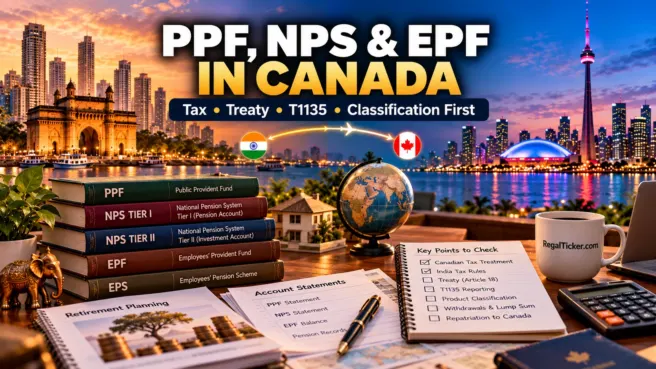
Foreign retirement arrangements and certain retirement trusts have specific exclusions, so PPF/NPS/EPF-type products should be classified rather than automatically added to the total.
1. Start With One Question: Are You a Canadian Resident for the Year?
T1135 is a Canadian resident reporting rule.
A non-resident does not file T1135 merely because they have Canadian employment income. The form becomes relevant when the taxpayer is resident in Canada and holds enough specified foreign property.
For an immigrant or returning resident, that makes the Canadian residency date the starting point.
The most important newcomer rule is easy to miss:
An individual generally does not have to file T1135 for the tax year in which they first become resident in Canada.
That does not make foreign income disappear. Canadian income-tax rules can still require worldwide income for the resident part of the year.
It simply means the T1135 information return normally starts from the following year, if the foreign-property cost test is then met.
2. The Threshold Is CAD 100,000 in Total — Not CAD 100,000 Per Asset
Suppose a Canadian resident has the following Indian assets:
| Indian asset | Canadian cost amount |
|---|---|
| NRE deposit | CAD 20,000 |
| NRO fixed deposit | CAD 30,000 |
| Indian shares | CAD 35,000 |
| Indian mutual funds | CAD 25,000 |
| Total | CAD 110,000 |
No single holding is above CAD 100,000.
The taxpayer can still cross the T1135 threshold because the specified foreign property is added together.
CRA gives the same type of example with foreign shares plus a foreign bank account: the properties are aggregated to determine whether the threshold is exceeded.
This is why looking only at the largest Indian account is risky.
3. Cost Amount Is Not the Same as Market Value
The basic T1135 threshold is generally based on cost amount.
For many investments, that means something close to Canadian adjusted cost base rather than today’s market value.
Example: market value is high, but cost is low
You bought Indian shares years ago for the Canadian-dollar equivalent of CAD 60,000. They are now worth CAD 140,000.
If those are your only specified foreign assets and there have been no cost adjustments that push the cost amount above CAD 100,000, the market value alone does not create the threshold.
Example: market value has fallen, but cost is high
You bought foreign assets for CAD 125,000 and they later fell to CAD 85,000.
The lower market value does not necessarily remove the T1135 filing obligation because the threshold is cost-based.
And if your specified foreign property exceeded CAD 100,000 at any time during the year, selling assets before December 31 does not automatically remove the requirement for that year.
Investor note
Do Not Use Your Year-End Portfolio Screenshot as the T1135 Test
A current-value statement is useful evidence, but it is not the same thing as the Canadian cost record. Keep purchase history, arrival-date values and later additions separately.
4. Newcomers Get a First-Year Exception — and a New Starting Cost
CRA says an individual does not file T1135 for the tax year in which they first become resident in Canada.
For future years, property already owned when Canadian residency began generally gets a T1135 cost amount equal to its fair market value at that time.
Imagine Priya becomes a Canadian resident in September 2026.
On that date she owns Indian shares worth CAD 55,000, mutual funds worth CAD 35,000, and an NRE deposit of CAD 25,000. The total is CAD 115,000.
She generally does not file T1135 for her first Canadian-resident tax year simply because the total is above CAD 100,000.
For the following year, the arrival-date fair market values become important starting cost amounts for testing the threshold.
This is why a newcomer should save statements and a defensible exchange-rate record on the residency date instead of reconstructing the number years later.
5. Part A and Part B: What the CAD 250,000 Number Really Means
The CAD 250,000 figure is often misunderstood.
It is generally not the threshold for whether T1135 is required.
- CAD 100,000 or less: generally no T1135 filing based on the cost threshold.
- More than CAD 100,000 but less than CAD 250,000 throughout the year: Part A simplified reporting is generally available.
- CAD 250,000 or more at any time during the year: Part B detailed reporting generally applies.
A taxpayer who qualifies for Part A can choose to use detailed Part B instead.
CAD 100,000 decides whether the form may be required. CAD 250,000 decides how much detail you generally have to report.
6. Do NRE, NRO and Other Indian Bank Accounts Count?
Foreign funds and bank deposits can fall within specified foreign property.
That means Indian bank balances can matter for the aggregate test.
For a Canada-based NRI, review NRE savings and fixed deposits, NRO savings and fixed deposits, FCNR(B) deposits, and other Indian bank or deposit accounts that fall within the statutory definition.
The account being tax-exempt in India does not remove it from the Canadian T1135 analysis.
For the Indian banking route, use RegalTicker’s NRE vs NRO vs PIS guide.
7. Indian Shares and Mutual Funds Are Usually Straightforward T1135 Categories
Direct Indian shares
CRA states that shares of non-resident corporations are specified foreign property even when held through a broker.
So direct holdings of Indian companies can count toward the T1135 threshold.
Indian mutual funds
CRA also addresses non-resident mutual funds directly.
Generally, the investment in the non-resident mutual fund is the specified foreign property for the investor.
The investor does not separately list every share or bond held inside that mutual fund.
For the broader Indian-side investment route, see RegalTicker’s NRI Mutual Fund Investing in India.
8. Indian Property: Personal Home and Rental Property Can Produce Different Answers
Not every house in India belongs on T1135.
CRA excludes personal-use property.
CRA says “primarily” means more than 50% for personal-use purposes.
A house held mainly for your own or your family’s personal use can fall outside specified foreign property.
A property rented with a reasonable expectation of profit can be specified foreign property.
Mixed-use facts require closer review.
Also remember that financing does not reduce the property’s cost amount to the cash down payment.
9. Indian Life Insurance Can Count Too
CRA says a life-insurance policy issued by a foreign issuer can meet the definition of specified foreign property.
For T1135 cost purposes, the policy’s adjusted cost basis can serve as a reasonable approximation of cost amount.
That makes Indian cash-value, endowment or similar life-insurance arrangements worth reviewing rather than ignoring them because they do not look like “investments.”
10. PPF, NPS and EPF: Classify Before You Add Them to the T1135 Total
This is one area where a broad internet checklist can cause trouble.
Canadian rules exclude certain interests in foreign retirement arrangements and certain retirement trusts from specified foreign property.
That means it is unsafe to say:
“Every PPF, NPS or EPF balance automatically goes on T1135.”
It is equally unsafe to assume every one is excluded.
The exact legal structure has to be classified.
Until that classification is complete, do not force the balance into or out of the T1135 total simply because a generic checklist says so.
11. T1135 Does Not Decide Whether Indian Income Is Taxable
CRA says Canadian residents must report foreign income even when the cost of the foreign property is below CAD 100,000.
So the following statement is wrong:
> “My Indian assets are below CAD 100,000, so I do not need to report the income.”
The correct distinction is:
T1135 threshold → foreign-asset disclosure requirement
Canadian income-tax rules → whether foreign interest, dividends, rent or gains are taxable
The two systems interact, but one does not replace the other.
12. What Happens If T1135 Is Filed Late?
T1135 is an information return, but the penalties are real.
CRA’s current penalty table says the basic failure-to-file penalty can be CAD 25 per day for up to 100 days, with a minimum of CAD 100 and a maximum of CAD 2,500.
More serious penalties can apply where the failure is knowing or amounts to gross negligence.
If an old filing was missed, do not improvise a correction. CRA’s Voluntary Disclosures Program can be available in qualifying cases, and an amended form may also be appropriate depending on the facts.
13. A Practical T1135 Checklist for Indian Assets
Before filing, build a simple asset register.
| Asset | What to record |
|---|---|
| NRE/NRO/FCNR | Institution, account number, Canadian cost/value history |
| Indian shares | Company, Canadian cost base, income, disposals |
| Indian mutual funds | Fund/folio, Canadian cost, distributions, redemptions |
| Rental property | Cost amount, use, rent, sale history |
| Personal-use property | Evidence supporting personal-use classification |
| Life insurance | Issuer, policy number, adjusted-cost information |
| Retirement/savings products | Legal structure and classification |
| Other foreign assets | Cost amount, income, gains/losses |
For newcomers, add one more column: fair market value when Canadian residency began.
Keep the historical Indian records even after Canada establishes a new starting cost. India may still use the earlier acquisition history for its own tax calculation.
The same long-horizon record discipline applies across investments. RegalTicker’s Demerger Cost Basis Calculator is a useful reminder that future tax work often depends on records created years before the taxable event.
Frequently asked questions
What is the T1135 threshold for Indian assets?
A Canadian resident generally files T1135 when the aggregate cost amount of specified foreign property exceeds CAD 100,000 at any time during the year.
Is the CAD 100,000 threshold per account?
No. It is generally an aggregate threshold across all specified foreign property.
Is the threshold based on market value?
Generally no. CRA says the threshold is based on cost amount, which is generally adjusted cost base rather than current fair market value.
Do I need T1135 in my first year after moving to Canada?
An individual generally does not have to file T1135 for the tax year in which they first become resident in Canada.
What cost do newcomers use in later years?
For foreign property already owned when Canadian residency began, CRA generally uses fair market value at the time Canadian residency began as the cost amount for future T1135 purposes.
What is the difference between the CAD 100,000 and CAD 250,000 thresholds?
CAD 100,000 is the main filing threshold. If specified foreign property remains below CAD 250,000 throughout the year, simplified Part A reporting is generally available. If it reaches CAD 250,000 or more at any time, detailed Part B reporting generally applies.
Does my NRE account count for T1135?
Foreign funds and bank deposits can be specified foreign property, so an NRE account can be relevant to the aggregate test.
Are Indian mutual funds reported on T1135?
Generally yes when they meet the specified-foreign-property rules. CRA says the investor usually reports the interest in the non-resident mutual fund rather than every underlying security.
Does my Indian family home go on T1135?
A property held primarily for personal use can be excluded. A rental or investment property held for profit can be specified foreign property.
Does a foreign life-insurance policy count?
CRA says a life-insurance policy issued by a foreign issuer can be specified foreign property, and adjusted cost basis can be a reasonable approximation of its T1135 cost amount.
Do PPF and NPS automatically go on T1135?
Do not assume either answer. Canadian rules contain exclusions for certain foreign retirement arrangements and retirement trusts, so the exact legal structure should be classified first.
If I am below CAD 100,000, is my Indian income tax-free in Canada?
No. The T1135 threshold is a reporting threshold, not an income-tax exemption.
What is the basic penalty for filing T1135 late?
CRA’s current basic failure-to-file penalty is CAD 25 per day for up to 100 days, with a minimum CAD 100 and maximum CAD 2,500. More serious penalties can apply in other circumstances.
Verify through official sources
Official references
- Canada Revenue Agency — Questions and Answers About Form T1135 — Current CRA guidance on the CAD 100,000 threshold, cost amount, newcomer exception, Part A/Part B, shares, mutual funds, property, insurance, income and reassessment.
- Canada Revenue Agency — Foreign Income Verification Statement — Who must file T1135 and the definition of specified foreign property.
- Canada Revenue Agency — Form T1135 — Current T1135 form and filing access.
- Canada Revenue Agency — Table of Foreign-Reporting Penalties — Current failure-to-file and false-statement penalty framework.
- Canada Revenue Agency — Penalties — Additional CRA explanation of foreign-reporting penalties.
Educational disclaimer: This article is for investor education and general Canadian tax-awareness purposes. It is not individual Canadian or Indian tax, legal, accounting or investment advice. T1135 classification can depend on residence status, ownership, legal structure, use of the property, cost history and the exact foreign product. Investors should obtain professional advice for material balances, retirement arrangements, missed filings or mixed-use property.
Final takeaway
Add the Assets Together, but Classify Them Before You Count Them
T1135 is easier to manage when you stop treating it as a mysterious “foreign wealth form.”
The process is practical:
confirm Canadian residency → identify specified foreign property → establish Canadian cost amount → add the assets together → apply the CAD 100,000 threshold → choose Part A or Part B → report foreign income separately.
For Indian investors, the traps are predictable: checking only the largest account, using market value instead of cost, forgetting the newcomer rule, treating CAD 250,000 as the filing threshold, automatically including personal-use property, or automatically classifying every retirement/savings product the same way.
A clean India-asset register solves most of those problems before tax season begins.