Tuesday’s closing numbers make the session look dull. They were not.
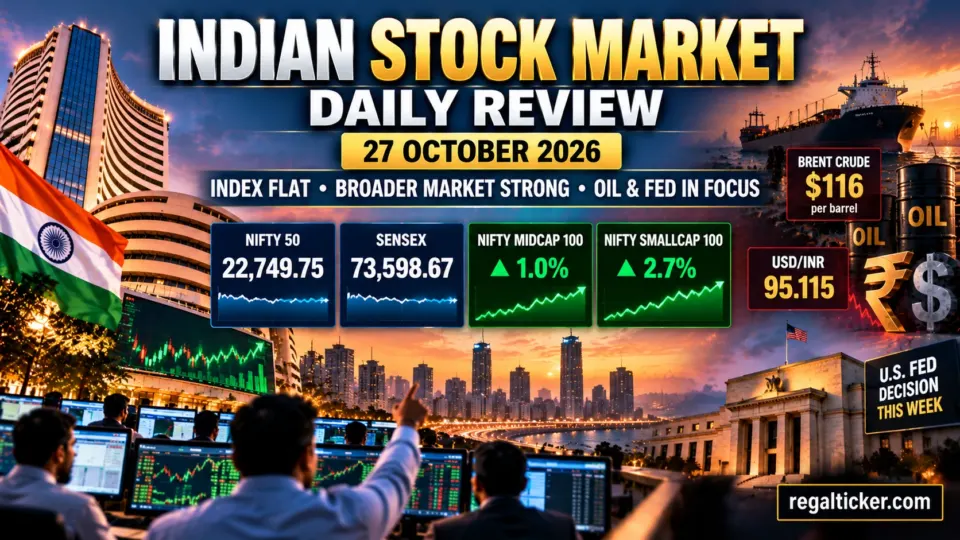
The Nifty 50 slipped just 0.02% to 22,749.75 and the Sensex eased 0.01% to 73,598.67. On the surface, that is almost no move at all. Underneath the benchmarks, however, the market was far more active: the Nifty Midcap 100 gained about 1% and the Nifty Smallcap 100 rose roughly 2.7%, while 12 of the 16 major sectoral indices finished higher.
That divergence matters because it tells us investors were willing to take stock-specific and broader-market risk even though the macro backdrop remained uncomfortable. Brent crude stayed around $116 a barrel, the rupee closed near ₹95.115 per dollar, and investors were reluctant to take a large index-level position before the U.S. Federal Reserve’s policy decision on Wednesday.
Yesterday’s 26 October Daily Market Review described Monday’s rise as a relief rebound that still needed confirmation. Tuesday provided a mixed answer: the large-cap index did not extend the rally, but market participation broadened sharply. That is stronger than a simple flat close suggests, yet not strong enough to declare the correction finished.
Flat benchmarks hid a much stronger broader market
The Nifty and Sensex barely moved, but smallcaps rose about 2.7%, midcaps gained about 1% and most sector indices finished higher. Investors were willing to buy selected earnings and defence-linked stocks, while expensive crude, a weak rupee and the Fed decision kept heavyweight index risk constrained.
⚡ Quick answer
What happened in the Indian market on 27 October 2026?
The Nifty 50 closed at 22,749.75, down 0.02%, and the Sensex ended at 73,598.67, down 0.01%. The broader market was significantly stronger: smallcaps rose about 2.7% and midcaps about 1%. Auto and pharma led sector gains, while financials and IT lagged. Brent near $116 and USD/INR around 95.115 kept the macro backdrop cautious ahead of the Federal Reserve decision and Jio Platforms’ 28 October listing.
Key takeaways
Nifty 50 closed at 22,749.75, down 0.02%.
Sensex ended at 73,598.67, down 0.01%.
Nifty Midcap 100 gained about 1% and Nifty Smallcap 100 rose about 2.7%.
Auto gained about 1.5% and pharma about 1.9%; financials and IT declined.
Brent crude remained near $116 a barrel, keeping India’s inflation and external-balance risks elevated.
The rupee ended nearly unchanged at about ₹95.115 per dollar, but underlying pressure remained.
Defence stocks drew interest after the Defence Acquisition Council cleared proposals worth about ₹2.12 lakh crore.
Jio Platforms’ listing and the U.S. Federal Reserve decision are both due on 28 October.
1. The headline indices were flat, but breadth was the real story
A flat Nifty can mean very different things depending on what is happening underneath it. Tuesday was a good example.
The Nifty 50 ended only 3.45 points lower at 22,749.75, while the Sensex slipped 8.08 points to 73,598.67. If an investor looked only at those two numbers, the session would appear directionless.
But the broader indices told a different story. Midcaps gained about 1%, while smallcaps rose roughly 2.7%. Reuters also reported that 12 of the 16 major sectors closed higher.
That is important after last week’s sharp damage in smaller companies. The 19–23 October Weekly Market Review showed smallcaps falling much more sharply than the benchmarks. Tuesday’s rebound does not erase that drawdown, but it does show that risk appetite has not disappeared completely.
For investors, the practical lesson is to separate index direction from market breadth. A flat benchmark with improving breadth can be healthier than a rising benchmark driven by only a few heavyweight stocks. The reverse is also true.
2. Auto and pharma led; financials and IT held the index back
Sector performance was uneven enough to explain why the broader market could rally while the Nifty stayed flat.
Auto stocks gained about 1.5% and pharma rose roughly 1.9%. At the other end, financials fell around 0.6% and IT slipped about 0.3%.
That split matters because financials have a large weight in the benchmark. Weakness in banks and financial services can suppress the Nifty even when many other parts of the market are rising.
The stronger performance in autos and pharma also had company-specific support. Earnings reactions remained important, with investors rewarding companies where results or outlook improved rather than simply buying every beaten-down stock.
This is the kind of market where Fundamental Analysis becomes more useful than broad thematic guessing. If a sector is rising because several companies have reported stronger margins, volumes or earnings, that is a different signal from a one-day rally caused by short covering.
3. Tata Consumer showed how strongly the market is rewarding earnings quality
Tata Consumer Products was one of the day’s clearest large-cap movers, rising about 6.8% after stronger-than-expected quarterly results and brokerage upgrades.
The company reported a 16% rise in second-quarter profit to about ₹469 crore and 14% revenue growth, according to Reuters. Growth in newer businesses such as packaged staples helped the market look beyond the company’s traditional tea and salt franchises.
The important market lesson is not that one strong result makes a stock attractive at any price. It is that earnings quality is becoming a more powerful differentiator in a market where macro conditions are difficult.
High crude, a weak rupee and expensive global capital raise the hurdle for companies. Businesses that can still expand margins, maintain demand and defend cash flow tend to receive more investor attention. Companies that disappoint face a less forgiving market.
That is why this earnings season should be read stock by stock rather than as a single bullish or bearish signal.
4. Defence stocks had a real policy catalyst, not just momentum
Defence-related shares also attracted buying after the Defence Acquisition Council approved capital acquisition proposals worth about ₹2.12 lakh crore.
The official Ministry of Defence release lists a wide range of proposed systems, including high-mobility vehicles, self-propelled tracked guns, air-defence systems, counter-drone platforms, surveillance UAVs and long-range kamikaze drone systems.
An Acceptance of Necessity is an important step, but it is not the same thing as immediate revenue for every listed defence company. Procurement still moves through specifications, tendering, contracts, execution and delivery.
That distinction matters for investors. A large policy headline can improve the opportunity set without automatically justifying every valuation in the sector.
RegalTicker’s Risk Management framework is useful here because defence themes can become crowded quickly. Position size and valuation discipline still matter even when the long-term policy direction is supportive.
5. Brent near $116 remains the biggest macro constraint on India
The market’s ability to broaden despite crude near $116 was encouraging, but expensive oil remains the most important macro risk for India.
Brent traded around $116 a barrel on Tuesday as investors balanced fresh attacks and supply risks in the Middle East against ongoing diplomatic efforts. Oil has pulled back from last week’s highs, but it is still close to six-month peak levels.
For India, the transmission chain is familiar but powerful:
higher crude → larger import bill → inflation pressure → rupee demand for dollars → pressure on margins and household purchasing power.
The RegalTicker crude and Hormuz analysis explains why the market impact is broader than oil producers alone. Airlines, paints, chemicals, logistics, consumer companies and the government’s fiscal arithmetic can all feel the effect through different channels.
The fact that Indian equities did not fall sharply on Tuesday does not mean the oil risk has disappeared. It means investors were willing to look through it selectively for one session.
6. The rupee stabilised, but the underlying pressure is still visible
The rupee ended at about ₹95.115 per dollar, only slightly stronger than Monday’s ₹95.185 close.
That stability is useful, but the underlying setup remains difficult. Reuters cited high crude prices, equity outflows and elevated U.S. Treasury yields as continuing pressure points. The Reserve Bank of India has also been active in limiting disorderly moves.
A weak rupee matters to equity investors for two reasons.
First, it changes company economics. Import-heavy businesses face higher costs, while some exporters may receive a translation benefit.
Second, it changes the return calculation for foreign investors. A foreign investor can earn a positive local-currency equity return and still see that return reduced by currency depreciation.
That is why the recent ₹48,056 crore FPI outflow analysis links crude, the rupee and U.S. yields rather than treating foreign selling as an isolated equity-market event.
7. Institutional flows still need confirmation after Monday’s selling
The latest reliable provisional cash-market figure available when this review was locked was for 26 October.
FIIs were net sellers of about ₹1,462.49 crore, while DIIs bought roughly ₹2,609.57 crore. The 27 October provisional cash-market numbers had not yet been reliably published across the primary/standard market-data sources at the publication cut-off, so this review does not substitute an unverified tracker value.
This distinction matters because institutional-flow data is frequently copied before final or exchange-collated numbers are available.
The broader October pattern remains clear: foreign selling has been heavy, while domestic institutions have absorbed a large part of that supply. But one day of foreign buying or selling should not be treated as a trend reversal by itself.
Investor note
Flow data is evidence, not a trading signal
FII and DII numbers help explain who supplied or absorbed shares during a session, but they do not tell you whether tomorrow’s market must rise or fall. Use flows alongside earnings, valuation, currency, crude and global rates rather than as a standalone prediction tool.
8. L&T’s after-market result adds another infrastructure signal for Wednesday
Larsen & Toubro reported a 33% increase in second-quarter profit after Tuesday’s market close, with profit rising to about ₹5,202 crore from roughly ₹3,926 crore a year earlier, according to Reuters.
The result was supported by infrastructure demand and strong Gulf-region orders. That makes L&T especially relevant in the current market because it sits at the intersection of India’s domestic capex cycle and Middle East infrastructure spending.
The stock-market reaction will come on Wednesday, so the result belongs in the next-session watchlist rather than being used to explain Tuesday’s closing move.
During earnings season, it is also useful to keep company-result dates separate from shareholder-event dates. RegalTicker’s Corporate Actions Calendar tracks confirmed dividends, splits, bonuses, rights issues, buybacks and restructurings by ex-date, so investors do not confuse an earnings announcement with a corporate-action entitlement date.
9. Jio’s 28 October listing could dominate attention even beyond Reliance
Jio Platforms is scheduled to list on 28 October after one of the most heavily subscribed IPOs in Indian market history.
The issue attracted roughly $77 billion in bids and was subscribed more than 22 times overall, according to Reuters. Institutional demand was especially strong.
That makes the listing important for more than Jio itself. A high-profile debut can influence sentiment toward large IPOs, telecom and digital-platform valuations, Reliance Industries, and the broader primary market.
RegalTicker’s Jio Platforms IPO guide contains the confirmed price band, issue size, business metrics and risk factors. For Wednesday, the key question is no longer subscription demand. It is how public-market investors price the company once real exchange trading begins.
A strong listing would not automatically prove the valuation is cheap. A weak listing would not automatically invalidate the business. The first few sessions should be read as price discovery, not as a final verdict.
10. The Fed decision is the global event India cannot ignore
The Federal Reserve is expected to announce its policy decision on Wednesday.
The immediate market consensus is for no change in rates, which means the tone of the statement and Chair commentary could matter more than the decision itself. Investors will be looking for clues about whether inflation and energy costs keep the Fed biased toward additional tightening later.
For Indian markets, a hawkish Fed can transmit through several channels:
- higher U.S. Treasury yields,
- a stronger dollar,
- weaker emerging-market currency carry,
- pressure on FPI allocation,
- valuation compression in rate-sensitive growth stocks.
That is why Tuesday’s flat benchmark close should not be interpreted in isolation. The market was effectively waiting for a large external variable that will arrive after India’s cash session.
11. What investors should watch on 28 October
Wednesday has an unusually dense event calendar.
First, Jio Platforms lists. Watch price discovery and whether the listing absorbs or releases market liquidity and attention.
Second, the Federal Reserve decides policy. The rate itself may be unchanged, but the inflation and future-rate language can move the dollar, yields and emerging markets.
Third, L&T reacts to its Q2 result. Its order inflow, margins and management commentary will matter for the infrastructure and capital-goods narrative.
Fourth, another large earnings slate arrives. Results from major Indian companies can create substantial stock-specific movement even if the index stays quiet.
Fifth, keep watching Brent and the rupee together. A durable easing in oil plus a stable currency would give the Indian market more room to extend the broader-market recovery. A renewed oil spike would work in the opposite direction.
For technical context, Nifty has now spent two sessions around the 22,750 area after Monday’s sharp recovery. The next useful signal is not a guessed target; it is whether the index can sustain gains while breadth remains healthy. Price behaviour should be combined with business and macro evidence rather than treated as a guaranteed forecast.
12. The useful reading of Tuesday: risk appetite improved, macro risk did not
Tuesday’s session was more constructive than the Nifty’s 0.02% decline suggests.
Smallcaps and midcaps rose, most sectors advanced, earnings winners were rewarded and defence names found a policy catalyst. Those are signs that investors are still willing to take risk selectively.
At the same time, Brent near $116, a rupee around ₹95.1 per dollar, persistent foreign-flow pressure and an approaching Fed decision are not minor details. They are the constraints preventing a broader re-rating of the market.
That leaves Indian investors with a balanced conclusion: breadth improved, but the macro ceiling is still there.
For the wider context, use the Market hub to move between daily, weekly and monthly reviews rather than treating one session as a standalone trend. And when corporate restructurings affect holdings, the Demerger Cost Basis Calculator remains the correct tool for maintaining acquisition-cost records independently of market direction.
Frequently asked questions
Where did Nifty close on 27 October 2026?
The Nifty 50 closed at 22,749.75, down 0.02% for the session.
Where did Sensex close on 27 October 2026?
The Sensex ended at 73,598.67, down 0.01%.
Why were smallcaps strong when Nifty was flat?
Buying was broader outside the heavyweight index, supported by earnings reactions and defence-sector interest. The Nifty Smallcap 100 rose about 2.7% and the Midcap 100 about 1% while financials and IT weighed on the benchmark.
Which sectors performed best?
Auto gained about 1.5% and pharma about 1.9%. Financials fell roughly 0.6% and IT about 0.3%.
What happened to the rupee?
The rupee ended nearly unchanged at about ₹95.115 per U.S. dollar. High crude, foreign outflows and elevated U.S. yields continued to weigh on sentiment.
What are the latest FII and DII numbers?
The latest reliable provisional cash-market numbers available at publication cut-off were for 26 October: FIIs sold about ₹1,462.49 crore net while DIIs bought about ₹2,609.57 crore net. The 27 October provisional figures were still pending reliable publication.
What is the biggest event for 28 October?
There are several: Jio Platforms’ stock-market listing, the Federal Reserve policy decision, L&T’s post-result market reaction and another heavy Indian earnings calendar.
Verify through official sources
Official references
- Reuters — Indian equity benchmarks muted as elevated oil and Fed stay in focus — Nifty and Sensex closing levels, broader-market moves, sector performance and market drivers on 27 October.
- Reuters — Rupee boxed in range as traders watch oil, outflows and RBI defence — USD/INR close and the main currency pressures from crude, foreign flows and U.S. yields.
- Reuters — Oil rises as diplomacy hopes offset renewed Houthi attacks — Brent crude context and Middle East supply-risk developments.
- Ministry of Defence / PIB — DAC clears capital acquisitions worth ₹2.12 lakh crore — Official Acceptance of Necessity approvals that supported defence-sector interest.
- Reuters — Tata Consumer posts strongest one-day gain in nearly 19 months — Tata Consumer’s share-price reaction and Q2 profit/revenue context.
- Reuters — Larsen & Toubro profit rises 33% on infrastructure and Gulf orders — L&T’s Q2 result released after the market close and the demand drivers behind it.
- Larsen & Toubro — Q2 FY27 earnings conference call notice — Official company confirmation of the 27 October earnings release and investor call.
- Reuters — An early Diwali for Ambani — Jio IPO subscription, institutional demand and 28 October listing context.
- Moneycontrol — FII and DII cash-market activity — Latest reliably published provisional cash-market flow figures available at article cut-off.
Final takeaway
Flat index, stronger market underneath
The benchmark close was almost unchanged, but Tuesday’s market was not weak in the same way. Smallcaps, midcaps and most sectors advanced, showing that investors were willing to take selective risk even while the Nifty stayed pinned near 22,750.
The catch is that the macro constraints have not gone away. Brent remains around $116, the rupee is still near ₹95 to the dollar, foreign-flow pressure remains important and the Fed decision can change the global rate backdrop overnight.
Wednesday therefore becomes a useful test. If breadth remains healthy through Jio’s listing, L&T’s earnings reaction and the Fed event, the two-day recovery will look more durable. If oil, the dollar or global yields reassert themselves, Tuesday’s smallcap strength may prove to have been only a temporary burst of risk appetite.
Educational disclaimer: This article is for education and general market information only. It is not investment advice, a trading signal or a recommendation to buy or sell any security. Market prices, index levels, currency rates, commodity prices and institutional-flow figures can change or be revised after publication. Verify time-sensitive information through the relevant exchange, company filing, regulator, broker or authorised market-data provider before making financial decisions.