


NRI Investing
A practical roadmap to NRE/NRO banking, Demat and trading accounts, KYC, tax and repatriation.
⚡ Quick answer
Can an NRI invest in the Indian stock market?
Yes. NRIs can invest in eligible Indian securities, but the account structure and money flow are different from those used by a resident investor. The practical route is to confirm your non-resident status, use the appropriate NRE or NRO banking setup, complete NRI KYC, open suitable Demat and trading accounts, fund investments through the correct bank route, and then keep tax and repatriation records. The exact setup depends on the security, whether the investment is repatriable or non-repatriable, and the bank/broker arrangement. Start with the structure first; choose investments only after the structure is correct.
Key takeaways
Start with status
FEMA residency affects the banking and investment route; Indian tax residency is tested separately.
Separate the accounts
NRE/NRO are bank accounts, Demat holds securities, and the trading account handles market transactions.
Decide the money route
Repatriable and non-repatriable investing can require different banking and broker setups.
Keep KYC current
Passport, PAN, overseas address and other documents must match your NRI profile.
Plan tax before selling
Capital gains, TDS and DTAA questions should be understood before a large exit.
Keep records
Contract notes, bank statements, corporate-action records and remittance documents can matter later.
How can an NRI invest in the Indian stock market?
The easiest way to understand NRI investing is as a chain:
Status → Bank account → KYC → Demat & Trading → Funding → Investing → Tax & Repatriation
If one link is wrong, the problem may not appear on day one. It may surface later when you sell shares, receive money, try to repatriate funds or prepare an Indian tax return.

1
TITLE: The NRI investing route in six steps
1
Check your status
Confirm that your banking and investment relationships correctly reflect your non-resident status.
2
Set up NRE / NRO banking
Decide which account receives overseas funds, Indian income and investment proceeds.
3
Complete NRI KYC
Update PAN, passport, overseas address and other documents required by the intermediary.
4
Open Demat & trading accounts
Use an NRI-compatible securities setup that matches the chosen banking route.
5
Fund and invest
Transfer money through the linked bank account and invest only in eligible products through the permitted route.
6
Track tax and repatriation
Preserve purchase, sale, tax and bank records before moving proceeds abroad.
First understand your NRI status: FEMA and income tax are different
A common mistake is to use one simple day-count rule for every NRI question. That is not reliable.
For foreign-exchange and banking purposes, the Reserve Bank of India describes an NRI as a person resident outside India who is a citizen of India. The FEMA framework affects issues such as NRE/NRO accounts, permitted credits and debits, investment routes and repatriation.
Indian income-tax residential status is determined separately under the Income-tax Act. The tax tests can involve different day-count rules and additional provisions for certain Indian citizens and persons of Indian origin.
Important terms
Terms used in this section
- FEMA residential status — Used for foreign-exchange, banking and cross-border investment rules.
- Income-tax residential status — Used to determine how income is treated for Indian tax purposes.
- NRI — For the RBI/FEMA banking context, an Indian citizen who is resident outside India.
- OCI — Overseas Citizen of India; investment permissions can overlap with NRI rules in several areas, but the precise rule should be checked for the transaction.
Investor note
Do not rely on “182 days = NRI” as a universal rule
A day-count may be relevant to income-tax residency, but FEMA status and tax status answer different questions. If your position is unclear—especially after moving abroad or returning to India—verify both separately before restructuring accounts or making a large transaction.
For the complete residency framework, read RegalTicker’s FEMA vs Income Tax Residency for NRIs guide. It explains the FEMA residence test, 182-day and 120-day income-tax rules, deemed residency, NR vs RNOR vs ROR, and what can happen when an NRI leaves or permanently returns to India.
If you have recently moved overseas, review the banking relationships you already have. RBI guidance states that when a resident Indian becomes a person resident outside India, an existing resident account should be redesignated as an NRO account.
NRE vs NRO vs Demat vs trading account
Four account names appear repeatedly in NRI investing, but they do different jobs.
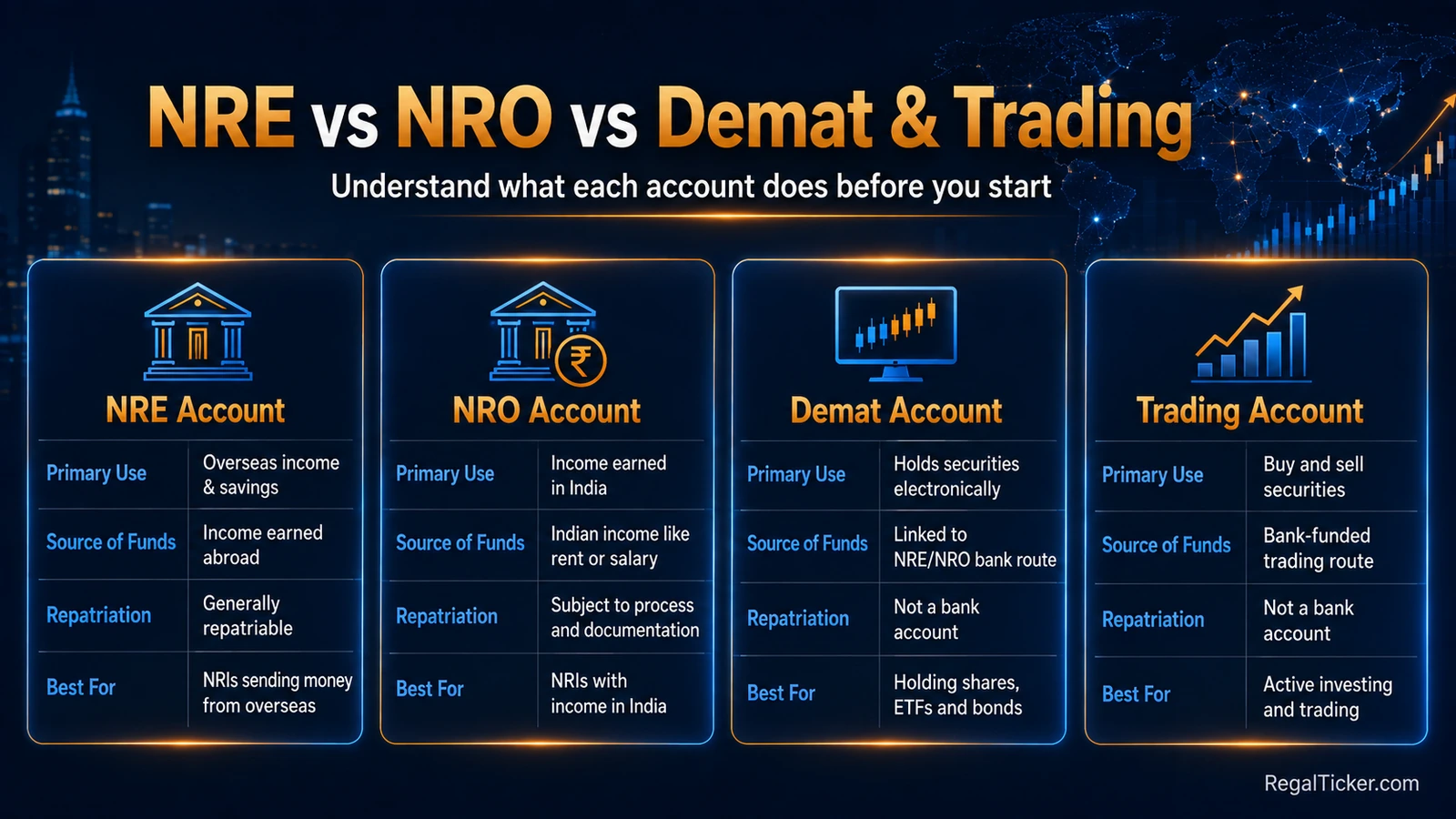
Banking accounts
- NRE account — Generally used for eligible overseas funds and is repatriable under the applicable rules.
- NRO account — Commonly used for legitimate rupee income and funds in India; repatriation follows a different framework.
Securities accounts
- Demat account — Holds shares and other eligible securities electronically.
- Trading account — Used through the broker to place and record buy/sell transactions.
- A useful mental model is:
- Bank account = money
- Trading account = transaction
- Demat account = securities
- If these concepts are new, first read What Is a Demat Account?, What Is a Trading Account? and Demat Account vs Trading Account vs Bank Account.
What is an NRE account?
An NRE account is an Indian-rupee account designed for eligible non-resident funds. RBI guidance permits eligible inward remittances and certain qualifying credits and describes NRE balances as repatriable, subject to the applicable rules.
For an investor, the important question is not simply “Do I have an NRE account?” It is “Does my investment route preserve the repatriable character I need?”
What is an NRO account?
An NRO account is commonly used for legitimate rupee income and other permitted funds in India. Examples can include eligible rent, pension, dividend, interest or other Indian receipts.
NRO money is not treated the same way as NRE money for repatriation. RBI permits remittance of current income subject to conditions and also provides an annual facility for eligible NRO balances and qualifying assets, subject to documentation and tax compliance.
For a deeper account-level explanation, continue to NRE vs NRO vs PIS Account.
What does the Demat account do?
The Demat account is the electronic holding account for securities. SEBI’s depository guidance confirms that an NRI does not need RBI permission merely to open a Demat account, although every credit, debit and underlying transaction must still comply with the applicable rules.
What does the trading account do?
The trading account is maintained through the broker and is used to place eligible market orders. It does not hold your cash like a bank account or hold your shares like a Demat account.
What is PIS, and does every NRI need it?
PIS means Portfolio Investment Scheme. It remains relevant in some NRI bank/broker structures, particularly where listed shares are being bought and sold through a repatriable route linked to the designated banking arrangement.
However, beginners should avoid two opposite assumptions:
- “Every NRI stock investment needs PIS.”
- “PIS is completely irrelevant now.”
The practical answer depends on your investment route, bank, broker, repatriation choice and the security being traded. NSE’s current NRI trading-account FAQ still refers to PIS documentation where a PIS-based setup is being used.
Questions to ask before choosing PIS or non-PIS
- Is this investing setup repatriable or non-repatriable?
- Which NRE or NRO account will fund it?
- Does this bank/broker combination require a PIS permission or designated PIS account?
- Where will sale proceeds be credited?
- Can the same account be used for every product I intend to buy?
- What documents will the bank require if I later repatriate the proceeds?
What can NRIs invest in India?
NRI investing is broader than individual Indian shares. Depending on the product, route and intermediary support, an NRI may be able to access several categories of Indian investments.

Listed shares
NRIs can invest in eligible Indian listed shares under the applicable foreign-investment and securities-market rules. This is the main focus of this guide.
Mutual funds
NRIs may invest in eligible Indian mutual-fund schemes. Product access can vary by fund house and country of residence because an Indian product can create additional compliance obligations in another jurisdiction.
ETFs
Exchange-traded funds can provide market-traded exposure to indices, sectors, commodities or other eligible themes. Buying and selling ETFs on an exchange typically requires a suitable Demat and trading setup.
IPOs
NRIs can participate in eligible public issues under the applicable investor category and issue conditions. Always read the specific offer document because payment route, category and allocation rules can differ.
Bonds and other eligible debt securities
Eligible fixed-income securities can provide a different risk/return profile from equities. Tax and repatriation treatment may differ by instrument.
REITs and InvITs
Listed REITs and InvITs can provide exposure to income-producing real estate or infrastructure through market-listed units. Distribution taxation can be more complex than a normal equity dividend, so understand the components before investing.
Caution
“Allowed in India” does not always mean “simple in your country”
Your country of residence may impose its own tax reporting, foreign-asset disclosure, product or broker restrictions. The Indian rule and the overseas-country rule must both be considered. This is why the NRI Specialist Academy will maintain a separate country-guide layer.
How to open an NRI Demat and trading account
The exact workflow differs between intermediaries, but the logic is consistent.
1. Review your existing Indian banking status
If you recently became non-resident, first check whether old resident accounts need redesignation. Do not build a new NRI trading setup around a bank relationship that is still incorrectly classified.
2. Keep PAN and identity documents ready
PAN is central to securities-market KYC and Indian tax reporting. Keep your current passport and overseas status documents ready as well.
3. Prepare overseas-address proof
NSE’s NRI trading FAQ requires the foreign address to be provided with documentary proof. Additional local correspondence-address proof may also be required if you choose to use one.
4. Complete NRI KYC
SEBI’s current KYC material lists passport/OCI/PIO-related documentation and overseas-address requirements for non-resident investors. Your bank, broker or KRA may ask for additional declarations depending on your case.
5. Open the NRI-compatible Demat account
Your depository relationship must correctly reflect your non-resident status and the investment route being used.
6. Open the trading account
Confirm which products and market segments the broker allows for your NRI setup. Do not assume that a trading account enables every type of trade.
7. Link the correct bank account
The funding and withdrawal route should match the chosen NRE/NRO and repatriation structure.
⭐ Pro tip
Ask the broker for the complete money-flow diagram
Before signing up, ask: “Which account sends money in, where do sale proceeds go, and which documents will I need to move eligible proceeds overseas?” A clear answer is more useful than a headline brokerage discount.
Repatriation: can an NRI take investment money back abroad?
Often yes—but the answer depends on how the investment was funded and how it was held.
This is why repatriation planning belongs at the beginning of the investing process.
NRE route
RBI describes NRE accounts as repatriable under the applicable framework. Eligible funds and permitted credits can generally be remitted abroad subject to the required bank process.
NRO route
NRO remittance follows a different framework. RBI permits eligible NRIs/PIOs to remit up to USD 1 million per financial year from qualifying NRO balances and specified assets, subject to the applicable conditions, documentation and tax compliance.
That is not an automatic entitlement to transfer every NRO balance. The authorised dealer bank must be satisfied that the remittance qualifies and that the required documents are in place.
Investor note
Decide on repatriation before you invest
If bringing eligible sale proceeds back to your country of residence is important, tell the bank and broker at the account-design stage. Do not discover after the sale that your chosen route has different remittance conditions from what you expected.
How are NRI stock-market gains taxed in India?
Tax deserves a dedicated NRI guide, but every investor should understand the basic listed-equity framework before selling.
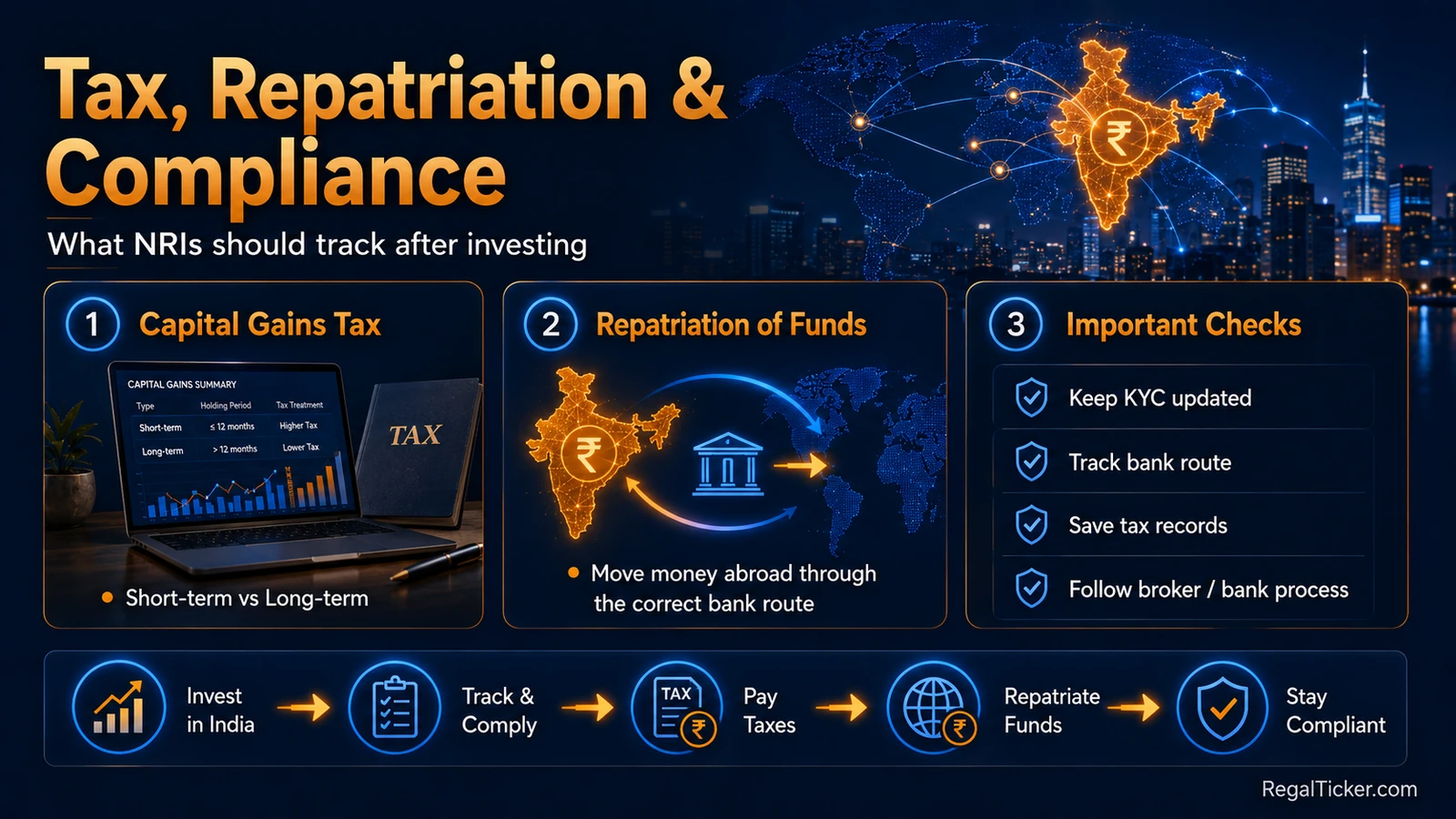
For qualifying listed equity shares and other specified securities satisfying the relevant conditions, current Income Tax Department guidance states that transfers on or after 23 July 2024 are generally taxed at:
- 20% for qualifying Section 111A short-term capital gains; and
- 12.5% for qualifying Section 112A long-term capital gains above the available ₹1.25 lakh aggregate annual threshold.
These headline rates are not a complete NRI tax return. Your actual outcome can also depend on TDS, surcharge, cess, losses, other income, the type of security, DTAA provisions and your country of residence.
Use the calculator
Estimate eligible listed-equity capital gains tax
Use the RegalTicker Capital Gains Tax Calculator to understand the current Section 111A / 112A mechanics for an eligible transaction. For NRIs, treat the result as an educational base estimate because the calculator does not model NRI TDS, DTAA relief, foreign tax credit or repatriation. For the NRI-specific tax layer, continue to NRI Capital Gains Tax on Indian Shares.
TDS is not always the final tax
Tax deducted at source and the final tax liability can differ. Depending on the transaction, you may need to calculate the actual capital gain, claim credit for tax already deducted, pay additional tax, report capital losses or claim treaty relief where applicable.
Caution
Do not copy a resident investor’s tax calculation blindly
The underlying capital-gains rate may be the same for a qualifying transaction, but NRI withholding, DTAA, foreign tax credit and reporting can change the practical outcome. Use a qualified tax professional for material transactions or cross-border tax questions.
Investment limits: use current rules, not an old percentage table
NRI ownership limits are an area where old blog posts and Budget headlines can create confusion.
The applicable position can depend on the security, investor category, repatriation basis, aggregate non-resident holding, sectoral rules and current amendments to the foreign-investment framework.
Do not treat a single historical percentage as a universal permanent rule.
Before a large NRI shareholding
- Check the current FEMA / Non-Debt Instrument framework.
- Check the company’s applicable foreign-investment headroom if relevant.
- Follow the broker and authorised dealer bank’s current compliance process.
- Verify whether a recent policy announcement has actually been implemented through the applicable legal or regulatory instrument.
What should an NRI track after investing?
Buying the security is only the beginning of the record trail.
Keep KYC updated
Update the intermediary when material details such as your passport, overseas address, country of residence, residence permit, bank relationship or contact information change.
Keep bank-route evidence
Know which bank account funded each investment route. This becomes important when sale proceeds arrive or when you later request repatriation.
Save tax records
Preserve:
- contract notes,
- acquisition dates and costs,
- sale dates and proceeds,
- brokerage and eligible transaction records,
- dividend/distribution statements,
- TDS certificates where applicable,
- and annual capital-gain statements.
Reconcile corporate actions
Bonus shares, stock splits, rights issues, buybacks, mergers and demergers can change quantity, cost basis or tax calculations. Use RegalTicker’s Corporate Actions learning hub and relevant Investor Tools when you need to understand the mechanics.
Protect the account
Use your own email and mobile number, enable available security controls, verify broker and adviser registrations, and treat unsolicited stock tips with suspicion. Start with Investor Safety in the Stock Market and the 30-Point Investor Safety Checklist.
Common mistakes NRIs should avoid
Continuing to use an old resident account
If your residential status has changed, the account classification may also need to change. Fix the banking status before building an investment structure around it.
Treating FEMA and tax residency as the same thing
They are separate tests with different consequences.
Choosing a broker only by price
Use the Brokerage Calculator to understand costs, but do not let a small fee difference override correct NRI account structure, service and compliance support.
Assuming every NRI investment is automatically repatriable
The source of funds and route matter. Confirm the expected treatment before investing.
Mixing personal and third-party bank accounts
Maintain a clean funding trail using your permitted account structure.
Ignoring tax until the money reaches the bank
Estimate the tax position before selling a large holding.
Following Telegram, WhatsApp or social-media stock tips
An overseas investor can still be targeted by fake trading apps, impersonation scams and unregistered advisers. Verify independently before transferring money or sharing account credentials.
Does your country of residence matter?
Yes. The Indian investment rule is only one side of a cross-border investment.
A person living in the UAE, United States, United Kingdom, Canada, Singapore, Australia or another country can face different local rules involving:
- taxation of foreign investment income,
- overseas-asset reporting,
- foreign tax credit,
- estate or inheritance rules,
- broker/product availability,
- and local compliance requirements.
This is why country-specific investing guides should sit under the NRI Specialist Academy rather than being mixed into the universal foundation.
A practical NRI investing checklist before your first order
Check the structure before you choose the stock
- Is my Indian banking status correctly classified as non-resident where required?
- Do I need NRE, NRO or both for my actual money flows?
- Do I know whether the investment should be repatriable or non-repatriable?
- Is my PAN and NRI KYC current?
- Is the Demat account correctly classified for my status and route?
- Is my trading account linked to the correct bank account?
- Have I confirmed whether PIS applies to this setup?
- Do I understand the products and market segments the broker permits?
- Have I checked the Indian tax consequences before investing?
- Do I know what my country of residence may require me to report?
- Am I using regulated intermediaries and keeping my own records?
💡 Real example
Arjun moves abroad and wants to keep investing in India
Arjun previously lived in India and has moved overseas for employment. He still has a resident savings account and an old Demat relationship. Instead of immediately transferring overseas savings into the old account and placing trades, he first reviews his status with the bank and broker. The resident bank account is redesignated where required, he chooses the NRE/NRO setup that matches his money flows, updates NRI KYC, and opens the correct NRI-compatible Demat and trading route. He then funds the account through the linked bank relationship, keeps contract notes and acquisition records, estimates tax before a future sale and follows the authorised bank process when eligible proceeds need to move abroad.
What this means for you: the first NRI investing decision is not which stock to buy; it is whether the account and money-flow structure is correct.
Where to continue in the NRI Specialist Academy
This guide is the map. The specialist guides should handle the decisions that need deeper treatment, including:
- FEMA vs income-tax residency,
- NRE, NRO and FCNR banking,
- NRI Demat and trading account opening,
- PIS vs non-PIS,
- eligible investment products,
- NRI shareholding limits,
- repatriation,
- capital gains, TDS and tax filing,
- DTAA and foreign tax credit,
- mutual funds and ETFs,
- IPO investing,
- corporate actions,
- nomination, gifting and inheritance,
- returning to India,
- investor safety,
- and country-specific NRI investing.
Use the NRI Investing Specialist Academy whenever you want to return to the full roadmap.
Final takeaway
Build the investing structure before building the portfolio
NRIs can participate in India’s securities market, but cross-border investing adds a banking, FEMA, KYC, tax and repatriation layer that resident investors do not face in the same way. Get the status, account route and records right first. Then choose investments that fit your goals, risk and permitted setup.
Frequently asked questions
Can an NRI invest in the Indian stock market?
Yes. NRIs can invest in eligible Indian securities subject to the applicable FEMA, SEBI, banking, KYC, tax and investment-route requirements.
Can an NRI buy shares of Indian companies?
Yes, subject to the permitted investment route, applicable foreign-investment limits and other regulatory conditions.
Does an NRI need a Demat account to buy Indian shares?
For normal electronic holding of listed Indian shares, securities are held through a Demat account with a depository participant. SEBI states that RBI permission is not required merely to open an NRI Demat account, although transactions must comply with the applicable rules.
Does every NRI need both NRE and NRO accounts?
No. The appropriate account structure depends on where the money comes from, whether you receive Indian income and whether the investment proceeds need to remain repatriable.
Is PIS compulsory for every NRI stock-market investment?
Do not treat PIS as a universal requirement for every NRI investment. It remains relevant in certain PIS-based bank/broker structures, while other permitted setups can use different routes. Confirm the current requirement for your specific account.
Can NRIs invest in Indian mutual funds?
NRIs may invest in eligible Indian mutual-fund schemes, subject to the fund house’s onboarding policy and any country-specific compliance restrictions.
What is the current tax rate on listed-equity gains?
For qualifying transactions on or after 23 July 2024, current Income Tax Department guidance shows a 20% Section 111A rate for qualifying short-term gains and a 12.5% Section 112A rate on qualifying long-term gains above the available ₹1.25 lakh aggregate annual threshold, subject to the statutory conditions and additional tax components.
Can an NRI repatriate stock-market profits abroad?
Potentially yes. The treatment depends on the investment and bank route. NRE balances are generally repatriable, while NRO remittance follows a different framework and documentation process.
What happens to my resident bank account when I become NRI?
RBI guidance says that when a resident Indian becomes a person resident outside India, the existing resident account should be redesignated as an NRO account.
What should I do if I return permanently to India?
Review the status of NRE/NRO accounts, Demat, trading and tax records. RBI guidance provides for redesignation of NRE accounts when the account holder becomes resident again, subject to the applicable rules.
Verify through official sources
Official references
- Reserve Bank of India — Accounts in India by Non-residents
- NSE — FAQs for NRI Trading Account
- SEBI Investor Education — Investments by NRIs in Indian Securities Market
- SEBI — FAQs on Depository System / NRI Demat Accounts
- SEBI — KYC Norms for the Securities Market
- Income Tax Department — Tax on Sale of Shares in India
Educational disclaimer: This guide explains NRI investing concepts for education. It is not personalised investment, legal, tax or foreign-exchange advice. Rules and intermediary procedures can change. Verify material account, tax, repatriation and regulatory decisions with the relevant official authority, authorised dealer bank, regulated intermediary or qualified professional for your own circumstances.