
⚡ Quick answer
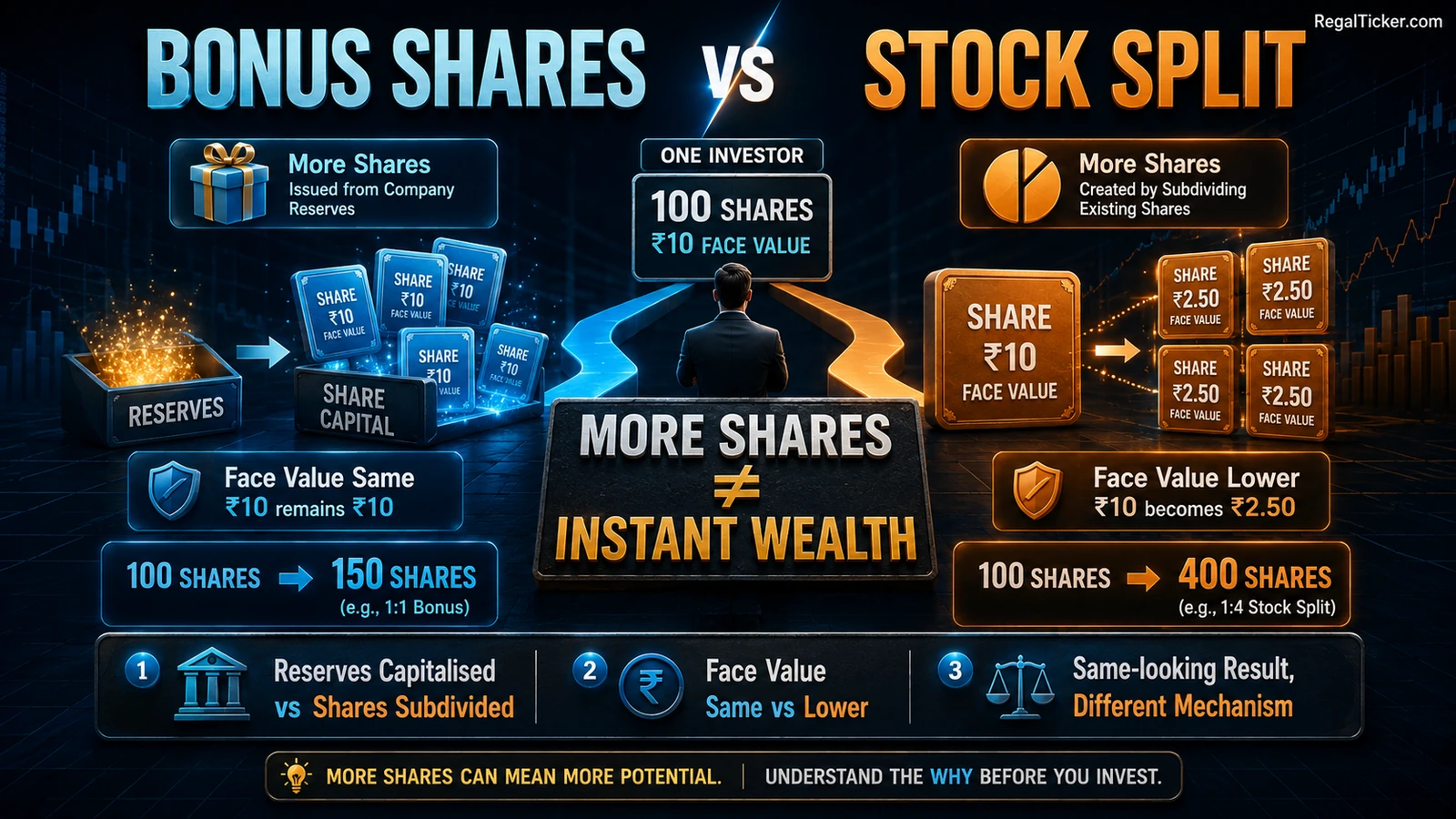
Bonus shares and a stock split can look similar in your Demat account because both increase the number of shares you hold and usually lead to a lower theoretical price per share. But they are not the same corporate action. In a bonus issue, a company issues additional fully paid shares to eligible shareholders by capitalising permitted reserves, while the face value of each share normally stays unchanged. In a stock split, the company subdivides each existing share into smaller-denomination shares, so the face value falls in the split ratio. Neither action creates instant shareholder wealth by itself, and neither normally requires the shareholder to pay fresh money.
Key takeaways
Both bonus shares and stock splits increase the number of shares held by an eligible investor.
Both normally lead to a proportional theoretical reduction in the market price per share.
A bonus issue creates additional shares by capitalising eligible reserves.
A stock split subdivides the existing shares into smaller face-value shares.
Face value normally stays the same after a bonus issue but falls proportionately after a stock split.
Neither action creates instant wealth merely because the share count rises.
The investor’s percentage ownership is generally unchanged by the action itself if all eligible shares are treated proportionately.
Bonus and split calculations should be based on the official company ratio or face-value announcement, not on a broker’s temporary display.
The comparison matters most when you are interpreting share quantity, face value, cost records and company capital structure.
Bonus Shares vs Stock Split: The Difference in One Table
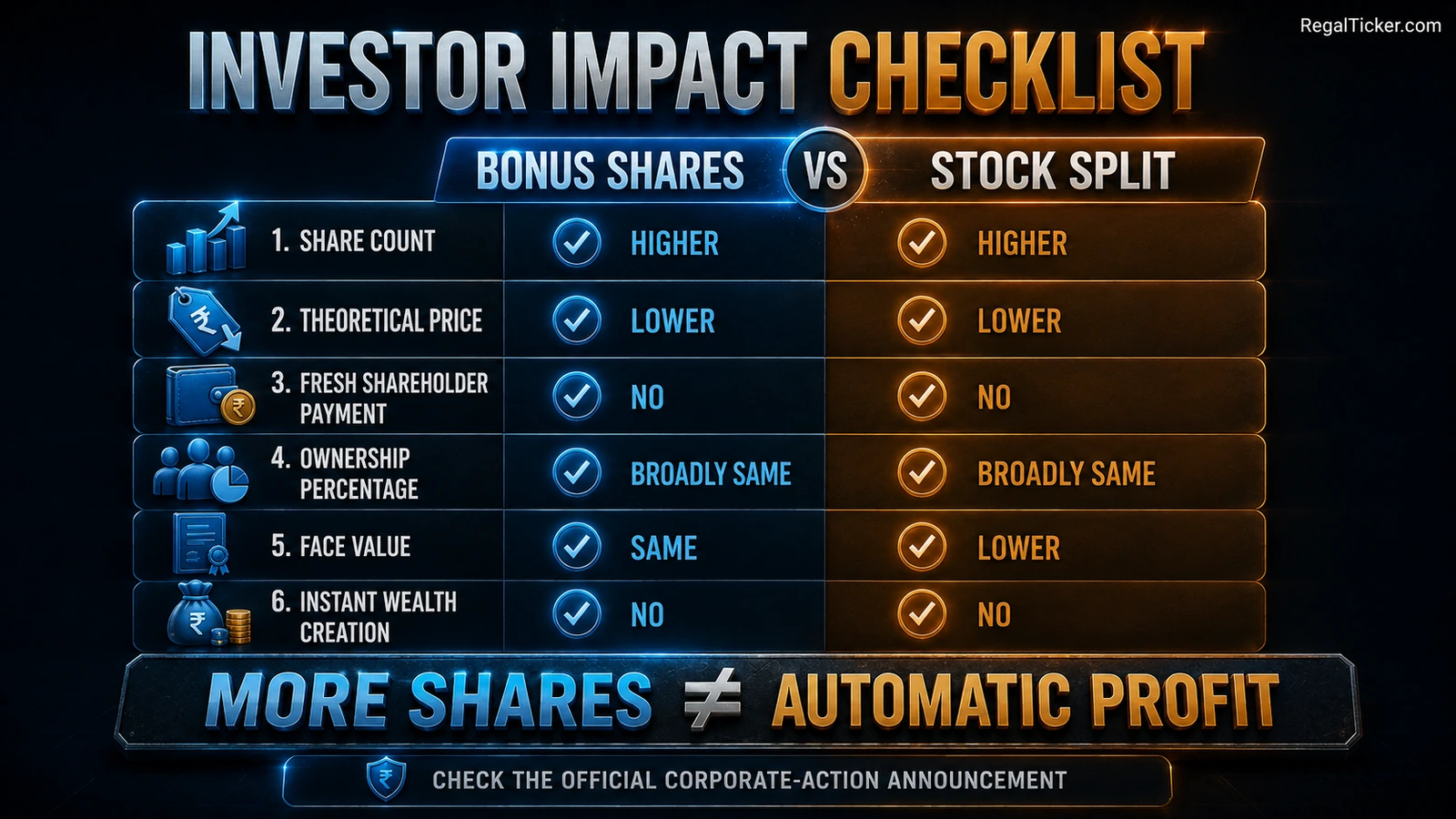
| Point | Bonus Shares | Stock Split |
|---|---|---|
| Basic mechanism | Company issues additional fully paid shares to eligible shareholders | Each existing share is subdivided into more shares |
| Fresh shareholder payment | No | No |
| Share count | Increases according to bonus ratio | Increases according to split factor |
| Face value per share | Normally unchanged | Reduces in the split ratio |
| Company reserves | Eligible reserves are capitalised into share capital | No reserve capitalisation is required merely because of the split |
| Paid-up share capital | Generally increases because new bonus shares are issued | Total paid-up share capital generally remains unchanged; denomination changes |
| Theoretical market price per share | Falls according to bonus adjustment factor | Falls according to split factor |
| Investor’s percentage ownership | Generally unchanged | Generally unchanged |
| Instant wealth creation | No | No |
| Typical stated format | 1:1, 1:2, 2:1 bonus | ₹10 to ₹5, ₹10 to ₹2, or 2-for-1 / 5-for-1 split |
| Main investor clue | Extra shares issued | Face value changes |
What Is a Bonus Issue?
A bonus issue gives eligible existing shareholders additional fully paid shares without asking them to pay a subscription price.
Under Section 63 of the Companies Act, 2013, a company may issue bonus shares from specified sources such as free reserves, the securities premium account or the capital redemption reserve account, subject to the statutory conditions. The Act also states that bonus shares cannot be issued in lieu of dividend.
For a beginner, the easiest way to think about it is:
The company converts part of eligible reserves into share capital and issues additional shares proportionately to existing shareholders.
📖 Definition
Bonus Ratio
A bonus ratio such as 1:1 means one new bonus share for every one eligible existing share. A ratio of 1:2 means one new bonus share for every two eligible existing shares.
If you own 100 shares and the company announces a 1:1 bonus:
Bonus shares = 100 × 1 ÷ 1 = 100
Total shares after bonus = 100 + 100 = 200
Read the full concept guide: What Are Bonus Shares? Meaning, Ratio and Examples.
What Is a Stock Split?
A stock split divides each existing share into a larger number of shares with a smaller face value.
Section 61 of the Companies Act, 2013 permits a company, subject to the applicable corporate approvals and its constitutional documents, to subdivide shares into shares of a smaller amount.
For investors in India, companies often describe the split as a face-value change.
For example:
Face value ₹10 → ₹5
Split factor:
₹10 ÷ ₹5 = 2
If you held 100 shares before the split:
100 × 2 = 200 shares after the split
The face value per share becomes ₹5 instead of ₹10.
Read the detailed guide: What Is a Stock Split? Meaning, Ratio & Examples.
1:1 Bonus vs 2-for-1 Stock Split: Same-Looking Result, Different Mechanism
This is the comparison most investors need.
Assume:
- You hold 100 shares.
- Market price before the action = ₹1,000 per share.
- Face value before the action = ₹10.
- Total theoretical holding value = ₹1,00,000.
💡 Real example
Scenario A — 1:1 Bonus Issue
With a 1:1 bonus, you receive one additional share for every one existing share.
Old shares = 100
Bonus shares = 100
Total shares = 200
Theoretical ex-bonus price:
₹1,000 ÷ 2 = ₹500
Face value remains ₹10 per share.
Theoretical holding value:
200 × ₹500 = ₹1,00,000
💡 Real example
Scenario B — 2-for-1 Stock Split
Assume the company splits face value from ₹10 to ₹5.
Split factor:
₹10 ÷ ₹5 = 2
Old shares = 100
New share count = 200
Theoretical adjusted price:
₹1,000 ÷ 2 = ₹500
Face value becomes ₹5 per share.
Theoretical holding value:
200 × ₹500 = ₹1,00,000
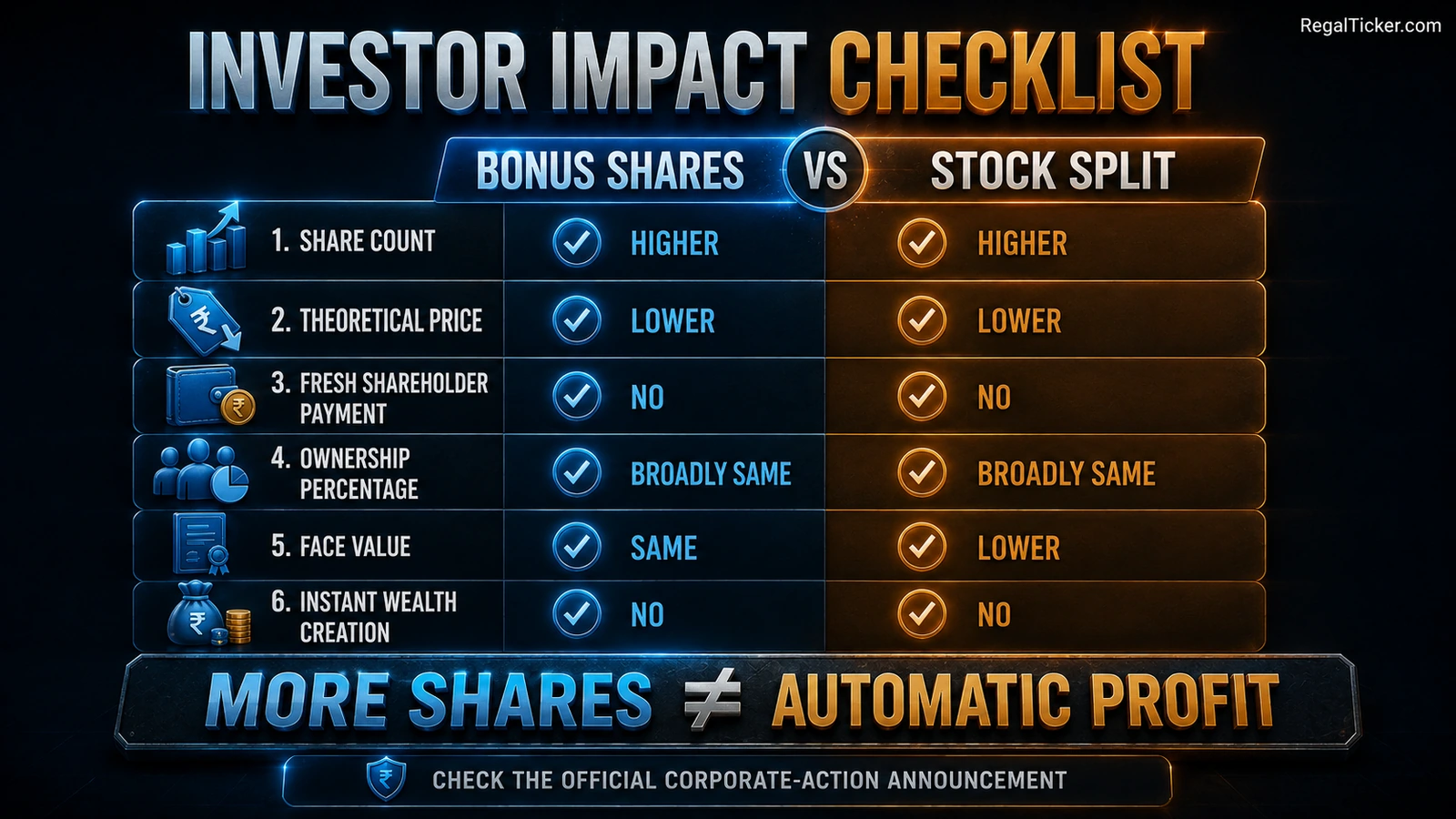
| Result | 1:1 Bonus | ₹10→₹5 Stock Split |
|---|---|---|
| Shares before | 100 | 100 |
| Shares after | 200 | 200 |
| Theoretical price before | ₹1,000 | ₹1,000 |
| Theoretical price after | ₹500 | ₹500 |
| Theoretical holding value | ₹1,00,000 | ₹1,00,000 |
| Face value after action | ₹10 | ₹5 |
| Corporate mechanism | New bonus shares issued | Existing shares subdivided |
Why Does Face Value Change in a Stock Split but Not in a Bonus Issue?
Face value is the nominal denomination attached to each share in the company’s capital structure. It is not the market price.
In a stock split, the company is subdividing each existing share into smaller-denomination shares.
A ₹10 face-value share split into five shares becomes five ₹2 face-value shares.
The total nominal amount represented by the original share remains:
1 × ₹10 = 5 × ₹2 = ₹10
In a bonus issue, the existing face value normally stays unchanged because the company is issuing additional shares of the existing denomination.

📖 Definition
Face Value vs Market Price
Face value is the nominal value assigned to a share in the company’s capital structure. Market price is the price at which investors trade that share on the stock exchange. A stock split reduces face value in the announced ratio, while a bonus issue normally keeps face value unchanged. In both cases, the market price can adjust theoretically because the number of shares changes, but face value and market price are not the same thing.
What Changes Inside the Company?
This is the difference that many short comparison articles miss.
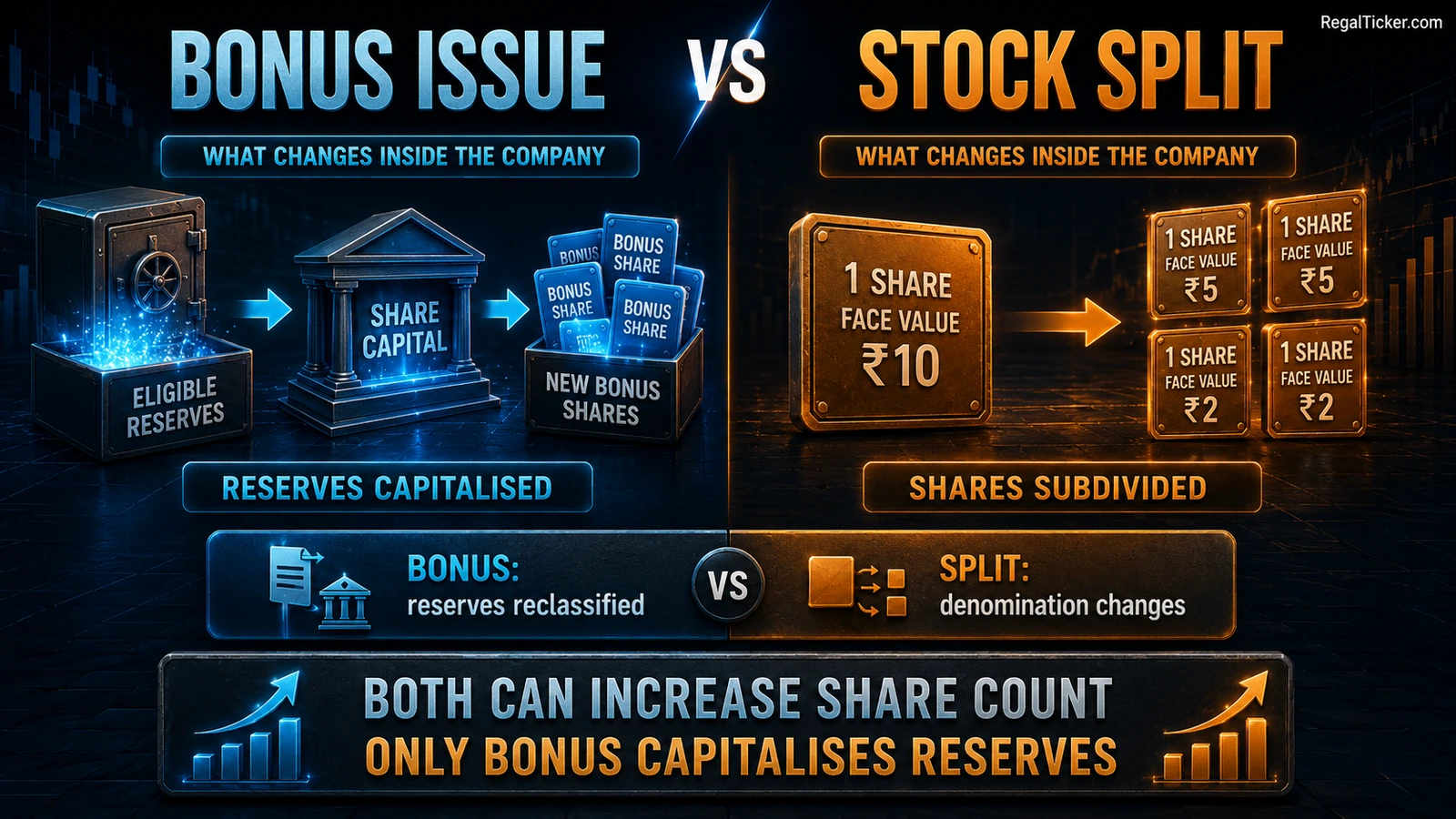
In a Bonus Issue
A bonus issue is linked to the capitalisation of eligible reserves.
Conceptually:
Eligible reserves ↓
Paid-up share capital ↑
The company has not received fresh cash from shareholders. It has reclassified part of its eligible reserves into share capital and issued additional fully paid shares.
The company’s total net worth does not become larger merely because of this accounting reclassification.
In a Stock Split
A stock split primarily changes the number and denomination of shares.
For a simple fully paid split:
Number of shares ↑
Face value per share ↓
Total nominal paid-up share capital ≈ unchanged
That is why a stock split is better understood as a subdivision rather than a distribution of additional economic value.
Investor note
More shares do not mean a bigger company
A company does not become twice as valuable because your share count doubles. The market capitalisation depends on the number of shares multiplied by the market price, and the price adjusts to reflect the larger number of shares. Future business performance can then move the actual market value in either direction.
Does a Bonus Issue or Stock Split Increase Your Wealth?
Not by itself.
If no other information changes, the theoretical price adjusts in proportion to the increased number of shares.
Before:
100 shares × ₹1,000 = ₹1,00,000
After a 1:1 bonus or 2-for-1 split:
200 shares × ₹500 = ₹1,00,000
This is a mathematical adjustment, not a guaranteed trading price.
Once the shares trade after the corporate action, the actual price can move because of:
- earnings expectations;
- market sentiment;
- liquidity;
- sector conditions;
- company news;
- valuation;
- supply and demand.
Caution
Do Not Treat the Adjusted Price as a Forecast
A theoretical ex-bonus or post-split price is only an arithmetic reference. The stock exchange price can trade above or below that level once the market reacts.
What Happens to EPS, Book Value Per Share and Other Per-Share Numbers?
When the number of shares increases, per-share metrics need to be interpreted on the adjusted share count.
If profit is unchanged but the share count doubles, earnings per share will mathematically be based on twice as many shares.
The same logic affects several per-share measures:
| Metric | What the corporate action can do mechanically |
|---|---|
| Shares outstanding | Increases |
| EPS | Recomputed over the larger share count |
| Book value per share | Spreads the relevant equity over more shares |
| Market price per share | Adjusts theoretically downward |
| Investor’s proportional ownership | Generally unchanged |
| Total business profit | Not increased merely by the action |
| Total market value | Not mechanically increased merely by the action |
Which Action Is Better for an Investor?
Neither is automatically “better.”
A bonus issue can be attractive to investors because it increases the number of shares held without a cash payment. A stock split can make a high-priced share numerically more accessible by reducing the price per share.
But neither action improves:
- revenue;
- profit;
- free cash flow;
- competitive advantage;
- return on capital;
- management quality;
- balance-sheet strength
simply because the share count changes.
The investor should therefore separate the corporate-action arithmetic from the investment thesis.
❌ Myth
A stock split makes a company cheaper.
✅ Fact
It lowers the price per share, but valuation measures such as total market capitalisation do not become cheaper merely because each share has been divided into smaller units.
Bonus Shares vs Stock Split: What Happens to Your Cost Records?
For investors, corporate actions can temporarily make broker portfolio screens look confusing.
After either action, you may see:
- a changed share count;
- a temporary mismatch in average price;
- old quantities before new shares are fully reflected;
- an apparent large profit or loss before records adjust.
For a stock split, the same total acquisition cost is spread across the larger number of split shares, so the cost per share is adjusted by the split factor.
Bonus-share cost and holding-period treatment follows the applicable income-tax rules and can differ from the simple stock-split adjustment. India’s tax framework changed with the Income-tax Act, 2025 coming into force from April 1, 2026, so investors should verify the current rules applicable to the actual sale year instead of relying on an old broker FAQ or pre-2026 tax article.
Keep:
- original contract notes;
- company corporate-action announcement;
- Demat credit statement;
- broker adjustment record;
- tax working used at the time of sale.
Do not change your tax records simply because a broker app temporarily shows an unusual average price.
Record Date, Ex-Date and Demat Credit
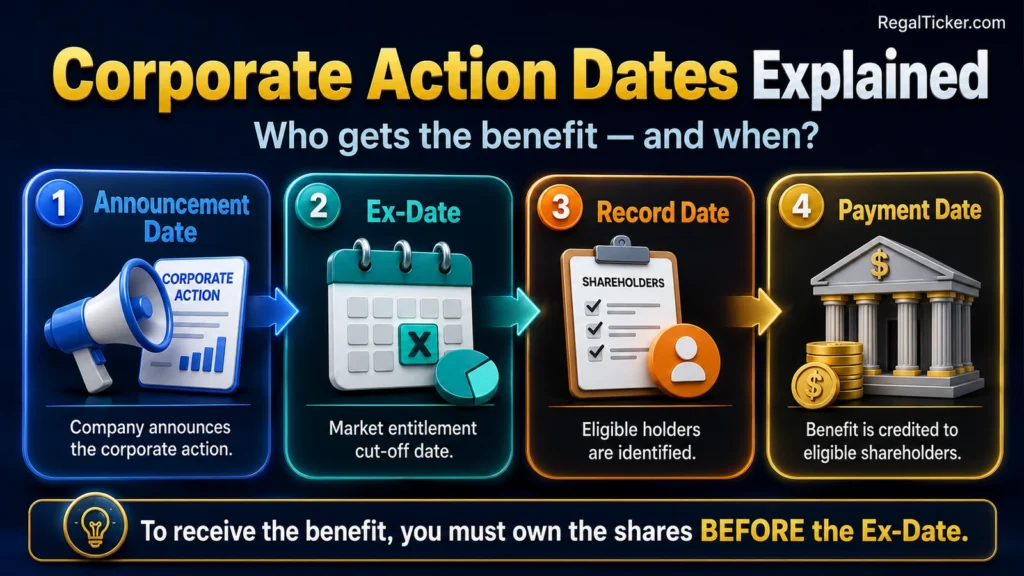
Both bonus issues and stock splits use corporate-action dates to identify eligible holdings and implement the adjustment.
The exact timeline depends on the company announcement and exchange process.
Do not guess eligibility from the date you first see news about the corporate action. Verify the official announcement and understand the difference between announcement date, ex-date and record date.
Read: Corporate Action Dates: Ex-Date, Record Date and Eligibility Explained.
Which Calculator Should You Use?
Use the calculator that matches the actual corporate action.
| Your question | Best RegalTicker tool |
|---|---|
| How many bonus shares will I receive? | Bonus Share Calculator |
| What is the theoretical ex-bonus price? | Bonus Share Calculator |
| How many shares will I have after a face-value split? | Stock Split Calculator |
| What is my adjusted stock-split cost per share? | Stock Split Calculator |
| What happens after both bonus and split events over time? | Bonus & Split Adjusted Return Calculator |
Use the calculator
Compare Bonus and Split Adjustments With Real Numbers
Use RegalTicker’s dedicated corporate-action calculators to check bonus entitlement, stock-split share count, theoretical adjusted price and combined bonus/split return adjustments. Always enter the ratio or face-value change from the official company announcement. For a pure bonus calculation, use the Bonus Share Calculator. For a face-value split, use the Stock Split Calculator.
Common Mistakes When Comparing Bonus Shares and Stock Splits
- Thinking a higher share count means higher wealth.
- Treating face value as the stock’s market value.
- Calling every increase in share quantity a “bonus.”
- Assuming a 1:1 bonus and a 2-for-1 split are legally or financially identical.
- Ignoring the reserve-to-share-capital effect of a bonus issue.
- Assuming a stock split transfers reserves.
- Comparing pre-action and post-action EPS without adjustment.
- Using the theoretical adjusted price as a guaranteed market price.
- Guessing tax cost from a temporary broker display.
- Using the bonus ratio inside a stock-split calculator or vice versa.
Quick Knowledge Check
🎯 Quiz yourself
You hold 100 shares and receive a 1:1 bonus. How many shares do you hold after the bonus?
200 shares—your 100 existing shares plus 100 bonus shares.
A company splits face value from ₹10 to ₹2. What is the split factor?
Five. Each old ₹10 face-value share becomes five ₹2 face-value shares.
Which action normally changes face value per share: a bonus issue or a stock split?
A stock split. A bonus issue normally issues additional shares at the existing face value.
Final takeaway
Similar Arithmetic, Different Corporate Action
Bonus shares and stock splits can produce the same visible outcome—more shares and a lower theoretical price per share—but the mechanism is different. A bonus issue capitalises eligible reserves and issues additional shares, while a stock split subdivides existing shares and reduces face value. Neither creates instant wealth by itself. When comparing the two, focus on share quantity, face value, company capital structure, cost records and the official corporate-action announcement—not on the psychological appeal of owning more shares.
Frequently asked questions
What is the main difference between bonus shares and a stock split?
A bonus issue creates additional fully paid shares by capitalising eligible company reserves, while a stock split subdivides existing shares into a larger number of shares with a lower face value.
Is a 1:1 bonus the same as a 2-for-1 stock split?
They can produce the same share count and similar theoretical price adjustment, but they are not the same corporate action. A 1:1 bonus normally keeps face value unchanged, while a 2-for-1 split halves the face value per share.
Do bonus shares or stock splits increase the value of my investment?
Not automatically. The number of shares rises, but the theoretical price per share adjusts downward. Actual value after trading resumes depends on the market and the company’s fundamentals.
Which is better, bonus shares or a stock split?
Neither is inherently better. Both are corporate actions that change per-share arithmetic. Investors should evaluate the underlying business rather than treating either action as a reason to buy a stock.
Verify through official sources
Official references
- SEBI Investor — Corporate Actions: Dividends, Bonus, Splits, etc. — Investor education explaining bonus issues, stock splits, face value and theoretical price adjustment.
- India Code — Companies Act, 2013, Section 63: Issue of Bonus Shares — Statutory basis for bonus shares and permitted sources for capitalisation.
- India Code — Companies Act, 2013, Section 61: Power to Alter Share Capital — Statutory basis for subdivision of shares into smaller denominations.
- Income Tax Department — Special Provision for Sale of Shares — Current capital-gains reference material for share sales and acquisition-cost concepts.
- RegalTicker — Bonus Share Calculator — Bonus entitlement and theoretical ex-bonus price.
- RegalTicker — Stock Split Calculator — Face-value split factor, revised shares and adjusted cost per share.
Educational disclaimer: This article is for investor education and general information only. It is not investment, legal, accounting or tax advice. Corporate-action terms, eligibility dates, fractional treatment, accounting treatment and tax consequences can vary. Verify the official company and stock-exchange announcement and the current tax law applicable to your transaction before acting.