
⚡ Quick answer
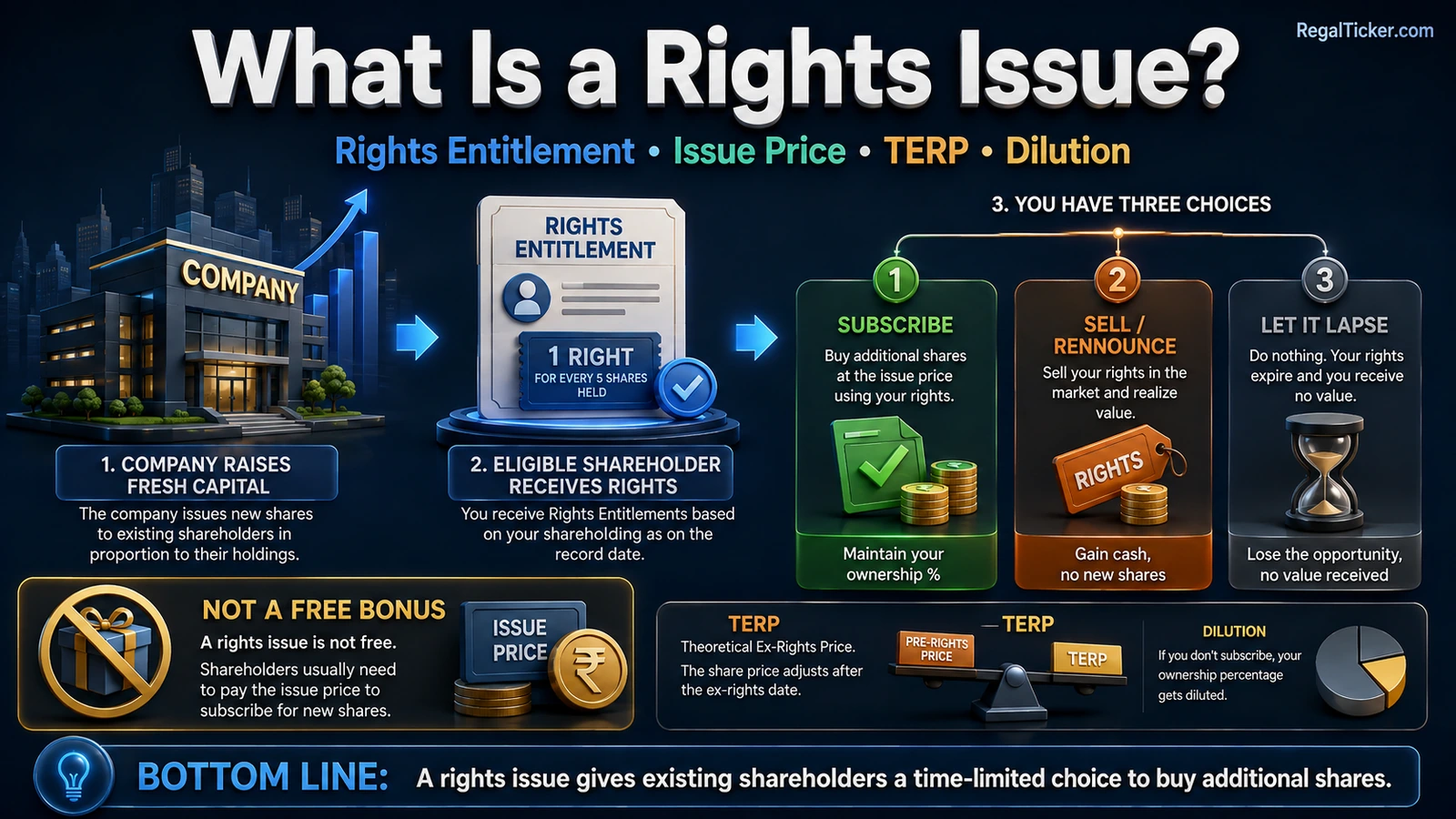
A rights issue is a way for a company to raise fresh capital by offering additional shares or other specified securities to eligible existing shareholders in a stated ratio and at a stated issue price. The shareholder receives a Rights Entitlement (RE) based on the eligible holding on the record date. An RE is not the final equity share. The investor must still decide what to do before the applicable deadlines: subscribe, sell or renounce the RE where permitted, apply for only part, or allow it to lapse. Buying an RE on the exchange also does not complete the investment—the buyer must submit a valid rights application and pay the issue price. A discounted issue price can look attractive, but it does not guarantee profit.
Key takeaways
A rights issue raises fresh money for the company; it is not a free distribution like bonus shares.
The Rights Entitlement (RE) is a temporary right to apply for the offered securities.
The rights ratio tells you how many new shares you may apply for under the basic entitlement.
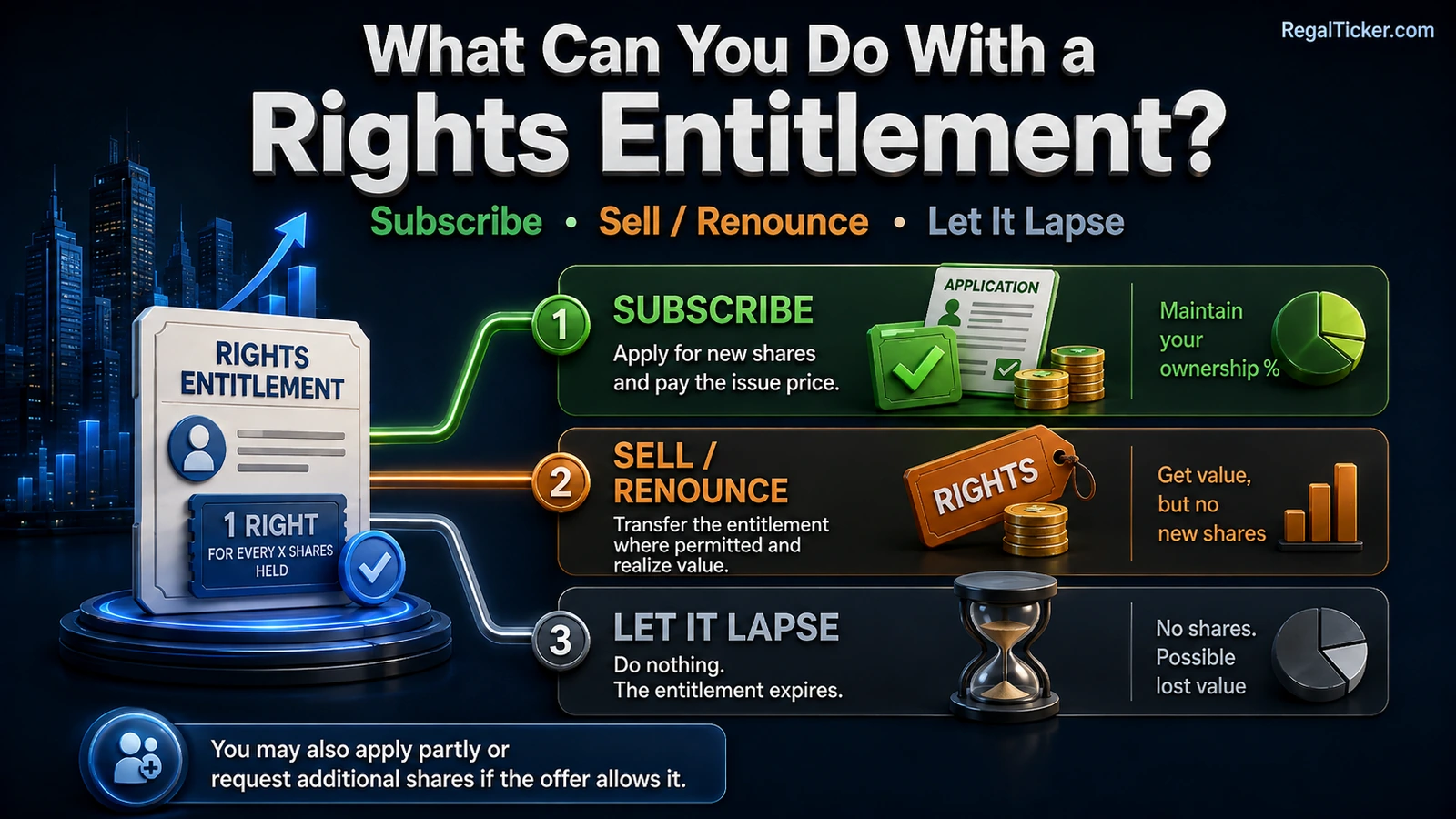
You can commonly subscribe, sell/renounce where permitted, or do nothing and let the RE lapse.
If you buy REs but do not submit the rights application, you do not automatically receive the final shares.
Doing nothing can mean losing the economic value of the RE and can also reduce your ownership percentage.
TERP is a theoretical post-rights price, not a prediction of where the share will trade.
The real investment question is why the company needs capital and what return it can earn on that capital.
Use the Rights Issue Calculator for arithmetic only after checking the official ratio, issue price and terms.
Rights Entitlement First: What Does RE Mean?
This is the most important concept to understand before analysing a rights issue.
📖 Definition
Rights Entitlement (RE)
A Rights Entitlement is the temporary right to apply for securities offered in a rights issue. For eligible shareholders, the number of REs is generally linked to the number of shares held on the official record date and the announced rights ratio. REs can have a separate ISIN and may be transferable or exchange-traded during the permitted period. An RE is not the final equity share.
Suppose you hold 500 eligible shares and the company announces a 1:5 rights issue.
That means you are offered:
500 × 1 ÷ 5 = 100 rights shares
Your basic entitlement is therefore 100 rights shares, subject to the official Letter of Offer and any fractional treatment.
The key point is what happens next.
| Your choice | What you do | Possible result |
|---|---|---|
| Subscribe fully | Apply for all 100 entitled shares and pay the issue price | You may receive the allotted rights shares |
| Subscribe partly | Apply for fewer than 100 | You receive only the valid allotted quantity; unused REs need separate treatment |
| Sell / renounce | Transfer eligible REs during the permitted window | You may receive market value for the entitlement instead of subscribing |
| Apply for additional shares | Request more than the basic entitlement where the offer allows it | Extra allotment is not guaranteed |
| Do nothing | Neither apply nor transfer before the deadline | REs can lapse; no rights shares are received from those REs |
Receiving or Buying REs Is Not the Same as Buying the Final Shares
NSE states that a person who acquires Rights Entitlements must still submit the rights-issue application. If REs are purchased but no valid application is made before the issue closes, the investor does not receive the offered shares from those REs.
What Happens If You Do Nothing?
This is where a rights issue can hurt an inattentive investor.
If an RE is neither subscribed nor renounced before the applicable deadline, it can lapse. That can mean:
- no new shares from that entitlement;
- loss of any market value the RE might have had;
- lower percentage ownership if the company issues new shares to others;
- lower participation in future earnings, voting and distributions compared with subscribing proportionately.
This does not mean every rights issue should be subscribed to. It means the investor should make an active decision rather than ignore a temporary entitlement.
Use the calculator
Calculate your entitlement before deciding
Enter your eligible holding, rights ratio, issue price and market price in the RegalTicker Rights Issue Calculator to estimate your basic entitlement, subscription cash, TERP and theoretical RE value. Use the official Letter of Offer for the real terms.
What Is a Rights Issue?
A rights issue is a fundraising method in which a company offers additional securities to eligible existing shareholders, usually in proportion to their existing holdings.
Unlike a bonus issue, the investor normally has to contribute fresh money to receive the additional rights shares.
A rights issue may be used for:
- expansion or a new project;
- acquisition;
- debt repayment;
- working capital;
- strengthening the balance sheet;
- meeting regulatory or capital needs;
- funding a turnaround.
The purpose matters more than the discount.
If a healthy company can deploy the new capital at attractive returns, the issue may strengthen future value. If a weak company repeatedly raises equity just to cover operating problems, the same rights mechanism can lead to poor outcomes.
A Discounted Rights Price Is Not Automatically a Bargain
The parent share can fall below the issue price, the company can misuse the funds, future earnings can disappoint, and the market can value the enlarged company differently. Always read the Objects of the Issue, risk factors, debt position, cash flow and dilution before deciding.
How a Rights Issue Works From Start to Finish
A rights issue has several stages. Eligibility alone is not enough.
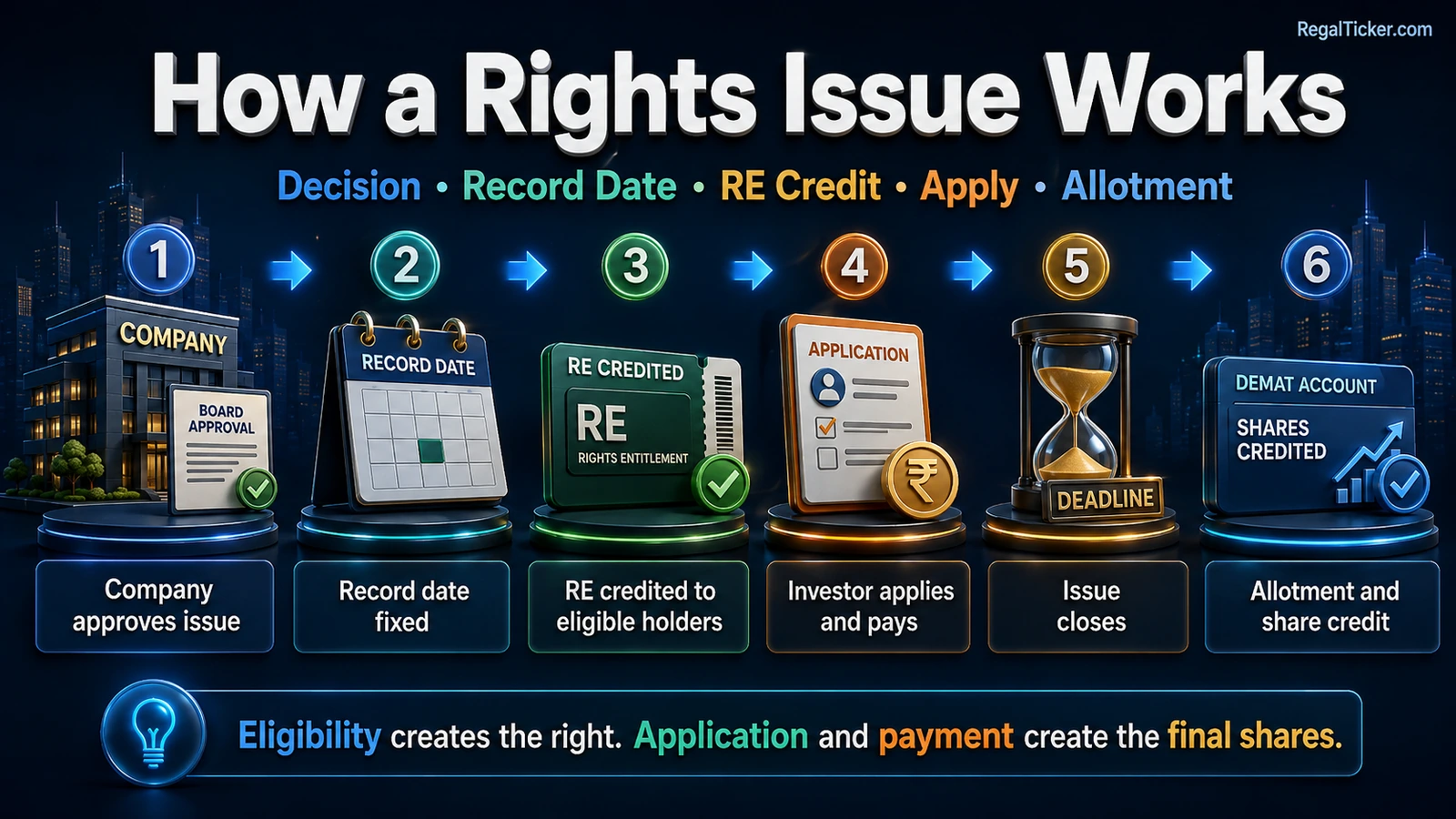
1
Company approves the fundraising
The board approves or proposes the rights issue and the company discloses the purpose and issue structure.
2
Terms and record date are fixed
The ratio, issue price, record date and other terms are finalised through the applicable process.
3
REs are credited
Eligible shareholders receive Rights Entitlements in demat form before the issue opens under the current framework.
4
Issue opens
Investors can apply using the permitted application route and arrange the required funds.
5
RE trading / renunciation happens
Where permitted, REs can be sold or transferred during the stated window.
6
Issue closes
Any unused REs can lapse after the relevant deadlines.
7
Allotment and share credit
Valid applications are processed, allotted securities are credited and trading begins after the applicable approvals.
Current Faster Rights-Issue Framework in India
SEBI’s faster rights-issue framework applies to rights issues approved by the issuer’s board from April 7, 2025.
The framework requires the rights-issue process to be completed within 23 working days from board approval, subject to the applicable process and adjustments where shareholder approval is required for specified instruments. It also provides that a rights issue should remain open for at least 7 days and no more than 30 days.
For an investor, the important lesson is not to memorise the regulatory T-day schedule. The company can publish its actual:
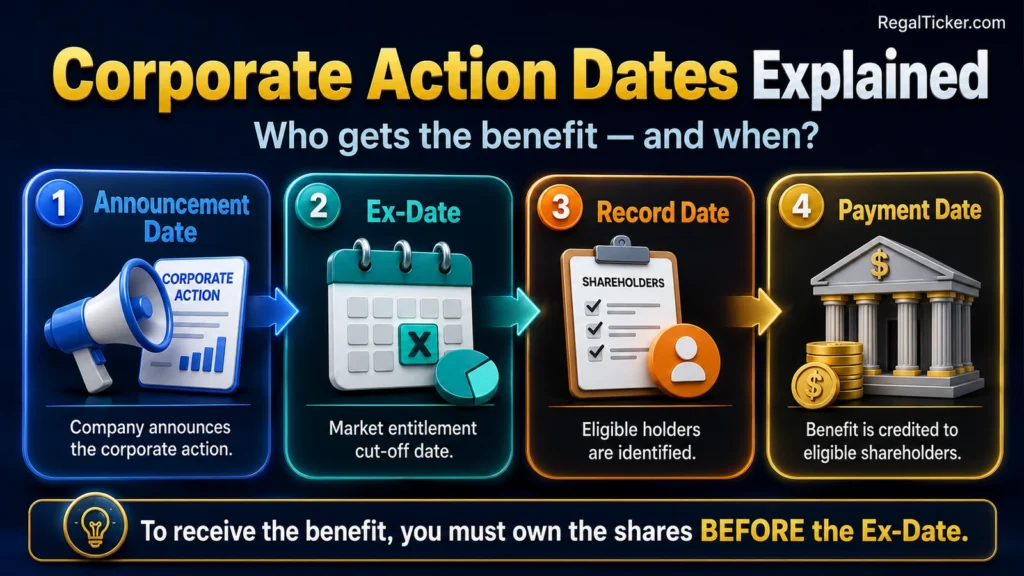
- record date;
- RE credit date;
- issue opening date;
- RE trading or renunciation window;
- issue closing date;
- allotment and credit timetable.
Use those live dates.
Rights Issue Ratio: How Many Shares Can You Apply For?
The rights ratio connects your eligible old shares to your basic entitlement.
| Rights ratio | Meaning | Entitlement on 500 eligible shares |
|---|---|---|
| 1:5 | 1 new share for every 5 old shares | 100 |
| 2:5 | 2 new shares for every 5 old shares | 200 |
| 3:10 | 3 new shares for every 10 old shares | 150 |
| 7:50 | 7 new shares for every 50 old shares | 70 |
💡 Real example
2:5 rights issue on 750 shares
Eligible holding = 750 shares
Rights ratio = 2:5
Entitlement:
750 × 2 ÷ 5 = 300 rights shares
If the issue price is ₹140 and you apply for all 300:
300 × ₹140 = ₹42,000 subscription amount
Fractional entitlements and rounding are controlled by the Letter of Offer. Do not invent your own rounding rule.
What Is TERP?
TERP means Theoretical Ex-Rights Price.
It estimates the theoretical blended price after combining:
- the value of the existing shares before the rights adjustment;
- the fresh money paid for the new rights shares;
- the enlarged number of shares.
TERP is useful for understanding the mechanics of a discounted issue. It is not a forecast.
TERP Formula
For a rights ratio expressed as new shares for old shares:
TERP = [(Old shares in ratio × Cum-rights market price) + (New shares in ratio × Issue price)] ÷ Total shares after the issue
💡 Real example
TERP for a 1:5 rights issue
Assume:
Cum-rights market price = ₹300 Rights issue price = ₹200 Rights ratio = 1:5
TERP:
[(5 × ₹300) + (1 × ₹200)] ÷ 6
= (₹1,500 + ₹200) ÷ 6
= ₹283.33 approximately
The market can trade above or below ₹283.33 after the adjustment because investors continue to react to business performance, valuation, market conditions and the attractiveness of the fundraising.
Theoretical RE Value
If one RE allows the holder to apply for one new share, a simple theoretical value per RE in this example is:
TERP − Issue price
₹283.33 − ₹200 = ₹83.33
The exchange-traded RE price can differ because it is affected by:
- movement in the parent share;
- remaining time before RE trading ends;
- liquidity;
- demand and supply;
- risk of missing the application deadline;
- expectations about the company and the issue.
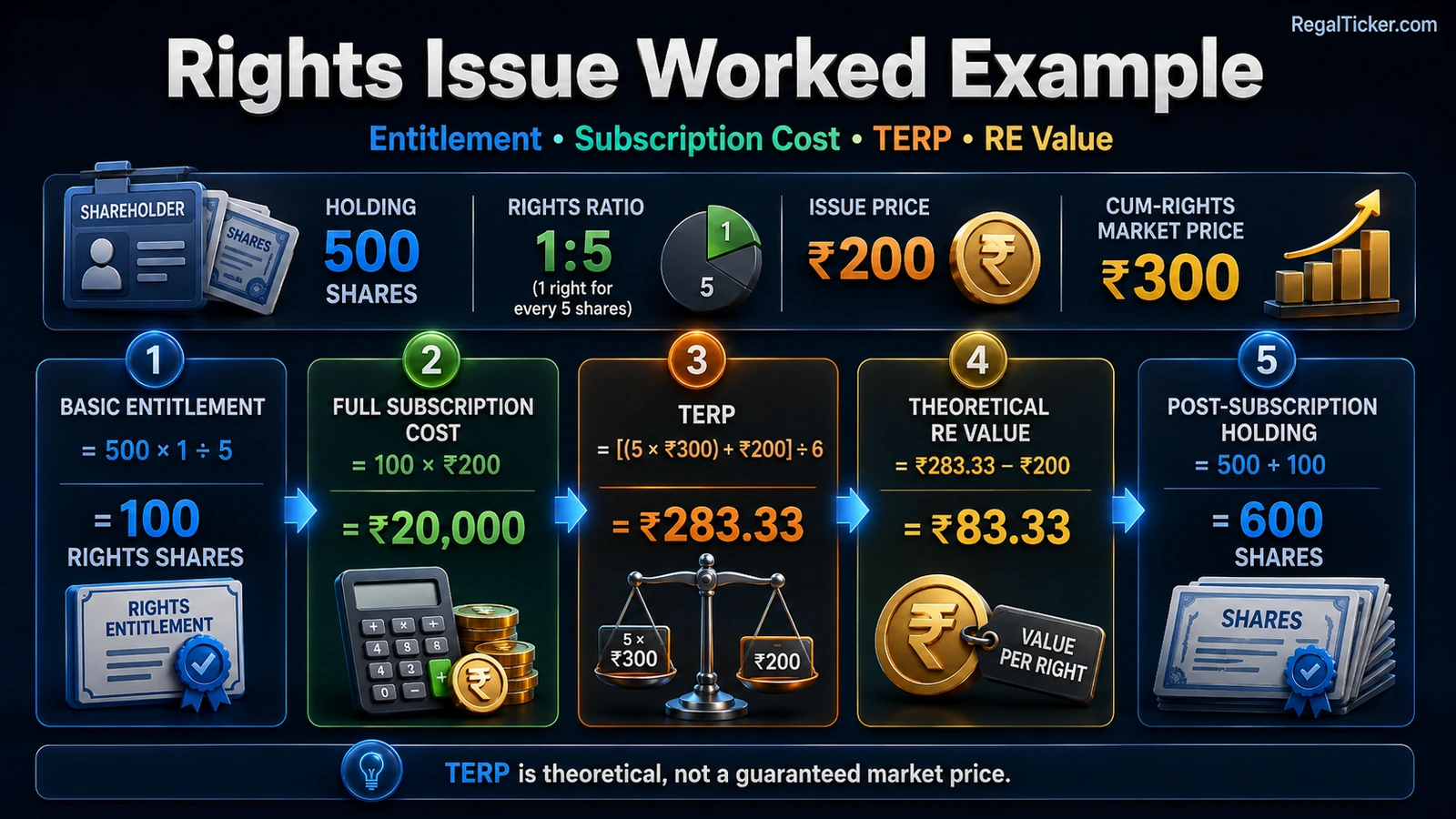
Complete Rights Issue Example: Entitlement, Cost, TERP and Final Holding
Assume an investor holds 500 eligible shares.
The company announces:
- Rights ratio: 1:5
- Cum-rights market price: ₹300
- Issue price: ₹200
| Step | Calculation | Result |
|---|---|---|
| Basic entitlement | 500 × 1 ÷ 5 | 100 rights shares |
| Full subscription cash | 100 × ₹200 | ₹20,000 |
| TERP | [(5 × ₹300) + ₹200] ÷ 6 | ₹283.33 approx. |
| Theoretical value per RE | ₹283.33 − ₹200 | ₹83.33 approx. |
| Post-subscription holding | 500 + 100 | 600 shares |
How Dilution Works If You Do Not Participate
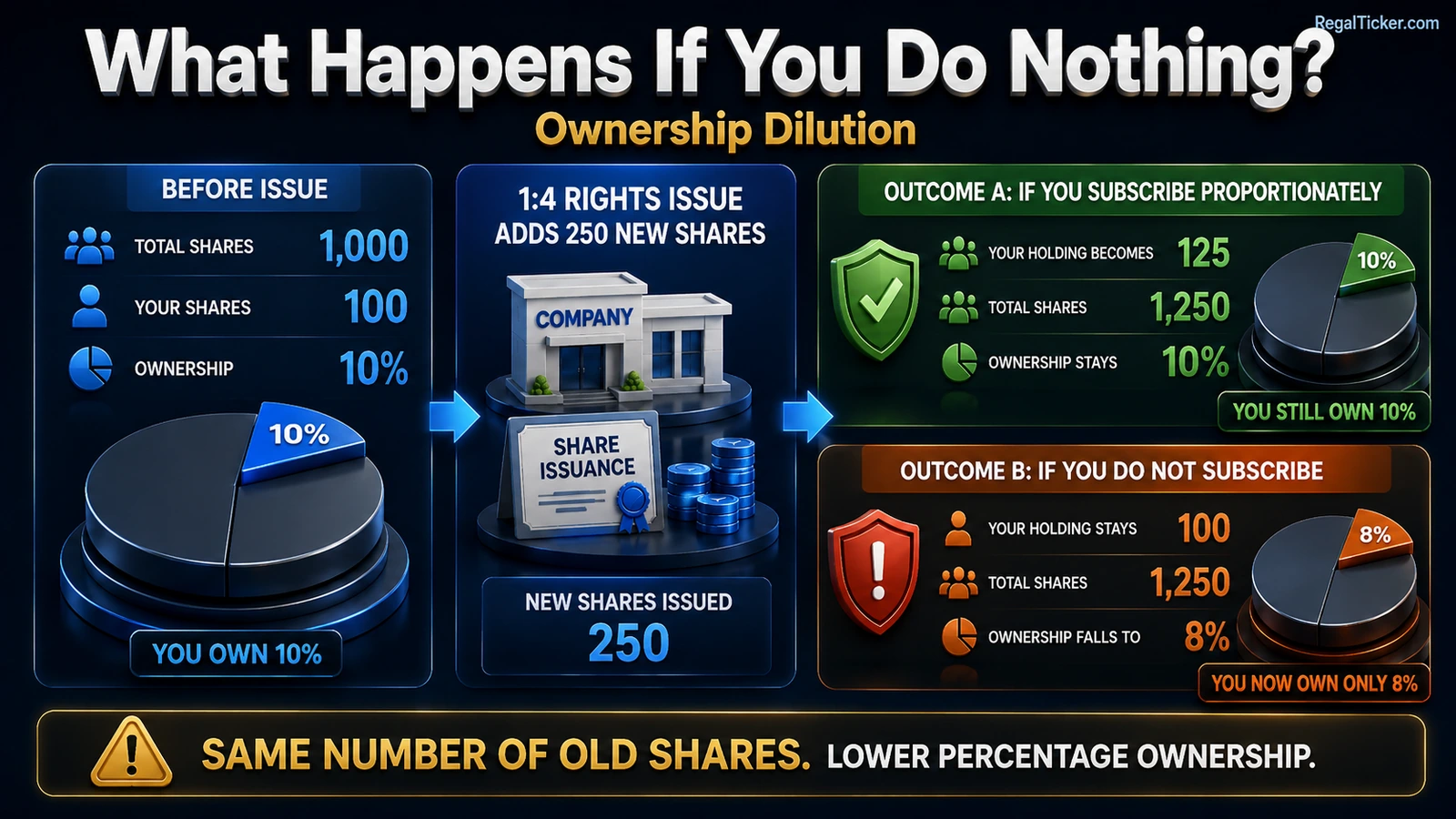
Dilution means your percentage ownership can fall when the company issues more shares and you do not increase your holding proportionately.
💡 Real example
Ownership falls from 10% to 8%
Before the issue:
Total company shares = 1,000 Your holding = 100 Your ownership = 10%
The company completes a 1:4 rights issue, creating 250 new shares if fully subscribed.
Total shares become:
1,000 + 250 = 1,250
If you subscribe proportionately, your entitlement is 25 shares:
125 ÷ 1,250 = 10%
If you do not subscribe:
100 ÷ 1,250 = 8%
You still own 100 shares, but your percentage ownership falls from 10% to 8%.
⭐ Pro tip
Ask what the new capital is expected to earn
Maintaining your ownership percentage is not a sufficient reason to subscribe. The more important question is whether management can deploy the new capital at a return that justifies the risk and dilution.
How to Decide: Subscribe, Sell the RE or Let It Lapse?
There is no universal answer. Use a decision framework.
| Question | Why it matters |
|---|---|
| Why is the company raising money? | Expansion and productive debt reduction are different from repeated emergency funding |
| Is the issue price attractive after considering TERP? | A headline discount can overstate the economic bargain |
| Can I afford the additional cash? | Full participation can require meaningful new capital |
| Do I want more exposure to this company? | Maintaining ownership also increases the money at risk |
| What happens if I do not participate? | Dilution and RE lapse can have economic consequences |
| Can I sell or renounce the RE? | A transferable RE can provide an alternative to subscribing |
| Are the shares partly paid? | Future call payments can create additional obligations |
| What do the risk factors say? | The Letter of Offer explains risks that a headline cannot |
Subscribe When the Investment Case Still Makes Sense
Subscription may be worth considering when you understand the business, want additional exposure, can fund the application and believe the use of proceeds is sensible.
Sell or Renounce When You Do Not Want More Exposure
If the RE is transferable and there is a permitted market or off-market route, selling or renouncing can be more deliberate than simply letting it expire.
Letting REs Lapse Is Still a Decision
Doing nothing can be reasonable if the RE has little or no practical value, but it should be a conscious decision made after checking the terms and deadlines.
How to Apply for a Rights Issue
SEBI’s investor guidance describes rights participation as voluntary and explains that investors may apply through the permitted process, including ASBA where applicable.
A practical workflow is:
Rights Issue Application Checklist
- Confirm the official record date and your basic entitlement.
- Read the Letter of Offer and Rights Entitlement communication.
- Check issue price, ratio and whether the shares are fully or partly paid.
- Note the issue opening and closing dates.
- Note the RE trading or renunciation deadline separately.
- Decide how many shares you want to apply for.
- Keep sufficient funds available for the application.
- Use the permitted ASBA or application channel.
- Verify PAN, DP ID / Client ID and application details.
- Save the application acknowledgement.
- Check final allotment and Demat credit after the issue closes.
Partly Paid Rights Shares
Some rights issues offer partly paid shares.
Suppose:
- total issue price = ₹100;
- amount payable on application = ₹40;
- future call amount = ₹60.
The initial ₹40 is not the total investment obligation. The investor must understand future call dates, consequences of non-payment and the conditions for the partly paid security.
Caution
Do not compare only the first instalment with the market price
A partly paid rights share can look unusually cheap because part of the issue price remains unpaid. Evaluate the full committed issue price, not only the amount payable on application.
Rights Issue vs Bonus Shares
This is an important distinction for beginners.
Rights Issue
- Company raises fresh capital
- Investor normally pays the issue price
- Participation is voluntary
- Rights Entitlement can be temporary and transferable
- Non-participation can dilute ownership
Bonus Shares
- No fresh subscription money from shareholders
- Eligible holders receive additional shares automatically under the terms
- No Rights Entitlement trading decision
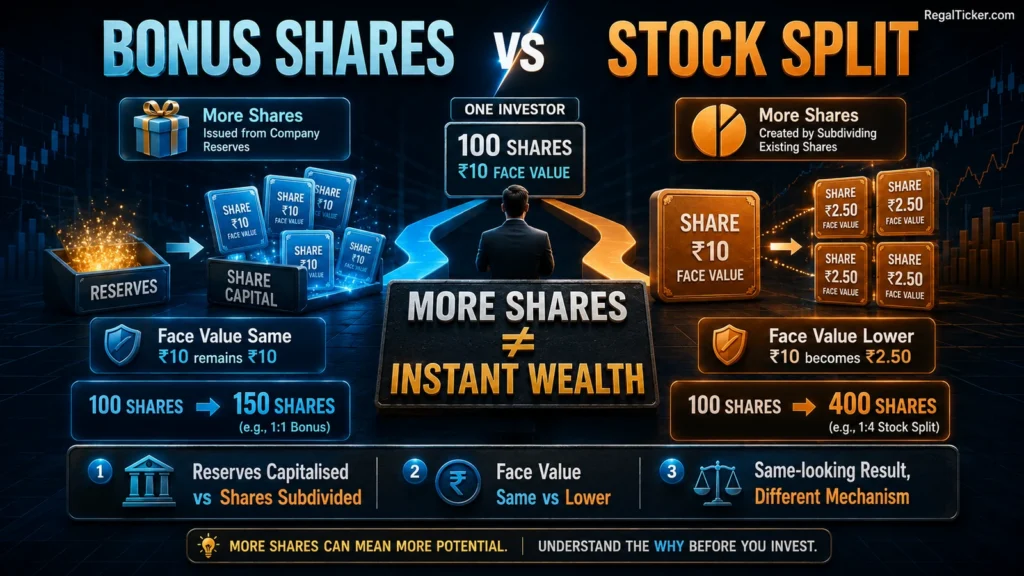
- Theoretical price adjusts for the increased share count
- Ownership percentage is generally unchanged by the bonus itself
- A rights issue is therefore not a discounted bonus issue.
- Read What Are Bonus Shares? for the separate lesson.
Common Rights-Issue Mistakes
Avoid these shortcuts:
- “The issue is at a 30% discount, so it is automatically cheap.”
- “I received REs, so final shares will appear automatically.”
- “I bought REs on the exchange, so my job is finished.”
- “I can wait until the rights issue closes to sell the RE.”
- “If I do not subscribe, nothing changes.”
- “TERP is where the stock must trade.”
- “The amount payable now is the total cost of a partly paid issue.”
- “Maintaining ownership percentage means the investment is good.”
All of these ignore either the deadline, the capital commitment or the underlying business.
Quick Knowledge Check
🎯 Quiz yourself
You receive 100 REs in your Demat account. Have you automatically received 100 new equity shares?
No. REs are temporary rights to apply. A valid application and the required payment are still needed for final allotment.
You buy REs on the exchange but make no rights application. What happens?
Buying the RE alone does not produce the final shares. If no valid application is made before the deadline, the entitlement can lapse.
A company completes a rights issue and you do not participate. Can your ownership percentage fall?
Yes. If the company’s total share count rises while your holding remains unchanged, your percentage ownership can be diluted.
Final takeaway
Treat the RE as a decision, not a gift
A rights issue gives you a time-limited choice. Start with why the company needs money, then check your Rights Entitlement, issue price and deadlines. Calculate the subscription cash and TERP, but do not let the arithmetic replace business analysis. If you do not want to subscribe, check whether the RE can be sold or renounced rather than simply allowing value to disappear. And remember: RE received or RE purchased is not the same as final shares allotted.
Frequently asked questions
What does a 1:5 rights issue mean?
It means an eligible shareholder is offered one rights share for every five eligible shares held under the record-date terms. A holding of 500 eligible shares gives a mathematical basic entitlement of 100 rights shares, subject to the Letter of Offer.
What happens if I do nothing with my Rights Entitlement?
If the RE is neither subscribed nor renounced before the applicable deadline, it can lapse. You receive no rights shares from that RE, may lose any possible RE market value and can face percentage ownership dilution if the company issues new shares to others.
Can someone who was not a shareholder on the record date buy REs and apply?
NSE explains that a person can purchase Rights Entitlements and then apply to the rights issue, subject to the issue terms and deadlines. Purchasing the RE is only the first step; the buyer still needs to make a valid rights application and pay the issue price.
Verify through official sources
Official references
- SEBI Investor — Rights Issue of Shares: A Simple Guide for Retail Investors — Official investor guidance on rights issues, participation choices and application.
- SEBI — Faster Rights Issue with a flexibility of allotment to specific investor(s), Circular dated March 11, 2025 — Current faster rights-issue framework, 23-working-day process and 7–30 day subscription window.
- NSE India — FAQs on Rights Entitlement Trading — Official RE meaning, renunciation, lapse and trading guidance.
- SEBI — Master Circular for issue of capital and disclosure requirements, February 2026 — Current consolidated framework including dematerialised Rights Entitlements.
- SEBI Investor — How to Invest in Rights Issue — Investor education on REs, application choices and key documents.
Educational disclaimer: This article is for investor education and general information only. It is not investment advice, personalised financial advice, tax advice, legal advice, a research recommendation or a solicitation to buy or sell securities. Rights-issue terms, dates, trading windows, payment requirements, tax treatment and allotment rules can change. Always read the current company filing, Letter of Offer, exchange notice and Registrar communication before acting.