
⚡ Quick answer
Ex-date and record date are not the same thing. The ex-date is the market cut-off for the upcoming corporate-action entitlement: a normal purchase made on or after the ex-date generally does not carry that benefit. The record date is the date used to identify eligible holders in the relevant company or depository records. The announcement date tells you what the company has proposed or approved, while the payment, credit or allotment date tells you when the benefit is finally delivered. In India, ex-date and record date can appear on the same calendar date for many actions, so use the current company and exchange filing rather than an old one-day-gap rule.
Key takeaways
Announcement date tells you what the company has disclosed, not whether a new purchase is eligible.
Ex-date is the market entitlement cut-off.
Record date is used to identify eligible holders in the relevant records.
Payment date is mainly a cash-action term; share-based actions may use allotment, credit, effective or trading dates instead.
A purchase on or after the ex-date generally does not carry the upcoming entitlement.
Record-date eligibility does not by itself complete a rights subscription or guarantee buyback acceptance.
Ex-date and record date may be the same calendar date for many Indian corporate actions.
The latest official filing wins if an earlier date has been revised.
Ex-Date vs Record Date: The Difference That Decides Eligibility
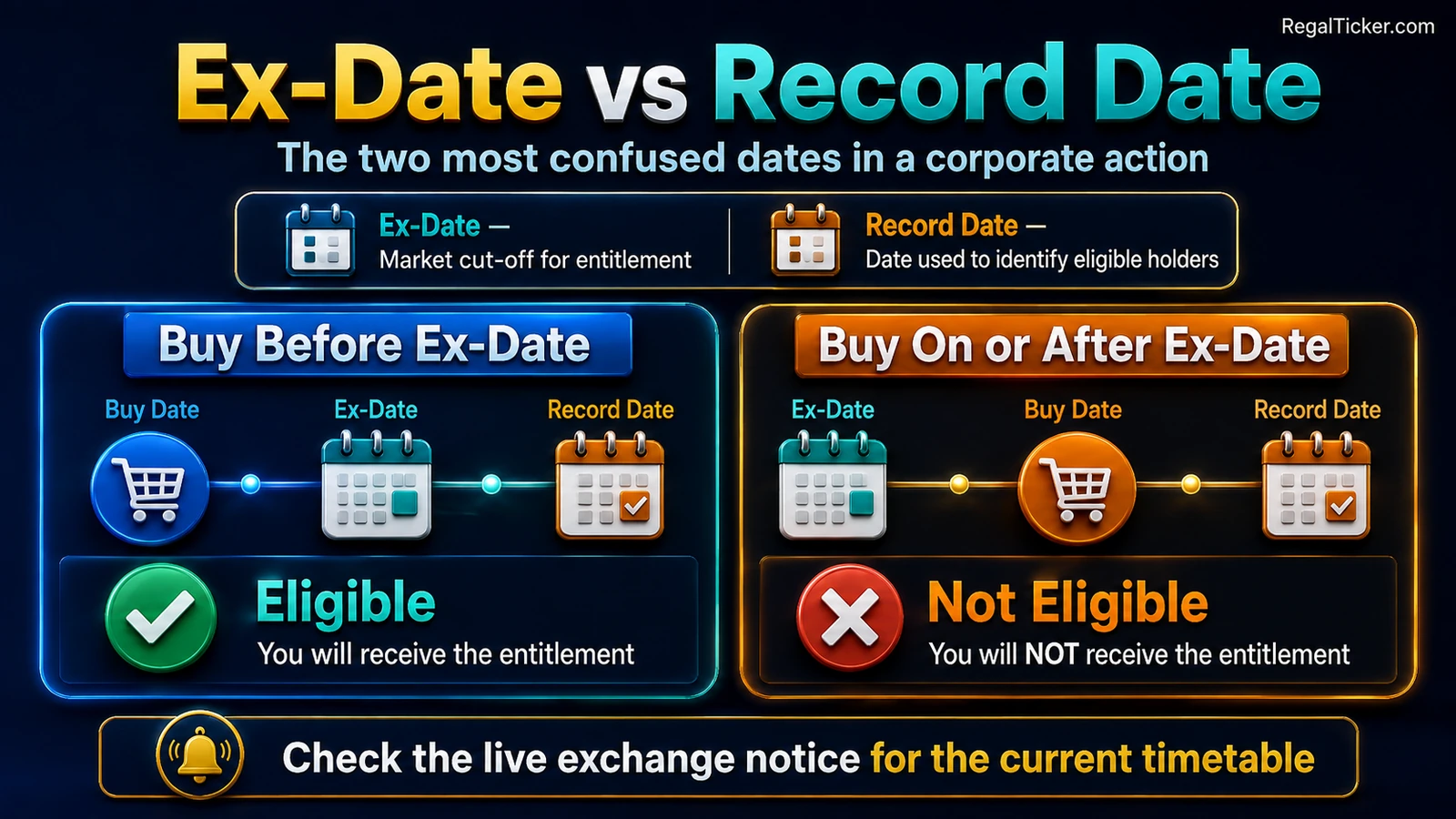
These two dates are often shown together, but they answer different questions.
Ex-Date
- Market cut-off for the upcoming entitlement
- Security trades without that specified benefit from this date
- A normal purchase on or after this date generally does not carry the benefit
- Most useful when asking: “If I buy now, will this purchase qualify?”
Record Date
- Date used to identify eligible holders in the relevant records
- Company, RTA and depository information supports the entitlement process
- Not a standalone instruction to buy on that date
- Most useful when asking: “Who is recorded for the action?”
A simple memory rule works well:
Ex-date = market entitlement changes. Record date = eligible-holder records are checked.
Risk
The record date is not a buying signal
If a headline says “Record Date: 10 September,” do not assume buying on 10 September makes the new purchase eligible. First check the official ex-date. If the share is already trading ex-entitlement, that purchase generally does not carry the announced benefit.
Example: Buying Before vs On the Ex-Date
💡 Real example
One day can change the entitlement
Assume an illustrative dividend schedule:
Announcement date: 2 September Ex-date: 10 September Record date: 10 September Payment date: 25 September
Ravi buys on 9 September. His purchase is before the ex-date, so it may carry the upcoming dividend entitlement, subject to the official terms and completed settlement.
Meera buys on 10 September. The share is already trading ex-dividend, so the new purchase generally does not carry that upcoming dividend.
The practical lesson is not to memorise these sample dates. It is to check the live ex-date before you buy for an entitlement.
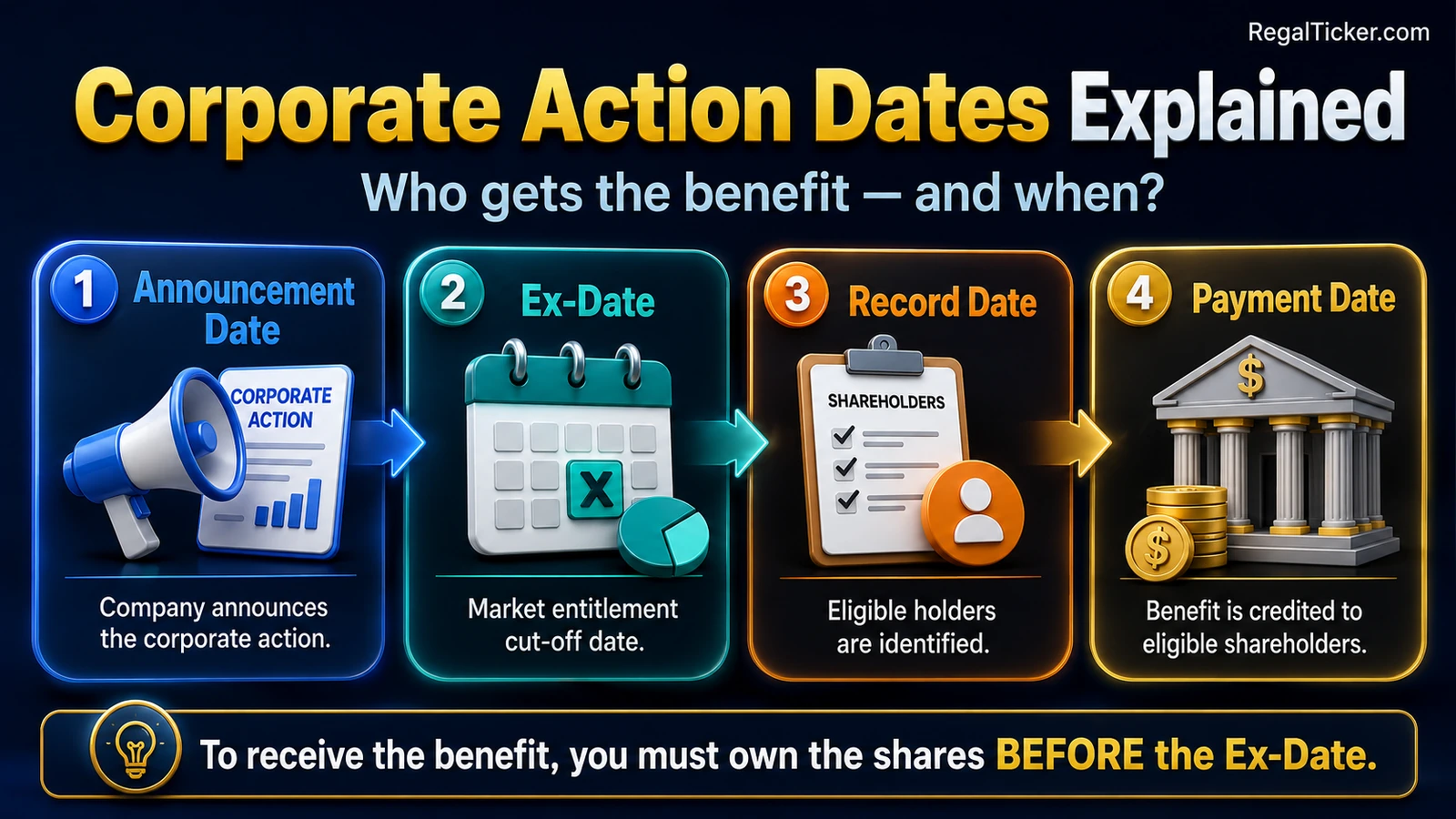
Announcement Date, Ex-Date, Record Date and Payment Date
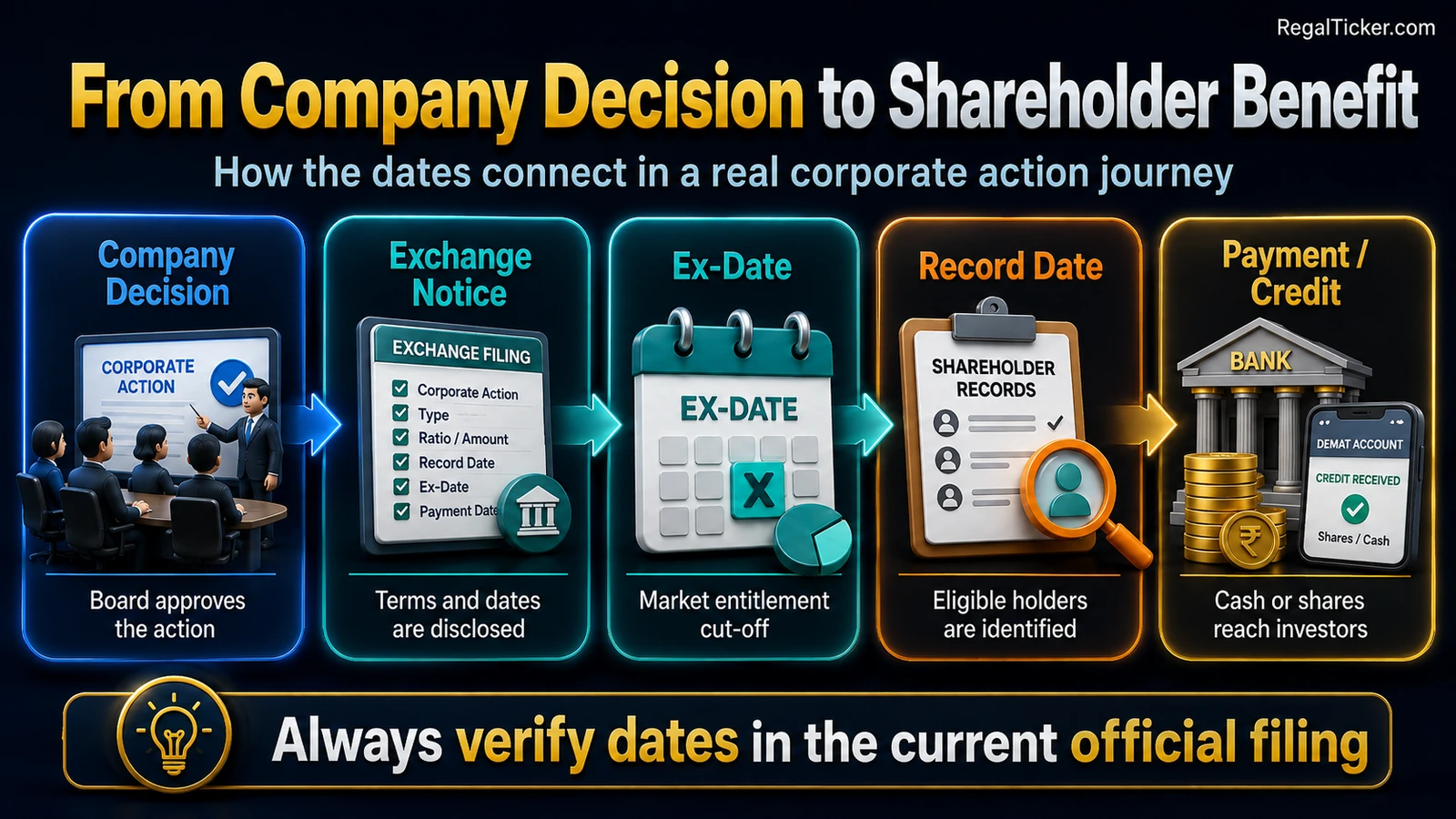
The dates form a sequence, but they do not all perform the same job.
| Date | What it means | Investor question |
|---|---|---|
| Announcement / approval date | Company discloses, recommends or approves the action | What has actually been announced? |
| Ex-date | Security begins trading without the specified upcoming entitlement | Does a new purchase still carry the benefit? |
| Record date | Eligible holders are identified in the relevant records | Who is recorded for the action? |
| Payment / credit / allotment date | Cash or securities are delivered or the action is completed | When should I expect the benefit? |
Announcement Date: Read the Status, Not Just the Headline
A corporate-action announcement can be proposed, recommended, approved, conditional or final.
A company may announce:
- dividend amount;
- bonus or rights ratio;
- split face-value change;
- buyback method and price;
- a record date;
- or that the record date will be fixed later.
That means the announcement date itself does not settle every investor question.
A headline such as “Board recommends 1:1 bonus” can be incomplete if the action still needs shareholder approval or if the eligibility dates are not yet fixed.
⭐ Pro tip
Check whether the action is final
Before focusing on the dates, find the words that describe the status: recommended, approved, subject to approval, record date fixed, revised, cancelled or effective. Those words can matter more than the headline.
Ex-Date: The Market Cut-Off
The ex-date is the date from which the security trades without the specified upcoming entitlement.
For a normal purchase:
- buying before the ex-date can allow the purchase to carry the entitlement, subject to the official terms and settlement;
- buying on or after the ex-date generally does not carry that upcoming entitlement.
The market price can adjust on the ex-date because the security no longer carries exactly the same benefit. Actual trading can move differently because valuation, news, demand and market conditions still matter.
India currently uses a T+1 rolling settlement framework for normal equity settlement, with an optional T+0 framework available for eligible trading under the applicable mechanism. The safest investor habit is not to calculate your own ex-date from settlement arithmetic. Use the ex-date published for the specific action.
Record Date: The Eligibility Record
The record date is the formal date used to identify eligible holders in the relevant shareholder or beneficial-owner records.
CDSL’s corporate-action procedure explains that depository beneficiary-owner information as of the record date is used for corporate-action processing, including cash-action calculations and remittances.
NSE’s July 2026 corporate-action FAQ is also explicit that the exchange recognises the formal Record Date for corporate-action submission. It says that a “cut-off date” or “book closure date” stated instead of the Record Date is not recognised for that purpose.
That is a useful lesson for investors too: use the formal current filing, not informal date terminology from an old article or social-media post.
Payment Date Is Not the Final Date for Every Action
For a dividend, payment date is easy to understand: it tells you when the company expects the cash-payment process to be completed.
But many corporate actions end with a different milestone.
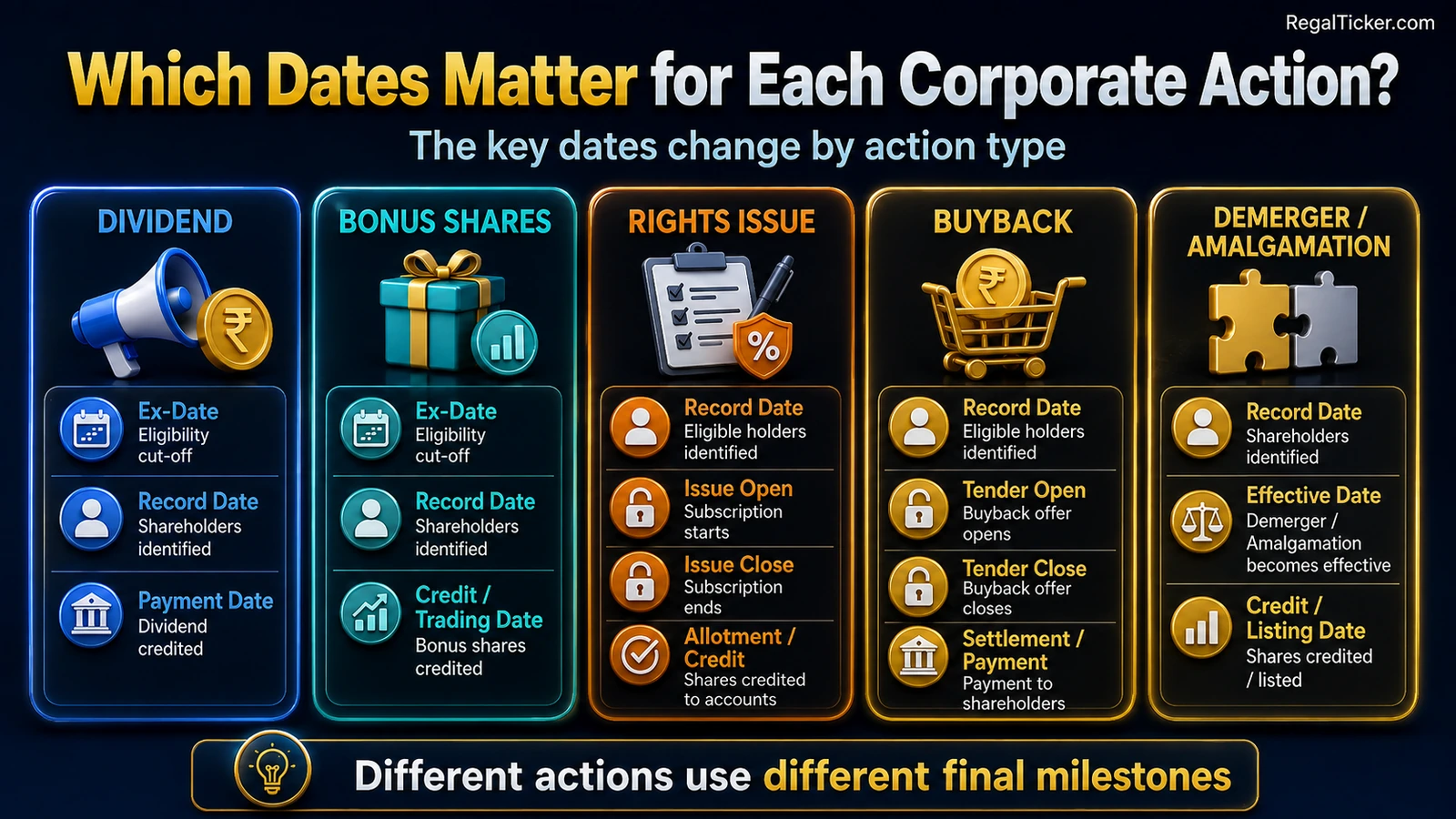
| Action | Final milestones investors may need to track |
|---|---|
| Dividend | Payment / bank credit |
| Bonus shares | Allotment, Demat credit and trading date |
| Stock split | Effective processing, revised quantity / ISIN handling and trading under revised terms |
| Rights issue | Issue closing, allotment, share credit and listing / trading |
| Tender buyback | Tender closing, acceptance, settlement and payment |
| Demerger / amalgamation | Effective date, allotment / credit and trading or listing dates |
Why Ex-Date and Record Date Can Be the Same in India
Many investors still remember a rule that the ex-date must be one trading day before the record date.
That shortcut is no longer reliable.
NSE states that its clearing system follows T+1 / T+0 rolling settlement. With shorter settlement, corporate-action schedules can show the same calendar date for ex-date and record date for many actions.
The correct rule is therefore:
Do not assume a fixed gap. Check the exact ex-date and record date published for that company and action.
This protects you from two opposite mistakes:
- assuming the ex-date must always be one day earlier;
- assuming ex-date and record date must always be identical.
The current exchange notice is the source of truth.
How Dates Work Differently for Each Corporate Action
The date that matters most changes with the action.
Dividend: Eligibility First, Cash Later
A dividend has two separate investor questions:
- Am I eligible?
- When will the cash arrive?
💡 Real example
Dividend entitlement and payment happen at different stages
Assume you hold 500 eligible shares and the company declares ₹4 per share.
Your gross dividend is:
500 × ₹4 = ₹2,000.
The ex-date and record date help determine the entitlement. The payment date tells you when the cash process should complete.
Use the Dividend Calculator only after the declared amount and eligibility are confirmed.
Bonus Shares: Price Adjustment Can Appear Before the Shares Are Tradeable
For a bonus issue, investors can become worried when the market price has adjusted but the additional shares are not yet visible or tradeable in the Demat account.
That can happen because eligibility, allotment, credit and trading are separate stages.
If you are eligible, check the company’s allotment and credit communication before concluding that the shares are missing.
Use the Bonus Share Calculator for the ratio calculation and What Are Bonus Shares? for the full lesson.
Stock Split: Check the Revised Security Processing
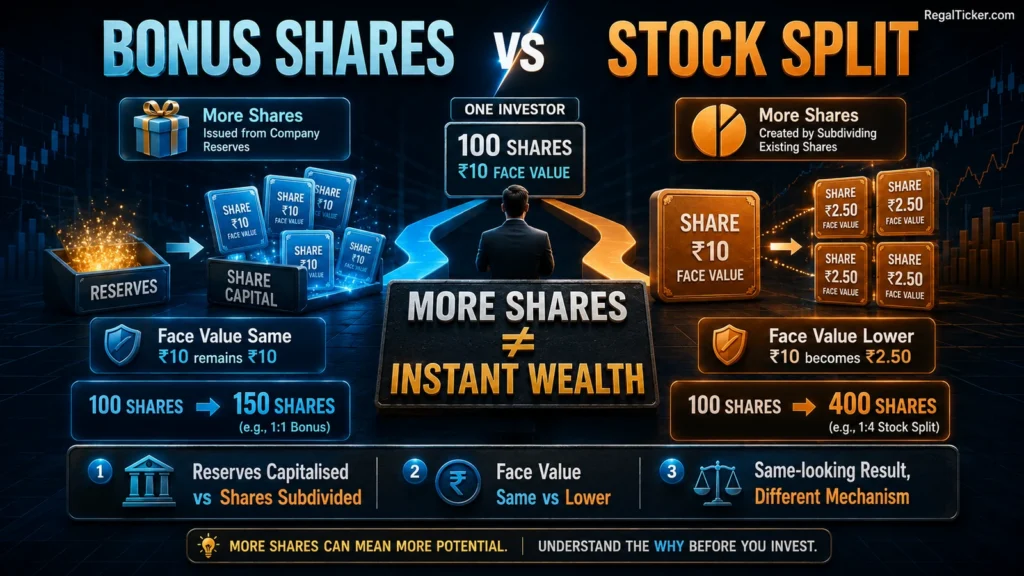
A stock split changes the number and face value of shares according to the approved split terms.
The ex-date and record date matter for the action, but investors may also need to watch the effective processing and trading of the revised security.
If an investor held 100 shares before a 1-to-5 subdivision, the expected post-split quantity would be 500 shares under the stated ratio. The Stock Split Calculator can handle the arithmetic after the official ratio is verified.
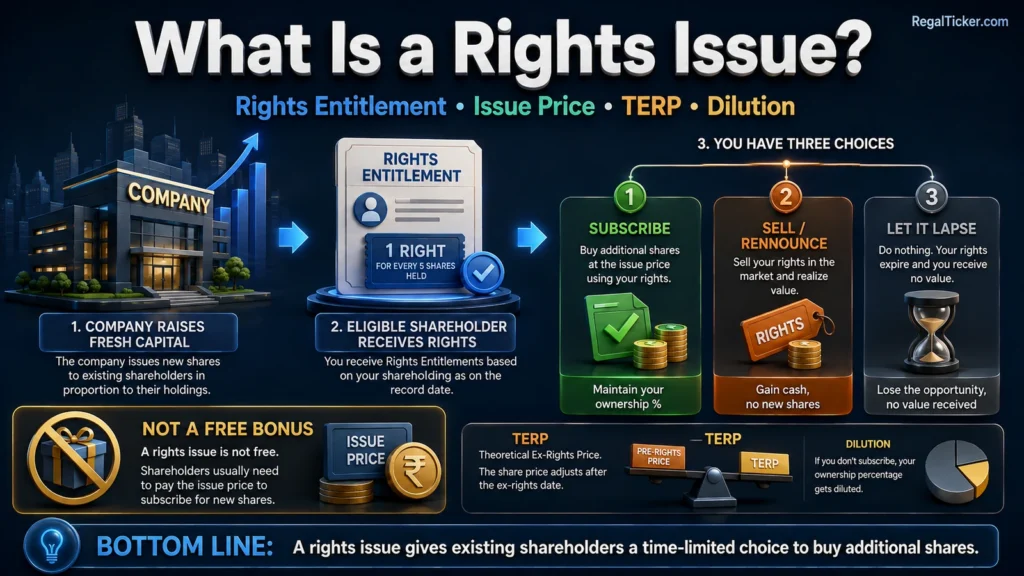
Rights Issue: Record-Date Eligibility Is Only Step One
A rights issue is where date confusion can become expensive.
💡 Real example
Eligible for rights does not mean subscribed
Assume the company fixes a record date and you qualify for a Rights Entitlement.
You still need to track:
Rights Entitlement credit; issue opening date; issue closing date; any permitted RE trading or renunciation window; allotment; final share credit and listing / trading.
If you qualify but do nothing before the relevant deadline, you can still lose the opportunity to subscribe.
Read What Is a Rights Issue? and use the Rights Issue Calculator only after the official ratio, price and issue timetable are known.
Buyback: Eligibility Does Not Guarantee Acceptance
In a tender buyback, the record date can determine eligibility to participate under the offer terms.
But eligible shareholders still need to track:
- tender opening;
- tender closing;
- final acceptance;
- settlement;
- payment.
If you tender 400 shares, the company may accept fewer than 400. The Buyback Acceptance Ratio Calculator is useful for scenarios, but the actual acceptance comes from the completed offer process.
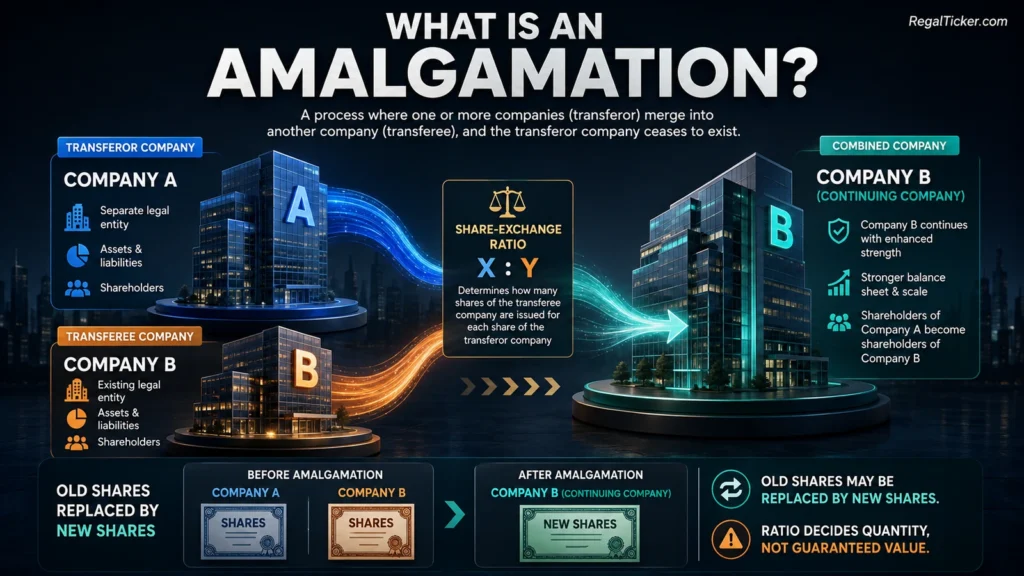
Demerger and Amalgamation: Watch the Scheme Milestones
Scheme-based actions can involve:
- record date;
- effective date;
- allotment or credit date;
- listing or trading date for the resulting securities.
These actions can also affect cost allocation and which business or legal entity you finally own.
For deeper mechanics, continue to What Is a Demerger? and What Is an Amalgamation?.
How to Verify Corporate Action Dates Before You Act
The safest process is more important than memorising any single date rule.
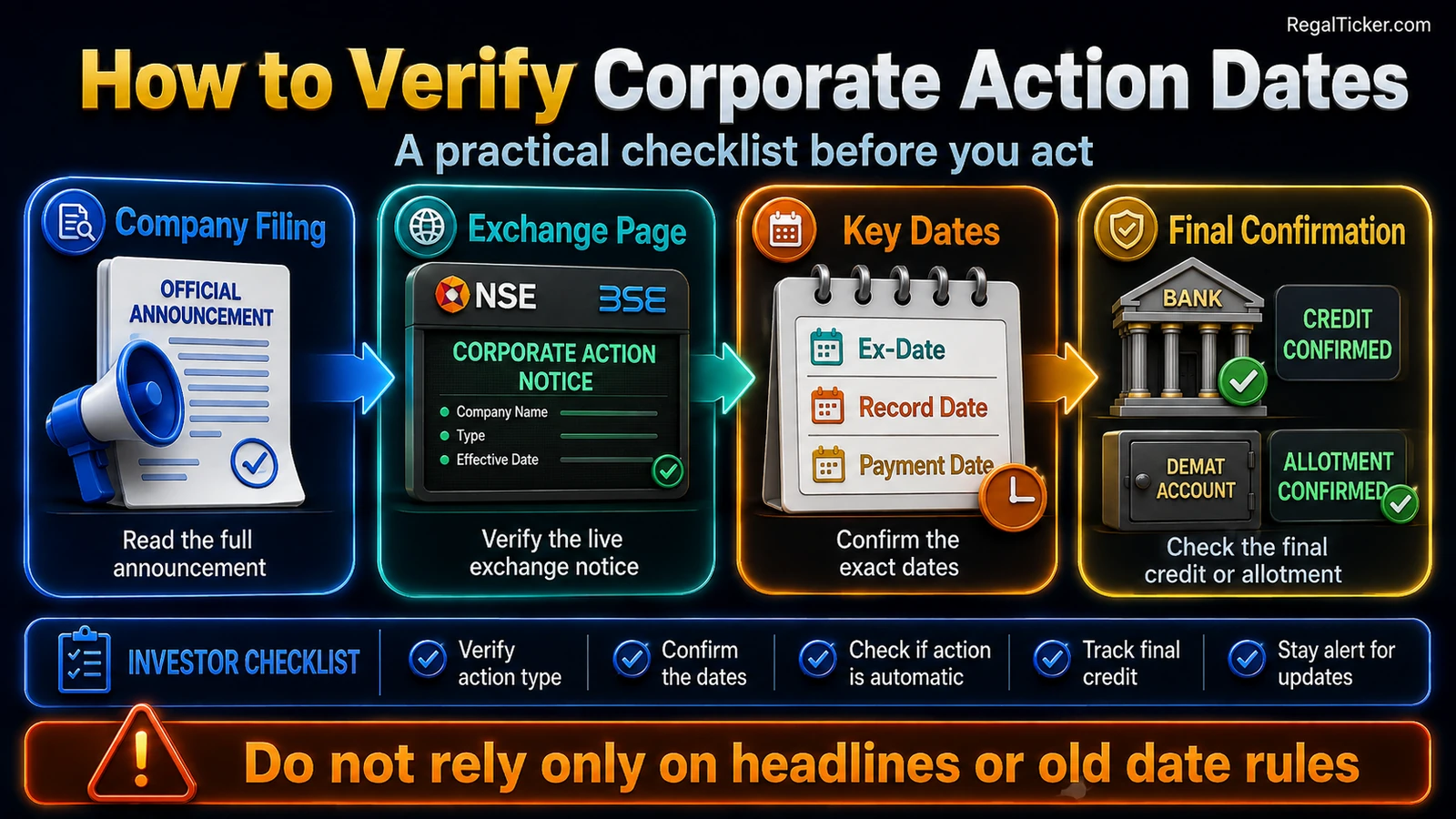
1
Read the full company filing
Do not rely only on a headline, broker alert or social-media screenshot.
2
Check the exchange page
Confirm the action on NSE or BSE and make sure you are looking at the latest notice.
3
Note the exact dates
Write down the ex-date, record date and the action-specific final milestone.
4
Check whether you must act
Dividend, bonus and split processing may be automatic for eligible holders; rights issues and tender offers can require action.
5
Confirm final delivery
Check the bank account, Demat statement, RTA communication or final settlement record.
⭐
NSE’s July 2026 FAQ
NSE’s July 2026 FAQ says that companies can revise or cancel a record date only through the applicable exchange process and within the required timeline. That is why an old screenshot should never override a later official filing.
Corporate Action Date Checklist
- What corporate action has been announced?
- Is it proposed, approved, conditional or effective?
- What is the latest official ex-date?
- What is the latest official record date?
- Has either date been revised or cancelled?
- Do I need to subscribe, tender or make another election?
- What is the payment, allotment, credit, closing or settlement date?
- Have I read the complete current company and exchange document?
- Have I saved the important filing for my records?
- After completion, have I confirmed the cash or securities credit?
Use the calculator
Dates decide eligibility; calculators explain the numbers
Once the official dates and terms are clear, use RegalTicker’s calculators for dividends, bonus shares, stock splits, rights issues and buybacks to estimate the mechanical impact. A calculator can reduce arithmetic mistakes, but it cannot decide whether you are eligible.
Common Date Mistakes to Avoid
Avoid these shortcuts:
- Treating announcement date as eligibility date.
- Buying on the record date without checking the ex-date.
- Assuming ex-date is always one day before record date.
- Assuming ex-date and record date are always the same.
- Expecting bonus shares to be tradeable immediately when the market price adjusts.
- Receiving a Rights Entitlement but forgetting the issue closing date.
- Treating buyback record-date eligibility as guaranteed acceptance.
- Using a saved screenshot after the company revises the schedule.
- Looking only for a “payment date” when the action uses allotment, credit, listing or settlement dates.
Quick Knowledge Check
🎯 Quiz yourself
A company has an ex-date of 10 September. You buy on 10 September. Does that new purchase generally carry the upcoming entitlement?
No. A normal purchase on or after the ex-date generally does not carry the specified upcoming entitlement. Check the official terms for the action.
Is record date the same thing as payment date?
No. The record date is used to identify eligible holders. Payment or securities credit happens according to a later action-specific timetable.
You qualify for a rights issue on the record date. Are you finished?
No. Record-date eligibility can establish the Rights Entitlement, but you still need to follow the issue timetable and application terms if you want to subscribe.
Final takeaway
Use the date that answers your question
If you want to know what the company announced, read the announcement. If you want to know whether a new purchase carries the benefit, check the ex-date. If you want to know who is recorded as eligible, check the record date. If you want to know when the benefit arrives, check the payment, allotment, credit, listing or settlement milestone that applies to that action.
The reliable sequence is: verify the latest filing → check the ex-date → confirm the record date → follow any investor deadline → track the final credit.
Frequently asked questions
Can I buy on the record date and still get the dividend or bonus?
Do not assume so. If the security is already trading ex-entitlement, a new purchase on that date generally does not carry the upcoming benefit. Check the official ex-date and record date.
Why are ex-date and record date sometimes the same in India?
India’s shorter settlement framework allows exchange corporate-action schedules to show the same calendar date for ex-date and record date for many actions. Always use the actual exchange entry for the company and action.
Can a company revise the record date after announcing it?
Yes, subject to the applicable exchange and regulatory process. NSE’s July 2026 corporate-action FAQ explains the process and timing for revision or cancellation, so investors should always check the latest filing.
Verify through official sources
Official references
- NSE — FAQs on Corporate Action, July 2026 — Current NSE guidance on formal record-date submissions, revisions and corporate-action notice requirements.
- NSE India — Settlement Cycle — Official NSE overview of T+1 and T+0 rolling settlement.
- NSE India — T+0 Settlement Cycle — Official NSE information on the optional T+0 framework.
- CDSL — Standard Operating Procedure for Corporate Actions — Depository-side explanation of record-date beneficiary information and corporate-action processing.
Educational disclaimer: This article is for investor education and general information only. It is not investment advice, personalised financial advice, tax advice, legal advice or a recommendation to buy or sell securities. Corporate-action dates, settlement procedures and company terms can change. Verify the latest company filing and stock-exchange notice before acting.