


Stock market terminology is the language used to describe ownership, exchanges, accounts, orders, company performance, valuation, corporate actions and price behaviour. A beginner does not need to memorise every financial expression before starting to learn. However, understanding the most frequently used terms makes broker screens, company announcements, news reports and investor-education material much easier to interpret.
The same word can affect a decision in a very practical way. A share represents ownership, while a market order is an instruction for execution. Volume describes traded quantity, while liquidity describes how easily trading can occur without a large price impact. Dividend is an amount declared per share, while dividend yield compares that amount with the market price. Mixing these ideas can lead to incorrect conclusions.
This first lesson in the Market Terminology learning hub explains 50 essential terms in six connected groups. Use it as a reference, then follow the internal links whenever you need a complete lesson on one concept.
Why Stock Market Terminology Matters
Learning vocabulary is not the same as learning how to invest. A person may know the definition of a P/E ratio and still misuse it. The purpose of this glossary is to give each word the correct place in the larger process.
Clear terminology helps a beginner:
- distinguish ownership from trading instructions;
- understand which institution performs which role;
- read an order screen without confusing price and quantity;
- interpret company results and basic valuation measures;
- understand corporate announcements;
- recognise market-direction and risk language;
- ask more precise questions before making a decision; and
- verify information through official sources instead of relying on tips.
SEBI describes the securities market as the marketplace where buyers and sellers trade shares and other securities. That broad system contains several participants and processes, so similar-looking words are not always interchangeable.
How to Use This Glossary
For every term, ask three questions:
- What does it describe? Ownership, an institution, an account, an order, a company number or market behaviour?
- Where will I see it? A broker app, contract note, exchange announcement, annual report or price chart?
- What does it not tell me? A definition may explain a number without proving whether a security is suitable, fairly valued or likely to rise.
The definitions below are intentionally concise, but each group includes examples and distinctions that prevent common beginner mistakes.
Market Structure and Ownership Terms
These first ten stock market terms explain what is traded, where it is traded and how ownership is measured.
Terms 1–5: Securities, Shares and Ownership
1. Security
A security is a financial instrument that can represent ownership, debt or another financial claim. Equity shares, bonds and certain fund units are examples. “Securities market” is broader than “share market” because not every security is an equity share.
2. Share or stock
A share is a unit of ownership in a company. “Share” commonly refers to one ownership unit, while “stock” can refer more generally to equity ownership. In everyday Indian market language, the words are often used interchangeably. Read What Is a Share? for the complete ownership, rights and risk explanation.
3. Equity
Equity is the owners’ residual interest in a business after liabilities are deducted from assets. In market conversation, “equity” also commonly refers to company shares as an asset class. Equity holders participate in business gains and losses, but their return is not guaranteed.
4. Shareholder
A shareholder is a person or entity recorded as owning one or more shares of a company. Shareholders may have rights relating to voting, declared dividends and eligible corporate actions, depending on the security, record date and applicable terms.
5. Listed company
A listed company has securities admitted for trading on a recognised stock exchange after meeting applicable requirements. Listing makes exchange trading possible; it does not mean the company is safe, profitable, fairly valued or suitable for every investor.
Terms 6–10: Markets, Exchanges and Measurement
6. Stock exchange
A stock exchange is an organised platform where eligible securities are traded and orders are matched under exchange rules. NSE and BSE are major Indian exchanges. An exchange is not the same as a broker: the exchange operates the marketplace, while the broker provides a client with access to it. NSE vs BSE explains this distinction in depth.
7. Primary market
The primary market is where new securities are issued to investors. An IPO, a fresh issue and certain rights issues are primary-market activities because capital is being raised through a new issue.
8. Secondary market
The secondary market is where existing securities are bought and sold after issuance. If one investor buys a listed share from another through an exchange, the transaction belongs to the secondary market; the company normally does not receive that purchase amount.
9. Market index
An index is a calculated measure representing a selected basket of securities according to a defined methodology. NIFTY 50 and SENSEX are widely followed Indian equity indices. An index summarises a market segment; it is not itself a stock exchange or a single company.
10. Market capitalisation
Market capitalisation, or market cap, is the current market value of a company’s outstanding equity shares.
Market capitalisation = Current market price per share × Outstanding equity shares
If a company has 10 crore outstanding shares and the market price is ₹250, its simplified market cap is ₹2,500 crore. Market cap measures market value—not revenue, profit, cash in the bank or the amount originally invested in the company. See What Is Market Capitalisation? for formulas, classifications and limitations.

Accounts, Institutions and Settlement Terms
The next ten terms explain who supervises market activity, how investors obtain access and how completed trades are recorded.
Terms 11–15: Regulator and Intermediaries
11. SEBI
The Securities and Exchange Board of India is the regulator of India’s securities market. SEBI frames regulations, supervises registered intermediaries and works to protect investor interests and promote the development and regulation of the securities market. SEBI does not recommend which individual stock a person should buy.
12. Stockbroker
A stockbroker is a SEBI-registered intermediary and exchange member that enables clients to place orders in the securities market. A broker may provide an app, web platform, reports and support, but the client remains responsible for understanding the product and decision. SEBI’s broker guide explains the intermediary’s role and the importance of registration checks.
13. Depository
A depository holds securities electronically and facilitates transfer of ownership through the depository system. NSDL and CDSL are India’s two depositories. A depository is not a broker and does not replace the trading account used to place exchange orders.
14. Depository Participant (DP)
A DP is an intermediary through which investors access depository services. Banks, brokers and other eligible institutions may act as DPs. The Demat account relationship is generally with the DP, while the securities are held within the depository system.
15. Demat account
A Demat account holds eligible securities in electronic form. It is comparable to a record of securities ownership, but it does not itself send buy or sell orders to an exchange. Those instructions normally pass through a trading account.
Terms 16–20: Access, Records and Completion
16. Trading account
A trading account is used to place buy and sell orders through a broker. The trading account connects the investor to market execution; the Demat account records electronic securities holdings. One account cannot be understood as a substitute for the other.
17. Know Your Customer (KYC)
KYC is the identity and verification process required before accessing regulated financial services. It can involve PAN, identity, address, bank and other verification information. KYC completion does not certify that a product is safe or that an investment decision is correct.
18. Unique Client Code (UCC)
A UCC is the unique code assigned to a client by a stockbroker for exchange transactions. Investors should check that trade communications and contract notes reflect their correct registered details rather than allowing someone else to operate through an unrelated code.
19. Contract note
A contract note is the broker-issued legal record of executed trades. It normally shows order and trade details, prices, quantities, charges and applicable levies. It is more reliable for checking the actual cost of a transaction than an informal profit calculation based only on buy and sell prices.
20. Settlement cycle
The settlement cycle is the timetable under which securities and funds are delivered after a trade. “T” means trade day, and a notation such as T+1 means settlement is scheduled one business day after trade day, subject to applicable market rules, holidays and the segment involved. Read T+1 Settlement Cycle Explained for a step-by-step example.
SEBI’s explanation of market infrastructure institutions shows how exchanges, clearing corporations and depositories perform separate but connected functions. Understanding those roles prevents the common mistake of calling every institution “the broker.”
Order, Price and Liquidity Terms
These terms appear on broker order windows and market-depth screens. They describe instructions, available prices and execution conditions—not whether the underlying company is a good investment.
Terms 21–25: Prices and the Order Book
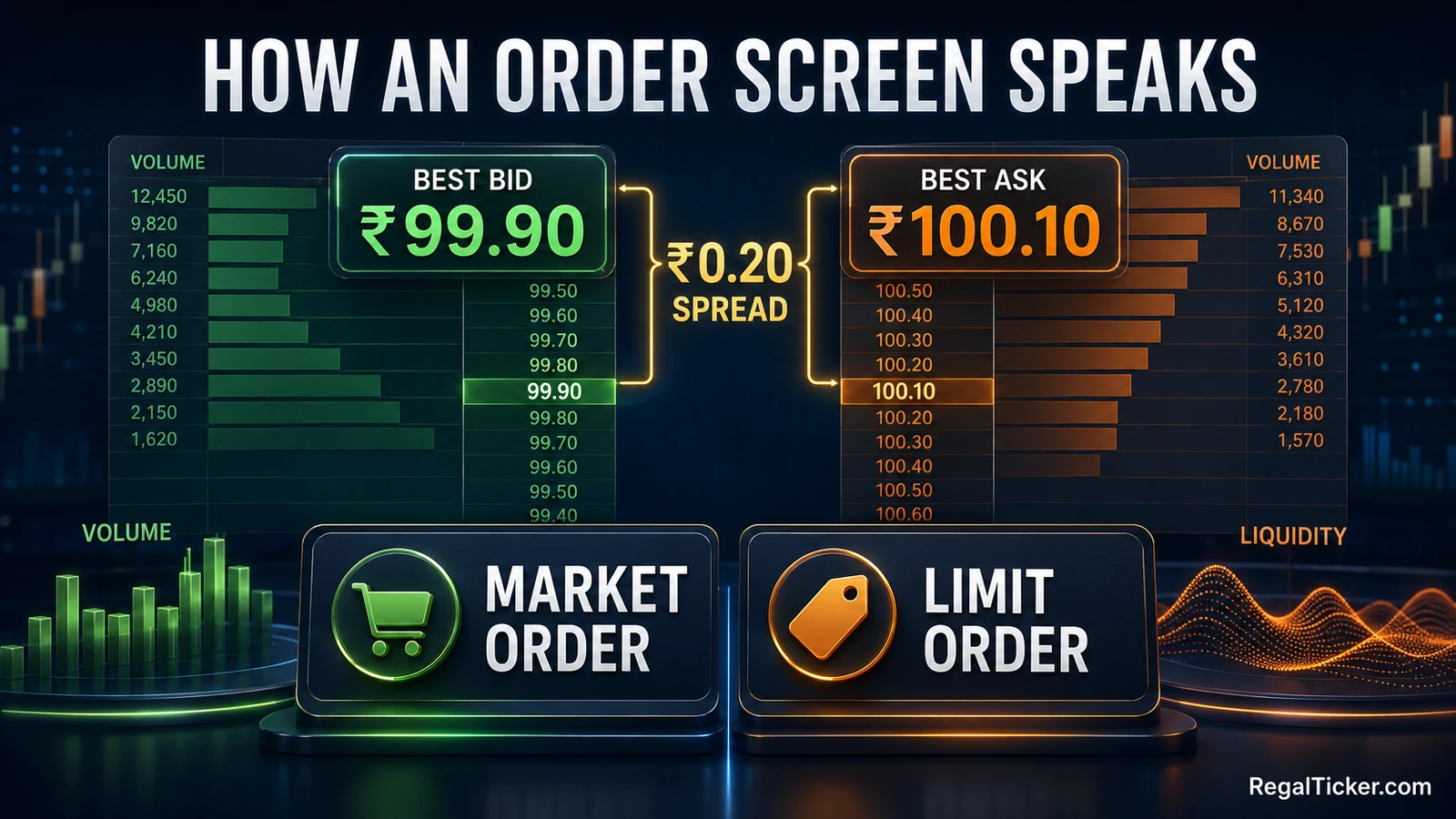
21. Bid price
The bid is the highest displayed price at which a buyer is currently willing to buy a security. A displayed bid can change or disappear, and it does not guarantee that every sell order will execute at that price.
22. Ask price
The ask, or offer, is the lowest displayed price at which a seller is currently willing to sell. A buyer who demands immediate execution may trade against available sell orders beginning near the best ask.
23. Bid–ask spread
The spread is the difference between the best ask and best bid.
Bid–ask spread = Best ask − Best bid
If the best bid is ₹99.90 and the best ask is ₹100.10, the spread is ₹0.20. A narrow spread often indicates better immediate trading conditions than a wide spread, but it should be considered with available quantity and market conditions.
24. Order book
The order book is the organised record of pending buy and sell orders at different prices. It changes continuously as orders enter, execute, change or cancel. It is a live queue, not a promise that visible quantities will remain available.
25. Market depth
Market depth displays several price levels and quantities on both sides of the order book. Depth helps a participant see how much visible interest exists near the current price. Visible depth alone cannot reveal every hidden intention or guarantee low market impact.
Terms 26–30: Instructions and Trading Activity
26. Market order
A market order prioritises execution at the best available prices. It does not guarantee one exact price, especially when liquidity is thin or the order is large. The final average execution price may span several order-book levels.
27. Limit order
A limit order sets a price boundary. A buy limit states the maximum acceptable purchase price; a sell limit states the minimum acceptable sale price. The price is controlled, but execution is not guaranteed.
28. Stop-loss order
A stop-loss instruction activates after a specified trigger condition. Depending on the order type, it may then become a market-type or limit-type instruction. A stop can reduce planned exposure, but gaps and limited liquidity can cause execution away from the trigger or prevent a stop-limit order from filling.
Use Market Order vs Limit Order vs Stop-Loss for the complete execution comparison.
29. Trading volume
Volume is the quantity of shares or contracts traded during a stated period. High volume means more units changed hands; it does not automatically mean price will rise. Direction, context, liquidity and comparison with normal activity matter. The detailed guide Trading Volume in Stock Market explains how price and volume are read together.
30. Liquidity
Liquidity is the ability to buy or sell without excessive delay or a large adverse price impact. A liquid security generally has active participation, reasonable depth and tighter spreads, although conditions can deteriorate rapidly during stress.
Closely Related Execution Terms
Slippage is the difference between an expected price and the actual execution price. Market impact is the price movement caused partly by the order itself. Both can make the real outcome worse than a simple calculator or chart entry suggests.
Market Movement and Risk Terms
Market language often compresses complex price behaviour into one word. These descriptions are useful only when the timeframe, reference point and definition are clear.
Terms 31–35: Direction and Price Change
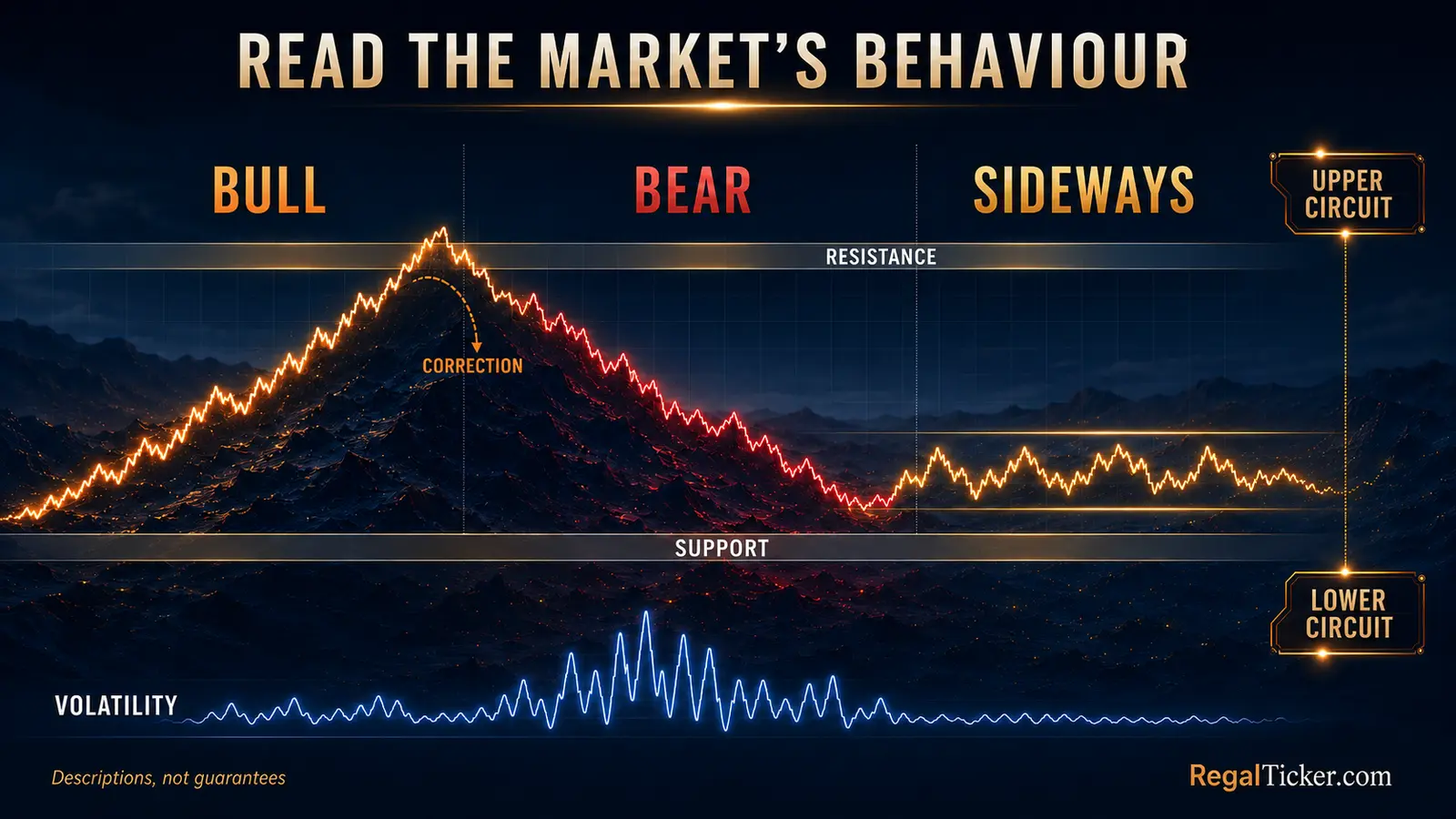
31. Bull market
A bull market describes a sustained period of broadly rising prices and positive market sentiment. The label is usually applied to a market or index over a meaningful period—not to one positive trading session. A bull market can still contain sharp declines.
32. Bear market
A bear market describes a sustained period of broadly falling prices and weak sentiment. A commonly cited percentage threshold may be used by commentators, but context and methodology matter. A bear market can contain strong temporary rallies.
33. Sideways market
A sideways or range-bound market moves mainly between upper and lower price areas without a persistent uptrend or downtrend. Strategies that work in strong trends may behave differently in a range. Read Bull, Bear and Sideways Markets Explained for a full comparison.
34. Correction
A correction is a meaningful decline from a recent high, often used for a stock, index or wider market. Commentators sometimes attach a percentage convention, but there is no universal definition that makes every decline identical. A correction does not automatically mean a bear market or a buying opportunity.
35. Volatility
Volatility describes the magnitude and frequency of price changes. High volatility means prices move more sharply or unpredictably; it does not specify direction. Volatility can increase both opportunity and risk, and it can make execution and position sizing more difficult.
Terms 36–40: Levels and Exchange Controls
36. Support
Support is a price zone where buying interest has previously slowed, paused or reversed a decline. It is an area of observed behaviour, not a guaranteed floor.
37. Resistance
Resistance is a price zone where selling interest has previously slowed, paused or reversed an advance. It is not a permanent ceiling; price can break through it or fail after moving beyond it.
38. Upper circuit
An upper circuit refers to the upper price limit applicable to a security or market mechanism for the session under relevant exchange rules. When the permissible upper level is reached, trading conditions can become one-sided. The presence of an upper circuit does not guarantee that a holder can sell at that price later.
39. Lower circuit
A lower circuit refers to the lower applicable price limit. A security can show many sell orders and few or no buyers near that level, making exit difficult. A price limit controls the permitted range; it does not guarantee liquidity.
40. Diversification
Diversification means spreading exposure across different securities, sectors, assets or risk drivers so that one adverse outcome has less power over the whole portfolio. Owning many highly correlated shares is not necessarily meaningful diversification.
Support, resistance, volatility and direction are market observations. They should never be treated as promises. Market prices can gap, trends can reverse and circuit conditions can make an exit difficult.
Company Performance and Valuation Terms
The next five terms appear in financial results, research discussions and valuation comparisons. They describe different layers of a business and should not be substituted for one another.
Terms 41–45: From Sales to Shareholder Return
41. Revenue
Revenue is the income generated from a company’s ordinary business activities before relevant expenses are deducted. Rising revenue shows growth in the top line, but it does not prove that profit, cash flow or shareholder value is improving.
42. Net profit
Net profit is the amount remaining after recognised expenses, finance costs, taxes and other relevant items are accounted for in the income statement. Profit can be affected by one-time items and accounting choices, so it should be read with cash flow and notes.
43. Earnings per share (EPS)
EPS expresses attributable earnings on a per-share basis.
Basic EPS = Profit attributable to equity shareholders ÷ Weighted-average equity shares
Diluted EPS may also reflect the potential effect of convertible instruments or options. A higher EPS is not automatically better if it comes from one-off gains, reduced share count or unsustainable margins.
44. Price-to-earnings ratio (P/E)
The P/E ratio compares market price per share with earnings per share.
P/E ratio = Market price per share ÷ EPS
A high P/E can reflect strong expectations, low current earnings or overvaluation; a low P/E can reflect undervaluation, weak prospects, cyclicality or risk. The ratio needs business and peer context.
45. Dividend yield
Dividend yield compares annual dividend per share with market price per share.
Dividend yield = Annual dividend per share ÷ Market price per share × 100
If annual dividend is ₹5 and the market price is ₹250, the simple yield is 2%. Dividends are not guaranteed, and a falling share price can mechanically increase the displayed yield even when business risk is rising.
Dividend Is an Amount; Yield Is a Percentage
A dividend is the amount declared per eligible share. Dividend yield relates that amount to the market price. A ₹10 dividend may be a high yield for one share and a low yield for another because their prices differ.

Issue and Corporate-Action Terms
The final five terms describe events that can change the number of shares, shareholder entitlements or the company’s capital structure.
Terms 46–50: New Issues and Shareholder Entitlements
46. Initial Public Offering (IPO)
An IPO is the process through which a company offers securities to the public and seeks listing for the first time under the applicable framework. An IPO application belongs to the primary market. Listing performance is uncertain, and oversubscription does not guarantee allotment or profit.
47. Rights issue
A rights issue offers eligible existing shareholders the right to apply for additional shares, usually in a stated ratio and at specified terms. Eligibility, price, dates, renunciation and payment structure must be checked in the official offer documents.
48. Bonus shares
Bonus shares are additional shares issued to eligible shareholders in a stated ratio without a separate purchase payment for those shares. The share count increases, while the market price generally adjusts; a bonus issue does not create free economic value by itself.
49. Stock split
A stock split divides each existing share into a larger number of shares while reducing face value proportionately. The investor’s proportional ownership is unchanged immediately by the split, subject to market movement and implementation details.
50. Buyback
A buyback is a company’s repurchase of its own shares through a permitted method and subject to applicable terms. An announcement does not mean every shareholder’s shares will necessarily be accepted. Eligibility, record date, entitlement, acceptance and final participation depend on the specific offer.
The Corporate Actions learning hub explains dividends, bonus issues, splits, rights issues and buybacks in dedicated lessons. Use the official announcement and offer document for any real event; never rely only on a social-media summary.
One Worked Example Using the Terminology
Suppose Meera wants to study a fictional listed company called Alpha Limited.
- She uses her trading account with a registered stockbroker to view the security.
- The shares, if purchased, will be credited through her Demat account in the depository system.
- Alpha has 5 crore outstanding shares and a market price of ₹200, giving a simplified market capitalisation of ₹1,000 crore.
- The order book shows a best bid of ₹199.90 and best ask of ₹200.10, so the visible spread is ₹0.20.
- Meera uses a limit order at ₹200 instead of assuming a market order will always fill at the last traded price.
- She checks market depth, volume and liquidity because displayed price alone does not describe execution quality.
- Alpha reports revenue of ₹600 crore, net profit of ₹60 crore and simplified EPS of ₹12. At ₹200, its simple P/E is about 16.7.
- She compares those numbers with business quality, cash flow, debt, industry conditions and valuation rather than treating P/E as a standalone answer.
- She notices that the stock is near a previous resistance zone and that broad-market volatility is elevated.
- She sets an exposure limit and avoids assuming that a familiar term or attractive ratio guarantees return.
This example shows why terminology works as a system. Ownership terms explain what is being bought; account terms explain access and custody; order terms explain execution; company terms explain performance; and risk terms explain uncertainty.
Common Pairs Beginners Confuse
| Pair | Correct distinction |
|---|---|
| Share vs security | A share is an ownership security; “security” is the broader category |
| Exchange vs broker | The exchange operates the market; the broker gives the client access |
| Demat vs trading account | Demat holds securities; trading account sends orders |
| Bid vs ask | Bid is the best displayed buyer price; ask is the best displayed seller price |
| Market order vs limit order | Market order prioritises execution; limit order prioritises a price boundary |
| Volume vs liquidity | Volume counts traded quantity; liquidity concerns ease and price impact of trading |
| Dividend vs dividend yield | Dividend is an amount per share; yield compares it with market price |
| Market cap vs company revenue | Market cap is market value of equity; revenue is business income before expenses |
| Bonus issue vs stock split | Both increase share count, but their legal and accounting structures differ |
| Volatility vs risk | Volatility measures price movement; risk is the possibility of an adverse outcome |
Beginner Checklist and Frequently Asked Questions
Before acting on an unfamiliar term:
- identify whether it concerns ownership, execution, company analysis or market behaviour;
- check the timeframe and calculation basis;
- distinguish a rupee amount from a percentage or ratio;
- verify whether a figure is historical, trailing, annualised or forward-looking;
- read the complete exchange or company announcement;
- confirm the current rule through SEBI, NSE, BSE, the depository or another primary source;
- follow the deeper Regal Ticker lesson instead of relying on a one-line definition; and
- remember that understanding a term does not remove investment risk.
NSE maintains an official market glossary, while SEBI provides a detailed securities-market glossary. These official references are useful when a regulatory document or exchange notice uses an unfamiliar expression.
What is stock market terminology in simple words?
Stock market terminology is the vocabulary used to describe securities, ownership, institutions, accounts, orders, company performance, valuation, corporate actions and market behaviour.
Which stock market terms should a beginner learn first?
Start with share, shareholder, stock exchange, broker, Demat account, trading account, bid, ask, market order, limit order, volume, liquidity, market capitalisation, EPS, P/E ratio, dividend and volatility.
Are share market and stock market terms different?
In everyday use, share market and stock market often refer to the same equity-market context. “Securities market” is broader because it can include debt securities, derivatives and other instruments in addition to shares.
What is the difference between a stock exchange and a broker?
The stock exchange is the organised marketplace where eligible orders are matched. A broker is a registered intermediary that gives its clients access to the exchange.
Is a Demat account the same as a trading account?
No. A Demat account holds eligible securities electronically. A trading account is used to place buy and sell instructions through a broker.
Does high trading volume mean a stock price will rise?
No. Volume measures traded quantity, not direction. High volume can occur during advances, declines, reversals, news reactions or range trading.
Is a low P/E ratio always good?
No. A low P/E may reflect undervaluation, but it may also reflect weak growth, cyclical earnings, governance concerns or higher risk. It needs company and industry context.
Are bonus shares free profit?
No. The shareholder receives additional shares according to the announced ratio, but the market price generally adjusts. The action does not create free economic value by itself.
Do stop-loss orders guarantee the exit price?
No. A trigger is not a guaranteed fill. Gaps, thin liquidity and rapidly moving prices can produce a different execution price, while a stop-limit order may remain unexecuted.
Where should investors verify unfamiliar market terms?
Use official investor-education pages, exchange glossaries, depository guidance, company filings and applicable regulatory documents. Definitions on social media should be checked against primary sources.
Conclusion
Stock market terminology becomes useful when each word is connected to its proper role. Shares describe ownership. Exchanges, brokers and depositories describe market infrastructure. Bid, ask, spread and order types describe execution. Revenue, profit, EPS and P/E describe different company-analysis layers. Corporate-action terms describe changes to securities or shareholder entitlements. Bull, bear, volatility and support describe market behaviour—not guaranteed outcomes.
Do not try to turn 50 definitions into 50 independent buy or sell signals. Use the language to read documents accurately, ask better questions and follow a disciplined learning path.
The next Market Terminology lesson should build on this foundation by explaining face value, book value and market value—three numbers that beginners frequently confuse.
Official References
- SEBI Investor — Investment in Securities Market
- SEBI Investor — Securities Market Glossary
- SEBI Investor — Understanding Brokers
- SEBI Investor — Market Infrastructure Institutions
- NSE — Market Glossary
Educational disclaimer: This article is for investor education and general information only. It is not financial advice, a research recommendation, an invitation to trade, an offer to buy or sell securities, or a guarantee of returns. Securities-market investments involve risk. Definitions, market processes and regulatory requirements can change; verify current information through official sources before acting.