

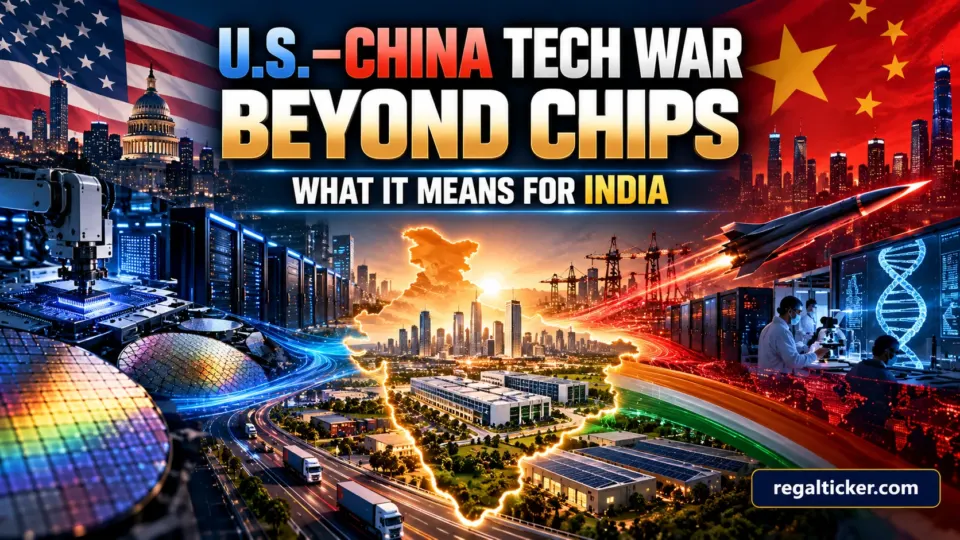
The technology contest between the United States and China has spent years being described as a chip war. That description is becoming too narrow.
On 22 October, the U.S. Treasury proposed a broader version of its outbound-investment security regime. The existing framework already restricts or requires notification for certain American investments tied to advanced semiconductors, artificial intelligence and quantum technologies in countries of concern. The proposed rules would add new technical coverage for high-performance computing and hypersonic systems, and Treasury has also proposed bringing biotechnology into the programme.
That matters because the policy is no longer aimed only at who can manufacture the fastest processor. It increasingly reaches the technologies that sit behind modern military systems, drug discovery, advanced computing, surveillance, autonomous systems and strategic industrial capacity.
For India, the obvious temptation is to read every new U.S.–China restriction as a transfer of opportunity from China to India. Reality is less automatic. Capital does not move simply because one jurisdiction becomes harder. It moves where there is talent, infrastructure, policy stability, customers and a believable path to returns.
India nevertheless enters this phase with more to offer than it did a few years ago. Semiconductor manufacturing is expanding, electronics production has scaled sharply, the National Supercomputing Mission has built indigenous capacity, biotechnology has become a formal industrial-policy priority, and defence laboratories are advancing hypersonic technologies. The question for investors is not whether India “wins” the tech war. It is which parts of the global technology stack India can credibly absorb if strategic capital and supply chains keep diversifying.
The technology conflict is widening from chips into strategic science and industrial capacity
The latest U.S. proposal would broaden outbound-investment controls across technologies that Washington considers relevant to military, intelligence, surveillance and cyber capabilities. China has strongly opposed the move and reserved the right to respond. For India, the opportunity is real but selective: semiconductor manufacturing, electronics, supercomputing, biotechnology and defence technology already have policy support and physical investment, while many other capabilities still require years of execution.
⚡ Quick answer
Could tighter U.S. investment rules on China benefit India?
Potentially, but not automatically. The rules may encourage companies and investors to diversify technology supply chains and strategic research exposure away from China. India can benefit where it already has credible capacity, incentives and talent—especially semiconductors, electronics manufacturing, high-performance computing, biotechnology, defence and space. The gains will depend on execution, not geopolitics alone.
Key takeaways
The U.S. Treasury proposal expands the outbound-investment security framework beyond its original chip-AI-quantum core.
High-performance computing and hypersonic systems are now explicitly part of the proposed technical scope, while biotechnology has been added by Treasury.
The proposal is not yet the final rule; public comments are open before final implementing regulations are issued.
China has called the expansion discriminatory and said it reserves the right to take countermeasures.
India has credible openings in semiconductors, electronics, supercomputing, biotech, defence and space, but there is no automatic transfer of capital from China.
Investors should distinguish a genuine structural opportunity from stocks that merely attach themselves to a geopolitical theme.
Investor note
“China+1” is a starting point, not an investment thesis
A geopolitical shift can enlarge an industry’s opportunity set without making every company in that industry a good investment. Revenue visibility, capital intensity, customer concentration, execution and valuation still matter. The policy backdrop is useful context; it is not a substitute for analysing the business.
1. What exactly changed in Washington?
The proposed rule comes from a broader U.S. effort to stop American capital and know-how from helping countries of concern develop technologies with national-security applications.
The original outbound-investment framework focused on three areas: semiconductors and microelectronics, quantum information technologies and artificial intelligence. The new proposal implements the Comprehensive Outbound Investment National Security Act and adds technical parameters for two more areas named by Congress—high-performance computing and supercomputing, and hypersonic systems. Treasury has separately proposed adding biotechnology under its authority to define other technologies that may contribute to military, intelligence, surveillance or cyber capabilities.
That does not amount to a blanket ban on American money entering China. The framework distinguishes between transactions that are prohibited and those that must be notified, depending on the technology, the entity and the nature of the transaction. There are also exceptions and national-interest mechanisms.
The important point is directional. Washington is building a permanent screening architecture around outbound capital, not merely imposing a temporary trade tariff.
The proposal is also still a proposal. Treasury is accepting comments through 7 December 2026 and will issue final implementing regulations later. Investors should therefore treat the current text as a strong policy signal rather than a finished compliance regime.
2. Why biotechnology changes the character of the tech war
Semiconductors are easy to understand as strategic technology. They power weapons, data centres, telecom networks and AI systems. Biotechnology is different because its commercial and national-security uses overlap in more complicated ways.
Modern biotech can involve genetic sequencing, synthetic biology, biological data, precision therapeutics, AI-assisted drug discovery and advanced biomanufacturing. Much of that work is civilian and medically valuable. Some of the same capabilities, however, can also raise concerns around surveillance, military medicine or dual-use biological research.
That is why the addition of biotechnology is significant. It pushes the U.S.–China technology competition deeper into research platforms and scientific infrastructure rather than limiting it to hardware.
India has a plausible opening here because biotech is already part of domestic industrial policy. NITI Aayog’s 2026 bioeconomy roadmap aims to make India a leading bioeconomy power by 2035, while the BioE3 policy identifies areas ranging from precision biotherapeutics and APIs to synthetic biology, biofuels and Bio-AI hubs.
That does not mean American biotech investment will simply relocate to Bengaluru, Hyderabad or Pune. But when global companies reassess where they place research partnerships, manufacturing capacity and sensitive data, India becomes a more credible alternative than it was when its bioeconomy was primarily viewed through generic pharmaceuticals.
3. High-performance computing is now part of economic security
The inclusion of high-performance computing is equally important.
Supercomputers are used for weather models, engineering simulations, nuclear research, drug discovery, aerospace design, cryptography and advanced AI workloads. The line between civilian computing power and strategic capability is therefore thin.
India has been building this capability for years through the National Supercomputing Mission. As of September 2026, the government said 40 supercomputers with a combined capacity of 68 petaflops had been deployed, with indigenous work spanning servers, system software, cooling and networking. The mission ultimately plans 50 systems with more than 123 petaflops of combined capacity.
This is not comparable with the very largest U.S. or Chinese systems, and India should not pretend otherwise. What matters is that there is already an institutional base, procurement ecosystem and engineering workforce to build on.
The opportunity also connects directly with the AI infrastructure cycle. RegalTicker’s analysis of the AI capex and CoreWeave debt boom looked at the financing pressure behind global data-centre expansion. If strategic restrictions push more countries to localise computing capacity, the beneficiaries may extend beyond software into servers, power systems, cooling, networking and data-centre infrastructure.
4. Chips still matter—but the story is now larger than chips
None of this makes semiconductors less important. If anything, the broader framework reinforces how foundational chips are to every other strategic technology.
India has already committed heavily to this area. Semicon 2.0 carries a government outlay of ₹1.275 lakh crore, while twelve semiconductor manufacturing projects had been approved by mid-2026 with investment commitments exceeding ₹1.64 lakh crore. Packaging facilities are already entering commercial production, and the ecosystem is moving beyond announcements toward physical plants.
That story is covered in detail in RegalTicker’s India semiconductor boom analysis. The useful distinction for this article is that the latest U.S. proposal increases the strategic value of having a broader domestic technology stack around those fabs: design, advanced computing, electronics, secure communications, biotechnology and defence systems.
A chip plant alone does not create technological sovereignty. The value comes from the network around it.
5. China’s response matters as much as the U.S. proposal
Beijing’s response was immediate. China’s Ministry of Commerce said the proposed rules discriminate against China, politicise economic issues and interfere with normal commercial cooperation. It also said China would monitor developments and reserved the right to take corresponding measures.
That wording matters because China has leverage of its own.
China occupies powerful positions in critical minerals, electronics components, industrial machinery, batteries, solar manufacturing and a range of intermediate goods. A wider technology conflict can therefore produce retaliation through export controls, licensing restrictions, procurement rules or pressure on supply chains.
This is the part of the “India opportunity” narrative that often gets ignored. India still depends heavily on Chinese imports for important industrial inputs. A sharper U.S.–China split can create opportunity in the long run while making components more expensive or harder to source in the short run.
China is also not becoming irrelevant to global capital. Recent official data showed foreign investment into China remained under pressure overall, but high-tech sectors were still attracting strong growth. That is a reminder that global companies continue to value China’s scale, supplier density and engineering depth even while governments try to reduce strategic dependence.
So this is not a simple exit story. It is a diversification story.
6. Where India has the strongest chance to benefit
The best way to think about India is sector by sector rather than through a broad “China+1” slogan.
Semiconductors and electronics
This is the most visible opportunity because policy, capex and production are already moving together. India’s electronics production reached roughly ₹13.11 lakh crore in FY2025–26, while the Electronics Component Manufacturing Scheme had approved 106 projects involving ₹69,548 crore of investment by August 2026. Thirty-eight approved plants were already operating.
That gives India something it lacked during earlier cycles: a large electronics base that can eventually consume and support more domestic components.
Supercomputing and data infrastructure
India’s National Supercomputing Mission creates a foundation for high-performance computing, while commercial data-centre demand is rising alongside AI and cloud adoption. If strategic computing becomes more geographically distributed, India can compete for infrastructure, engineering and downstream services even without matching the largest global supercomputers.
Biotechnology and biomanufacturing
India already has depth in pharmaceuticals, vaccines, contract research and process chemistry. The newer opportunity is moving further into biological data, synthetic biology, precision therapeutics and advanced biomanufacturing. Policy support helps, but the real test will be intellectual property, research quality and the ability to scale high-value products rather than only low-cost manufacturing.
Defence and hypersonic technology
India is not starting from zero here either. In May 2026, DRDO reported a successful 1,200-second test of an actively cooled full-scale scramjet combustor for its hypersonic missile programme. DRDO’s technology roadmap also includes hypersonic glide vehicles, high-temperature materials, thermal protection and advanced propulsion.
That makes the latest U.S. focus on hypersonics especially relevant for India. The opportunity is not that U.S. restricted capital suddenly funds Indian missiles. It is that global strategic competition increases the value of domestic aerospace, materials, electronics and precision-engineering capability.
Space and strategic intelligence
Defence, computing, semiconductors and space are increasingly connected. Satellite imagery, secure communications and geospatial intelligence all depend on the same broader technology stack. RegalTicker’s recent feature on India’s private-space boom explains why companies such as Skyroot, Pixxel, Agnikul, Dhruva and GalaxEye matter even though most remain private.
7. How this could reach Indian listed markets
The transmission into the stock market is unlikely to arrive through one obvious “U.S.–China tech war stock.” It is more likely to spread across several layers.
| Indian-market area | Why the policy shift could matter | What investors still need to verify |
|---|---|---|
| Electronics manufacturing | More global supply-chain diversification can support local component and assembly demand | Customer concentration, margins, imported content |
| Semiconductor ecosystem | Strategic diversification reinforces the case for local fabs, packaging and design | Project timelines, utilisation, technology, returns on capital |
| Data centres and power equipment | AI and sovereign computing require power, cooling, networking and backup systems | Capex intensity, power availability, customer economics |
| Biotech and research services | Global research partnerships may diversify geographically | IP quality, regulatory risk, customer stickiness |
| Defence and aerospace | Strategic competition raises demand for indigenous systems and components | Order conversion, execution, working capital, valuations |
| Precision engineering | Advanced technology programmes require specialised materials and manufacturing | Genuine programme exposure versus marketing claims |
This is where discipline matters. The fact that a company sells electronics, chemicals or engineering products does not mean it will benefit materially from strategic decoupling.
Investors should use the same process they would use for any structural theme: understand the revenue exposure, read management commentary, check capital requirements and compare expectations with valuation. RegalTicker’s fundamental-analysis guide is a useful framework for separating real business exposure from thematic storytelling.
8. The biggest risk is assuming every supply chain will move to India
India is competing with Vietnam, Mexico, Malaysia, Singapore, South Korea, Japan, Europe and the United States itself for strategic investment.
Some technologies are also likely to be reshored rather than “friend-shored.” Governments may prefer domestic production for the most sensitive defence, biotech and computing systems. In other cases, companies may keep substantial operations in China because moving would be too expensive.
India’s own bottlenecks remain familiar: infrastructure quality, electricity reliability, logistics, research depth, regulatory speed, imported components and the challenge of developing specialised skills at industrial scale.
There is also a valuation risk. Markets can price a decade of policy success into a stock long before revenue arrives. That can make a genuinely attractive industry a poor investment at the wrong price.
For themes driven by geopolitical headlines, risk management matters even more because policy expectations can reverse quickly.
9. What could China do next?
China has not announced a specific retaliation to this proposal, and investors should not assume one is inevitable.
Still, the policy toolkit is broad. Beijing could tighten export controls on strategic materials or manufacturing technologies, increase scrutiny of U.S. companies, use procurement rules, or target sectors where China holds a strong global position.
Recent Chinese policy shows that export controls are already an active tool. Beijing has been revising controls in areas ranging from dual-use equipment to advanced solar manufacturing technologies. That does not prove that any particular response will follow the U.S. outbound-investment proposal, but it shows the mechanism exists.
For India, retaliation could cut both ways. It could accelerate localisation and new investment while simultaneously raising costs for manufacturers that still rely on Chinese components or machinery.
The market implication is therefore asymmetric: strategic independence can be valuable, but building it is expensive.
10. What investors should watch from here
There are five checkpoints worth following.
First, watch the final U.S. rule after the comment period. The technical thresholds will determine how broad the practical impact really is.
Second, watch China’s response. A rhetorical objection is one thing; new export controls or investment restrictions would be much more consequential.
Third, watch actual investment announcements in India. Factory commitments, research centres, local partnerships and repeat capex matter more than summit language.
Fourth, watch utilisation and commercial production in Indian semiconductor, electronics and computing projects. Policy support creates capacity; customers create returns.
Fifth, watch whether biotechnology and advanced computing begin attracting the same scale of strategic capital that electronics and semiconductors are already receiving.
RegalTicker’s Market hub can provide the shorter-term context when these policy developments begin affecting global risk appetite, the rupee or Indian sector performance.
11. The opportunity for India is broader—but harder—than “China+1”
The latest U.S. proposal is important because it signals that the technology contest is moving into a new phase. Chips remain central, but the battleground now includes computing power, biological research, advanced aerospace systems and the capital that helps build them.
India has a better chance of participating in that reordering than it did a decade ago. It has scale in electronics, a growing semiconductor pipeline, an indigenous supercomputing programme, a large life-sciences base and increasingly ambitious defence and space ecosystems.
But the strongest case for India is not that geopolitics will hand it investment. It is that geopolitics is creating more reasons for companies and governments to diversify—and India has finally built enough capability in several strategic sectors to compete for a meaningful share of that diversification.
That is a more durable investment thesis because it can be tested. New factories can be tracked. Supercomputing capacity can be measured. Biotech research can be commercialised—or fail to be. Defence projects can convert into orders. Semiconductor plants can move from construction to production.
For investors, the practical job is to follow those proof points rather than buy the geopolitical headline.
Investor note
Keep corporate actions separate from thematic conviction
Technology themes can create long holding periods, restructuring events and corporate actions. If a company in your portfolio later undergoes a demerger, use RegalTicker’s Demerger Cost Basis Calculator to organise the cost-allocation calculation rather than mixing it into the original investment thesis.
Frequently asked questions
What did the U.S. change in its outbound-investment rules?
The October 2026 proposal would implement a broader statutory framework covering semiconductors, AI, quantum technologies, high-performance computing, hypersonic systems and biotechnology. The final technical rules are still subject to the rulemaking process.
Is the United States banning all investment in China?
No. The programme targets specific covered transactions and technologies. Some transactions may be prohibited, others may require notification, and exceptions can apply.
Why was biotechnology added?
Treasury says the programme is intended to address technologies that can support military, intelligence, surveillance or cyber capabilities. Advanced biotechnology can have both civilian and strategic applications.
Does this automatically redirect U.S. investment to India?
No. India must compete with several countries and with U.S. reshoring. Capital will move only where economics, infrastructure, talent and policy are attractive.
Which Indian sectors could benefit most?
Semiconductors, electronics manufacturing, data infrastructure, biotechnology, precision engineering, defence and aerospace are among the most plausible areas, although individual company outcomes will vary widely.
Could India also be hurt by a deeper U.S.–China technology split?
Yes. India still imports important industrial inputs from China, so retaliation or supply restrictions could increase costs even while creating longer-term localisation opportunities.
What should investors watch next?
The final U.S. rule, any Chinese countermeasures, new India-bound investment commitments, commercial production from strategic projects and evidence that revenue is actually reaching listed companies.
Verify through official sources
Official references
- U.S. Treasury — Outbound Investment Security Program — Current programme framework, countries of concern, rulemaking status and comment deadline.
- U.S. Treasury — Proposed COINS Act implementing rule — Proposed expansion across strategic technology sectors including biotechnology, HPC and hypersonics.
- China Ministry of Commerce — Response to U.S. proposed outbound-investment rules — China’s official objection and statement that it reserves the right to respond.
- Reuters — China urges U.S. to halt expanded outbound-investment curbs — Current reporting on the proposal and Beijing’s response.
- Reuters — Foreign investment flows into China fall in first three quarters — Context on overall FDI pressure and continued high-tech investment growth in China.
- PIB — India’s Rising Supercomputing Ecosystem — National Supercomputing Mission deployment and indigenous HPC capacity.
- PIB — NITI Aayog Bioeconomy Roadmap — India’s 2035 bioeconomy roadmap and long-term strategy.
- PIB — Contribution of BioE3 Policy — Priority biotechnology and Bio-AI sectors under BioE3.
- PIB — India’s Electronics Boost — Electronics production, exports and semiconductor policy context.
- PIB — Electronics Component Manufacturing Scheme — Approved ECMS projects, investment and operating plants.
- PIB — India Building Semiconductor Future — Semicon 2.0 outlay and approved manufacturing ecosystem.
- PIB — DRDO long-duration scramjet test — May 2026 hypersonic missile-development milestone.
- DRDO — Hypersonic Technologies — Current hypersonic technology development areas across propulsion, materials and control systems.
Educational disclaimer: This content is for education and general financial awareness only. It is not investment, tax, legal, accounting or personalised financial advice. Geopolitical and regulatory policies can change quickly. Verify current information with the relevant regulator, issuer, exchange or qualified professional before making financial decisions.


