

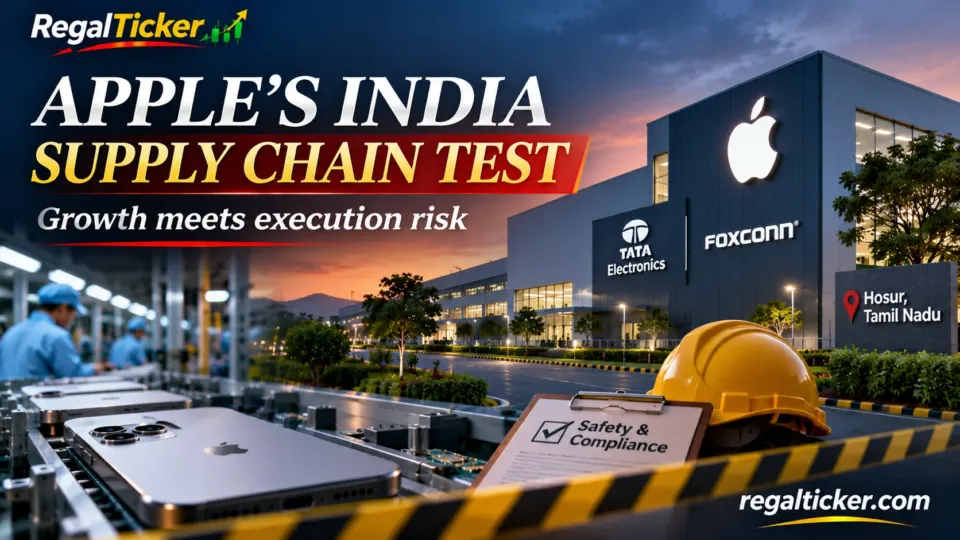
India has become too important to Apple for execution problems to be treated as isolated factory issues
Apple’s manufacturing shift toward India has moved well beyond experimentation.
Roughly a quarter of the world’s iPhones are now made in India, according to Reuters. Tata Electronics and Foxconn have become the two main manufacturing partners, and Tata alone accounts for about 40% of iPhone assembly in the country.
That makes what happens inside these factories increasingly relevant to investors.
On 10 November, Reuters reported that three contract workers died after inhaling gas while carrying out maintenance at an external nano-filtration tank connected to an effluent-treatment plant at Tata Electronics’ Hosur facility in Tamil Nadu. Apple, Tata and local authorities are investigating. Production was not affected because the site was closed for the Deepavali festival.
The incident is first and foremost a human tragedy.
For investors, it also sits inside a broader pattern of operational issues that Apple’s India supply chain has had to navigate: factory fires, labour unrest, cybersecurity incidents, wastewater concerns and scrutiny over workforce practices.
None of that means Apple’s India strategy is failing.
It means the strategy has reached a stage where execution quality matters almost as much as capacity growth.
⚡ Quick answer
Is Apple’s India manufacturing expansion at risk?
Not in any immediate sense. India has become a core part of Apple’s global diversification strategy, and both Tata Electronics and Foxconn continue to expand capacity. But the scale of the operation means safety, cybersecurity, environmental compliance, labour practices and production continuity are now material strategic risks. The question is no longer whether Apple can manufacture at scale in India. It is whether the supply chain can scale while meeting the reliability and governance standards expected of a global manufacturing base.
Key takeaways
Three contract workers died during maintenance at Tata Electronics’ Hosur facility on 10 November.
The workers inhaled gas while inspecting an external nano-filtration tank at an effluent-treatment plant.
Apple, Tata Electronics and Tamil Nadu authorities are investigating.
Production was unaffected because the site was closed for the Deepavali festival.
India now produces roughly one-quarter of the world’s iPhones.
Tata Electronics accounts for about 40% of iPhone assembly in India, with Foxconn producing most of the remainder.
Reuters has documented recent fires, labour disputes, cybersecurity incidents and environmental concerns across Apple supplier operations in India.
Tata Electronics is simultaneously expanding into semiconductors and high-value electronics manufacturing.
India’s broader electronics output reached about ₹13.11 lakh crore in FY2025-26, according to the government.
Electronics exports reached about ₹4.24 lakh crore, while mobile-phone exports reached roughly ₹2.59 lakh crore.
The investment question is not whether India remains strategically important to Apple; it is whether operational discipline can keep pace with the speed of expansion.
1. The Hosur incident matters because the plant is strategically important
The Tata Electronics facility near Hosur is not a marginal supplier site.
Reuters said the plant makes components for Apple iPhones and forms part of a manufacturing network that has become central to Apple’s attempt to reduce its dependence on China.
Tata Electronics describes its Hosur operation as its largest fully functional installed base for high-precision electronics components in India and says the site is on an aggressive capacity-expansion path.
That scale changes how investors should think about operational incidents.
A problem at a small supplier may be replaceable.
A problem at a major node in a concentrated manufacturing network can become a production, reputation or regulatory issue if it is serious enough.
In this case, Reuters reported that production was not affected because the plant was closed for the holiday.
That limits the immediate commercial impact.
The longer-term question is whether the investigations identify weaknesses that require changes in contractor management, maintenance procedures or environmental systems.
2. Apple’s India manufacturing shift is now large enough to influence global supply-chain resilience
India’s role in Apple’s manufacturing network has expanded rapidly.
Reuters estimates the country now produces roughly a quarter of global iPhones.
That is a very different position from a few years ago, when India was mainly an alternative assembly location.
Apple’s logic is straightforward.
China remains the world’s deepest electronics-manufacturing ecosystem, but tariffs, geopolitical tension and concentration risk make it dangerous for one country to dominate production of Apple’s most important product.
India gives Apple a second large manufacturing base.
For India, the relationship is equally important.
Apple’s suppliers have helped pull high-volume smartphone assembly, component production, export logistics and supplier investment into the country.
That is why an operational problem inside the Apple ecosystem matters beyond one factory.
It tests whether India can become not just a large assembly base, but a consistently reliable one.
3. The execution risks are no longer theoretical
Reuters’ review of Apple’s India supply chain lists several incidents over recent years.
A ransomware attack in 2026 exposed more than 200,000 files stolen from a Tata Electronics operation, including confidential supplier information and images linked to an unreleased iPhone.
Tata also faced a pollution-control warning related to alleged wastewater contamination, which the company said was resolved.
Fires disrupted operations at Tata, Pegatron and Foxlink facilities between 2023 and 2024.
There have also been labour-related incidents at Foxconn and Wistron sites, including worker protests and earlier disruptions.
Some allegations were later resolved or companies were cleared.
The point is not that every incident reflects the same problem.
They do not.
The point is that a supply chain expanding at very high speed is accumulating more points where execution can go wrong.
Investor note
Scale creates resilience only if the operating system behind the scale is strong
Diversifying production away from China reduces geographic concentration risk. But moving capacity into a new manufacturing base also creates new operational, labour, environmental, security and regulatory risks. Diversification improves resilience only when those risks are controlled well enough that the second base is genuinely dependable.
4. Tata Electronics is becoming much more than an iPhone assembler
Tata Electronics is trying to build an end-to-end electronics and semiconductor platform.
The company operates electronics-manufacturing facilities near Hosur, in Karnataka and in Tamil Nadu.
It has acquired Wistron’s India operations and a majority stake in Pegatron Technology India.
It is also building India’s first large commercial semiconductor fab at Dholera in Gujarat and a semiconductor assembly-and-test facility in Assam.
The government says the Dholera semiconductor SEZ alone is expected to support around 21,000 jobs.
Tata Electronics has separately signed partnerships with companies including ASML, Sojitz and NRS to build equipment, materials and supply-chain capability around the fab.
This broader strategy matters because the Apple relationship can act as an anchor customer and training ground for much deeper manufacturing capability.
But it also raises the stakes.
A company moving simultaneously into smartphone assembly, precision components and semiconductor manufacturing has to build industrial systems that can handle much more complexity.
5. India’s electronics growth is real—and already much bigger than one company
It would be a mistake to treat Apple’s India story as a single-customer project.
The government says India’s electronics production reached about ₹13.11 lakh crore in FY2025-26, up from roughly ₹1.9 lakh crore in 2014-15.
Electronics exports reached about ₹4.24 lakh crore.
Mobile-phone production rose to around ₹6.27 lakh crore.
Mobile-phone exports reached roughly ₹2.59 lakh crore.
Domestic value addition in electronics manufacturing is now estimated at 18%–20%.
Those numbers show why India is attracting global supply-chain investment.
The opportunity is no longer limited to assembling imported parts.
The long-term goal is to move into components, materials, capital equipment, semiconductor packaging and eventually more advanced chip manufacturing.
RegalTicker’s India Semiconductor Boom analysis looks at that next stage in more detail.
6. The bigger challenge is moving from volume to reliability
Manufacturing scale is easy to measure.
Reliability is harder.
A world-class electronics supply chain needs more than production capacity.
It needs worker safety.
Cybersecurity.
Environmental control.
Supplier qualification.
Maintenance discipline.
High yields.
Stable logistics.
Predictable regulation.
And management systems capable of learning quickly when something goes wrong.
China built that ecosystem over decades.
India is trying to compress part of that learning curve into a much shorter period.
That is possible.
But the speed of expansion makes process discipline more important, not less.
For Apple, the most valuable feature of India will eventually be not how many phones can be assembled there.
It will be how confidently production can be shifted there when another part of the global network is disrupted.
7. What does this mean for Apple investors?
The immediate financial impact of the Hosur incident appears limited because production was not affected.
The more important issue is strategic.
Apple is deliberately increasing manufacturing concentration in India at the same time that India is still building parts of the supplier ecosystem, industrial infrastructure and regulatory framework needed to support that scale.
If execution improves as capacity grows, the strategy becomes more valuable because Apple gains a stronger second manufacturing base outside China.
If operational incidents become more frequent or begin causing repeated production losses, the diversification benefit becomes less clean.
Investors should therefore watch a broader set of indicators than iPhone production volume alone.
Supplier continuity, factory safety, data security and environmental compliance are increasingly part of the Apple investment case.
8. What does this mean for Indian investors?
Tata Electronics is privately held, so there is no simple listed-company trade tied directly to the Hosur facility.
That is important.
Investors should avoid forcing a headline into unrelated Tata Group stocks simply because the Tata name appears in the story.
The broader listed-market relevance is thematic.
India’s electronics and semiconductor push can benefit industrial infrastructure, logistics, power, data centres, component makers, engineering businesses and technology suppliers over time.
But those benefits require actual contracts and earnings.
The Fundamental Analysis framework is useful here because “Make in India” exposure by itself is not enough reason to buy a stock.
Revenue visibility, margins, cash flow and return on capital still matter.
9. What should investors watch next?
The first thing is the outcome of the Hosur investigations.
Any findings on maintenance procedures, contractor oversight or safety systems will matter more than speculation.
Second, watch whether Apple or Tata announces operational changes.
Third, watch for any production disruption. So far, Reuters says there was none.
Fourth, monitor cybersecurity.
The earlier ransomware incident showed that digital security is now part of manufacturing resilience.
Fifth, watch environmental compliance.
Electronics and semiconductor production require increasingly sophisticated water, chemical and waste-management systems.
Sixth, watch localisation.
The real sign that Apple’s India strategy is maturing will be rising domestic value addition, not just more final assembly.
Finally, watch Tata Electronics’ semiconductor build-out.
If the company can execute successfully across both electronics manufacturing and semiconductors, it could become one of the most strategically important industrial platforms in India.
Frequently asked questions
What happened at Tata Electronics’ Hosur facility?
Three contract workers died after inhaling gas while carrying out maintenance at an external nano-filtration tank connected to an effluent-treatment plant. Apple, Tata and local authorities are investigating.
Was iPhone production affected?
Reuters reported that production was unaffected because the site was closed for the Deepavali festival.
How important is India to Apple’s iPhone production?
Reuters says India now produces roughly one-quarter of the world’s iPhones.
How much of Apple’s India production is handled by Tata?
Reuters reported that Tata accounts for about 40% of iPhone assembly in India, with Foxconn making most of the remainder.
Is Tata Electronics publicly listed?
No. Tata Electronics is privately held, so there is no direct listed Tata Electronics stock.
Does this incident mean Apple will reduce manufacturing in India?
There is no evidence of that. Apple’s India manufacturing expansion remains strategically important. The issue is whether safety and operational systems can keep pace with growth.
What are the broader risks in Apple’s India supply chain?
Recent years have included fires, labour disputes, cybersecurity incidents, environmental concerns and regulatory scrutiny across different supplier sites.
What is the investment opportunity for India?
The larger opportunity is the development of a deeper electronics and semiconductor ecosystem. The benefit will depend on local value addition, supplier quality, execution and actual earnings generated by participating companies.
Verify through official sources
Official references
- Reuters — Tata Electronics Hosur Incident — Three worker deaths, investigation status, production impact and Apple/Tata manufacturing-share context.
- Reuters — Apple India Supply Chain Woes — Recent safety, cybersecurity, environmental and labour issues across Apple supplier facilities in India.
- Tata Electronics — Electronics Manufacturing Services — Official description of Tata Electronics’ Hosur, Karnataka and Tamil Nadu manufacturing operations and expansion strategy.
- Tata Electronics — Semiconductor Materials Partnership — Official Dholera fab materials-supply-chain partnership and ₹91,000 crore fab context.
- Tata Group — Tata Electronics and ASML — Official ASML partnership for the Dholera semiconductor fab.
- PIB — Electronics Manufacturing Growth — Official electronics production, export, mobile manufacturing and employment statistics.
- PIB — Dholera Semiconductor SEZ — Official notification and employment estimate for Tata’s Dholera semiconductor SEZ.
Final takeaway
India’s manufacturing opportunity is real. Reliability will decide how valuable it becomes.
Apple’s shift toward India is one of the clearest signs that the country has become a serious part of the global electronics supply chain.
A quarter of the world’s iPhones being made in India would have sounded unrealistic not long ago.
That scale is now real.
So are the risks.
The Hosur deaths should not be reduced to an investment headline. They are a reminder that industrial growth depends on systems that protect workers, control environmental risk and keep complex factories running safely.
For investors, that is the bigger lesson.
India does not need to prove that it can attract manufacturing anymore.
It needs to prove that it can operate that manufacturing consistently at world-class standards.
If it does, Apple’s expansion can become much more than an iPhone story.
It can become part of a deeper electronics and semiconductor ecosystem that is difficult for global companies to ignore.
Educational disclaimer: This article is for education and general market information only. It is not investment advice or a recommendation to buy or sell Apple, any Tata Group company, Foxconn or any electronics-related security. Tata Electronics is privately held. Operational investigations are ongoing, and facts may change as authorities and companies release further information. Verify current company, regulator and government disclosures before making financial decisions.


