

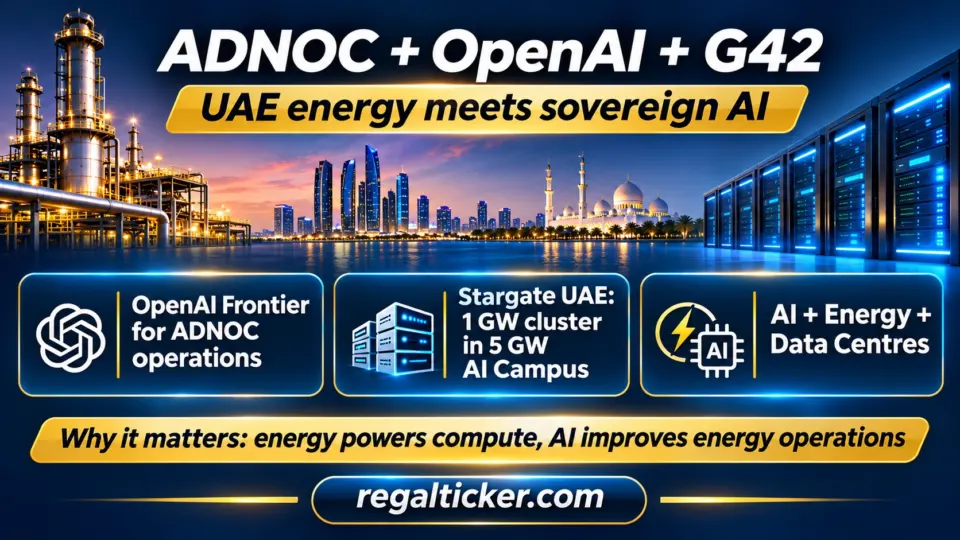
The UAE is turning energy from an AI constraint into an industrial advantage
The global AI story is usually told from the technology side: models need chips, data centres and electricity.
The UAE is now approaching the same equation from the opposite direction.
ADNOC, OpenAI and G42 have signed a multi-year partnership that will make ADNOC the first energy company to deploy OpenAI’s frontier technology across complex industrial operations. The initial use cases will connect subsurface data, field development, production, refining, logistics, sales and trading so that decisions can be evaluated together rather than in separate operational silos.
That makes the announcement more than an enterprise-software deal.
It sits inside a much larger UAE strategy built around three assets:
abundant energy + sovereign compute + industrial data.
OpenAI is already a partner in Stargate UAE, a 1 GW compute cluster inside the wider 5 GW UAE–U.S. AI Campus in Abu Dhabi. The first 200 MW phase of Stargate UAE is expected to come online in 2026.
Those are separate projects. ADNOC has not said its OpenAI workloads will automatically run on Stargate UAE. But together they show the same national direction: the UAE wants to be both a major energy supplier and a major location for frontier-scale compute.
For investors, the significance is the feedback loop. AI needs reliable energy infrastructure, while energy companies can use AI to improve field planning, operating efficiency, logistics and commercial decisions.
RegalTicker’s AI data-centre power-grid analysis examined the electricity bottleneck from the grid side. The ADNOC deal shows the other side of the equation: major energy producers are becoming sophisticated AI users themselves.
⚡ Quick answer
Why does the ADNOC–OpenAI–G42 partnership matter?
The partnership matters because it moves frontier AI from isolated enterprise tools into integrated industrial decision-making across a large energy company. ADNOC plans to use OpenAI Frontier with G42’s sovereign AI infrastructure to connect reservoir, production, refining, logistics, sales and trading decisions. At the same time, the UAE is building large-scale domestic compute infrastructure through Stargate UAE and the wider 5 GW UAE–U.S. AI Campus. The investment implication is not simply “AI helps oil.” It is that energy, compute, data-centre infrastructure and industrial productivity are beginning to converge into one capital cycle.
Key takeaways
ADNOC, OpenAI and G42 signed a multi-year industrial AI partnership on 2 November 2026.
ADNOC says it will become the first energy company to deploy OpenAI Frontier across complex operations.
The system will run using UAE-based sovereign AI infrastructure supplied through G42.
Human experts will retain oversight of consequential decisions.
Initial use cases include full-field development planning and integrated commercial optimisation from production to trading.
ADNOC says field master planning that traditionally takes months could be reduced to hours.
ADNOC already has more than 200 AI applications and around 70 robotics use cases deployed or under development.
ChatGPT Enterprise has been rolled out to more than 40,000 ADNOC employees, with adoption above 97%.
ADNOC’s ENERGYai uses a 70-billion-parameter model trained on more than 50 years of company data.
Stargate UAE is a separate 1 GW compute cluster inside the wider 5 GW UAE–U.S. AI Campus.
The first 200 MW Stargate UAE cluster is expected online in 2026.
G42 says the 5 GW campus is planned to use nuclear, solar and natural gas power.
The strategic opportunity spans energy operations, sovereign AI, data centres, power infrastructure, networking, cooling and cybersecurity.
The main risk is capital intensity
industrial AI only creates value if productivity gains exceed the cost of compute, infrastructure and integration.
1. What ADNOC, OpenAI and G42 actually agreed
ADNOC’s announcement is unusually ambitious for an enterprise AI deployment.
The companies are not describing a chatbot layered onto existing workflows.
The plan is to connect OpenAI’s advanced reasoning technology with ADNOC’s proprietary industrial data and operating systems so decisions can be evaluated across the entire business.
ADNOC says the platform will be deployed on G42’s sovereign AI infrastructure in the UAE.
Two initial applications explain the strategy.
The first is field master planning.
Today, subsurface analysis, facilities planning, economics and capital decisions are often performed in separate stages. ADNOC wants AI to connect decades of data from thousands of wells, multiple reservoirs and hundreds of surface facilities into one integrated planning process.
The company says that could reduce work that takes months into hours.
The second application is commercial.
ADNOC wants to connect intelligence from production through processing, refining, logistics, sales and trading so that the commercial value of a barrel can be analysed before operating decisions are made.
That is a much more consequential use of AI than automating office productivity.
2. Why energy is one of the hardest places to deploy frontier AI
Energy operations combine enormous datasets with physical systems where mistakes can be expensive.
A model operating inside an energy company may need to understand:
- geology;
- reservoir behaviour;
- well performance;
- equipment condition;
- process plants;
- shipping;
- commodity markets;
- capital costs; and
- safety constraints.
Those systems also operate continuously.
That means industrial AI needs more than reasoning quality.
It requires:
- secure infrastructure;
- low-latency access to operational data;
- domain-specific models;
- human oversight;
- cybersecurity; and
- clear accountability for consequential decisions.
ADNOC explicitly says humans will retain oversight.
That is important because the investment case for industrial AI depends on increasing productivity without introducing unacceptable operational risk.
3. ADNOC already had an AI base before OpenAI arrived
The partnership is not starting from zero.
ADNOC says it already has more than 200 AI applications and approximately 70 robotics use cases deployed or under development.
Its ENERGYai system is especially important.
ADNOC says ENERGYai is built on a 70-billion-parameter model trained on more than 50 years of company data.
The company also operates AI-enabled systems across drilling, production and real-time operations.
Its Real-Time Operations Center connects more than 120 rigs and has reduced engineering effort by roughly 30%–40%, according to ADNOC.
The OpenAI partnership therefore adds a higher-level orchestration layer.
ENERGYai provides deep domain intelligence around reservoirs and subsurface workflows.
OpenAI Frontier is intended to connect that intelligence with commercial, operational and capital decisions across the business.
That distinction matters.
The strategy is not to replace ADNOC’s existing industrial AI stack. It is to integrate it more deeply.
4. The 40,000-employee rollout shows the company is also targeting organisational productivity
ADNOC has already rolled out ChatGPT Enterprise to more than 40,000 employees.
The company says adoption exceeds 97%.
That suggests the AI strategy has two layers.
The first layer is workforce productivity: research, communication, analysis and knowledge work.
The second is industrial decision intelligence: reservoirs, plants, logistics, trading and capital allocation.
The second layer is financially more interesting because it can potentially affect:
- production efficiency;
- downtime;
- project economics;
- inventory;
- refinery margins;
- shipping decisions; and
- capital productivity.
But it is also harder to measure.
Investors should eventually look for evidence that AI changes actual operating metrics rather than merely increasing software usage.
Investor note
Adoption statistics are not the same as economic returns
A high employee-adoption rate proves that a tool is being used. It does not prove that it is improving return on capital. The more important long-term evidence will be lower costs, faster project cycles, higher uptime, better margins or more efficient capital deployment.
5. Stargate UAE is related strategically—but separate operationally
The ADNOC partnership should not be confused with Stargate UAE.
They are separate announcements.
Stargate UAE is a 1 GW AI compute cluster being built by G42 and operated by OpenAI and Oracle.
It will sit inside a wider 5 GW UAE–U.S. AI Campus in Abu Dhabi.
OpenAI says the first 200 MW of Stargate UAE is expected to go live in 2026.
G42 says the full campus spans about 10 square miles and is intended to be powered by a mix of nuclear, solar and natural gas.
Partners in Stargate UAE include:
- G42;
- OpenAI;
- Oracle;
- NVIDIA;
- Cisco; and
- SoftBank.
There is no public statement in the ADNOC announcement saying its workloads will necessarily run on Stargate UAE.
The connection is strategic rather than contractual.
Both projects show the UAE building domestic compute infrastructure while encouraging major industries to consume more advanced AI.
That is how a national AI ecosystem becomes self-reinforcing.
6. Why the UAE has a structural advantage in the AI-energy convergence
AI infrastructure needs three things the UAE can supply at scale:
capital, energy and land.
Frontier-scale data centres are expensive to build and expensive to power.
The UAE has large sovereign investment pools, a major energy sector and the ability to plan infrastructure at a national level.
That does not eliminate constraints.
AI data centres still require:
- grid connections;
- transformers;
- cooling;
- water or alternative thermal systems;
- advanced chips;
- networking;
- secure fibre; and
- skilled operators.
But the UAE can coordinate those layers in ways that fragmented electricity markets often struggle to do.
This is one reason the country is positioning itself as a sovereign-compute hub rather than only a buyer of foreign cloud services.
7. Energy is becoming both the input and the customer
This is the most important economic idea in the story.
Historically, technology companies bought electricity from the energy system.
Now the relationship is becoming two-way.
Energy companies supply the physical power needed by AI infrastructure.
At the same time, they are becoming major buyers of AI technology.
That creates a circular capital cycle:
energy → compute → industrial AI → productivity → more infrastructure investment.
The cycle can be powerful if productivity gains are real.
But it can also become capital-intensive very quickly.
RegalTicker’s AI data-centre power-grid analysis explains why electricity infrastructure is emerging as one of the limiting factors for global compute growth.
The ADNOC partnership adds another layer: the companies that own energy infrastructure can themselves become some of AI’s highest-value industrial customers.
8. The biggest investment opportunity may sit between oil and software
The obvious interpretation is that AI could help ADNOC produce hydrocarbons more efficiently.
That is only part of the opportunity.
The physical infrastructure around sovereign AI can create demand for:
- high-voltage equipment;
- transmission infrastructure;
- data-centre construction;
- advanced cooling;
- backup power;
- networking;
- optical connectivity;
- cybersecurity;
- industrial sensors;
- robotics; and
- specialised engineering.
This is why the AI theme keeps migrating into sectors that were not traditionally classified as technology.
For Indian investors, the lesson is similar to the one in RegalTicker’s India AI power-infrastructure analysis: the strongest beneficiaries may be the companies that solve physical bottlenecks rather than the companies with the most AI branding.
Still, no Indian stock should be called a beneficiary of the ADNOC partnership without an actual order or disclosure.
9. The oil-market backdrop makes this strategy more relevant
The partnership arrives during a period of unusual stress in global energy markets.
ADNOC said this week that disruption around the Strait of Hormuz has drained nearly one billion barrels from global inventories, while logistics costs have risen sharply as a share of delivered oil costs.
That environment makes operational intelligence more valuable.
When supply routes are unstable, an integrated energy company must constantly optimise:
- production;
- inventories;
- shipping;
- refinery configuration;
- customer commitments; and
- trading decisions.
AI may help companies process those trade-offs faster.
But the geopolitical problem itself remains physical.
Software cannot reopen a shipping route or replace lost infrastructure.
That is why the Hormuz and crude-oil analysis remains essential context. AI can improve decision-making around scarcity; it does not remove scarcity.
10. The main risk is paying frontier-AI costs without getting frontier-AI returns
Industrial AI can sound compelling before the economics are proven.
The cost stack includes:
- advanced models;
- compute infrastructure;
- data engineering;
- systems integration;
- cybersecurity;
- employee training; and
- ongoing model operations.
Large energy companies can afford those costs.
The question is whether the resulting improvements are large enough to change operating economics.
Investors should eventually look for measurable evidence such as:
- shorter field-development cycles;
- reduced drilling cost;
- better recovery rates;
- lower unplanned downtime;
- more efficient refinery optimisation;
- improved shipping economics; and
- higher return on invested capital.
The Fundamental Analysis guide is the right framework because an exciting technology partnership only becomes financially important when it changes revenue, cost, cash flow or capital efficiency.
11. Why this matters beyond ADNOC and the UAE
If the deployment works, the model could spread across other energy companies.
Oil and gas producers have several characteristics that suit frontier AI:
- enormous proprietary datasets;
- high-value decisions;
- expensive physical assets;
- complex supply chains; and
- measurable operating outcomes.
That makes energy a natural test case for enterprise AI that goes beyond office productivity.
It also creates a broader strategic competition.
Countries that control reliable energy and sovereign compute may be able to attract more AI-intensive industry.
Countries that lack both may remain dependent on imported computing capacity and foreign infrastructure.
The UAE is clearly trying to sit on the first side of that divide.
12. What investors should watch next
The partnership now needs measurable execution.
First, watch whether ADNOC publishes quantified improvements from field master planning.
Second, watch whether AI starts affecting operating costs, project cycle times or asset utilisation.
Third, watch the first 200 MW Stargate UAE phase and whether it enters service on schedule.
Fourth, watch how quickly the wider 5 GW campus secures power, cooling, networking and chip supply.
Fifth, watch whether more UAE industrial companies adopt sovereign AI infrastructure rather than foreign-hosted systems.
Sixth, watch capital intensity. The UAE has the balance sheet to build aggressively, but returns still matter.
Finally, watch whether other global energy majors copy ADNOC’s integrated approach.
If they do, industrial AI could become a much larger infrastructure market than the current enterprise-software framing suggests.
Frequently asked questions
What did ADNOC, OpenAI and G42 announce?
They announced a multi-year partnership to deploy OpenAI Frontier across ADNOC’s operations using UAE-based sovereign AI infrastructure provided through G42.
Is ADNOC the first oil company to use OpenAI technology?
ADNOC says it will become the first energy company to deploy OpenAI Frontier across integrated industrial operations.
What will the AI system do first?
Initial applications include integrated field master planning and connecting decisions across production, processing, refining, logistics, sales and trading.
How much AI does ADNOC already use?
ADNOC says it has more than 200 AI applications and around 70 robotics use cases deployed or under development.
What is ENERGYai?
ENERGYai is ADNOC’s specialist industrial AI system, built on a 70-billion-parameter model trained on more than 50 years of company data.
How many ADNOC employees use ChatGPT Enterprise?
ADNOC says ChatGPT Enterprise has been rolled out to more than 40,000 employees with adoption above 97%.
Is Stargate UAE the same project as the ADNOC partnership?
No. Stargate UAE is a separate 1 GW compute project inside the 5 GW UAE–U.S. AI Campus. The ADNOC announcement does not say its workloads will necessarily run there.
How large is Stargate UAE?
Stargate UAE is planned as a 1 GW cluster, with the first 200 MW expected to go live in 2026.
How large is the wider UAE AI campus?
G42 says the wider UAE–U.S. AI Campus will provide 5 GW of AI data-centre capacity.
What powers the campus?
G42 says the campus is planned to use nuclear, solar and natural gas power.
Verify through official sources
Official references
- ADNOC — OpenAI and G42 partnership — Primary ADNOC announcement covering OpenAI Frontier deployment, initial use cases, sovereign infrastructure, existing AI applications and workforce adoption.
- Reuters — ADNOC, G42 and OpenAI deal — Current reporting on the ADIPEC agreement, OpenAI’s UAE ties and the 5 GW data-centre backdrop.
- OpenAI — Introducing Stargate UAE — Primary OpenAI source for the 1 GW Stargate UAE cluster and first 200 MW phase expected in 2026.
- G42 — Global Tech Alliance Launches Stargate UAE — Primary G42 source for the wider 5 GW UAE–U.S. AI Campus, partners and planned energy mix.
- ADNOC — Global Energy Security Must Be Rebuilt for a New Era — ADNOC context on energy security, logistics disruption and the role of AI in operational resilience.
Educational disclaimer: RegalTicker provides educational and informational content only. This article is not investment advice or a recommendation to buy or sell any security, technology, energy or infrastructure company. The ADNOC partnership and Stargate UAE are separate projects, and no company should be treated as a direct beneficiary without a disclosed commercial relationship. AI productivity gains, infrastructure timelines, power availability and capital returns can change materially. Verify current company, regulator and government disclosures before making financial decisions.
Final takeaway
The UAE is building a two-way AI-energy economy
Most countries discuss AI as a new source of electricity demand.
The UAE is trying to make the relationship work in both directions.
Its energy system can supply the power and capital required for large-scale compute.
Its industrial companies can then become major customers of the AI infrastructure being built around them.
ADNOC’s partnership with OpenAI and G42 is the clearest example yet of that strategy.
If industrial AI genuinely improves field development, operations and commercial decisions, the value will not sit only in software.
It will spread across data centres, power, networking, cooling, cybersecurity and industrial automation.
That is why this story matters beyond one oil company.
The UAE is attempting to turn energy abundance into compute capacity—and compute capacity back into industrial productivity.


