


⚡ Quick answer
The main IPO investor categories in an Indian main-board public issue can include Retail Individual Investors, Non-Institutional Investors, Qualified Institutional Buyers and eligible employees. A retail individual application generally does not exceed ₹2 lakh. “HNI” is a common market term, while the formal offer-document category is usually Non-Institutional Investor or Non-Institutional Bidder. Current offer structures commonly divide the NII portion between applications above ₹2 lakh and up to ₹10 lakh, and applications above ₹10 lakh. QIBs are specified institutional investors such as eligible mutual funds, banks, insurers and other regulated institutions. An employee category exists only when the issuer reserves shares for employees under the issue terms.
Investor note
Key Takeaways
Select the category from the RHP, not from informal labels. Retail generally means an eligible individual bid not exceeding ₹2 lakh. An application above ₹2 lakh is not a retail application. HNI is a common market term; NII or NIB is the formal IPO category. NII applications are commonly split into more than ₹2 lakh up to ₹10 lakh and more than ₹10 lakh. QIBs are specified institutions, not wealthy individuals. Anchor investors are eligible QIBs, not a separate retail-facing category. Employee reservation exists only when the issue provides it. Employee eligibility is defined in the offer document. Employee discounts are issue-specific and not guaranteed. Category allocation can differ according to the issuer’s eligibility route. Regulation 6(1) and Regulation 6(2) issues can have different category shares. Reservation portions are generally separated before calculating the net offer. Application value should be calculated at the cap price when required. UPI or ASBA payment limits do not change the investor category. A valid application does not guarantee allotment. Duplicate or incorrectly classified applications can be rejected. Category subscription should not replace business and valuation analysis.
An IPO can be subscribed ten times overall while one category remains weak and another is subscribed fifty times.
This happens because the public offer is divided among different groups of applicants.
The categories are not merely labels. They influence:
eligibility; application value; reservation; bidding rules; allotment method; subscription data; payment processing; probability of receiving shares.
The most common beginner confusion is the word “HNI.”
Broker platforms and financial media often display:
retail; small HNI; big HNI; QIB; employee.
The legal and offer-document terminology can instead use:
Retail Individual Bidder; Non-Institutional Bidder; Qualified Institutional Bidder; Eligible Employee.
This lesson explains how the categories work and how an investor should choose the correct one.
Read What Is an IPO? Meaning, Process and Example for the basic concept.
Read How Does an IPO Work in India? Complete Process for bidding, ASBA, allotment and listing.
IPO Investor Categories at a Glance
| Category | Typical applicant | Application value or eligibility |
|---|---|---|
| Retail Individual Investor | Individual investor | Generally not more than ₹2 lakh |
| Small NII or small HNI | Individual, HUF or eligible non-institutional applicant | More than ₹2 lakh and up to ₹10 lakh |
| Large NII or big HNI | Eligible non-institutional applicant | More than ₹10 lakh |
| QIB | Specified regulated institution | Institutional eligibility, not a simple rupee threshold |
| Employee | Eligible employee named by issue criteria | Only when an employee reservation exists |
| Shareholder or policyholder | Eligible reserved applicant | Only when the issue creates that reservation |
| Anchor investor | Eligible QIB | Applies in the pre-issue anchor portion |
The exact definitions and allocations must be read from the RHP.
Category Names Can Vary
Offer documents and platforms may use:
- RII or RIB for retail;
- NII or NIB for non-institutional;
- QIB for qualified institutional;
- EMP for employee;
- SHA for shareholder;
- POL for policyholder.
The meaning should be verified from the issue’s “Definitions” and “Offer Structure” sections.
Retail Individual Investor Category
The retail category is designed for eligible individual investors applying within the retail value limit.
Retail Application Limit
A Retail Individual Investor generally applies or bids for specified securities whose total value is not more than ₹2 lakh.
The calculation is based on the complete application value, not on:
- the investor’s bank balance;
- annual income;
- demat portfolio;
- net worth;
- amount ultimately allotted.
Retail Application Formula
Application value = Number of lots × Shares per lot × Bid price
Suppose:
- lot size: 40 shares;
- cap price: ₹480;
- application: 10 lots.
Application value:
10 × 40 × ₹480 = ₹1,92,000
This remains within ₹2 lakh.
For 11 lots:
11 × 40 × ₹480 = ₹2,11,200
This exceeds the retail limit and should not be treated as a retail bid.
Calculate at the Relevant Bid Price
When the investor selects cut-off, sufficient funds may need to be available based on the cap price.
Read IPO Price Band, Lot Size and Issue Size Explained for detailed calculations.
Cut-Off Option
Eligible retail investors can generally select “cut-off” in a book-built issue.
This means accepting the final issue price discovered through book building.
It does not mean:
- the lowest price;
- a special discount;
- guaranteed allotment;
- guaranteed listing gain.
Retail Allotment in Heavy Oversubscription
When the retail portion is heavily oversubscribed, the basis of allotment may seek to provide the minimum lot to the maximum possible number of successful retail applicants, subject to applicable rules and available shares.
This means applying for many retail lots may not increase the allotment proportionately.
Retail Application Checklist
Confirm:
- total application value;
- lot multiple;
- PAN;
- demat details;
- bank account;
- UPI ID where used;
- mandate approval;
- category selected;
- absence of duplicate applications;
- sufficient funds.

HNI and Non-Institutional Investor Categories
“HNI” means high-net-worth individual in common usage.
In IPO documents, the formal category is normally Non-Institutional Investor or Non-Institutional Bidder.
Who Can Be an NII?
The NII category can include eligible applicants that are neither:
- Retail Individual Investors;
- Qualified Institutional Buyers.
Depending on the offer, applicants can include:
- individuals;
- Hindu Undivided Families;
- companies;
- trusts;
- societies;
- other eligible entities.
The RHP determines eligibility.
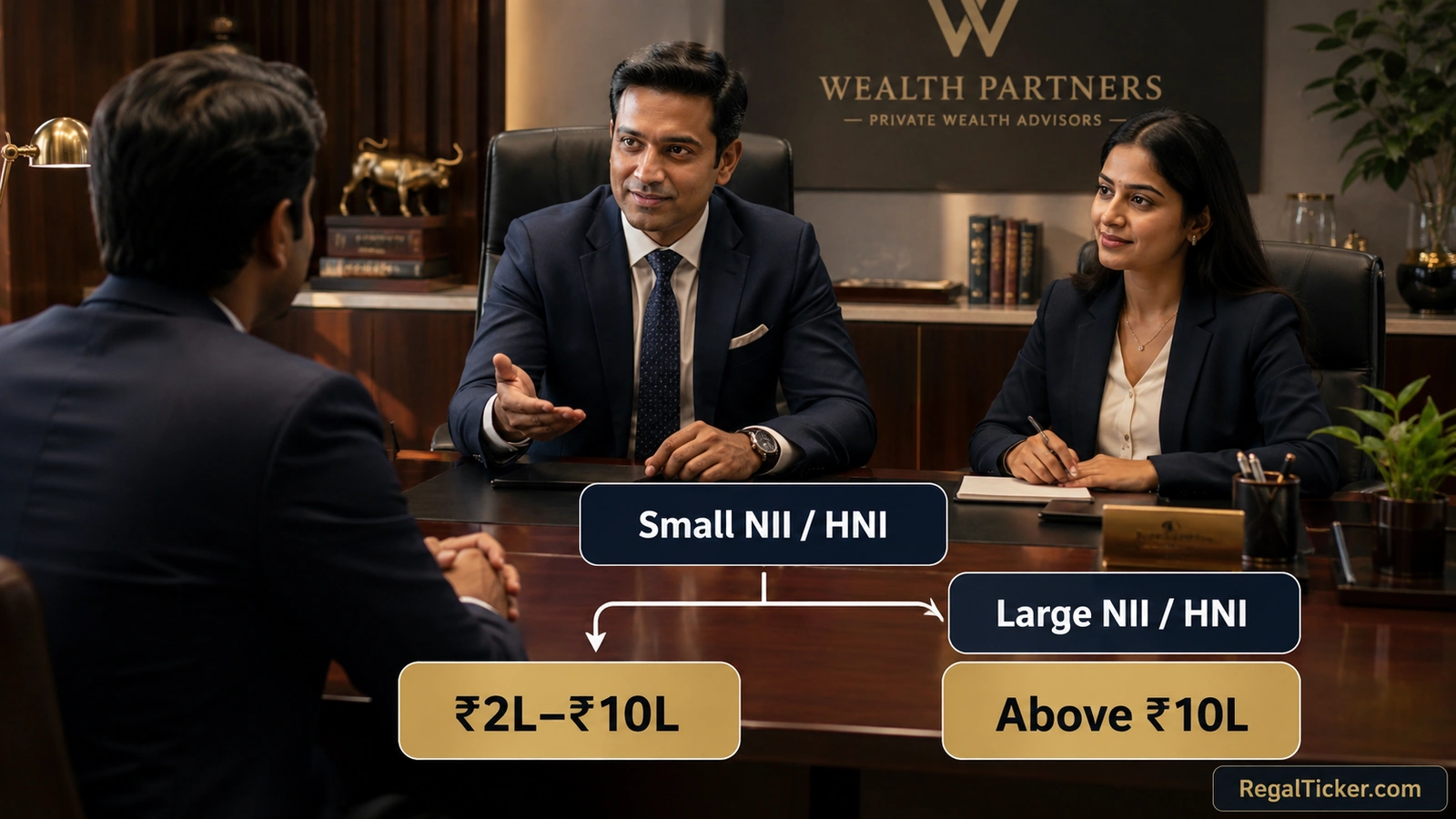
Small NII or Small HNI
Current main-board offer structures commonly reserve one-third of the NII portion for applications:
More than ₹2 lakh and up to ₹10 lakh
This is widely called:
- small NII;
- sNII;
- small HNI.
Large NII or Big HNI
The remaining two-thirds of the NII portion is commonly reserved for applications:
More than ₹10 lakh
This is widely called:
- large NII;
- bNII;
- big HNI.
NII Subcategory Table
| Informal name | Formal position | Application value |
|---|---|---|
| Small HNI | Small NII subcategory | Above ₹2 lakh and up to ₹10 lakh |
| Big HNI | Large NII subcategory | Above ₹10 lakh |
The exact RHP controls the category.
NII Allotment
NII allotment is generally proportionate within the applicable subcategory, subject to valid bids and the basis of allotment.
Suppose the small-NII portion has 10 lakh shares available and receives valid demand for 50 lakh shares.
Simplified subscription:
50 lakh ÷ 10 lakh = 5 times
A valid applicant may receive only a proportion of the requested quantity.
Actual allotment uses the final basis and lot-rounding rules.
Does a Larger NII Application Guarantee More Shares?
No.
It can increase the requested quantity, but allotment depends on:
- subcategory subscription;
- valid demand;
- lot size;
- shares available;
- basis of allotment.
Borrowing to Apply as HNI
Some investors borrow money to make large IPO applications.
This creates additional risks:
- interest cost;
- processing charges;
- low allotment;
- weak listing;
- delayed fund release;
- market volatility;
- overconfidence from grey-market premiums.
A high subscription number cannot guarantee that leveraged application costs will be recovered.
Qualified Institutional Buyer Category
QIB means Qualified Institutional Buyer.
It is a regulatory category of specified institutional investors.
Examples of QIBs
Depending on current regulations and eligibility, QIBs can include categories such as:
- mutual funds;
- scheduled commercial banks;
- insurance companies;
- specified foreign portfolio investors;
- Alternative Investment Funds;
- public financial institutions;
- multilateral or bilateral development institutions;
- eligible provident funds;
- eligible pension funds;
- other institutions identified under the regulations.
A wealthy person does not become a QIB merely because of net worth.
An individual applying for a large amount is generally an NII, not a QIB.
Why IPOs Allocate Shares to QIBs
Institutional participation can support:
- price discovery;
- professional analysis;
- large-scale demand;
- market confidence;
- broad institutional ownership.
Institutional demand does not guarantee that the issue is fairly valued.
QIB Allocation in Main-Board IPOs
For many book-built IPOs using the standard profitability-based eligibility route, the net offer commonly provides:
- at least 50% for QIBs;
- at least 15% for NIIs;
- at least 35% for retail investors.
Issues using an alternative eligibility route can have a higher QIB share and a smaller retail share, commonly with up to 10% of the net offer available to retail.
Always check:
- the regulatory eligibility route;
- the cover page;
- offer structure;
- category allocation.
Mutual Fund Portion
Within the QIB allocation, a specified part can be available for mutual funds under the applicable rules.
The exact offer-document language should be followed.
Anchor Investors
Anchor investors are eligible QIBs allocated shares before the public issue opens.
Anchor Is Not a Separate Public Category
Retail and NII investors cannot select “anchor” on a normal IPO application form.
The anchor process takes place before public bidding.
Why Investors Watch the Anchor Book
The anchor allocation can show:
- names of institutional participants;
- allocation concentration;
- domestic and foreign demand;
- mutual-fund participation.
It does not guarantee:
- retail allotment;
- full subscription;
- listing gain;
- long-term return.
Anchor Lock-In
Anchor allocations can be subject to applicable lock-in requirements.
Investors should check current regulations and the anchor-allocation report.

Employee IPO Category
An employee category exists only when the issuer creates an employee reservation portion.
Not every IPO offers it.
Who Is an Eligible Employee?
The RHP defines eligible employees.
Eligibility can depend on:
- employment with the issuer;
- employment with specified subsidiaries;
- employment status on a stated date;
- residence;
- legal restrictions;
- exclusions for promoters or directors under the issue terms.
An employee should not rely only on the employer’s internal announcement.
Read the definition in the RHP.
Employee Reservation
The employee reservation is usually separated from the net offer.
The remaining shares are then divided among QIB, NII and retail categories.
Employee Discount
Some issuers provide a discount to eligible employees.
💡 Real example
Simple example
offer price: ₹800; employee discount: ₹60; employee price: ₹740.
The discount is issue-specific.
It is not automatic.
Employee Application Limit
Recent issue pages can specify a maximum employee subscription amount of up to ₹5 lakh, but the exact limit, allotment cap and application procedure must be checked in the current RHP and exchange issue information.
The employee category should never be assumed to follow the same limit as retail.
Can an Employee Also Apply in Retail?
Some offer documents permit an eligible employee to apply in the employee reservation and also submit another valid application in an eligible net-offer category.
The rules are issue-specific.
Check:
- multiple-application provisions;
- PAN treatment;
- category limits;
- combined application restrictions.
Employee Allotment
Allotment in the employee portion can be proportionate, subject to:
- valid applications;
- reservation size;
- issue terms;
- application limits;
- basis of allotment.
A discount does not guarantee allotment.

Other Reserved IPO Categories
Some IPOs create additional reservation portions.
Shareholder Reservation
A shareholder category may be available to eligible shareholders of a specified listed parent or promoter entity.
Eligibility depends on:
- record date;
- PAN;
- ownership;
- RHP definition;
- issue-specific conditions.
Policyholder Reservation
An insurance-company IPO may create a reservation for eligible policyholders.
The document can define:
- eligible policy;
- cut-off date;
- PAN linkage;
- maximum bid;
- discount.
Reservation vs Net Offer
A simplified structure may be:
Total offer − employee reservation − shareholder reservation = Net offer
The net offer is then allocated among:
- QIB;
- NII;
- retail.
This is why category percentages should be applied to the correct base.
Category Allocation and Subscription Data
Subscription data should be read category by category.
Simplified Example
Assume:
- net offer: 1 crore shares;
- QIB portion: 50 lakh;
- NII portion: 15 lakh;
- retail portion: 35 lakh.
Demand received:
- QIB: 1.5 crore shares;
- NII: 1.2 crore shares;
- retail: 2.1 crore shares.
Subscription:
| Category | Shares available | Demand | Subscription |
|---|---|---|---|
| QIB | 50 lakh | 150 lakh | 3 times |
| NII | 15 lakh | 120 lakh | 8 times |
| Retail | 35 lakh | 210 lakh | 6 times |
Overall subscription alone would hide these differences.
Small-NII and Large-NII Data
The NII portion should also be separated into:
- small NII;
- large NII.
A heavily subscribed large-NII book does not necessarily mean the small-NII book has the same allotment pressure.
Employee Subscription
An employee portion may be:
- undersubscribed;
- fully subscribed;
- heavily oversubscribed.
Employee discount and lower competition can affect interest, but no outcome is guaranteed.
Choosing the Correct IPO Category
The correct category is determined by eligibility and application value.
Step 1: Identify the Applicant
Is the applicant:
- an individual;
- HUF;
- company;
- trust;
- institutional investor;
- eligible employee;
- eligible shareholder;
- eligible policyholder?
Step 2: Calculate the Full Application Value
Use:
Lots × Shares per lot × Bid price
Do not classify the application using only the blocked balance or expected allotment.
Step 3: Read the RHP Definition
Check:
- Definitions;
- Offer Structure;
- Issue Procedure;
- Application Form;
- Basis of Allotment.
Step 4: Select the Correct Payment Method
All public-issue applicants generally use ASBA, with eligible individual applications using the supported UPI process where applicable.
SEBI’s investor guidance currently states an IPO UPI transaction limit of ₹5 lakh. That payment limit does not convert an application above ₹2 lakh into a retail bid.
Step 5: Avoid Duplicate or Conflicting Bids
Applications can be rejected for:
- duplicate PAN;
- invalid category;
- third-party bank or UPI details;
- incorrect demat information;
- insufficient funds;
- mandate failure;
- ineligible reservation claim.
Worked Examples
Example 1: Retail Application
- lot size: 25;
- cap price: ₹600;
- lots: 12.
Application:
25 × ₹600 × 12 = ₹1,80,000
This can fall within retail.
Example 2: Application Above Retail Limit
Same IPO, 14 lots:
25 × ₹600 × 14 = ₹2,10,000
This exceeds ₹2 lakh and should not be submitted as retail.
Example 3: Small NII
- lot size: 30;
- cap price: ₹500;
- lots: 40.
Application:
30 × ₹500 × 40 = ₹6,00,000
This falls above ₹2 lakh and up to ₹10 lakh.
It is commonly treated as small NII.
Example 4: Large NII
- lot size: 20;
- cap price: ₹1,000;
- lots: 75.
Application:
20 × ₹1,000 × 75 = ₹15,00,000
This exceeds ₹10 lakh.
It is commonly treated as large NII.
Example 5: Employee Discount
- normal offer price: ₹900;
- employee discount: ₹50;
- allotted shares: 100.
Employee purchase amount:
₹850 × 100 = ₹85,000
Normal-price value:
₹900 × 100 = ₹90,000
Discount benefit:
₹5,000
The market can still list below ₹850.
Example 6: Listing Return
An investor receives 100 shares at ₹850 and sells at ₹930.
Gross gain:
₹80 × 100 = ₹8,000
Gross return:
₹80 ÷ ₹850 × 100 ≈ 9.41%
Use the Stock Return Calculator, Brokerage Calculator and Capital Gains Tax Calculator to estimate a more complete result.
IPO Category Checklist and Common Mistakes
Calling Every Large Individual Application “QIB”
A wealthy individual is generally NII, not QIB.
Treating HNI as the Formal Category Name
HNI is common shorthand.
The RHP normally uses NII or NIB.
Applying Above ₹2 Lakh as Retail
The full bid value determines the category.
Assuming the UPI Limit Is the Retail Limit
Payment capability and category classification are separate.
Believing More Lots Guarantee Allotment
Allotment depends on category subscription and the basis of allotment.
Ignoring Small-NII and Large-NII Splits
The two NII subcategories can have very different subscription levels.
Selecting Employee Without Eligibility
The employee definition must be satisfied.
Assuming Employee Discount Guarantees Profit
The listing price can be below the discounted application price.
Reading Only Overall Subscription
Category-wise data is more useful.
Using Borrowed Funds Without Calculating Cost
Interest and low allotment can make an HNI application unprofitable.
Submitting Duplicate Applications
Duplicate or conflicting applications can be rejected.
Ignoring the Offer’s Eligibility Route
Regulation 6(1) and Regulation 6(2) issues can allocate different percentages to retail and QIBs.
IPO Category Checklist
Before bidding, confirm:
- applicant identity;
- PAN;
- demat account;
- application value;
- lot multiple;
- category;
- subcategory;
- cut-off eligibility;
- reservation eligibility;
- employee discount;
- ASBA or UPI details;
- sufficient funds;
- mandate deadline;
- duplicate-application rule;
- category subscription;
- valuation and business quality.
Do not choose a category solely because it appears less subscribed.
An invalid category can cause rejection.
Using RegalTicker Calculators
Stock Return Calculator
Use the Stock Return Calculator to calculate return from issue price to sale price.
Brokerage Calculator
Use the Brokerage Calculator before treating a listing-day gross gain as net profit.
Capital Gains Tax Calculator
Use the Capital Gains Tax Calculator for a simplified tax estimate after a sale.
CAGR Calculator
Use the CAGR Calculator for a multi-year IPO investment held after listing.
Investor Tools Hub
Access the complete collection through the RegalTicker Investor Tools Hub.
Frequently Asked Questions
What are the main IPO investor categories?
Common categories include Retail Individual Investors, Non-Institutional Investors, Qualified Institutional Buyers and eligible employees.
What is the retail IPO limit?
A retail individual application generally does not exceed ₹2 lakh.
Is HNI an official IPO category?
HNI is common market terminology. The formal category is generally Non-Institutional Investor or Non-Institutional Bidder.
What is small HNI or small NII?
It commonly refers to an NII application above ₹2 lakh and up to ₹10 lakh.
What is big HNI or large NII?
It commonly refers to an NII application above ₹10 lakh.
Is a wealthy individual a QIB?
No. QIB status depends on the investor being an institution specified by the regulations.
What is a QIB?
A QIB is an eligible institutional investor such as a qualifying mutual fund, bank, insurer, FPI, AIF or other specified institution.
What is an anchor investor?
An anchor investor is an eligible QIB allocated shares before the public IPO bidding opens.
Can retail investors apply in the anchor category?
No.
What is the employee IPO category?
It is an issue-specific reservation for employees who satisfy the RHP’s eligibility definition.
Does every IPO have an employee category?
No.
Do employees always receive a discount?
No. The issuer may provide a discount, but it is issue-specific.
Can an employee apply in both employee and retail categories?
Some issues allow it under specified rules. The RHP must be checked.
Is the employee application limit always ₹2 lakh?
No. Employee limits can differ from retail and must be verified in the issue documents.
Does UPI allow an application up to ₹5 lakh?
SEBI’s investor page currently states a ₹5 lakh IPO UPI transaction limit. Category classification remains separate.
Does a ₹5 lakh UPI application count as retail?
No. An application above ₹2 lakh is not retail merely because UPI can process it.
How are NII shares divided?
Current main-board offer structures commonly reserve one-third for applications above ₹2 lakh up to ₹10 lakh and two-thirds for applications above ₹10 lakh.
Is NII allotment guaranteed?
No. It depends on valid demand, subscription and basis of allotment.
Why does one IPO have 35% retail and another only 10%?
The issuer’s regulatory eligibility route can affect the net-offer allocation. The RHP explains the exact structure.
Which category has the best allotment probability?
There is no fixed answer. It depends on shares available and valid demand in each category.
Final Takeaway
IPO categories determine who can apply, how much can be bid and how shares are allocated.
Use these practical rules:
- Up to ₹2 lakh: generally retail for an eligible individual.
- Above ₹2 lakh up to ₹10 lakh: commonly small NII or small HNI.
- Above ₹10 lakh: commonly large NII or big HNI.
- Specified institutions: QIB.
- Eligible employee under the RHP: employee reservation category.
Remember:
- HNI and QIB are not the same.
- UPI payment limits and category limits are not the same.
- Employee reservation is issue-specific.
- Regulation 6(1) and Regulation 6(2) issues can have different category allocations.
- Category subscription does not prove business quality.
- Correct category selection does not guarantee allotment.
- Borrowed-money applications add financing risk.
- The RHP is the final authority for the application.
Continue learning:
- What Is an IPO? Meaning, Process and Example
- How Does an IPO Work in India? Complete Process
- IPO Price Band, Lot Size and Issue Size Explained
- DRHP vs RHP: How to Read IPO Documents
- Fresh Issue vs Offer for Sale in an IPO
- Stock Return Calculator
- Brokerage Calculator
- Capital Gains Tax Calculator
- CAGR Calculator
- Investor Tools Hub
Official References
- SEBI Investor — Apply in IPO Through ASBA and UPI
- SEBI — ICDR Master Circular Updated Through December 2025
- NSE India — Frequently Asked Questions on IPOs
- NSE India — e-IPO FAQs
- NSE India — Public Offer Documents
Educational disclaimer: This article is for general investor education only. It is not investment advice, legal advice, tax advice, a research recommendation, an offer, a solicitation or a guarantee of allotment or returns. IPO categories, application limits, UPI limits, employee eligibility, reservation, allocation and procedures can change. Verify the current RHP, exchange issue information, SEBI rules, registrar instructions and authorised intermediary guidance before applying.