

⚡ Quick answer
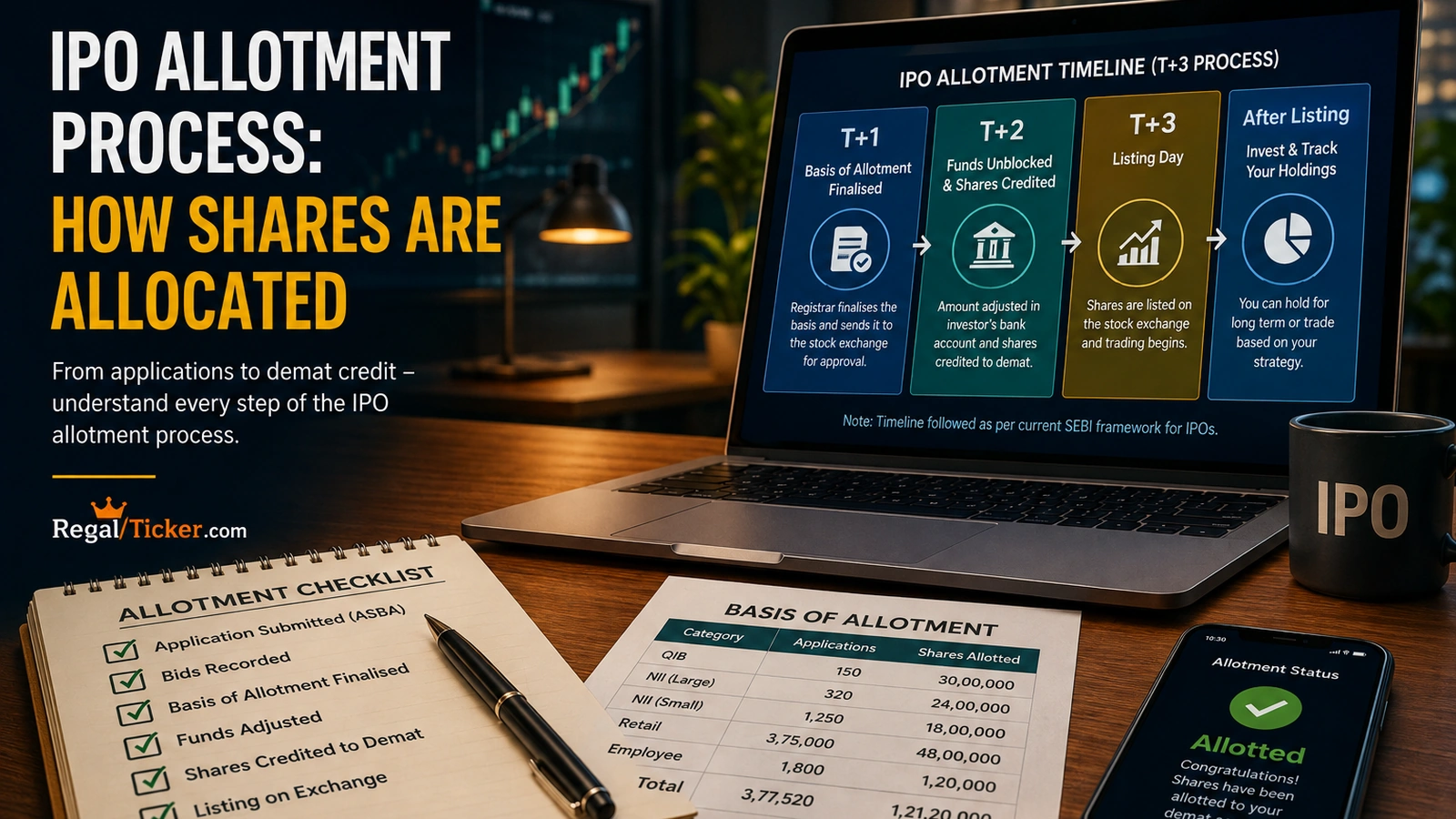
The IPO allotment process begins after the issue closes and all bids, ASBA blocks and UPI mandates are reconciled. Invalid or technically defective applications are removed. The registrar then calculates category-wise valid demand and prepares the basis of allotment in consultation with the designated stock exchange. Retail applicants may receive the minimum bid lot through a draw when there are more valid applicants than available minimum lots. NII and QIB allocations are generally completed on a proportionate basis under the applicable offer structure. After approval, the required funds are transferred, unused amounts are unblocked, shares are credited to successful applicants’ demat accounts and trading begins under the current T+3 listing framework.
Investor note
Key Takeaways
A submitted IPO application is not automatically a valid application. Technical rejections are removed before allotment. Allotment is calculated separately for each investor category. Overall subscription does not determine an individual investor’s exact allotment. Retail allotment can use a minimum-lot draw when valid applicants exceed the number of available minimum lots. Applying for more retail lots may not improve the chance of receiving one lot in heavy oversubscription. Small NII and large NII are separate subcategories. NII and QIB allocations are generally proportionate. Employee, shareholder and policyholder reservations follow issue-specific rules. Anchor allocation occurs before public bidding and is not part of normal retail allotment. The registrar prepares the basis of allotment. The designated stock exchange approves the basis. ASBA funds remain blocked until the allotment result is processed. Successful applicants are debited only for allotted shares. Unsuccessful or partially successful applicants receive fund unblocking. Shares are credited to the demat account before listing. Under the current T+3 framework, listing occurs on the third working day after issue closure. Allotment status should be checked only through official registrar or exchange sources. High subscription does not guarantee listing gains. Allotment is not proof that the IPO is fairly valued.
An IPO application does not directly become an allotment.
Between the investor’s bid and the demat credit, the application passes through:
bid reconciliation; ASBA or UPI validation; PAN and demat verification; duplicate checks; category checks; technical rejection tests; final issue-price confirmation; category-wise demand calculation; basis-of-allotment approval; fund transfer and unblocking; corporate action for share credit.
This process is necessary because a public issue can receive millions of applications across:
retail investors; small NII; large NII; QIBs; employees; shareholders; policyholders; other reserved applicants.
The available shares are limited, and each category can have a different allocation method.
Read How to Read IPO Subscription Data before using subscription multiples to estimate allotment pressure.
Read Retail, HNI, QIB and Employee IPO Categories Explained to understand the applicant categories.
What Is IPO Allotment?
IPO allotment is the formal allocation of offered shares to successful valid bidders.
The process answers three questions:
- Which applications are valid?
- How many shares are available in each category?
- How should those shares be distributed among valid bidders?
Main Participants
The process can involve:
- issuer company;
- selling shareholders where applicable;
- Book Running Lead Managers;
- registrar to the issue;
- designated stock exchange;
- other stock exchanges;
- Self-Certified Syndicate Banks;
- sponsor banks;
- depositories;
- clearing and payment systems.
Registrar to the Issue
The registrar performs much of the operational work.
Its responsibilities can include:
- receiving bid data;
- reconciling bank and exchange records;
- identifying technical rejections;
- separating valid bids by category;
- calculating the basis of allotment;
- coordinating share credit;
- publishing allotment status;
- responding to investor queries.
Designated Stock Exchange
The designated stock exchange reviews and approves the proposed basis of allotment.
Recent basis-of-allotment announcements state that the basis is finalised in consultation with the designated exchange.
Board Approval
After the basis is approved, the issuer’s board or authorised committee records and completes the allotment.
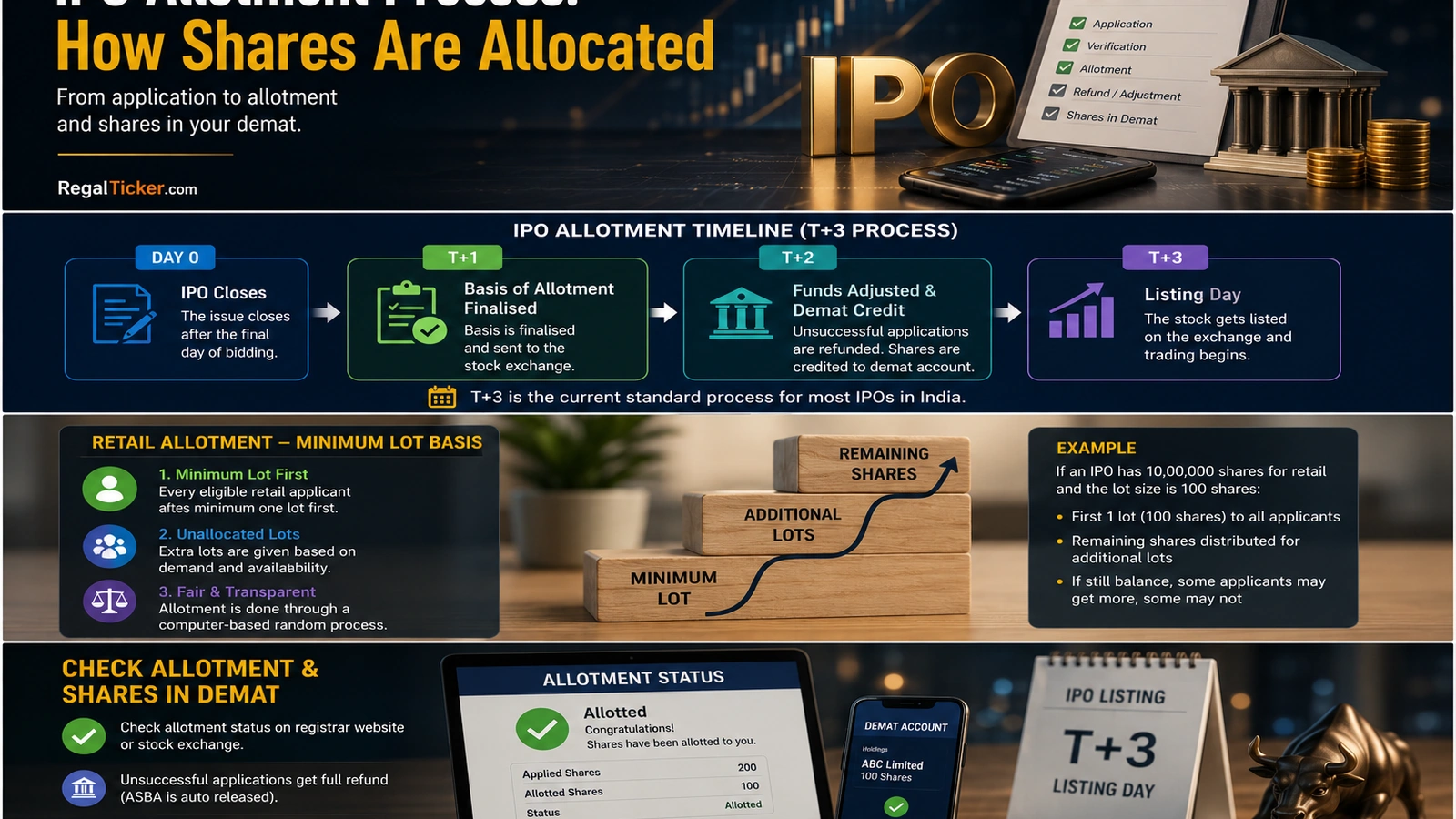
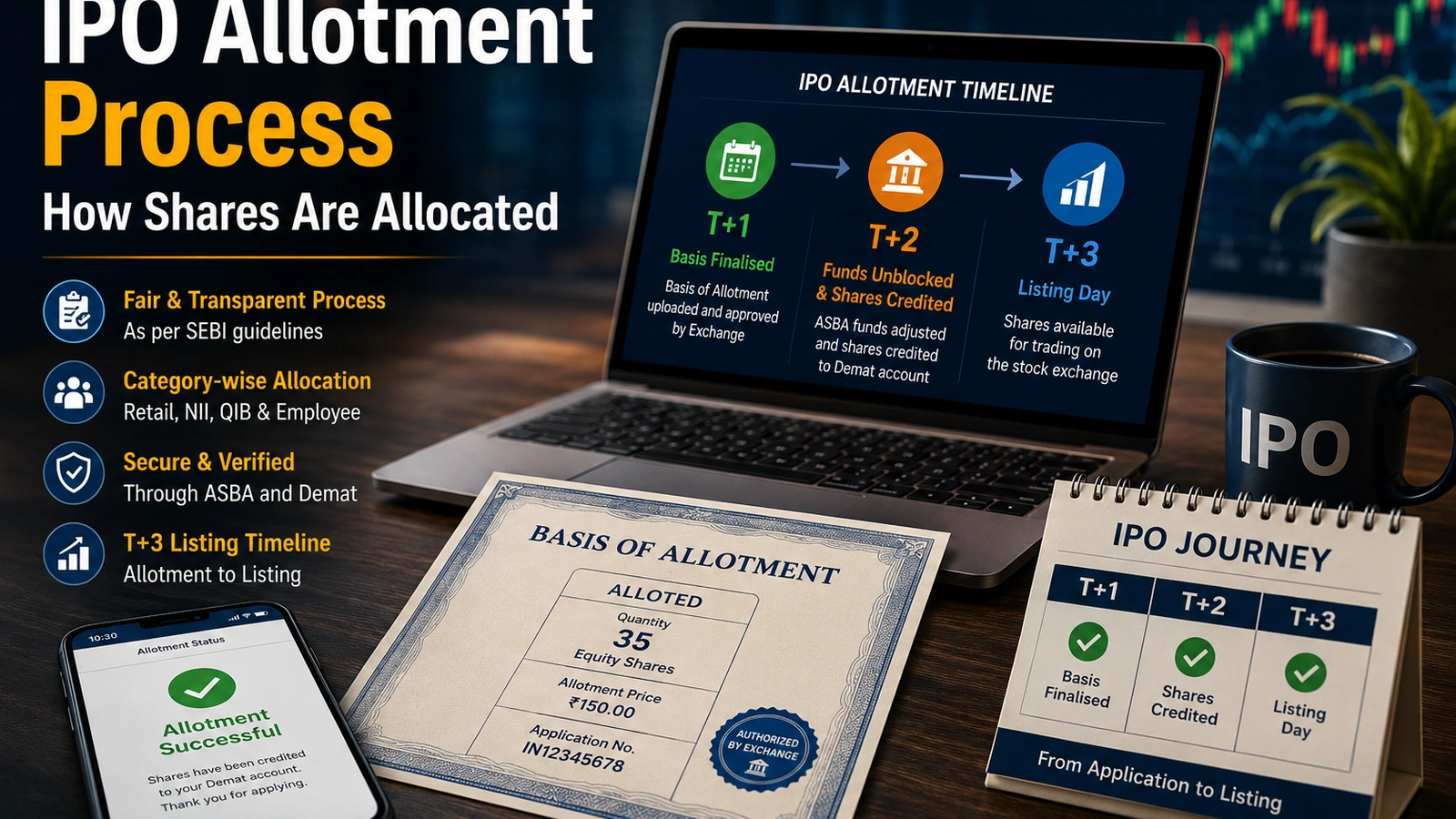
IPO Allotment Timeline Under T+3
SEBI shortened the equity public-issue listing timeline to T+3 working days.
The framework became mandatory for public issues opening on or after December 1, 2023.
Here, T means the issue-closing day.
Issue Closing Day: T
By the close of the issue:
- final bids are received;
- UPI mandates must be accepted within the applicable deadline;
- funds are blocked;
- exchange bid data is compiled;
- banks and sponsor banks submit blocking confirmations.
T+1: Validation and Basis of Allotment
The registrar:
- reconciles exchange and bank data;
- completes technical rejection tests;
- determines valid applications;
- calculates category-wise demand;
- finalises the basis of allotment.
Under the T+3 process, the registrar submits the basis to the designated exchange by the prescribed T+1 deadline, and the exchange approves it later on T+1.
T+2: Funds and Demat Credit
After approval:
- debit instructions are sent for allotted shares;
- unused ASBA funds are unblocked;
- the issuer completes allotment;
- depositories process the corporate action;
- shares are credited to successful applicants;
- listing formalities are completed.
T+3: Listing and Trading
The shares are admitted to trading on the recognised stock exchange.
The first market price can be:
- above the issue price;
- near the issue price;
- below the issue price.
The T+3 timeline describes process speed, not investment quality.
How Applications Become Valid or Rejected
The registrar does not allot shares from every submitted bid.
It first removes invalid or technically defective applications.
Common Technical Rejection Reasons
Applications can be rejected because of:
- PAN mismatch;
- invalid PAN;
- demat-account mismatch;
- incorrect depository details;
- duplicate applications;
- bid below the final issue price;
- incorrect investor category;
- non-multiple quantity;
- insufficient blocked amount;
- failed UPI mandate;
- third-party bank account or UPI details where not permitted;
- incomplete application information;
- ineligible employee or shareholder reservation claim;
- application submitted after the deadline;
- multiple bids that violate the offer rules.
UPI Submission Is Not Enough
A broker app can show that the application was submitted.
The bid may still fail if:
- the UPI mandate is not received;
- the investor does not approve it;
- the approval is late;
- the bank does not block the amount;
- the UPI ID does not match the applicant’s permitted payment setup.
Duplicate PAN Applications
Multiple applications under the same PAN can be treated as duplicate applications where the issue rules do not permit them.
Eligible applications in separate reservation categories may have specific exceptions.
The RHP controls the treatment.
Price-Related Rejection
A retail investor selecting cut-off agrees to the final issue price.
A bid entered at a fixed price below the final issue price can become ineligible.
Category-Related Rejection
An application above ₹2 lakh should not be submitted in the retail category.
The full application amount is calculated using:
Lots × Shares per lot × Bid price
Read IPO Price Band, Lot Size and Issue Size Explained.
How Retail IPO Allotment Works
Retail allotment causes the most confusion because the final result depends on both shares and applicants.
Retail Category Availability
A main-board IPO can provide a specified percentage of the net offer to Retail Individual Bidders.
The exact allocation depends on the issuer’s regulatory route and the RHP.
When Retail Is Not Oversubscribed
Suppose:
- retail shares available: 20 lakh;
- valid retail demand: 15 lakh shares.
The category is subscribed 0.75 times.
Valid retail applicants can generally receive the quantity requested, subject to:
- issue terms;
- final price;
- lot structure;
- valid fund block.
Unused retail shares may be reallocated under the rules stated in the offer document.
When Retail Demand Exceeds Available Shares
SEBI’s retail-allotment framework aims to provide at least the minimum bid lot to the maximum number of valid retail applicants, subject to available shares.
Two situations can occur.
Situation 1: Enough Minimum Lots for Every Valid Applicant
Suppose:
- retail shares available: 30 lakh;
- lot size: 30 shares;
- valid retail applicants: 80,000.
Maximum minimum-lot allottees:
30,00,000 ÷ 30 = 1,00,000
There are enough minimum lots for all 80,000 applicants.
Every valid applicant can receive at least one lot.
The remaining retail shares are distributed according to the applicable proportionate process.
Situation 2: More Applicants Than Available Minimum Lots
Suppose:
- retail shares available: 30 lakh;
- lot size: 30 shares;
- valid retail applicants: 5,00,000.
Maximum minimum-lot allottees:
30,00,000 ÷ 30 = 1,00,000
Only one lakh applicants can receive one lot.
The successful applicants are selected through a draw of lots or computerised selection approved in consultation with the designated stock exchange.
Approximate Retail Success Ratio
A simplified estimate is:
Maximum minimum-lot allottees ÷ Valid retail applicants
Using the example:
1,00,000 ÷ 5,00,000 = 20%
This does not guarantee that a particular PAN has a 20% result because:
- valid-application counts can change;
- reservation and spillover can affect shares;
- the official basis controls the final outcome.
Does Applying for More Retail Lots Help?
In a very heavily oversubscribed retail issue where available shares can provide only one minimum lot to a limited number of applicants, applying for several lots may not improve the chance of receiving one lot.
The selection is based on valid applicants, not simply on dividing the requested lots by the subscription multiple.
When enough shares exist to give every applicant one lot, additional requested lots can matter in the proportionate distribution of remaining shares.
Retail Allotment Is Not Always “One Lot or Nothing”
The phrase is useful for heavily oversubscribed issues but is not a universal rule.
Retail applicants can receive:
- full requested quantity;
- one minimum lot;
- one lot plus additional shares;
- no shares.
The outcome depends on the official basis.

How NII, QIB and Reserved-Category Allotment Works
Different categories use different allocation methods.
Small NII
Small NII commonly refers to applications:
Above ₹2 lakh and up to ₹10 lakh
The available subcategory shares are allocated on a proportionate basis, subject to valid bids and lot rounding.
Large NII
Large NII commonly refers to applications:
Above ₹10 lakh
This subcategory also uses proportionate allocation.
NII Example
Suppose a small-NII subcategory has:
- shares available: 10 lakh;
- valid shares bid: 50 lakh.
Subscription:
50 lakh ÷ 10 lakh = 5 times
A simplified entitlement for an applicant requesting 5,000 shares is:
5,000 ÷ 5 = 1,000 shares
The final number is adjusted according to:
- lot size;
- category table;
- rounding;
- spillover;
- approved basis.
NII Under-Subscription and Spillover
Current offer structures commonly state that under-subscription in one NII subcategory can be allocated to the other NII subcategory.
The exact treatment is given in the RHP.
QIB Allocation
The net QIB portion is generally allocated on a proportionate basis to valid QIB bidders at or above the offer price.
A specified mutual-fund portion can apply.
Anchor Investors
Anchor investors receive an allocation before the public issue opens.
They are eligible QIBs and are not part of the normal retail or NII allotment process.
Employee Reservation
Employee allotment follows the employee-reservation terms.
It can be:
- full allotment when undersubscribed;
- proportionate allotment when oversubscribed;
- subject to a per-applicant cap;
- adjusted for an employee discount.
Shareholder and Policyholder Reservations
These follow issue-specific eligibility and allocation rules.
Applicants must satisfy the record-date and PAN requirements stated in the offer document.

What Is the Basis of Allotment Document?
The basis of allotment is the official category-wise allocation table published after the issue.
It explains how valid applications were converted into share allotments.
What the Document Usually Shows
A basis-of-allotment announcement can include:
- issue price;
- issue size;
- issue dates;
- listing date;
- category subscription;
- applications received;
- applications rejected;
- shares applied for;
- shares allotted;
- ratio of successful applicants;
- category-wise allotment tables;
- anchor allocation;
- fund and demat-credit information;
- registrar contact details.
Retail Basis Table
A retail table can show:
- lots or shares applied for;
- number of applications;
- total shares requested;
- number of shares allotted per successful applicant;
- ratio of allottees to applicants;
- total shares allotted.
Understanding the Ratio
A table can show a ratio such as:
1:5
This can mean one successful applicant is selected for every five valid applicants in that application category.
The exact column heading must be read.
Do not assume every ratio means shares allotted divided by shares applied.
Additional Share Rounding
The basis can include:
- one minimum lot to successful applicants;
- additional shares distributed among a subset;
- small adjustments caused by rounding;
- spillover from another category.
Recent Real-World Example
A recent 2026 main-board basis-of-allotment announcement reported a retail category subscribed more than 20 times and disclosed the number of successful retail applicants and category-wise ratios.
This illustrates why the final basis document is more useful than the headline subscription multiple alone.
Worked IPO Allotment Examples
Example 1: Retail Draw of Lots
- retail shares: 12 lakh;
- lot size: 40;
- valid applicants: 1,20,000.
Maximum minimum-lot allottees:
12,00,000 ÷ 40 = 30,000
Simplified success ratio:
30,000 ÷ 1,20,000 = 25%
Approximately one in four valid applicants can receive one lot, subject to the official basis.
Example 2: Retail Applicants All Receive One Lot
- retail shares: 24 lakh;
- lot size: 40;
- valid applicants: 50,000.
Minimum-lot requirement:
50,000 × 40 = 20 lakh shares
Every valid applicant can receive one lot.
Remaining shares:
24 lakh − 20 lakh = 4 lakh
These are distributed according to the applicable proportionate method.
Example 3: Small NII Proportionate Allocation
- small-NII shares: 8 lakh;
- valid demand: 32 lakh;
- subscription: 4 times;
- applicant request: 8,000 shares.
Simplified entitlement:
8,000 ÷ 4 = 2,000 shares
The approved allotment can differ after lot rounding and category adjustments.
Example 4: Partial Retail Allotment
An investor applies for 10 lots of 50 shares.
Requested:
500 shares
The category is oversubscribed, but enough shares exist to give all valid applicants one lot and distribute part of the balance.
The investor may receive:
- one lot;
- more than one lot;
- no allotment only if the application is invalid or the selection rules produce no allocation.
The subscription multiple alone cannot determine the exact result.
Example 5: Final Debit
- cap-price amount blocked: ₹14,850;
- final issue price: ₹290;
- allotted shares: 50.
Required amount:
₹290 × 50 = ₹14,500
Amount released:
₹14,850 − ₹14,500 = ₹350
How to Check IPO Allotment Status
Use official sources only.
Registrar Website
The registrar commonly allows a search using:
- PAN;
- application number;
- demat or DP/client details.
Stock Exchange
NSE and BSE can provide issue and allotment information.
Demat Account
After the corporate action is completed, successful applicants should see the shares in the demat account.
Bank Account
Check:
- actual debit for allotted shares;
- release of excess blocked amount;
- complete unblocking when no shares are allotted.
Broker Application
A broker app can provide a convenient status display.
The official registrar, exchange, bank and demat records remain more authoritative.
Allotment Status Messages
Common results include:
- allotted;
- partially allotted;
- not allotted;
- application not found;
- mandate or payment failure;
- application rejected.
“Application not found” can result from entering incorrect data or checking before the registrar updates the system.
Allotment, Demat Credit and Listing-Day Decisions
Receiving shares does not complete the investment analysis.
Confirm the Final Issue Price
The debit amount is based on the final issue price, not necessarily the cap price.
Confirm the Quantity
Compare the demat credit with the registrar’s allotment result.
Estimate the Listing Return
Use the Stock Return Calculator to compare:
- final issue price;
- listing or sale price;
- quantity.
Include Trading Costs
Use the Brokerage Calculator before treating the gross listing difference as net profit.
Consider Tax
Use the Capital Gains Tax Calculator for a simplified estimate after a sale.
Do Not Treat Allotment as a Recommendation
An allotment means the application received shares.
It does not prove:
- fair valuation;
- listing gains;
- low risk;
- long-term quality.
Review:
- the RHP;
- business;
- cash flow;
- valuation;
- use of funds;
- promoter ownership;
- market conditions.
Common IPO Allotment Myths
“Subscription Multiple Tells Me My Exact Allotment”
False.
The basis depends on category, applicants, lots and allocation rules.
“Applying for More Retail Lots Always Improves My Chance”
Not in every heavily oversubscribed retail issue.
When only one minimum lot can be allotted to selected applicants, the applicant count matters more than the number of lots requested.
“Retail Allotment Is Always Proportionate”
Retail allotment uses a minimum-lot framework and can require a draw among valid applicants.
“HNI and QIB Allotment Works Like Retail”
False.
NII and QIB categories are generally proportionate.
“UPI Mandate Approved Means Shares Are Guaranteed”
The mandate only confirms the fund block.
The application still must be valid and receive allotment.
“Money Debited Means the Stock Has Listed”
Debit and demat credit occur before listing under the T+3 process.
“No Allotment Means the Application Was Rejected”
Not necessarily.
A valid application can receive no shares because of oversubscription.
“Allotment Means Guaranteed Listing Gain”
False.
The market determines the listing price.
IPO Allotment Checklist
Before applying:
- confirm PAN;
- confirm demat details;
- choose the correct category;
- calculate the full application amount;
- use the correct lot multiple;
- keep sufficient funds;
- approve the UPI mandate;
- avoid duplicate applications;
- verify reservation eligibility;
- read the RHP.
After issue closure:
- check official subscription data;
- wait for the basis of allotment;
- check registrar status;
- verify bank debit or unblocking;
- check demat credit;
- confirm listing date;
- decide whether the plan is listing-day or long-term;
- calculate costs and tax;
- ignore guaranteed-return claims.
Frequently Asked Questions
What is the IPO allotment process?
It is the validation and category-wise distribution of IPO shares among successful valid applicants after the issue closes.
Who decides IPO allotment?
The registrar prepares the basis of allotment in consultation with the designated stock exchange, which approves it.
When is IPO allotment finalised?
Under the current T+3 process, the basis is finalised and approved on T+1 after issue closure.
When are IPO shares credited?
The corporate action and share credit are completed before listing, generally on T+2 under the current framework.
When does the IPO list?
Equity public issues currently list on T+3 working days after issue closure.
How is retail IPO allotment done?
If there are enough shares, each valid retail applicant can receive at least one minimum lot. If there are more applicants than available minimum lots, successful applicants are selected through an approved draw.
Is retail allotment proportionate?
It can include a proportionate component after minimum-lot allocation, but heavily oversubscribed retail issues can use a draw to select minimum-lot allottees.
Does applying for more retail lots improve allotment chances?
Not always. In a heavily oversubscribed minimum-lot draw, additional lots may not improve the chance of receiving one lot.
How is NII allotment done?
Small-NII and large-NII shares are generally allocated proportionately within their subcategories.
How is QIB allotment done?
The net QIB portion is generally allocated on a proportionate basis under the offer structure.
What is the basis of allotment?
It is the official document showing category-wise valid demand, successful applicants, allotment ratios and shares distributed.
Why was my application rejected?
Possible reasons include PAN or demat mismatch, duplicate application, failed mandate, insufficient funds, invalid quantity, wrong category or bid below the issue price.
Why did I receive no shares even though my application was valid?
The category may have been oversubscribed and the application may not have been selected under the approved basis.
What happens to blocked money if I receive no shares?
The blocked amount is released.
What happens when I receive partial allotment?
The amount required for allotted shares is debited and the balance is unblocked.
Where can I check IPO allotment status?
Use the registrar’s official website, stock-exchange issue information, bank account and demat account.
Can allotment status appear late?
Yes. Registrar and platform updates can occur at different times.
Does an approved UPI mandate guarantee allotment?
No.
Does high subscription guarantee listing gains?
No.
Can an IPO list below the issue price?
Yes.
Final Takeaway
The IPO allotment process is not a simple division of shares by the overall subscription multiple.
It involves:
- validating applications;
- removing technical rejections;
- separating categories;
- calculating category demand;
- applying retail minimum-lot rules;
- allocating NII and QIB shares proportionately;
- obtaining exchange approval;
- debiting and unblocking funds;
- crediting shares;
- completing T+3 listing.
For retail investors, the most important figures are:
- retail shares available;
- minimum lot;
- valid retail applicants;
- maximum possible minimum-lot allottees;
- official basis-of-allotment ratio.
For NII investors, check:
- small or large NII subcategory;
- valid demand;
- proportionate entitlement;
- financing cost;
- lot rounding.
For every applicant:
- use official sources;
- verify bank and demat records;
- do not confuse a valid application with guaranteed allotment;
- do not confuse allotment with guaranteed profit.
Continue learning:
- What Is an IPO? Meaning, Process and Example
- How Does an IPO Work in India? Complete Process
- IPO Price Band, Lot Size and Issue Size Explained
- DRHP vs RHP: How to Read IPO Documents
- Fresh Issue vs Offer for Sale in an IPO
- Retail, HNI, QIB and Employee IPO Categories Explained
- How to Read IPO Subscription Data
- Stock Return Calculator
- Brokerage Calculator
- Capital Gains Tax Calculator
- Investor Tools Hub
Official References
- SEBI — Current Public-Issue Master Circular
- SEBI — T+3 Public-Issue Listing Framework
- NSE India — Frequently Asked Questions on IPOs
- NSE India — ASBA Procedure
- NSE India — e-IPO FAQs
- NSE Archive — Recent Basis of Allotment Example
Educational disclaimer: This article is for general investor education only. It is not investment advice, legal advice, tax advice, a research recommendation, an offer, a solicitation or a guarantee of allotment or returns. Public-issue rules, timelines, category definitions and operating procedures can change. Verify the current RHP, registrar information, exchange announcements, SEBI circulars, bank records and demat records for the specific IPO.