
⚡ Quick answer
A DRHP, or Draft Red Herring Prospectus, is the draft offer document filed during the earlier stage of a book-built IPO. It contains detailed information about the company, business, promoters, financial statements, risks and proposed offer, but several final details—such as the final issue price and sometimes exact offer quantities—may remain blank or be shown with placeholders. An RHP, or Red Herring Prospectus, is the updated offer document filed closer to the IPO opening after required observations, revisions and issue terms have been incorporated. The RHP normally contains the price band, lot size, issue dates and more current disclosures, although the final discovered issue price is still determined after bidding.
Investor note
Key Takeaways
The DRHP is the earlier draft offer document. The RHP is the updated offer document available before the IPO opens. Neither document guarantees that the company is safe, profitable or fairly valued. Blank brackets or placeholders in a DRHP show information that is not final. The RHP should be checked for changes from the DRHP. Risk factors should be connected to financial and business evidence. Read revenue together with profit, cash flow, debt and margins. Separate fresh-issue proceeds from offer-for-sale proceeds. Review promoter holding, selling shareholders and dilution. Compare IPO valuation with suitable listed peers. Read related-party transactions and contingent liabilities. Check litigation, regulatory dependence and customer concentration. The objects of the issue explain how fresh capital is proposed to be used. Subscription data and GMP cannot replace document analysis. The final prospectus records the final issue price after price discovery.
An IPO application can be completed in minutes.
Reading the offer document can take several hours.
That difference explains why many investors focus on:
subscription numbers; grey-market premiums; social-media opinions; expected listing gains;
while ignoring the primary documents that describe the business and the offer.
The DRHP and RHP are not designed as promotional brochures. They contain:
legal disclosures; financial information; business risks; promoter details; issue structure; objects of the issue; litigation; related-party transactions; valuation information; material contracts.
These documents can be long because an IPO transfers part of a private business into public ownership.
This lesson explains the difference between DRHP and RHP and provides a practical method for reading IPO documents without starting from page one and moving mechanically to the end.
Readers who need the basic IPO meaning should begin with What Is an IPO? Meaning, Process and Example.
For the complete regulatory and listing journey, read How Does an IPO Work in India? Complete Process.
DRHP vs RHP: Main Difference
The terms sound similar, but the timing and level of finalisation differ.
| Point | DRHP | RHP |
|---|---|---|
| Full form | Draft Red Herring Prospectus | Red Herring Prospectus |
| Stage | Earlier draft stage | Closer to issue opening |
| Filed during | Regulatory and exchange review process | After key observations and updates |
| Price band | Usually not final | Normally available separately or incorporated for the issue |
| Issue dates | May be unavailable | Normally available before bidding |
| Lot size | May be unavailable | Normally available before bidding |
| Offer size | Can contain placeholders | More finalised |
| Financial and risk disclosures | Detailed draft disclosures | Updated disclosures |
| Investor use | Early research | Final pre-application review |
| Final issue price | Not available | Not available until book building ends |
The RHP is not the final prospectus in the complete sequence.
After the bidding and price-discovery process, a final prospectus is filed with the final offer price and related details.
What Are DRHP and RHP?
What Is a DRHP?
DRHP stands for Draft Red Herring Prospectus.
It is the draft offer document prepared for a proposed book-built IPO.
What a DRHP Usually Contains
A DRHP can contain:
- company background;
- industry overview;
- business operations;
- strengths and strategies;
- risk factors;
- objects of the offer;
- capital structure;
- promoter and management details;
- restated financial statements;
- related-party transactions;
- outstanding litigation;
- material contracts;
- issue structure;
- selling-shareholder information;
- basis for the offer price;
- regulatory and statutory disclosures.
Why Are Some Fields Blank?
A DRHP can contain brackets or placeholders such as:
- `[●] equity shares`;
- `₹[●] million`;
- `[●] stock exchange`;
- `[●] offer price`.
These figures may depend on:
- final issue structure;
- pre-IPO placement;
- regulatory observations;
- price band;
- market conditions;
- shareholder decisions.
The presence of blanks does not make the document useless.
The business, financial, risk and governance sections can still support detailed analysis.
Does SEBI Approve the Company?
No.
Offer documents commonly state that the equity shares have not been recommended or approved by SEBI and that SEBI does not guarantee the accuracy or adequacy of the document.
The issuer, selling shareholders and intermediaries bear disclosure responsibilities according to the statements in the document.
Investors must conduct their own examination.
What Is an RHP?
RHP stands for Red Herring Prospectus.
It is filed closer to the opening of the book-built issue.
What Changes Before the RHP?
Between the DRHP and RHP, the issuer can:
- respond to regulatory observations;
- update financial statements;
- revise risk factors;
- update litigation;
- complete exchange approvals;
- change issue size;
- complete a pre-IPO placement;
- revise fresh issue or OFS quantities;
- identify the designated stock exchange;
- finalise issue dates;
- announce the price band and lot size;
- update promoter or shareholder information.
What Does the RHP Still Exclude?
The final issue price is not yet known because bidding has not ended.
The RHP can include the price band, but the final discovered price is fixed later.
RHP vs Final Prospectus
After bidding:
- the final price is determined;
- allotment is completed;
- the final prospectus includes the issue price and related final details.
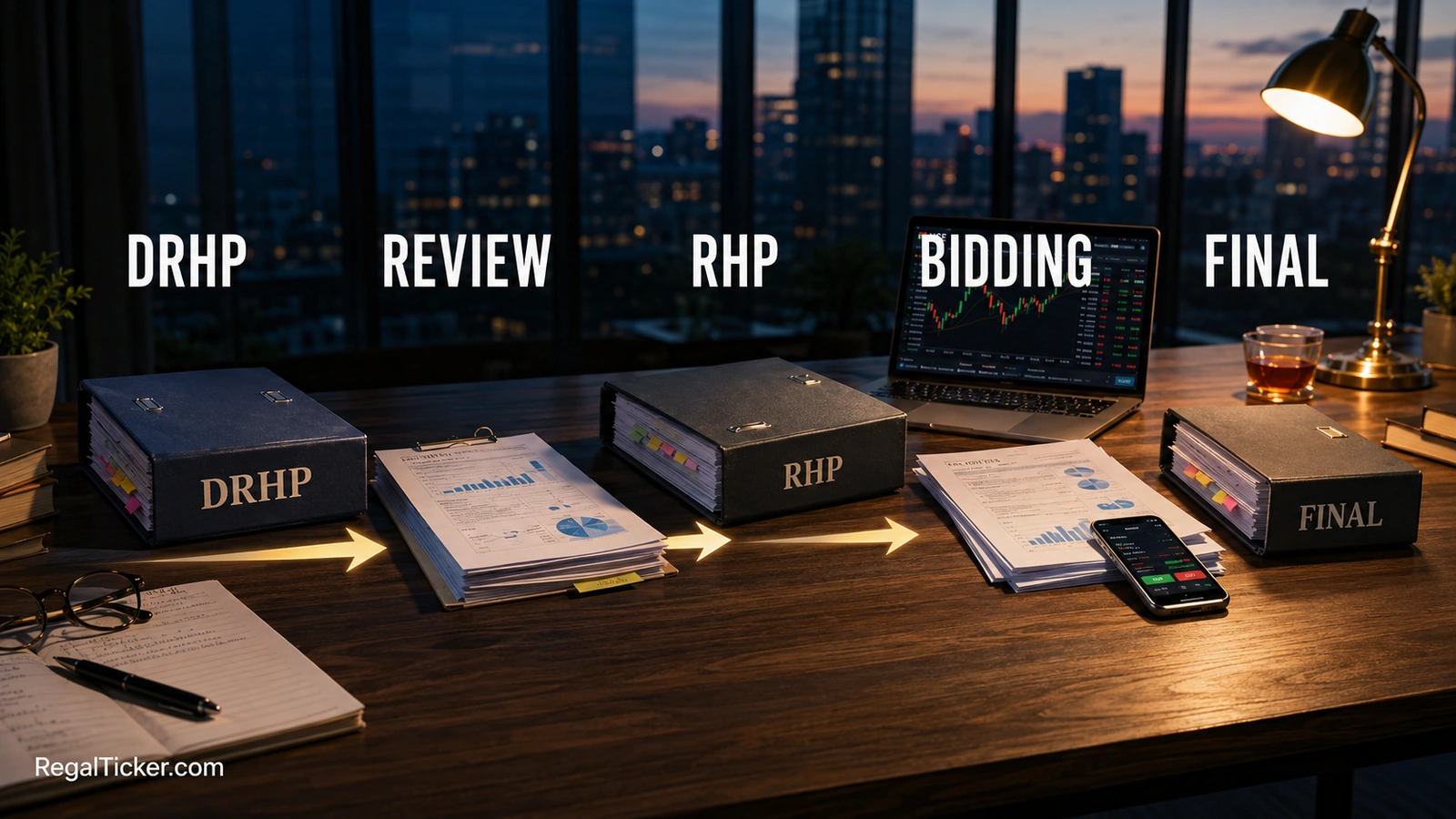
The broad sequence is:
DRHP → Regulatory review and updates → RHP → Bidding → Final price → Final prospectus → Listing
Where to Find Official IPO Documents
Use official or authorised sources.
SEBI Filings
SEBI publishes:
- draft offer documents;
- observations and issue-related filings;
- RHP documents filed with the Registrar of Companies;
- addenda and corrigenda.
Stock Exchange Filings
NSE and BSE provide offer-document pages containing:
- DRHP;
- RHP;
- abridged prospectus;
- issue advertisements;
- issue dates;
- listing information;
- final prospectus where available.
Company and BRLM Websites
The company and Book Running Lead Managers may publish the documents in their public-issue sections.
Avoid Unverified Copies
A downloaded document may become outdated if the issuer publishes:
- an addendum;
- corrigendum;
- revised financial information;
- revised price band;
- revised issue dates.
Always check the latest official version.
How to Read an IPO Document Efficiently
Do not start with every page in sequence.
Use a risk-first reading order.
Recommended Reading Order
- Cover page
- Offer structure
- Risk factors
- Objects of the issue
- Capital structure
- Business section
- Industry section
- Financial statements
- Management discussion
- Basis for offer price
- Promoters and selling shareholders
- Related-party transactions
- Litigation
- Material contracts
- Regulatory disclosures
This order answers the most important questions first:
- What is being offered?
- Where does the money go?
- What can go wrong?
- Is the business financially sound?
- Who is selling?
- What valuation is being requested?
Business, Offer and Risk Analysis
Step 1: Read the Cover Page
The cover page contains high-value information.
Check:
- issuer name;
- registered office;
- contact person;
- website;
- type of offer;
- face value;
- proposed listing exchanges;
- BRLMs;
- registrar;
- promoter status;
- fresh issue;
- offer for sale;
- issue eligibility;
- risk warning.
Absolute Responsibility Statement
Offer documents contain responsibility statements from:
- the company;
- selling shareholders;
- other parties where applicable.
Read which party accepts responsibility for which disclosures.
Listing Statement
The cover page states the proposed exchange and whether in-principle approvals have been received.
Exchange approval should not be treated as an investment recommendation.
Step 2: Understand the Offer Structure
Before analysing the business, understand what investors are buying.
Check:
- fresh issue value;
- OFS quantity;
- total offer size;
- employee reservation;
- shareholder reservation;
- retail allocation;
- NII allocation;
- QIB allocation;
- pre-IPO placement;
- promoter holding before and after.
Fresh Issue
Fresh-issue proceeds generally go to the company after expenses.
Offer for Sale
OFS proceeds go to selling shareholders.
Why the Mix Matters
Assume:
- total issue: ₹2,000 crore;
- fresh issue: ₹500 crore;
- OFS: ₹1,500 crore.
Only 25% represents fresh capital for the company.
The remaining 75% represents shareholder exits.
That is not automatically negative, but it changes the purpose of the IPO.
Read IPO Price Band, Lot Size and Issue Size Explained for the complete calculation framework.
Step 3: Read the Risk Factors First
Risk factors are among the most important sections.
They are often lengthy because the company describes material risks that can affect:
- revenue;
- profitability;
- licences;
- operations;
- ownership;
- valuation;
- share price;
- issue completion.
Group Risks into Categories
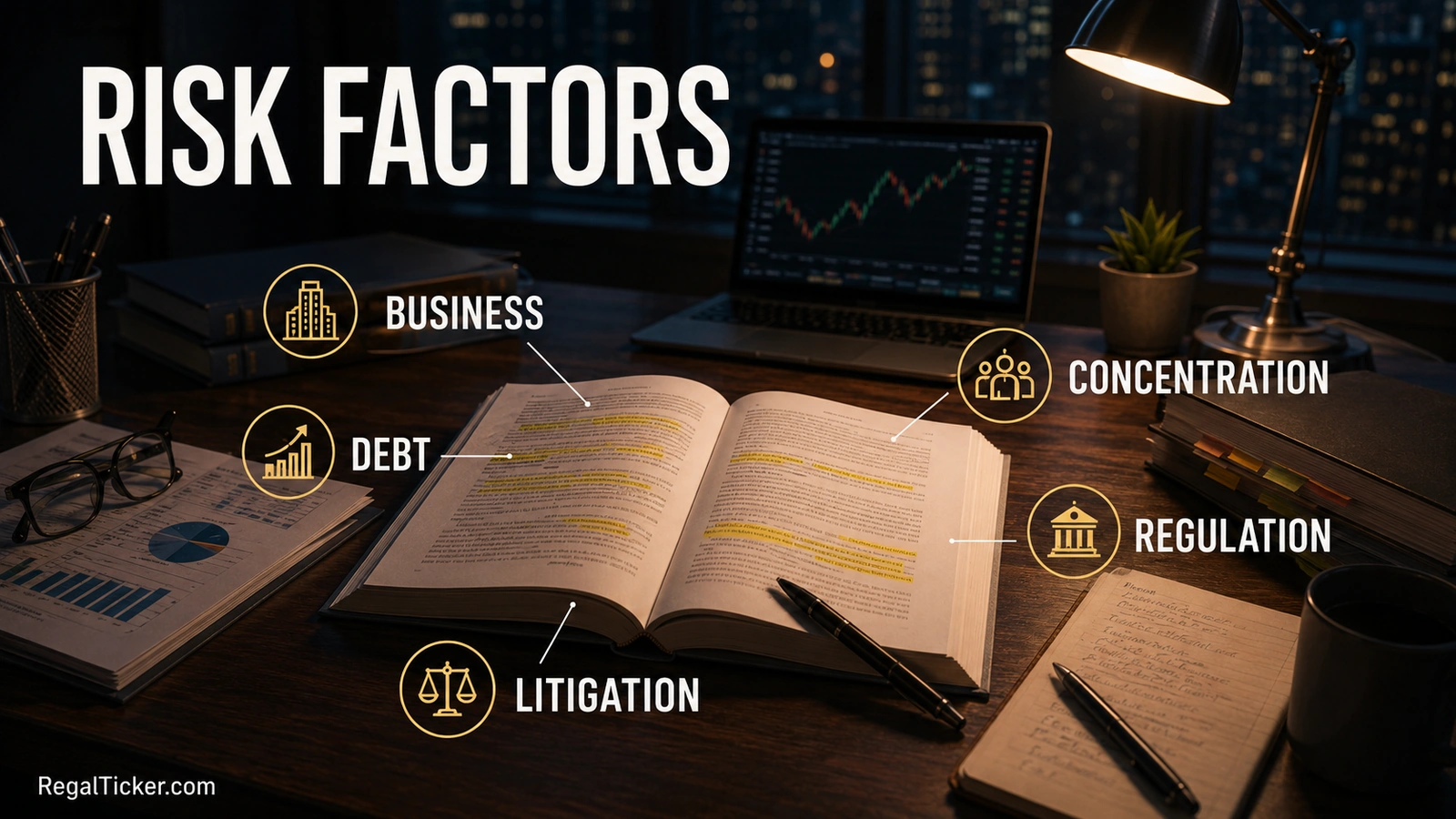
Create five categories:
- Business risks
- Financial risks
- Legal and regulatory risks
- Promoter and governance risks
- Offer and market risks
Business Risks
Examples:
- dependence on one product;
- customer concentration;
- supplier concentration;
- geographic concentration;
- seasonal demand;
- technology disruption;
- low entry barriers;
- dependence on key employees.
Financial Risks
Examples:
- declining margins;
- negative cash flow;
- high debt;
- working-capital pressure;
- contingent liabilities;
- foreign-exchange exposure;
- repeated exceptional income;
- accumulated losses.
Legal and Regulatory Risks
Examples:
- pending litigation;
- regulatory investigation;
- licence dependence;
- environmental approvals;
- tax disputes;
- industry restrictions.
Promoter and Governance Risks
Examples:
- related-party dependence;
- promoter conflicts;
- pledged shares;
- group-company competition;
- governance history;
- succession risk.
Offer and Market Risks
Examples:
- no previous public market;
- valuation uncertainty;
- low post-listing liquidity;
- selling-shareholder exits;
- dilution;
- volatile market conditions.
How to Test a Risk Factor
Do not merely count the number of risks.
Test each material risk against evidence.
Example: Customer Concentration
The risk section states that one customer contributes 32% of revenue.
Check:
- whether the percentage is increasing;
- contract duration;
- customer bargaining power;
- payment terms;
- replacement possibilities;
- impact if the customer leaves.
Example: Negative Cash Flow
The company reports profit but negative operating cash flow.
Check:
- receivables;
- inventory;
- supplier payments;
- working-capital cycle;
- one-time items;
- cash conversion.
Example: Litigation
Check:
- amount involved;
- nature of the dispute;
- stage of proceedings;
- possible operational effect;
- whether provisions exist;
- whether the matter involves promoters or directors.
The risk-factor section gives the warning.
Other sections provide the evidence.
Step 4: Read the Objects of the Issue
The objects section explains how fresh-issue proceeds are proposed to be used.
Common uses include:
- capital expenditure;
- working capital;
- debt repayment;
- acquisitions;
- subsidiary investment;
- technology;
- store expansion;
- general corporate purposes.
Questions to Ask
- Is the use specific?
- Is the amount clearly allocated?
- Is the project already approved?
- Has land or equipment been identified?
- Is debt repayment reducing financial risk?
- Is working capital structurally increasing?
- Is a large amount allocated to general corporate purposes?
- Is the company dependent on future approvals?
- How long will deployment take?
General Corporate Purposes
This is a permitted flexible category within applicable limits.
Investors should still examine:
- proportion of the issue;
- management’s capital-allocation history;
- clarity of expected use.
Monitoring of Proceeds
Larger issues can require monitoring arrangements.
Read how the company will report utilisation.
Step 5: Study the Capital Structure and Dilution
The capital-structure section shows how ownership changes.
Check:
- pre-issue shares;
- fresh shares;
- post-issue shares;
- promoter holding;
- investor holding;
- employee options;
- convertible securities;
- pre-IPO placements;
- weighted average acquisition cost.
Dilution Formula
Dilution percentage = New shares ÷ Post-issue shares × 100
Suppose:
- pre-issue shares: 18 crore;
- new shares: 2 crore;
- post-issue shares: 20 crore.
Dilution:
2 crore ÷ 20 crore × 100 = 10%
Promoter Holding
A decline in promoter percentage can result from:
- fresh-issue dilution;
- promoter OFS;
- both.
Check the absolute number of shares and percentage.
Step 6: Analyse the Business Model
The business section should answer:
- What does the company sell?
- Who pays the company?
- How does revenue repeat?
- What creates pricing power?
- What resources are required?
- What can competitors copy?
- What approvals are necessary?
- How scalable is the model?
Revenue Segmentation
Break revenue by:
- product;
- geography;
- customer type;
- channel;
- business segment.
A fast-growing segment may still have:
- lower margins;
- poor cash flow;
- high concentration;
- regulatory risk.
Competitive Strengths
Offer documents list strengths such as:
- brand;
- distribution;
- technology;
- customer relationships;
- cost advantage;
- management experience.
Test each claim.
A strength should appear in:
- margins;
- market share;
- customer retention;
- growth;
- return ratios;
- cash generation.
Step 7: Read the Industry Section Carefully
The industry section provides market context.
It may rely on:
- commissioned reports;
- government data;
- industry associations;
- public research.
Questions to Ask
- Who prepared the report?
- Did the issuer commission it?
- What period does the forecast cover?
- Are assumptions disclosed?
- Is the addressable market realistic?
- Does the company actually serve the full stated market?
- Are growth estimates nominal or real?
- How cyclical is the industry?
A large industry does not guarantee that the issuer will gain market share.
Financial, Governance and Valuation Analysis
Step 8: Analyse Financial Statements
Financial statements usually include restated information for multiple periods.
Do not focus only on revenue growth.
Revenue
Check:
- growth rate;
- segment mix;
- customer concentration;
- organic versus acquisition-led growth;
- one-time revenue.
Profit
Option A
- EBITDA;
- operating profit;
- profit before tax;
- profit after tax;
- exceptional items.
- Cash Flow
- A company can report profit while consuming cash.
- Check:
- cash flow from operations;
- capital expenditure;
- free cash flow;
- financing cash flow;
- working-capital movement.
- Debt
- Check:
- total borrowings;
- secured and unsecured debt;
- interest cost;
- maturity;
- debt repayment from IPO proceeds;
- debt-to-equity ratio.
- Margins
- Calculate:
- Operating margin = Operating profit ÷ Revenue × 100
- Net margin = Profit after tax ÷ Revenue × 100
- Compare multiple years.
- Return Ratios
- Review:
- return on equity;
- return on capital employed;
- return on net worth.
- High return ratios can be distorted by:
- low equity base;
- one-time profit;
- debt;
- asset-light accounting.
Option B

Step 9: Check Profit Quality
Profit quality asks whether reported earnings are supported by operations and cash.
Warning Signs
- profit rising while cash flow falls;
- receivables growing faster than sales;
- frequent exceptional gains;
- large capitalised expenses;
- dependence on subsidies;
- unexplained margin changes;
- related-party revenue;
- large write-backs.
Cash Conversion
A simplified comparison is:
Cash conversion = Operating cash flow ÷ Profit after tax
A ratio below 1 in one year is not automatically a problem.
Persistent weakness requires explanation.
Step 10: Review Related-Party Transactions
Related parties can include:
- promoters;
- directors;
- subsidiaries;
- group companies;
- entities controlled by management;
- relatives in specified cases.
Transactions may include:
- purchases;
- sales;
- loans;
- guarantees;
- rent;
- services;
- asset transfers.
Questions to Ask
- Are transactions material?
- Are they increasing?
- Are terms comparable with independent transactions?
- Does the company depend on a promoter-owned supplier?
- Are loans being extended to related entities?
- Is the IPO expected to reduce or increase dependence?
Related-party transactions are not automatically improper.
They require transparency and commercial justification.
Step 11: Read Litigation and Contingent Liabilities
Litigation can affect:
- cash;
- licences;
- reputation;
- operations;
- promoters;
- directors.
Check:
- civil cases;
- criminal proceedings;
- tax disputes;
- regulatory matters;
- labour cases;
- environmental cases;
- promoter litigation;
- group-company litigation.
Contingent Liabilities
A contingent liability is a potential obligation dependent on a future event.
Compare it with:
- net worth;
- annual profit;
- cash balance;
- issue size.
A ₹200 crore claim has different significance for a company earning ₹20 crore versus one earning ₹2,000 crore.
Step 12: Understand the Basis for Offer Price
This section explains the issuer’s valuation presentation.
It may include:
- earnings per share;
- price-to-earnings ratio;
- return on net worth;
- net asset value;
- industry peer comparison;
- qualitative factors.
Do Not Accept the Peer List Blindly
Check whether the peers have similar:
- business models;
- revenue mix;
- margins;
- size;
- debt;
- growth;
- geography;
- regulatory environment.
P/E Ratio
P/E ratio = Issue price ÷ Earnings per share
Suppose:
- issue price: ₹450;
- diluted EPS: ₹15.
P/E:
₹450 ÷ ₹15 = 30
Compare the multiple with:
- peer growth;
- margins;
- return ratios;
- balance-sheet quality;
- risks.
Step 13: Review Promoters and Selling Shareholders
Check:
- promoter experience;
- promoter holding before and after;
- shares sold in OFS;
- weighted average acquisition cost;
- past business conduct;
- group companies;
- criminal or regulatory disclosures;
- competing businesses;
- succession.
Selling Shareholder Analysis
Ask:
- Who is selling?
- What percentage is being sold?
- How much ownership remains?
- Is the seller a promoter or financial investor?
- Is the sale a partial exit or complete exit?
- Does the company receive any of these proceeds?
Weighted Average Cost of Acquisition
Offer documents can show how much selling shareholders paid for their shares.
A large difference from the IPO price is not automatically unfair.
Early investors accepted earlier business risk.
However, the information helps investors understand exit economics.
Compare the DRHP and RHP Before Applying
Step 14: Compare the DRHP and RHP
Do not assume the RHP is identical to the DRHP.
| DRHP item | RHP update |
|---|---|
| Proposed fresh issue | Finalised fresh issue |
| Proposed OFS | Updated OFS |
| Financials up to earlier period | Latest restated period |
| Draft risk factors | Revised risk factors |
| No price band | Price band announced |
| No issue dates | Opening and closing dates |
| Placeholders | Finalised details |
Step 15: Use the Abridged Prospectus Correctly
The abridged prospectus summarises key information.
It is useful for:
- quick review;
- issue terms;
- selected risks;
- financial highlights;
- application information.
It cannot replace the full document for serious analysis.
Use it as a navigation tool, then open the relevant full sections.
Worked IPO Document Example
Assume Nova Healthcare Limited files a DRHP.
This is a fictional example.
DRHP Information
- fresh issue: up to ₹700 crore;
- OFS: up to 2 crore shares;
- revenue: ₹1,500 crore;
- PAT: ₹90 crore;
- debt: ₹600 crore;
- customer concentration: top five customers contribute 48%;
- objects: debt repayment and new facilities.
RHP Updates
- fresh issue reduced to ₹600 crore;
- OFS reduced to 1.5 crore shares;
- price band: ₹420–₹445;
- lot size: 33 shares;
- new financial period added;
- litigation section updated;
- promoter holding after issue disclosed.
Investor Analysis
The investor should check:
- Why was the fresh issue reduced?
- Is less debt being repaid?
- Did the OFS seller reduce the exit?
- Did revenue and profit improve?
- Did operating cash flow improve?
- Is the top-customer concentration lower?
- What P/E does ₹445 imply?
- How does that compare with peers?
- What percentage of the fresh issue is used for growth?
- Has new litigation appeared?
The document update can change the investment conclusion.
Practical Checklists, Calculators and Common Mistakes
Red-Flag Checklist for IPO Documents
Review carefully when the document shows:
- repeated negative operating cash flow;
- rapidly rising receivables;
- customer or supplier concentration;
- high promoter OFS;
- large related-party dependence;
- unresolved material litigation;
- sudden profit increase before the IPO;
- aggressive valuation;
- large general-corporate-purpose allocation;
- unclear use of funds;
- large contingent liabilities;
- frequent auditor qualifications;
- promoter-group competition;
- major regulatory dependence;
- high debt despite a growth narrative;
- declining promoter holding;
- complicated group structure;
- one-time gains supporting profit;
- weak return ratios;
- inconsistent data across sections.
One red flag does not always reject an IPO.
Several connected red flags can indicate structural risk.
IPO Document Reading Checklist
Cover and Offer
- Issuer identity verified
- Proposed exchanges checked
- Fresh issue identified
- OFS identified
- Selling shareholders identified
- Total issue structure understood
Business and Risks
- Revenue model understood
- Customer concentration checked
- Supplier concentration checked
- Regulatory dependence checked
- Key risk factors tested
Financials
- Revenue trend checked
- Profit trend checked
- Operating cash flow checked
- Debt checked
- Margins checked
- Return ratios checked
- Contingent liabilities checked
Governance
- Promoter background reviewed
- Related-party transactions reviewed
- Litigation reviewed
- Group-company dependence reviewed
- Auditor information checked
Valuation
- EPS verified
- P/E calculated
- Peer list tested
- Issue price compared with business quality
- Dilution calculated
- Post-issue market capitalisation estimated
Final RHP Review
- Price band checked
- Lot size checked
- Issue dates checked
- DRHP changes identified
- Addenda checked
- Latest financial information reviewed

Using RegalTicker Calculators After Reading the RHP
The offer document provides raw information.
Calculators help convert it into comparable figures.
Stock Return Calculator
Use the Stock Return Calculator after listing to compare the issue price and actual market or sale price.
CAGR Calculator
Use the CAGR Calculator when evaluating multi-year revenue, profit or investment growth.
Brokerage Calculator
Use the Brokerage Calculator before estimating a net listing-day return.
Capital Gains Tax Calculator
Use the Capital Gains Tax Calculator for a simplified estimate of possible tax consequences after a sale.
Complete Tools Hub
Access all calculators through the RegalTicker Investor Tools Hub.
Common Mistakes While Reading DRHP and RHP
Reading Only the First Page
The cover gives the structure, not the complete risk.
Reading Only the Risk-Factor Titles
The detail explains probability, exposure and possible impact.
Ignoring Footnotes
Financial footnotes can explain:
- unusual transactions;
- accounting changes;
- related parties;
- contingent liabilities;
- segment details.
Treating Revenue Growth as Proof of Quality
Revenue without cash, margin or return analysis can mislead.
Ignoring the Difference Between Fresh Issue and OFS
Only the fresh component generally provides new capital to the company.
Using an Irrelevant Peer Group
A company can appear cheap when compared with stronger or structurally different businesses.
Ignoring the Latest RHP
Old DRHP figures may not reflect the final offer.
Ignoring Addenda
Material updates can appear after the main RHP.
Assuming Disclosure Removes Risk
Disclosure informs investors.
It does not remove the underlying risk.
Frequently Asked Questions
What is the full form of DRHP?
DRHP means Draft Red Herring Prospectus.
What is the full form of RHP?
RHP means Red Herring Prospectus.
What is the main difference between DRHP and RHP?
The DRHP is an earlier draft document, while the RHP is the updated document filed closer to the IPO opening after key observations and issue details are incorporated.
Does a DRHP contain the IPO price?
The final issue price is not available. The price band may also remain unavailable at the DRHP stage.
Does an RHP contain the final issue price?
No. It can contain the price band, but the final issue price is determined after bidding.
What comes after the RHP?
The bidding process, price discovery, allotment and final prospectus follow.
Where can I download a DRHP?
Use SEBI, NSE, BSE, the issuer or the BRLM’s official public-issue pages.
Is the RHP more important than the DRHP?
Both are useful. The DRHP supports early research, while the RHP provides the updated pre-issue information needed before applying.
Does SEBI approve the IPO company?
SEBI regulates the disclosure and issue process. It does not guarantee investment quality or returns.
Which section should I read first?
Start with the offer structure, risk factors, objects of the issue and financial statements.
What are the objects of the issue?
They explain how fresh-issue proceeds are proposed to be used.
Why are risk factors so long?
They describe material uncertainties related to the company, industry, promoters, regulation, offer and market.
What should I check in financial statements?
Review revenue, profit, operating cash flow, debt, margins, return ratios, working capital and contingent liabilities.
Why should I compare DRHP and RHP?
The issue size, OFS, financials, risks, litigation and other material information can change.
Is an abridged prospectus enough?
It is useful for a summary but should not replace the full RHP for detailed analysis.
What is a corrigendum?
It is an official correction or update to a previously published document.
What is an addendum?
It adds or updates material information after the original document.
How do I identify an expensive IPO?
Calculate valuation ratios, compare suitable peers and test whether growth, margins, return ratios and risk justify the premium.
Is a large OFS a negative sign?
Not automatically. Examine who is selling, why they are selling and how much ownership remains.
What is the most important IPO document section?
There is no single section, but risk factors, financial statements, objects of issue and valuation together provide the strongest foundation.
Final Takeaway
The DRHP and RHP are the most important public sources for analysing an IPO before application.
Use the DRHP to understand:
- the business;
- proposed issue;
- risk factors;
- promoters;
- financial history;
- proposed use of funds.
Use the RHP to confirm:
- updated disclosures;
- finalised issue structure;
- price band;
- lot size;
- issue dates;
- recent financial and legal developments.
Do not treat the documents as a compliance formality.
Use them to answer:
- How does the company make money?
- What can damage the business?
- Is profit supported by cash flow?
- How much debt exists?
- Where will fresh capital go?
- Who is selling shares?
- How much dilution occurs?
- What valuation is being requested?
- What changed between DRHP and RHP?
- Is the risk suitable for the investor?
Continue with:
- What Is an IPO? Meaning, Process and Example
- How Does an IPO Work in India? Complete Process
- IPO Price Band, Lot Size and Issue Size Explained
- Stock Return Calculator
- CAGR Calculator
- Brokerage Calculator
- Capital Gains Tax Calculator
- Investor Tools Hub
Official References
- SEBI — Public-Issue Offer Documents
- SEBI Investor — Primary Markets Reference Material
- SEBI Investor — Book-Building Process
- NSE India — Corporate Filings and Offer Documents
- NSE India — Public Offer Documents
Educational disclaimer: This article is for general investor education only. It is not investment advice, legal advice, tax advice, a research recommendation, an offer, a solicitation or a guarantee of allotment or returns. Offer documents, regulations, financial information and issue terms can change. Verify the latest DRHP, RHP, addenda, corrigenda and exchange filings from official sources before applying.