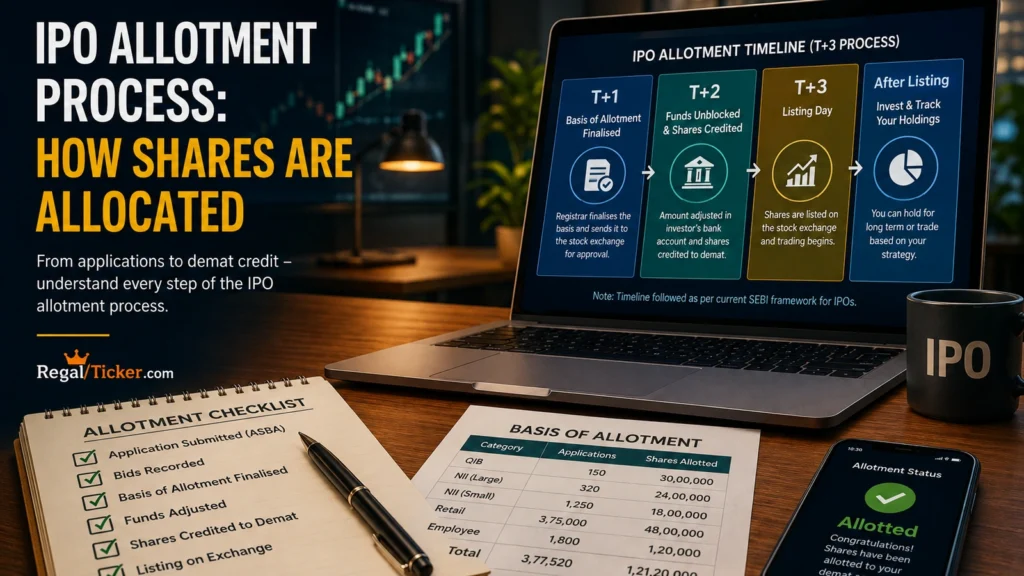


⚡ Quick answer
The IPO process in India begins when an eligible private company decides to raise capital or provide an exit opportunity to existing shareholders by offering shares to the public. It appoints merchant bankers and other intermediaries, completes due diligence, prepares a Draft Red Herring Prospectus, responds to regulatory observations, files the Red Herring Prospectus, announces the price band and opens the issue for bidding. Investors apply through ASBA, including eligible UPI-based applications. After the issue closes, demand is evaluated, the final issue price and basis of allotment are determined, shares are credited to successful applicants and the company’s shares are listed for trading on a recognised stock exchange.
Investor note
IPO Process at a Glance
Company decides why it wants to go public. Merchant bankers, lawyers, auditors and registrars are appointed. Financial, legal and business due diligence is completed. A DRHP containing detailed disclosures is filed. Regulatory and exchange observations are addressed. The RHP, issue dates, lot size and price band are published. Investors submit bids through ASBA. Demand is collected through book building. The final issue price and basis of allotment are determined. Shares are credited and blocked funds are adjusted or released. The shares list and begin trading on the exchange.
An IPO is often described as a company “going public,” but the public issue itself is only one part of a much longer process.
Before investors see an application button in a broker app, the issuer may have spent months preparing financial statements, reorganising governance, completing legal due diligence, appointing intermediaries and drafting extensive disclosures.
After the bidding period closes, the work continues. The issuer, merchant bankers, registrar and stock exchanges must complete price discovery, validate applications, finalise the basis of allotment, credit shares and complete listing formalities.
This article explains the complete IPO process in India from the company’s first decision to the first day of exchange trading.
Readers who need the basic meaning first should begin with What Is an IPO? Meaning, Process and Example.
Complete IPO Process in India: Overview
The exact structure can vary according to the type and size of the issue, the exchange platform and the applicable regulations. A typical book-built main-board IPO follows this broad sequence:
| Stage | Main activity | Main participants |
|---|---|---|
| 1 | Company decides to launch an IPO | Board, promoters, management |
| 2 | Intermediaries are appointed | BRLMs, lawyers, auditors, registrar |
| 3 | Due diligence and restructuring | Company and advisers |
| 4 | DRHP is prepared and filed | Issuer, BRLMs, SEBI, exchanges |
| 5 | Observations and updates | SEBI, exchanges, issuer |
| 6 | RHP and issue terms are finalised | Issuer and BRLMs |
| 7 | Price band and issue dates are announced | Issuer and exchanges |
| 8 | Anchor allocation may occur | Eligible institutional investors |
| 9 | Public bidding opens | QIBs, NIIs and retail applicants |
| 10 | Issue closes and demand is evaluated | BRLMs, exchanges, registrar |
| 11 | Final issue price is determined | Issuer and BRLMs |
| 12 | Basis of allotment is finalised | Registrar and designated exchange |
| 13 | Shares are credited and funds adjusted | Depositories, banks, registrar |
| 14 | Shares are listed | Issuer, NSE or BSE |
SEBI’s investor education material explains that book building collects investor demand within a price band and uses that demand for price discovery. It also states that listing must take place within the prescribed shortened timeline after the issue closes.
Before the IPO Opens: Company Preparation
An IPO should begin with a business objective, not merely with a desire for publicity.
Why a Company May Launch an IPO
The company may want to:
- finance expansion;
- build manufacturing capacity;
- repay or reduce debt;
- invest in technology;
- acquire another business;
- improve brand visibility;
- create liquidity for existing shareholders;
- provide an exit to early investors;
- establish a market value for its shares;
- create a platform for future fundraising.
Fresh Issue and Offer for Sale
An IPO can contain:
- Fresh issue
New shares are issued by the company. The money, after issue-related expenses, generally goes to the company for the stated objects of the issue.
- Offer for sale
Existing shareholders sell some of their shares. The sale proceeds go to those selling shareholders rather than to the company.
An issue can contain either component or a combination of both.
Corporate Approvals and Governance Preparation
The company completes the necessary corporate approvals and prepares for public-company obligations.
This may require changes to:
- capital structure;
- articles and internal policies;
- board composition;
- governance committees;
- reporting systems;
- related-party processes;
- employee-share arrangements;
- promoter and group-company disclosures.
The decision to launch an IPO does not guarantee that the company will complete the issue. Market conditions, regulatory observations, business developments or valuation expectations can change the plan.
Intermediaries, Due Diligence and DRHP Filing
An IPO is managed by several specialised organisations.
Book Running Lead Managers
Book Running Lead Managers, commonly called BRLMs, coordinate the issue.
Their work can include:
- advising on issue structure;
- coordinating due diligence;
- helping prepare the offer documents;
- interacting with regulators and exchanges;
- developing the marketing strategy;
- managing the book-building process;
- coordinating allotment and listing.
A large issue may appoint several BRLMs.
Legal Advisers and Auditors
Law firms review corporate records, contracts, litigation, regulatory permissions, intellectual property, promoter structures and disclosure obligations.
Auditors and reporting accountants help prepare or review restated financial information, accounting policies, financial ratios, contingent liabilities and issue-related certificates.
Registrar to the Issue
The registrar processes application data, identifies technical rejections, coordinates with banks and exchanges, calculates category-wise demand, prepares the basis of allotment and arranges share credit.
Due Diligence
The advisers study:
- revenue model;
- customer and supplier dependence;
- industry structure;
- competitive position;
- operating licences;
- financial performance;
- borrowings and working capital;
- related-party transactions;
- material contracts;
- legal proceedings;
- promoter and management history;
- objects of the issue.
What Is a DRHP?
A Draft Red Herring Prospectus is the draft offer document used in a book-built issue.
It normally contains detailed disclosures about:
- the company;
- business operations;
- industry;
- promoters and management;
- financial statements;
- risk factors;
- objects of the issue;
- capital structure;
- litigation;
- related-party transactions;
- issue structure.
The final issue price is not included because price discovery has not yet been completed.

SEBI Review, RHP and IPO Terms
The issuer submits the draft document through its merchant bankers.
SEBI and Exchange Review
SEBI reviews disclosures and may ask for clarification, additional information, corrected presentation, stronger risk disclosure or updated financial and legal information.
The proposed stock exchange also reviews the document from the perspective of listing requirements.
SEBI or exchange processing should not be treated as an investment-quality endorsement or a guarantee of returns.
What Is the RHP?
The Red Herring Prospectus is filed before the public issue opens.
It contains updated disclosures and key issue terms available at that stage, although the final discovered issue price may still be pending.
Price Band
In a book-built IPO, investors bid within a price band.
💡 Real example
Simple example
floor price: ₹320; cap price: ₹336.
An investor can place a bid at a price within this range.
Eligible retail investors can generally choose the cut-off option, which means agreeing to apply at the final discovered issue price.
Lot Size
Applications are made in lots.
Suppose:
- price at the upper band: ₹336;
- lot size: 44 shares.
Application amount for one lot:
₹336 × 44 = ₹14,784
An applicant normally requests one lot or a permitted multiple of the lot.
Issue Dates
The issue announcement states:
- opening date;
- closing date;
- price band;
- lot size;
- category structure;
- issue size;
- expected allotment date;
- expected listing date.
Investors should verify these details through the exchange, company offer document or authorised intermediary.
IPO Bidding, Book Building, ASBA and UPI
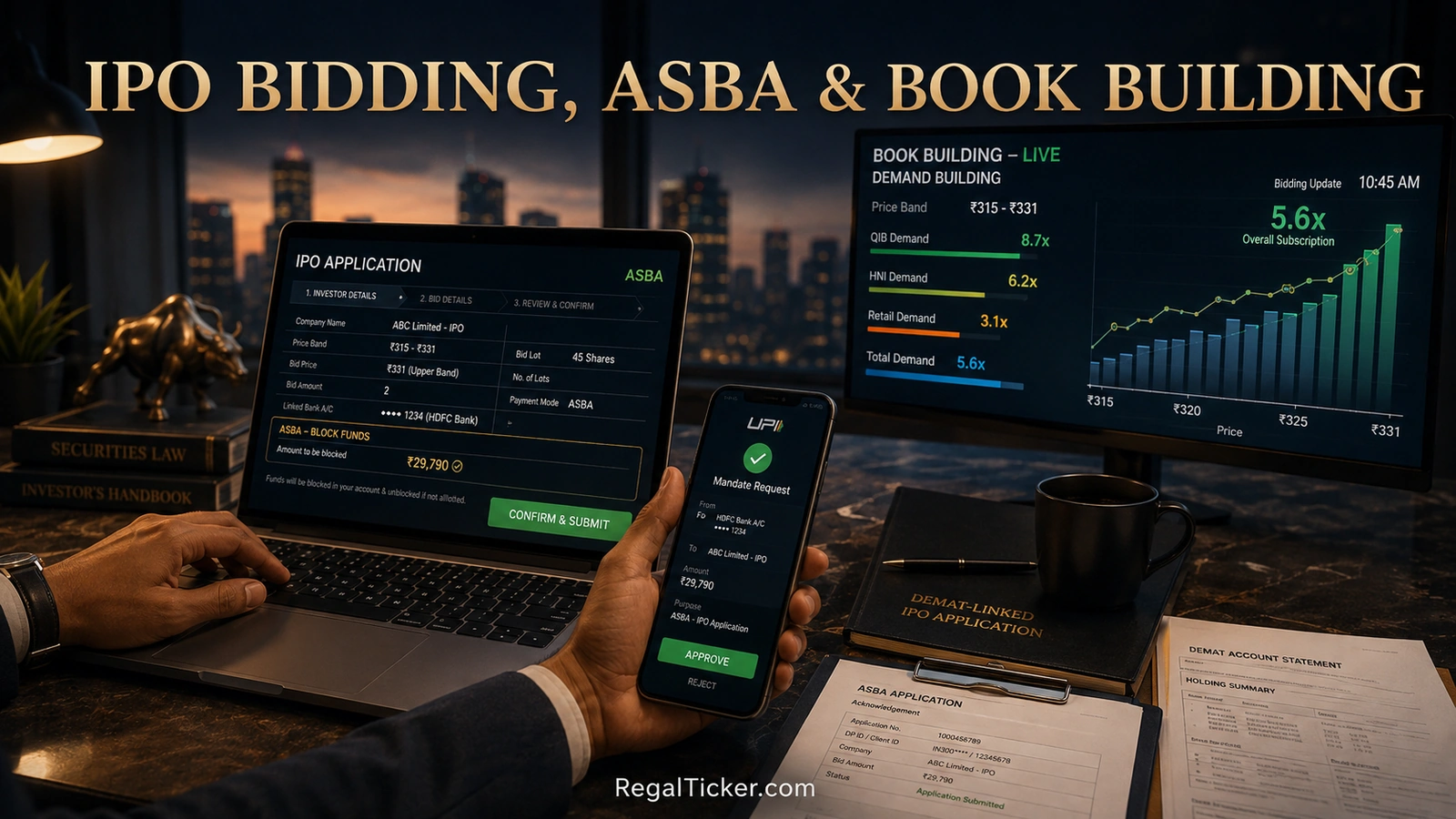
Book building collects bids from investors and records demand at different prices.
Main Investor Categories
The issue can include allocations for:
- Qualified Institutional Buyers;
- Non-Institutional Investors;
- Retail Individual Investors;
- employees or shareholders where a reservation is offered.
The exact allocation structure depends on the issue and applicable rules.
What an IPO Bid Contains
A bid can include:
- investor category;
- number of shares or lots;
- bid price;
- cut-off selection where permitted;
- PAN;
- demat-account details;
- bank or UPI details.
Incorrect PAN, demat, category or payment information can make an application invalid.
What Does Cut-Off Mean?
When an eligible retail applicant selects cut-off, the applicant agrees to pay the final discovered issue price.
The applicant must still have sufficient funds for the application at the upper end of the price band.
How ASBA Works
ASBA means Application Supported by Blocked Amount.
The application amount is blocked in the investor’s bank account. It remains in the account but cannot be used for another purpose while blocked.
After allotment:
- the required amount is debited for allotted shares;
- the balance is released;
- if no shares are allotted, the blocked amount is released.
UPI-Based IPO Applications
Eligible individual investors can use a supported UPI ID through an authorised intermediary.
The broad process is:
- submit the IPO bid with the UPI ID;
- receive the mandate request;
- verify the amount and issuer details;
- approve the mandate before the deadline;
- keep sufficient funds available;
- wait for allotment and final debit or release.
SEBI’s investor guidance currently states that applicable UPI IPO applications can be made up to ₹5 lakh per transaction.
Investors should verify the current limit and eligibility at the time of application because rules and operational limits can change.
Common ASBA and UPI Errors
Applications can fail because of:
- incorrect UPI ID;
- mandate not approved;
- insufficient balance;
- mismatch in PAN or demat details;
- duplicate applications;
- wrong category;
- late approval;
- unsupported bank or UPI setup.

Price Discovery, Allotment and Listing
After bidding closes, the demand data is evaluated.
Demand at Different Prices
Assume an IPO receives these simplified bids:
| Bid price | Cumulative demand |
|---|---|
| ₹320 | 8 crore shares |
| ₹326 | 7 crore shares |
| ₹332 | 5 crore shares |
| ₹336 | 3 crore shares |
The issuer and BRLMs review demand, issue size and applicable rules before finalising the price.
This simplified example is for explanation only. Actual price discovery considers category-wise demand and regulatory requirements.
Final Issue Price
The final price may be:
- at the upper end;
- within the band;
- at the lower end.
A heavily subscribed issue does not guarantee listing gains.
Subscription is one data point, not a complete valuation method.
Basis of Allotment
When demand exceeds available shares, not every valid applicant receives the full quantity requested.
The basis of allotment is the method used to distribute available shares among valid applicants under the applicable category rules.
The registrar prepares the calculation in coordination with the issuer, BRLMs and designated stock exchange.
Application Validation
Applications are checked for issues such as:
- duplicate PAN;
- invalid demat account;
- PAN mismatch;
- incorrect category;
- payment failure;
- insufficient blocked amount;
- incomplete details.
Share Credit and Fund Release
After allotment:
- successful applicants receive shares in their demat accounts;
- the amount required for allotted shares is debited;
- the unused blocked amount is released;
- unsuccessful applicants receive no shares and their blocked amount is released.
Listing on NSE or BSE
Listing is the stage when the shares become available for secondary-market trading.
The listing price can be above, near or below the issue price.
It is influenced by:
- demand and supply;
- overall market conditions;
- valuation;
- sector sentiment;
- institutional participation;
- business news;
- global markets;
- available free float.
After listing, selling can involve brokerage or platform charges, statutory charges, bid-ask spread, slippage and tax consequences.
Use the Brokerage Calculator to estimate trading costs and the Capital Gains Tax Calculator for a simplified tax estimate.

Worked Example of an IPO Application
Assume Meridian Consumer Limited plans an IPO.
This is a fictional example.
Issue Structure
- fresh issue: ₹600 crore;
- offer for sale: ₹400 crore;
- total issue: ₹1,000 crore;
- price band: ₹250–₹265;
- lot size: 56 shares.
Retail Application
An investor applies for one lot at cut-off.
Maximum blocked amount:
₹265 × 56 = ₹14,840
The investor approves the ASBA or UPI mandate.
Final Price and Allotment
Suppose the final issue price is ₹262.
If the investor receives one lot:
Debit:
₹262 × 56 = ₹14,672
Amount released:
₹14,840 − ₹14,672 = ₹168
Listing-Day Value
Suppose the stock lists at ₹286.
Initial unrealised gain per share:
₹286 − ₹262 = ₹24
For 56 shares:
₹24 × 56 = ₹1,344
This is a gross market-value difference before costs and tax.
If the investor sells, use the Stock Return Calculator to calculate the actual return after entering the purchase and sale values.
A listing gain is never guaranteed.
Retail Investor Checklist and Common Mistakes
Before Applying
- Read the RHP.
- Understand the business.
- Review the objects of the issue.
- Separate fresh issue from offer for sale.
- Study the risk factors.
- Review financial statements.
- Compare valuation with listed peers.
- Check promoter and management information.
- Review litigation and related-party transactions.
- Confirm the price band and lot size.
- Avoid using emergency money.
While Applying
- Use an authorised platform.
- Select the correct category.
- Verify PAN and demat details.
- Use the correct UPI ID or ASBA account.
- Keep sufficient balance.
- Approve the mandate before the deadline.
- Avoid duplicate applications.
- Save the application number.
Common Mistakes
Believing SEBI approves the investment SEBI regulates the process and reviews disclosures. It does not guarantee that the company is profitable, fairly valued or suitable for every investor.
Applying only because the IPO is oversubscribed Subscription data shows demand. It does not measure business quality or future return.
Ignoring the offer for sale component A large offer for sale may mean that much of the money goes to selling shareholders rather than to the company.
Treating cut-off as a discount Cut-off is not a lower price. It means accepting the final discovered issue price.
Approving the UPI mandate late A submitted application may still fail if the mandate is not approved within the required time.
Expecting guaranteed allotment or listing gains A valid application does not guarantee allotment, and allotment does not guarantee profit.
Frequently Asked Questions
How does an IPO work in India?
A company appoints intermediaries, completes due diligence, files draft disclosures, responds to regulatory observations, files the RHP, announces the price band, accepts investor bids, finalises price and allotment, credits shares and lists them on an exchange.
What is the first step in the IPO process?
The company first defines why it wants to go public and obtains the necessary internal approvals before appointing merchant bankers and other advisers.
A Draft Red Herring Prospectus is the draft offer document for a book-built issue. It contains detailed disclosures but does not contain the final discovered issue price.
What is an RHP?
The Red Herring Prospectus is the updated offer document filed before the issue opens. It contains the material issue disclosures and terms available at that stage.
What is book building?
Book building is a price-discovery process in which investors bid for shares within a price band and demand is collected at different prices.
What is a price band?
It is the permitted range within which investors can submit bids in a book-built IPO.
What does cut-off price mean?
An eligible retail investor selecting cut-off agrees to apply at the final issue price discovered through book building.
What is ASBA?
ASBA is an application method in which the IPO application amount is blocked in the investor’s bank account and debited only to the extent of allotment.
Can IPO applications be made through UPI?
Eligible individual investors can apply through supported UPI-based channels and approve a fund-blocking mandate, subject to the current rules and limits.
When is the money deducted?
The amount needed for allotted shares is debited after allotment. The unused blocked amount is released.
How is the final IPO price decided?
The issuer and BRLMs evaluate demand collected during book building and finalise the price according to the issue structure and applicable regulations.
Why do some valid applicants receive no shares?
When a category is oversubscribed, the available shares are distributed under the basis-of-allotment rules. Validity alone does not guarantee allotment.
Where are IPO shares credited?
Allotted shares are credited to the demat account mentioned in the application.
How soon does an IPO list?
SEBI’s investor education guidance states that IPO listing occurs within the prescribed three-day timeline after closure, subject to completion of the required process.
Can an IPO list below its issue price?
Yes. The listing price is determined by market demand and can be above, equal to or below the issue price.
Does high subscription guarantee profit?
No. High subscription indicates demand during the issue but cannot guarantee the listing price or long-term return.
Final Takeaway
The IPO process in India connects company fundraising with public investor participation through a regulated sequence.
The company must prepare its governance, appoint qualified intermediaries, complete due diligence, provide detailed disclosures, conduct public bidding, complete price discovery and allotment, credit shares and satisfy listing requirements.
The investor must verify the offer document, apply through authorised channels, approve the fund block correctly, avoid duplicate or incorrect applications and treat allotment and listing gains as uncertain.
For the basic concept, read What Is an IPO? Meaning, Process and Example.
To evaluate performance after listing, use the Stock Return Calculator, CAGR Calculator, Brokerage Calculator, Capital Gains Tax Calculator and the complete RegalTicker Investor Tools Hub.
Official References
- SEBI Investor — Book-Building Process
- SEBI Investor — Apply in IPO Through ASBA
- SEBI Investor — UPI and ASBA Application Flow
- NSE India — Frequently Asked Questions on IPOs
- NSE India — Book Building
- NSE India — About Initial Public Offerings
- NSE India — Listing Process
Educational disclaimer: This article is for general investor education only. It is not investment advice, a research recommendation, tax advice, legal advice, an offer, a solicitation or a guarantee of allotment or returns. IPO rules, application limits, timelines and exchange procedures can change. Verify current details from the RHP, SEBI, the relevant stock exchange, registrar, bank or authorised intermediary before applying.