

⚡ Quick answer
An IPO, or Initial Public Offering, is the first public sale of a company’s shares. It allows an unlisted company to raise capital, provide an exit or partial exit to existing shareholders, and seek listing on a recognised stock exchange. After listing, investors can generally buy and sell the shares in the secondary market, subject to market liquidity and exchange rules.
An IPO is one of the most visible events in the stock market. A company that was previously owned by founders, promoters, employees and private investors opens part of its ownership to the public.
For beginners, the important point is simple:
An IPO is not merely a new stock appearing on an exchange. It is a regulated process through which a private company becomes publicly owned and publicly traded.
The process involves offer documents, intermediaries, regulatory observations, price discovery, investor applications, allotment and listing.
What Is an IPO?
IPO stands for Initial Public Offering.
- Initial means the company is making its first public issue of shares.
- Public means eligible investors can apply for the offered shares.
- Offering means shares are being offered under defined terms through an offer document.
Before the IPO, the company is unlisted. Its shares are not normally available for everyday trading on NSE or BSE. After a successful issue and listing, its equity shares can trade in the secondary market.
The SEBI investor education material describes an IPO as the first public issue by an unlisted company that results in its shares being listed on a stock exchange.
What Changes After an IPO?
An IPO can change several aspects of the business:
- The company gains public shareholders.
- Its shares become subject to market price discovery.
- It must meet continuing disclosure and listing obligations.
- Promoters and existing investors may hold a lower ownership percentage.
- Financial performance, governance and important events receive greater public scrutiny.
- Investors can compare the company with listed competitors.
Listing does not automatically make the company profitable, safe or fairly valued. It only creates a regulated public market for the shares.
IPO, FPO and Rights Issue Are Different
An IPO is the first public issue by an unlisted company.
A follow-on public offer, or FPO, is a later public issue by a company that is already listed.
A rights issue offers additional shares primarily to existing shareholders according to the terms of the issue.
These methods can all raise capital, but they serve different situations.

Why Do Companies Launch an IPO?
Companies do not launch IPOs for one universal reason. The exact purpose is disclosed in the offer document under the objects of the issue.
Raise Money for Growth
A fresh issue can provide capital for:
- new plants or offices;
- technology and product development;
- expansion into new regions;
- working capital;
- acquisitions;
- repayment or reduction of borrowings;
- general corporate purposes within permitted limits.
Public capital may support a scale of expansion that is difficult to fund only through retained profits or private investors.
Provide Liquidity to Existing Shareholders
Founders, venture-capital funds, private-equity investors or other shareholders may sell part of their holdings through an offer for sale.
This creates liquidity for the sellers. However, the money from the sold shares goes to those shareholders, not to the company.
Create a Public Market Value
Once shares are listed, the market continuously assigns a price based on demand, supply, financial performance, expectations and broader market conditions.
A listed valuation may help the company:
- use shares in acquisitions;
- design employee stock-based compensation;
- improve visibility among lenders and business partners;
- access capital markets again in the future.
Improve Visibility and Governance Discipline
A listed company must make periodic disclosures and report material developments. This can increase public visibility and create stronger governance expectations.
However, listing also increases compliance costs and public accountability.
How Does the IPO Process Work in India?
The exact timeline and documents depend on the issue, but the main-board book-built IPO process generally follows these stages.
Company Preparation and Appointment of Intermediaries
The issuer prepares its financial, legal and governance records and appoints intermediaries such as:
- book-running lead managers or merchant bankers;
- legal advisers;
- auditors;
- registrar to the issue;
- bankers and sponsor bank;
- advertising and other professional agencies.
The merchant bankers coordinate due diligence, documentation and the public-issue process.
Draft Red Herring Prospectus Filing
The company prepares a Draft Red Herring Prospectus, commonly called the DRHP.
The DRHP normally contains detailed information about:
- the company and its business;
- promoters and management;
- industry and competition;
- financial statements;
- risk factors;
- legal matters;
- objects of the issue;
- capital structure;
- existing shareholders;
- fresh issue and offer-for-sale components.
The draft document is filed with SEBI and the stock exchanges in accordance with the applicable process.
SEBI publishes draft offer documents on its public-issues portal. Investors should remember that the filing or regulatory observation is not a recommendation to invest.
Regulatory and Exchange Review
SEBI reviews the disclosures and may issue observations. The stock exchanges examine listing-related requirements and provide in-principle approval according to their process.
The purpose is disclosure and regulatory compliance. It does not guarantee the company’s future performance or the attractiveness of the issue price.
Red Herring Prospectus and Price Band
Before the issue opens, the company publishes the Red Herring Prospectus and announces important issue details, including:
- price band;
- lot size;
- issue dates;
- investor categories;
- fresh issue and offer-for-sale size;
- application procedure;
- expected allotment and listing schedule.
In a book-built IPO, investors bid within the announced price band. Eligible retail applicants may generally select the cut-off option, meaning they agree to pay the final discovered issue price within the band.
Public Bidding
The issue opens for a defined bidding period.
Applications are submitted through supported channels using ASBA. With ASBA, the application money remains blocked in the investor’s bank account rather than being transferred immediately.
UPI can also be used through eligible channels for supported individual applications. Investors should use their own bank account and valid UPI ID and approve the mandate within the required time.
Price Discovery
After the issue closes, demand across price levels is analysed. The issuer and book-running lead managers determine the final issue price according to the book-building process and the issue terms.
A heavily subscribed issue is not automatically a good investment. Subscription shows demand during the issue period; it does not prove that the valuation is reasonable or that the share price will rise after listing.
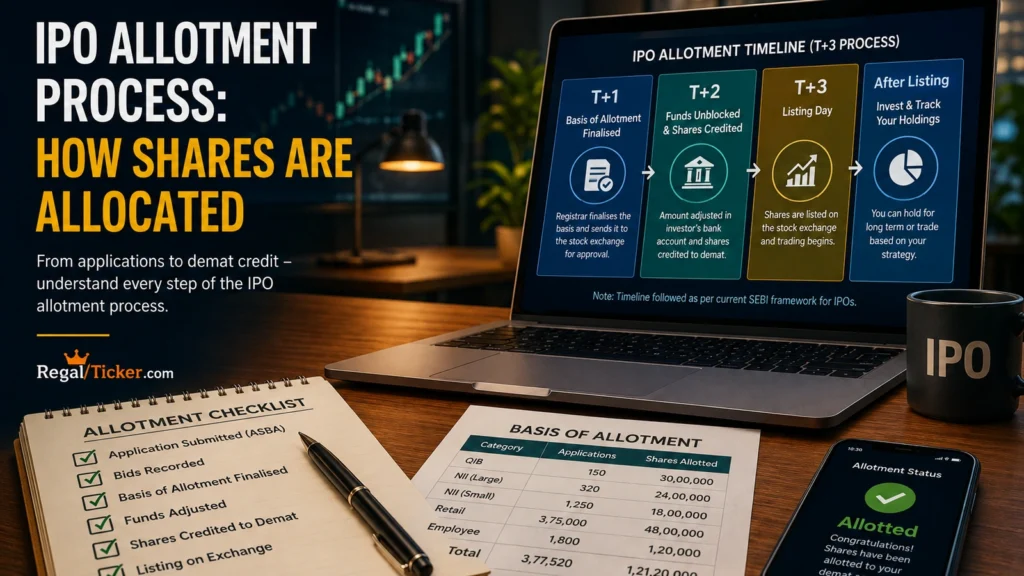
Basis of Allotment
When demand exceeds the available shares, every applicant may not receive the full quantity requested.
The registrar finalises the basis of allotment in consultation with the designated stock exchange, following the applicable allocation rules.
Investors who receive shares have the corresponding amount debited. The remaining blocked amount is released. Applicants who receive no shares have their blocked amount unblocked.
Credit of Shares and Listing
Allotted shares are credited to the successful applicants’ demat accounts.
After completion of the issue formalities, the shares are listed on the recognised stock exchange. SEBI’s current book-building investor guidance states that IPO listing is to take place within three days after issue closure under the applicable framework.
Once trading begins, the market price may be above, below or equal to the issue price.

Fresh Issue vs Offer for Sale
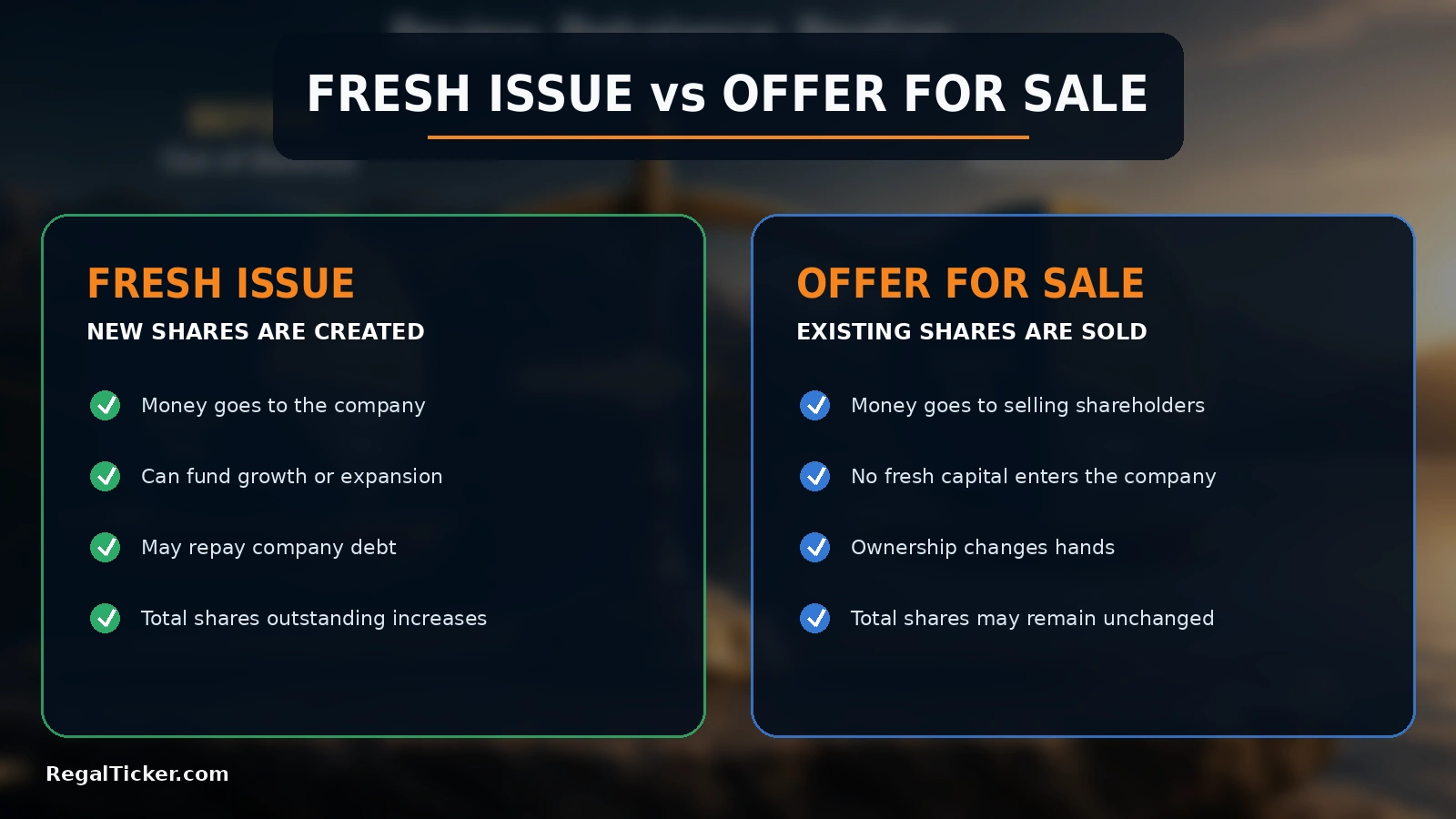
This distinction is essential because it tells investors where the IPO money goes.
Fresh Issue
In a fresh issue, the company creates new shares and sells them to investors.
The proceeds go to the company, after issue-related expenses, and are used for the disclosed objects.
A fresh issue increases the number of outstanding shares and can dilute the percentage ownership of existing shareholders.
Offer for Sale
In an offer for sale, existing shareholders sell some of their current shares to public investors.
The proceeds go to the selling shareholders. The company does not receive those sale proceeds.
An OFS can provide an exit or partial exit to promoters or early investors and can help increase public shareholding.
Many IPOs Contain Both
An IPO can combine:
- a fresh issue;
- an offer for sale;
- both components.
💡 Real example
Simple example
| Component | Amount | Recipient of proceeds | |—|—:|—| | Fresh issue | ₹600 crore | Company | | Offer for sale | ₹400 crore | Selling shareholders | | Total IPO size | ₹1,000 crore | Split according to components |
The total issue size is ₹1,000 crore, but only ₹600 crore enters the company before deducting issue expenses.
A Simple IPO Example
Assume ABC Consumer Products Limited is an unlisted company.
It plans an IPO with:
- price band: ₹190 to ₹200;
- lot size: 75 shares;
- fresh issue: ₹750 crore;
- offer for sale: ₹250 crore;
- total issue size: ₹1,000 crore.
Minimum Retail Application at the Upper Price
75 shares × ₹200 = ₹15,000
The investor’s application amount would be ₹15,000 for one lot at the upper price.
Where Does the Money Go?
- The fresh-issue proceeds of ₹750 crore go to the company, subject to expenses and the disclosed objects.
- The ₹250 crore OFS proceeds go to the selling shareholders.
What Happens if the Issue Is Oversubscribed?
Suppose the retail category receives applications for substantially more shares than available.
The applicant may receive:
- one lot;
- fewer shares than expected under the applicable basis;
- no allotment.
The number of times subscribed should not be treated as a guaranteed allotment formula.
What Happens on Listing Day?
Assume the issue price is ₹200.
Possible listing outcomes include:
| Listing price | Difference from issue price | Simple interpretation |
|---|---|---|
| ₹230 | +15% | Listed above issue price |
| ₹200 | 0% | Listed at issue price |
| ₹175 | −12.5% | Listed below issue price |
A listing gain or loss is not the same as the long-term return of the business.
To compare a later selling price with the purchase price, use the Stock Return Calculator. For multi-year growth, use the CAGR Calculator.
Benefits and Risks of Investing in IPOs
An IPO may be attractive, but it is not automatically better than buying an already listed company.
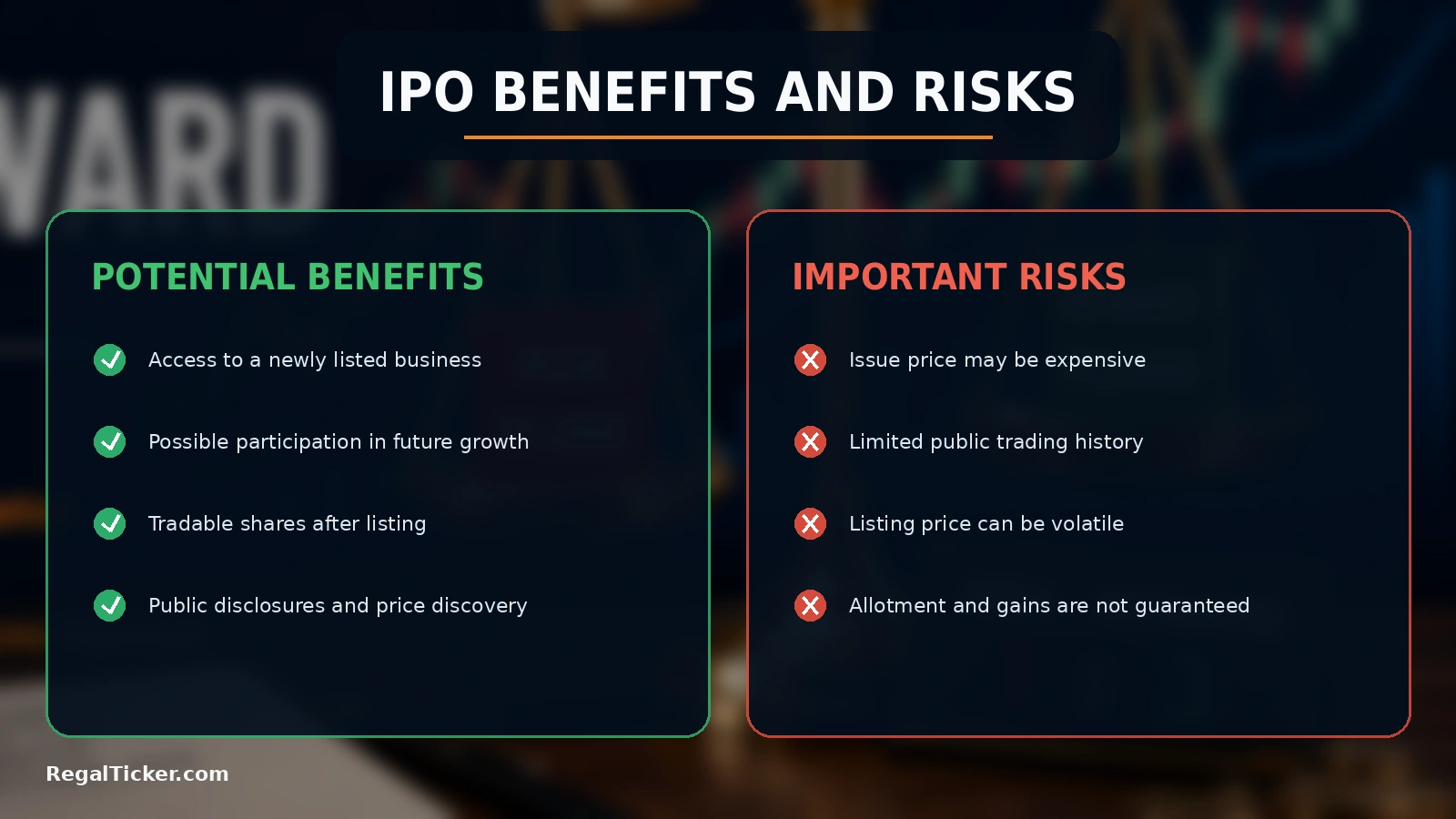
Possible Benefits
Access to a newly listed business: Investors may obtain shares before normal secondary-market trading begins.
Participation in future growth: A successful company may expand earnings and value over time.
Public disclosures: The offer document provides extensive information about the business, financials, risks and issue structure.
Potential listing gain: The market price may open above the issue price, although this is never guaranteed.
Liquidity after listing: Once listed, shares can generally be traded in the market, subject to demand, supply and market conditions.
Important Risks
Overvaluation: A popular issue may be priced at demanding assumptions.
Limited public-market history: The company has no previous listed-market price history.
Business risk: Revenue, margins, competition, regulation or debt may change after the issue.
Listing volatility: The first trading sessions can show sharp price movements.
No guaranteed allotment: Applying does not mean shares will be received.
No guaranteed listing gain: The stock may list below the issue price.
OFS-heavy issue: A large offer-for-sale component may mean that most proceeds do not enter the company.
Market risk: Weak broader market conditions can affect even a fundamentally reasonable IPO.
How Can a Retail Investor Apply for an IPO?
A retail investor normally needs:
- a PAN;
- a demat account;
- an eligible bank account;
- access through a broker, bank or other supported intermediary;
- sufficient unencumbered balance for the application;
- a valid application process using ASBA or eligible UPI channels.
ASBA in Simple Words
ASBA means Application Supported by Blocked Amount.
The application amount is blocked in the bank account. It is debited only to the extent required for allotted shares, while excess blocked funds are released.
Before Approving a UPI Mandate
Check:
- issuer name;
- application amount;
- UPI ID;
- mandate expiry;
- bid quantity and price;
- whether the request came through the intended application.
Do not share the UPI PIN. The PIN is entered by the user only inside the authorised UPI application to approve the mandate.
What Does Cut-Off Price Mean?
In a book-built issue, an eligible retail applicant choosing cut-off agrees to accept the final discovered issue price within the announced band.
It does not mean the lowest price and does not guarantee allotment.
How to Analyse an IPO Before Applying
The offer document is more important than social-media excitement or unofficial premium estimates.
Understand the Business
Ask:
- How does the company earn money?
- Who are its customers?
- Is demand recurring or cyclical?
- Is the industry growing?
- What are the major competitive advantages?
- What could make those advantages disappear?
Read the Risk Factors
Risk factors may include:
- dependence on a few customers;
- regulatory approvals;
- litigation;
- promoter-related concerns;
- high debt;
- weak cash flow;
- geographic concentration;
- supplier dependence;
- related-party transactions;
- dependence on one product.
Do not treat the risk section as legal formality.
Check the Objects of the Issue
Determine how much of the IPO is fresh issue and how much is OFS.
For the fresh issue, check the proposed use of funds:
- expansion;
- debt reduction;
- working capital;
- acquisition;
- general corporate purposes.
Then ask whether the intended use is likely to improve the business.
Compare Valuation
Compare the issue valuation with:
- listed peers;
- growth rate;
- profitability;
- return ratios;
- debt;
- cash flow;
- business quality.
A high-growth company can still be a poor investment when the price assumes unrealistic future performance.
Review Financial Quality
Examine several years where available:
- revenue;
- operating profit;
- net profit;
- margins;
- operating cash flow;
- borrowing;
- return on equity;
- return on capital employed.
One strong year before the IPO is not enough.
Check Promoters and Management
Review:
- promoter experience;
- shareholding after the issue;
- past regulatory matters;
- related-party transactions;
- material litigation;
- management remuneration;
- capital-allocation record.
Do Not Use Subscription as the Only Signal
High subscription can be influenced by market sentiment, category allocation and short-term expectations.
It does not replace valuation and business analysis.
Decide the Investment Purpose
An investor applying only for a listing gain is making a different decision from an investor planning to hold for five years.
Write the plan before applying:
- maximum application amount;
- listing-day action;
- long-term thesis;
- conditions for holding;
- conditions for selling;
- portfolio concentration limit.
Use the Brokerage Calculator to estimate secondary-market transaction charges and the Capital Gains Tax Calculator to estimate possible tax under the assumptions entered.
Common IPO Mistakes to Avoid
Applying Only Because of Hype
News coverage, social-media discussion and unofficial grey-market information can create fear of missing out.
The decision should still pass the business, valuation and risk checks.
Assuming Every IPO Gives a Listing Gain
Some issues list below the offer price. Others list strongly and decline later.
There is no guaranteed pattern.
Ignoring the OFS Component
A large IPO headline does not show how much money reaches the company.
Separate fresh issue from OFS.
Borrowing Aggressively to Apply
Borrowing creates a certain interest cost for an uncertain allotment and uncertain market outcome.
Applying without Reading the Prospectus
At minimum, review:
- business overview;
- risk factors;
- objects of the issue;
- financial information;
- capital structure;
- promoter information;
- basis for the offer price.
Buying Immediately After a Strong Listing
A strong listing can change the valuation materially.
Recalculate the investment case at the new market price instead of relying on the IPO issue analysis.
Frequently Asked Questions
What is an IPO in simple words?
An IPO is the first public sale of shares by an unlisted company, usually followed by listing on a recognised stock exchange.
Why does a company launch an IPO?
A company may raise fresh capital, provide liquidity to existing shareholders, create a public market for its shares or support future growth and fundraising.
Does SEBI approval mean an IPO is safe?
No. The regulatory process focuses on compliance and disclosure. It is not a recommendation and does not guarantee returns.
What is a price band?
A price band is the range within which investors submit bids in a book-built IPO.
What is the cut-off price?
The cut-off price is the final discovered issue price. An eligible retail applicant choosing cut-off agrees to pay that final price within the announced band.
What is the difference between a fresh issue and an OFS?
Fresh-issue money goes to the company and new shares are created. OFS money goes to existing shareholders selling their shares.
Is IPO allotment guaranteed?
No. In an oversubscribed issue, an applicant may receive partial allotment or no allotment.
Can an IPO list below the issue price?
Yes. Listing price depends on demand, market conditions and investor expectations and can be below the issue price.
Is a highly subscribed IPO always a good investment?
No. Subscription indicates demand during the offer period, not business quality, fair valuation or future return.
Where can I find official IPO documents?
Offer documents are available through SEBI’s public-issues filings and relevant stock-exchange or issuer pages.
Final Takeaway
An IPO is the regulated path through which an unlisted company offers shares to public investors and seeks stock-exchange listing.
Before applying, understand:
- why the company is raising money;
- how much is fresh issue and OFS;
- where the proceeds will go;
- the business model and financial quality;
- the major risk factors;
- the valuation;
- the application, allotment and listing process;
- your own investment purpose and risk limit.
The strongest IPO decision is not based on excitement. It is based on the offer document, financial evidence, valuation discipline and a written investment plan.
Explore the RegalTicker Investor Tools Hub for return, CAGR, brokerage and tax calculators that can support your calculations.
Official References
- SEBI Public Issues and Offer Documents
- SEBI Investor: Book-Building Process
- SEBI Investor: Apply in IPO Through ASBA and UPI
- NSE India: Public-Issue Listing Process
Educational disclaimer: This article is for general education only. It is not investment advice, an IPO recommendation, a solicitation or a guarantee of allotment, listing gain or return. Read the current offer document, verify information through official sources and consult an appropriately qualified professional where necessary.