

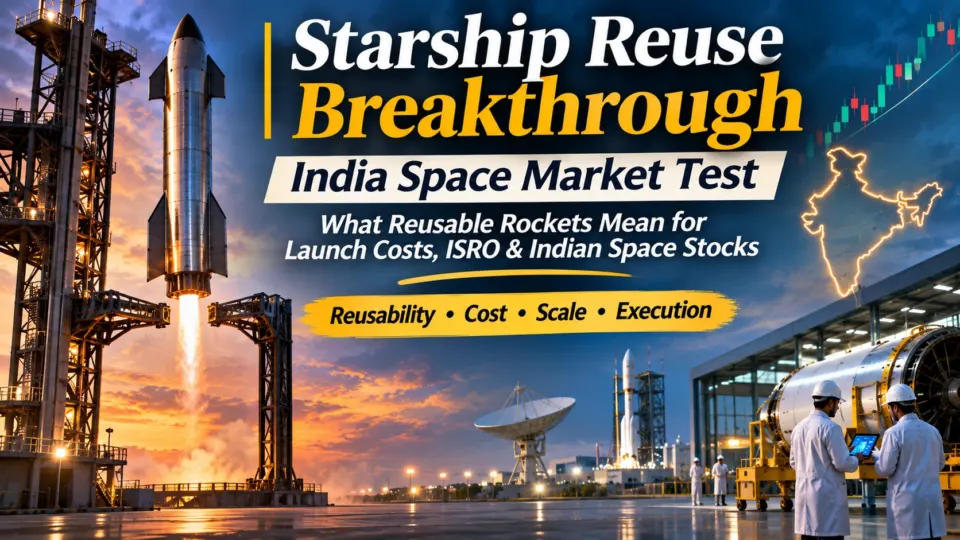
SpaceX just raised the benchmark that India’s launch economy is trying to meet
SpaceX’s Starship has completed its longest mission yet, circling Earth 14 times and returning the upper stage to the same Texas launch site where it began. The spacecraft was caught by the launch tower’s mechanical arms after more than 22 hours in orbit. That is a major engineering milestone for reusable launch systems, even though the Super Heavy booster did not complete its own planned return. For Indian investors, the useful question is not whether one American rocket makes Indian space companies obsolete. It is whether rapid reusability changes the economics of launch services fast enough to alter the competitive bar for ISRO, HAL, L&T, private launch startups and the wider Indian space supply chain.
⚡ Quick answer
Why does Starship matter to the Indian market?
Because India is trying to build a much larger commercial space economy while also developing reusable launch technology. A successful orbital return makes reusability less theoretical and raises expectations around launch cadence, turnaround time and cost. India’s listed and private space ecosystem can still grow strongly, but investors should focus on execution, manufacturing scale, launch reliability and whether Indian programmes can translate engineering progress into commercially competitive economics.
Key takeaways
Starship’s upper stage completed 14 Earth orbits during a roughly 22.5-hour mission.
It deployed 26 Starlink satellites before re-entry and was caught by tower arms at the Texas launch site.
The Super Heavy booster did not complete its planned return, so full two-stage reusability has not yet been demonstrated.
India is developing a partially reusable Next Generation Launch Vehicle with a vertically recoverable first stage.
A Government of India update on 15 November says India’s space economy was about $9 billion in August 2026, with roughly 440 registered space startups.
The government is targeting a roughly $44 billion Indian space economy by 2033.
HAL has received SSLV technology for industrial production, while HAL and L&T are already involved in industry-led launch-vehicle manufacturing.
For Indian investors, the important variables are launch cost, cadence, reliability, manufacturing scale and order conversion—not simply “space theme” sentiment.
Investor note
Reusability is an economic model, not just a spectacular landing
The market value of reusable launch systems comes from what happens after the landing: how quickly hardware can fly again, how much refurbishment costs, how reliable repeated operations become and whether the system can carry enough paid payload to improve unit economics. A successful return is important, but it is not the same thing as proving the final commercial cost structure.
1. What Starship achieved
Reuters reported that Starship’s upper stage completed 14 Earth orbits during the programme’s longest mission, spending roughly 22.5 hours in space before returning to Texas.
The spacecraft deployed 26 Starlink satellites, re-entered from orbit and descended into the mechanical arms of the launch tower. That return is significant because Starship is designed around a much more ambitious version of reusability than older expendable launch systems.
However, one detail matters for investors following the economics rather than the spectacle: the Super Heavy booster failed to make its planned return to the launch site. SpaceX therefore did not recover both stages in the same mission.
That means the milestone is real, but the full two-stage reusable system is still a work in progress.
2. Why reusable rockets can change launch economics
Traditional launch systems discard large, expensive sections of hardware after one mission. Reusability tries to turn a rocket from a one-time product into something closer to transport infrastructure.
If the same vehicle can fly repeatedly with limited refurbishment, the economic model changes in several ways:
- hardware cost can be spread across multiple missions;
- launch cadence can potentially increase;
- manufacturing demand shifts from one-for-one replacement toward fleet expansion and maintenance;
- customers may receive more frequent access to orbit;
- lower launch costs can make new satellite and in-orbit business models viable.
None of these benefits is automatic. They depend on reliability, refurbishment, payload efficiency and operating discipline.
But this is the competitive benchmark against which future launch systems will increasingly be judged.
3. India is already developing its own reusable launch architecture
India is not starting from zero.
ISRO’s 2025–26 annual report says development has begun on the Next Generation Launch Vehicle, or NGLV, a partially reusable and commercially viable launch system.
The NGLV is planned as a three-stage vehicle with up to 30 tonnes of payload capability to low Earth orbit. Its first stage is intended to be recovered through vertical landing and reused. ISRO is also developing LOX-methane propulsion and vertical take-off and vertical landing technologies.
This is important because Starship’s latest milestone does not suddenly create the concept of reusability for India. It makes the competitive timetable more visible.
The engineering question for India is becoming a commercial question: how quickly can reusable technology move from test programmes into dependable launch services?
4. Why the cost benchmark matters to ISRO and NSIL
India has built a strong reputation for reliable and relatively cost-efficient launch services, particularly through PSLV.
But the next decade of commercial space competition will not be fought only on historical cost advantages.
Customers will increasingly compare:
- price per kilogram to orbit;
- launch frequency;
- schedule flexibility;
- payload size;
- mission reliability;
- integration time;
- availability of rideshare and dedicated launches;
- the ability to support larger satellite constellations.
Reusable heavy-lift systems could pressure some traditional launch economics while also expanding the overall market by making more missions affordable.
That is why India’s response should not be viewed as a race to copy SpaceX vehicle-for-vehicle. India needs a launch architecture that is commercially competitive for the missions it wants to serve.
5. The Indian space economy is already scaling
The timing is important because India’s space sector is moving from a primarily government-led model toward a larger commercial ecosystem.
A Government of India press note published on 15 November says India’s space economy was estimated at about $9 billion in August 2026. Registered space startups had grown to roughly 440, while cumulative investment in Indian space startups reached about $618.5 million by 31 March 2026.
The same government update says India is targeting a space economy of about $44 billion by 2033.
That target cannot be reached by launch vehicles alone. It includes satellites, data, downstream services, manufacturing, communications, ground infrastructure and applications.
Still, launch capability matters because it affects how much of that ecosystem India can control domestically and how competitive Indian space businesses can become globally.
6. HAL and L&T show how launch manufacturing is moving into industry
The listed-market connection is clearest where government programmes are shifting mature systems toward industrial production.
The 15 November government update says HAL, as lead member of the HAL–L&T consortium, received a contract for production of five PSLV-XL launch vehicles.
It also says that in September 2025, NSIL, ISRO, IN-SPACe and HAL signed an agreement transferring SSLV technology to HAL for industrial production.
That matters for investors because India’s space-sector reforms are not only about startups. They are also about moving production responsibility into industrial companies with existing manufacturing scale.
For HAL and L&T, the space opportunity sits alongside much larger businesses. Investors therefore need to judge whether launch and space-manufacturing work becomes financially material rather than assuming every space headline changes the investment case immediately.
7. What Starship means for Indian private launch companies
India’s private launch ecosystem is also advancing quickly.
The government’s 15 November update highlights Skyroot Aerospace and Agnikul Cosmos as examples of private launch-sector progress, including orbital and propulsion milestones.
For these companies, Starship is less a direct competitor for every mission than a demonstration of where global launch economics may be heading.
Small-launch providers can still serve markets where dedicated access, orbital flexibility or customer-specific schedules matter more than the lowest theoretical cost per kilogram.
But if reusable launch becomes routine across heavier systems, every launch provider will face greater pressure to prove why its architecture deserves customer demand.
That makes technical differentiation and business-model discipline more important.
8. Which parts of the Indian market could benefit from a larger space economy
The space opportunity is broader than rocket manufacturers.
A larger Indian space economy can create demand across:
- precision manufacturing;
- electronics and avionics;
- propulsion components;
- advanced materials;
- satellite manufacturing;
- ground systems;
- communications equipment;
- geospatial data;
- software and analytics;
- testing and certification infrastructure.
For investors, that means the better question is not “Which stock is a space stock?”
It is “Which company has a measurable, defensible and growing space-related revenue stream?”
RegalTicker’s fundamental analysis guide is useful here because thematic excitement can easily run ahead of order books, margins and cash flow.
9. Why Indian space stocks should not be valued on SpaceX hype
A spectacular global milestone can create a powerful narrative trade.
That does not mean every Indian aerospace, defence or electronics company deserves a higher valuation.
Investors should separate three categories:
Direct launch exposure
Companies with actual launch-vehicle manufacturing, systems or propulsion work.
Broader space exposure
Companies supplying satellites, electronics, communication systems or mission hardware.
Theme-adjacent exposure
Businesses that are sometimes labelled “space plays” even when space contributes only a small share of revenue.
That distinction is crucial because the same headline can produce very different financial outcomes.
The market may trade a theme quickly. Earnings take longer to prove it.
10. The key metric is execution, not announcements
India already has ambitious policy targets, an expanding startup base and growing industry participation.
The next stage is execution.
Investors should watch whether:
- reusable-vehicle testing progresses toward operational missions;
- private launch cadence increases;
- HAL’s SSLV industrial production translates into repeat orders;
- industry-built PSLV production scales smoothly;
- space startups convert technology into recurring commercial revenue;
- India wins a larger share of global launch and satellite demand;
- private investment continues beyond early-stage funding.
A $44 billion space-economy target is strategically important.
But markets ultimately value delivery.
11. What Starship changes for India’s competitive timeline
The most important implication of Starship’s return is not that India is suddenly behind.
It is that the global commercial benchmark is moving faster.
SpaceX is trying to make very large, reusable rockets operate with aircraft-like repetition. India is pursuing a different path, balancing national missions, commercial launch services, human spaceflight, private-sector development and cost discipline.
Both approaches can create economic value.
But if full reusability begins to reduce launch costs and increase launch frequency materially, India will need its own programmes to reach commercial maturity fast enough to remain competitive in the markets it wants to serve.
That makes ISRO’s NGLV, industry-led SSLV production and private launch startups strategically connected pieces of the same story.
12. What Indian investors should watch next
There are six signals worth following.
First, watch whether SpaceX can repeat the Starship upper-stage return consistently rather than only once.
Second, watch whether the booster and upper stage can eventually be recovered in the same mission.
Third, watch ISRO’s NGLV and vertical-landing development milestones.
Fourth, watch HAL’s SSLV industrialisation and the HAL–L&T PSLV manufacturing programme.
Fifth, watch private Indian launch companies for mission cadence and paying customers rather than demonstration milestones alone.
Finally, watch valuation. A stronger space economy can create long-term winners, but paying any price for a good theme is still a poor investment discipline.
RegalTicker’s risk management guide is relevant whenever a fast-moving technology theme begins driving stock prices faster than fundamentals.
Investor note
Starship is a benchmark, not an Indian stock-market signal by itself
The engineering milestone is strategically relevant to India’s space ecosystem, but it does not automatically change the earnings of HAL, L&T or any Indian space-linked company. Investors should look for programme milestones, orders, revenue contribution and margins before treating global space news as a direct company catalyst.
Frequently asked questions
What did Starship achieve in its latest mission?
The upper stage completed 14 Earth orbits, deployed 26 Starlink satellites and returned to the Texas launch site, where it was caught by the tower’s mechanical arms.
Was the entire Starship rocket recovered?
No. The Super Heavy booster failed to complete its planned return, so full two-stage recovery was not achieved on this mission.
Is India developing reusable rockets?
Yes. ISRO says its Next Generation Launch Vehicle is planned as a partially reusable system with a vertically recoverable first stage, alongside work on reusable and vertical-landing technologies.
How large is India’s space economy?
A Government of India update on 15 November 2026 estimated it at about $9 billion as of August 2026 and projected roughly $44 billion by 2033.
Which listed Indian companies have direct launch-manufacturing relevance?
The government says HAL is the lead member of the HAL–L&T consortium producing PSLV-XL vehicles, while SSLV technology has been transferred to HAL for industrial production. Investors should still assess financial materiality company by company.
Does Starship make India’s launch programme uncompetitive?
No. One mission does not determine the future market. But repeated reusability could raise the benchmark for launch cost, cadence and payload economics, increasing competitive pressure across the global launch industry.
Verify through official sources
Official references
- Reuters — Current reporting on Starship’s 14-orbit mission, satellite deployment, upper-stage return and failed booster recovery.
- Press Information Bureau — Government of India update dated 15 November 2026 on India’s space economy, startups, investment, HAL and L&T launch-manufacturing roles, and the 2033 target.
- ISRO — Department of Space annual report describing NGLV, partial reusability, vertical landing, LOX-methane propulsion and industry participation.
- ISRO — Official overview of India’s operational and developing launch systems, including reusable-launch technologies.
Final takeaway
Starship raises the benchmark; India still has to prove the business model
The most important lesson from Starship’s orbital return is not that reusable rockets have suddenly arrived. It is that the global launch industry is moving closer to a world where hardware recovery, faster turnaround and higher launch cadence become normal competitive expectations. India is already developing reusable launch technology and shifting mature systems such as PSLV and SSLV toward industrial production. The opportunity is real: the government wants the space economy to grow to roughly $44 billion by 2033. But for Indian investors, the winning signal will not be a dramatic landing video. It will be repeat launches, reliable technology, commercial orders, manufacturing scale and profitable execution.
Educational disclaimer: This article is for investor education and general market information only. It is not investment advice or a recommendation to buy or sell HAL, L&T, any Indian aerospace or defence stock, SpaceX, or any private space company. Technology programmes, launch schedules, commercial economics and government targets can change, so investors should verify current company filings and official programme updates before acting.


