

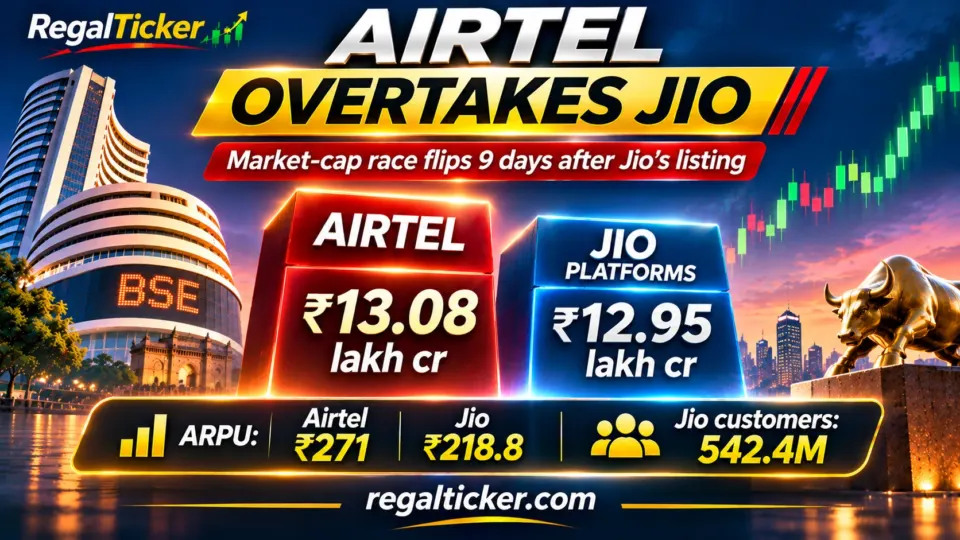
The market-cap lead changed hands faster than the businesses did
Bharti Airtel moved back ahead of Jio Platforms in market capitalisation on 6 November, just days after Jio’s blockbuster listing had made it India’s second-most valuable listed company.
Using BSE closing data, Airtel finished with a market value of about ₹13.08 lakh crore, compared with roughly ₹12.95 lakh crore for Jio Platforms. The gap was only about ₹13,606 crore—small relative to the size of both companies—but symbolically important because Jio had debuted above Airtel on 28 October.
The reversal did not happen because Jio suddenly became a weaker business. Jio’s latest quarter still showed 542.4 million customers, 300 million 5G users, ARPU of ₹218.8, operating revenue of ₹40,475 crore and EBITDA of ₹21,879 crore.
What changed was the market’s relative valuation of two different telecom models.
Airtel entered Friday with fresh quarterly results showing India mobile revenue up 10.1% year on year, industry-leading mobile ARPU of ₹271, consolidated EBITDA margin of 57.9% and strong postpaid momentum. Its shares rose while Jio slipped.
The result is a useful reminder for investors: market-cap rankings are not permanent verdicts on business quality. They are real-time prices placed on growth, monetisation, risk, free float and future expectations.
⚡ Quick answer
Why did Airtel overtake Jio Platforms in market capitalisation?
Airtel overtook Jio because its share price rose after strong quarterly results while Jio’s shares declined modestly after the initial post-IPO excitement. Airtel is currently being rewarded for stronger mobile monetisation, with ARPU at ₹271 versus Jio’s ₹218.8, while Jio still has the larger India digital-connectivity scale and faster customer growth. Jio’s very small free float also makes its share price more sensitive to short-term buying and selling. The market-cap crossover therefore reflects valuation and trading dynamics as much as operating fundamentals.
Key takeaways
Bharti Airtel’s BSE market cap ended 6 November at about ₹13.08 lakh crore.
Jio Platforms ended at about ₹12.95 lakh crore.
Airtel was ahead by roughly ₹13,606 crore on BSE closing data.
Airtel shares rose 1.66% on the BSE to ₹2,096.25.
Jio Platforms shares fell 0.90% to ₹1,405.75.
Jio had been ahead of Airtel on its 28 October listing day.
Jio listed at ₹1,358 versus an issue price of ₹1,119 and closed its debut at ₹1,417.50.
Airtel’s latest India mobile ARPU was ₹271, up from ₹256 a year earlier.
Jio’s latest ARPU was ₹218.8, up 3.5% year on year.
Airtel’s Q2 consolidated revenue was ₹60,878 crore and EBITDA ₹35,240 crore.
Airtel India revenue was ₹42,308 crore in Q2 FY27.
Jio’s Q2 operating revenue was ₹40,475 crore and EBITDA ₹21,879 crore.
Jio’s Q2 customer base was 542.4 million, including 300 million 5G customers.
Jio’s BSE free-float market capitalisation was only about 2.2% of its full market value on 6 November.
The comparison is not perfectly like-for-like because Airtel includes Africa, enterprise, homes and infrastructure exposure, while Jio Platforms reports a digital-services platform centered primarily on India.
1. The market-cap crossover was driven by price, not a sudden change in scale
A market capitalisation ranking can change in one trading session even when the underlying businesses barely change at all.
That is exactly what happened on Friday.
Airtel shares rose after investors digested a strong September-quarter result. Jio shares fell modestly after a powerful IPO debut and several volatile post-listing sessions.
On the BSE, Airtel closed at ₹2,096.25, up 1.66%, while Jio Platforms ended at ₹1,405.75, down 0.90%.
That was enough to put Airtel back in second place among India’s listed companies, behind Reliance Industries and just ahead of Jio.
This is why investors should be careful with headlines such as “Airtel becomes more valuable than Jio.”
The statement is correct at the closing market prices.
It does not mean Airtel suddenly gained customers, spectrum, towers or cash flows overnight.
The ranking changed because investors marked the two businesses at different prices.
2. Jio’s listing premium made the first comparison unusually sensitive
Jio entered the public market with enormous expectations.
The company listed on 28 October at ₹1,358, about 21% above its ₹1,119 issue price, and ended its first session at ₹1,417.50.
Reuters estimated Jio’s market value at around $137 billion on debut, making it India’s second-most valuable listed company at the time.
That listing-day premium mattered.
When a newly listed stock begins trading well above the offer price, part of its valuation reflects scarcity, excitement and immediate demand in addition to long-term fundamentals.
Jio’s public float is especially important here.
TelecomTalk reported that Jio’s free-float market capitalisation on the BSE was only around ₹28,205 crore on 6 November—roughly 2.2% of its full market capitalisation.
A small free float can magnify price moves because a relatively small quantity of tradable shares determines the market price applied to the company’s entire share count.
That does not make the market cap “wrong.”
It means investors should avoid treating a few days of post-listing price action as a settled long-term valuation.
The Jio Platforms IPO analysis provides the broader context behind the listing, growth expectations and valuation debate.
Investor note
Full market cap and free-float market cap answer different questions
Full market capitalisation values all outstanding shares at the current market price. Free-float market capitalisation counts only shares considered freely tradable. A company can therefore have a very large full market value but a relatively small tradable float, increasing short-term price sensitivity.
3. Airtel’s strongest advantage today is monetisation
The cleanest operating difference between the two companies is ARPU.
Airtel’s India mobile ARPU reached ₹271 in Q2 FY27, up from ₹256 a year earlier.
Jio’s ARPU was ₹218.8, up from ₹211.4 a year earlier.
That gap does not mean Airtel is automatically more profitable per customer in every sense, because the companies differ in customer mix, plans, network strategy, digital services and accounting structure.
But ARPU is still a useful measure of monetisation.
Airtel has spent years pursuing a premiumisation strategy: better-quality customers, stronger postpaid mix, higher-value plans and a more disciplined approach to pricing.
Its latest quarter added 1.2 million postpaid users—the strongest quarterly postpaid addition in its history—and took its postpaid base to 31.2 million.
That is exactly the kind of operating evidence public-market investors often reward.
Airtel is showing that it can raise the economic value of its customer base, not simply expand subscriber numbers.
4. Jio’s strongest advantage remains scale and ecosystem depth
Jio’s model is different.
Its Q2 customer base reached 542.4 million, up 36 million from a year earlier.
The company said it had 300 million 5G users and around 30 million home-broadband customers.
Monthly data consumption reached 44.2 GB per customer.
Jio’s strategy is built around scale, network utilisation and digital engagement across connectivity, entertainment, cloud, enterprise and other services.
That scale creates opportunities Airtel does not replicate in exactly the same way.
Jio can spread network and platform investment across a larger customer base and potentially monetise users through more than connectivity.
Its recent US technology-licensing story also shows management trying to convert technology developed in India into international revenue without building full overseas consumer networks.
The valuation question is therefore not “who has more subscribers?”
It is whether Jio can turn its massive scale into enough ARPU growth, digital-services revenue and free cash flow to justify a premium valuation.
5. The latest quarter shows both companies are executing well
The market-cap crossover should not be mistaken for a weak Jio quarter.
Jio’s Q2 operating revenue rose 11.4% year on year to ₹40,475 crore.
EBITDA increased 16.6% to ₹21,879 crore.
EBITDA margin expanded to 54.1%.
Profit after tax rose about 13.7%.
Jio also reported strong EBITDA less cash capex of ₹15,449 crore for the quarter and ₹32,130 crore for the first half.
Airtel’s quarter was also strong.
Consolidated revenue increased 16.7% year on year to ₹60,878 crore.
Consolidated EBITDA reached ₹35,240 crore with a 57.9% margin.
India revenue was ₹42,308 crore, up 9.4% year on year.
India mobile revenue grew 10.1%.
These are healthy operating numbers on both sides.
The market is not choosing between a strong company and a weak one.
It is comparing two strong telecom platforms with different growth and monetisation profiles.
6. Why the revenue comparison needs care
Airtel’s consolidated revenue is larger than Jio’s, but the number is not directly comparable.
Airtel operates across India and Africa.
It also includes mobile, homes, enterprise services, digital TV, passive infrastructure and other businesses.
Jio Platforms is reported as a digital-services segment centered on connectivity and platform/application/software businesses.
A more useful comparison is therefore not simply:
₹60,878 crore versus ₹40,475 crore.
Investors should instead examine India mobile monetisation, subscriber growth, EBITDA margins, cash generation, capex intensity, customer quality, enterprise exposure and the return earned on capital invested.
The Fundamental Analysis framework is useful here because market-cap comparisons become misleading when investors compare headline revenue without understanding the composition of the businesses.
7. Airtel has another asset Jio investors should not ignore: Africa
Airtel’s valuation includes a large African business.
The company reported 193.9 million customers in Africa in Q2 and constant-currency revenue growth of 20.6% year on year.
That gives Airtel geographic diversification that Jio does not currently have at the same operating scale.
It also creates currency, regulatory and political risks that Jio faces less directly.
Diversification can support valuation when multiple geographies are growing.
It can also complicate earnings when currencies move sharply.
Jio’s alternative approach appears to be more asset-light internationally: license technology, partner with local operators and avoid replicating the full India network model abroad.
That is why the market-cap race is also a strategic comparison between direct multinational operations and technology-led internationalisation.
8. Data centres and enterprise services are becoming part of the rivalry
Telecom is no longer just about mobile tariffs.
Airtel said it invested ₹2,826 crore in a strategic land parcel during the quarter as part of an ambition to build 1 GW of data-centre capacity.
Airtel Business is also expanding cloud, cybersecurity, communications and enterprise infrastructure services.
Jio is pushing from the other direction.
Its strategy includes cloud, enterprise connectivity, AI tools, home broadband, platform services and proprietary wireless technology.
Both companies are therefore chasing the same broad prize: becoming a digital infrastructure platform rather than a commodity telecom operator.
That can justify higher valuation multiples if returns improve.
It can also increase capital requirements.
Investors should watch whether new businesses create durable cash flow or simply add another layer of spending.
9. The ARPU gap is important—but Jio has more room to monetise
Airtel’s ₹271 ARPU is clearly higher than Jio’s ₹218.8.
That is a near-24% difference.
But the interpretation is not one-sided.
Airtel can argue that its premiumisation model is already producing superior monetisation.
Jio can argue that a lower ARPU combined with a much larger customer base leaves room for future tariff increases and deeper digital-services monetisation.
The risk for Jio is that the market may already be pricing some of that future monetisation into the stock.
The risk for Airtel is that higher ARPU expectations can become harder to beat if tariff increases slow or competition intensifies.
This is why valuation matters.
A great business can still be a poor investment if investors pay too much for the expected growth.
10. What the market-cap gap actually tells us
The gap between Airtel and Jio is tiny relative to their size.
On BSE closing data, Airtel was ahead by roughly ₹13,606 crore.
That is only about 1% of either company’s full market value.
A normal trading session can reverse that ranking again.
Investors should therefore avoid treating the number-two position as a trophy with deep analytical meaning.
The useful signal is the relative share-price trend.
Airtel is being rewarded after a strong quarter.
Jio is digesting a large IPO premium and its first results as a listed company.
If Airtel keeps growing ARPU and cash flow faster than expected, the valuation gap can widen.
If Jio demonstrates faster monetisation, digital-services growth or successful global licensing, it can move back ahead.
The race is likely to remain fluid.
11. What would make Jio re-rate higher again?
Several developments could matter.
First, faster ARPU growth.
Jio’s ARPU improved to ₹218.8, but the gap with Airtel remains material.
Second, stronger digital-services monetisation.
Revenue growth from cloud, AI, enterprise platforms and consumer digital services would reduce dependence on connectivity alone.
Third, international licensing.
If reported discussions with global operators become signed, financially meaningful contracts, investors may begin assigning value to Jio’s technology exports.
Fourth, lower capital intensity.
Jio’s improving EBITDA less cash capex is encouraging. Continued cash conversion would make the valuation easier to defend.
Fifth, better visibility on shareholder returns.
As the newly listed company matures, investors will watch dividend policy, capital allocation and use of IPO proceeds.
12. What would keep Airtel ahead?
For Airtel, the formula is more straightforward.
Keep ARPU moving higher.
Sustain postpaid and premium customer growth.
Maintain strong India mobile margins.
Continue improving the balance sheet.
Grow homes and enterprise services without damaging return on capital.
And make the Africa business contribute growth without creating excessive currency volatility.
Airtel’s latest net debt-to-EBITDA ratio improved to 1.18 from 1.63 a year earlier.
That balance-sheet improvement matters because telecom has historically been a capital-intensive industry.
The market generally rewards growth more strongly when debt is falling at the same time.
13. Which company is “better” for investors?
There is no useful answer without valuation.
Airtel currently offers stronger mobile monetisation, a diversified multinational business and improving balance-sheet metrics.
Jio offers unmatched India scale, stronger subscriber momentum, a very large 5G base, faster digital ecosystem expansion and potential upside from international technology licensing.
Those are different investment cases.
An investor buying Airtel is largely betting that premiumisation, execution and diversified cash flows continue.
An investor buying Jio is largely betting that enormous scale can be monetised more aggressively over time without sacrificing returns on capital.
The market-cap crossover tells us investors are currently giving Airtel a slightly higher total valuation.
It does not settle the long-term debate.
14. What investors should watch next
The first metric is ARPU.
The Airtel-Jio gap will remain one of the clearest indicators of monetisation.
Second, watch subscriber additions.
Jio’s scale advantage matters only if customer growth remains economically productive.
Third, watch free cash flow.
Telecom businesses can report strong EBITDA while absorbing enormous capex.
Fourth, monitor Jio’s free float and trading behaviour.
With a small public float, short-term price moves may remain more volatile than the full market cap suggests.
Fifth, watch tariff competition.
Another industry-wide tariff increase would benefit both companies, but the effect on churn and subscriber mix could differ.
Sixth, follow enterprise and data-centre spending.
Both companies are expanding beyond mobile connectivity.
Finally, watch valuation rather than ranking.
Airtel and Jio may swap second and third place several times. What matters is whether earnings, cash flow and return on capital are catching up with their trillion-rupee valuations.
Frequently asked questions
Did Airtel overtake Jio Platforms in market capitalisation?
Yes. Based on BSE closing data for 6 November 2026, Bharti Airtel’s full market capitalisation was about ₹13.08 lakh crore versus roughly ₹12.95 lakh crore for Jio Platforms.
How large was Airtel’s lead over Jio?
About ₹13,606 crore on BSE closing data, which is small relative to the roughly ₹13 lakh crore valuation of each company.
What was Airtel’s share price on 6 November?
Airtel closed at ₹2,096.25 on the BSE, up 1.66%.
What was Jio Platforms’ share price?
Jio Platforms closed at ₹1,405.75 on the BSE, down 0.90%.
What is Airtel’s latest mobile ARPU?
Airtel reported India mobile ARPU of ₹271 in Q2 FY27, up from ₹256 a year earlier.
What is Jio’s latest ARPU?
Jio reported ARPU of ₹218.8 per month in Q2 FY27, up 3.5% year on year.
Does Airtel have more customers than Jio?
Airtel reported 692.6 million customers across India and Africa, while Jio reported 542.4 million customers. These totals are not directly comparable because Airtel’s figure spans multiple countries and businesses.
Why does Jio’s small free float matter?
A small tradable float can make the share price more sensitive to short-term demand. TelecomTalk reported Jio’s free-float market capitalisation was only about 2.2% of its full market cap on 6 November.
Could Jio overtake Airtel again soon?
Yes. The gap is small enough that a normal move in either stock could reverse the ranking. The more important question is which company grows earnings, cash flow and returns faster over time.
Verify through official sources
Official references
- Bharti Airtel — Official Q2 FY27 results hub containing quarterly highlights, KPIs, press release and investor materials.
- Bharti Airtel Q2 FY27 Press Release — Official revenue, EBITDA, ARPU, India mobile, customer and balance-sheet metrics for the September 2026 quarter.
- Jio Platforms Investor Relations — Official Q2 FY27 financial-results page and investor presentation.
- NSE Jio Q2 Filing — Official integrated filing for Jio Platforms’ September 2026 quarter.
- SEBI Jio RHP — Official Jio Platforms red herring prospectus and IPO documentation.
- Reuters — Jio Listing — Jio listing price, debut valuation, issue size and market-cap position.
- Business Standard — BSE closing prices, market-cap ranking and 6 November comparison.
- TelecomTalk — BSE market-cap gap, Jio free-float market cap and post-listing comparison.
Final takeaway
Airtel’s lead is real—but the more important race is monetisation versus scale
Airtel’s return to the number-two market-cap position is a meaningful market signal, but not because the ranking itself decides which company is superior.
Airtel is being rewarded for something investors understand well: higher ARPU, strong postpaid growth, margin strength, international diversification and a healthier balance sheet.
Jio is being valued on a different proposition: unmatched India scale, a rapidly expanding 5G and broadband base, digital-service monetisation and the possibility of exporting its technology globally.
The gap between the two market values is small.
That means the ranking can change again quickly.
The more durable question is whether Airtel can keep monetising customers faster than Jio—and whether Jio can convert its much larger digital ecosystem into higher cash flow and returns without requiring proportionately higher capital.
That is the contest investors should watch, not the leaderboard alone.
Educational disclaimer: This article is for education and general market information only. It is not investment advice or a recommendation to buy, sell or hold Bharti Airtel, Jio Platforms, Reliance Industries or any other security. Market capitalisation changes with share prices and can move rapidly. Airtel and Jio have different business scopes, geographies and accounting structures, so headline metrics should not be compared without context. Verify current exchange, company and regulatory disclosures before making financial decisions.


