

The AI trade has moved from “how fast can it grow?” to “who earns enough to justify the spending?”
The latest technology selloff is not just another bad day for expensive growth stocks.
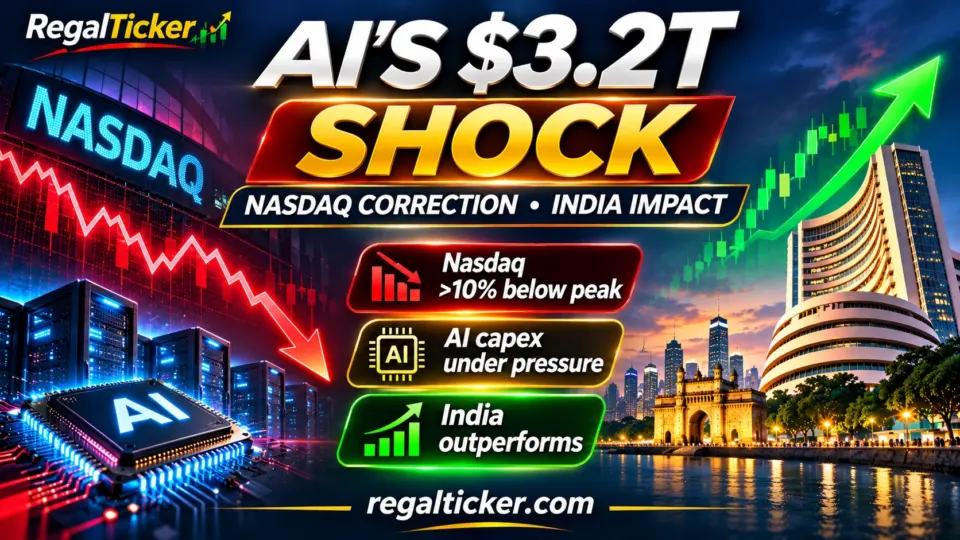
Reuters’ Morning Bid described the November 5 Wall Street rout as a roughly $3.2 trillion one-day market-value shock as investors reassessed the political, financial and economic assumptions behind the artificial-intelligence infrastructure boom. Separate Reuters reporting put the Nasdaq’s one-day loss at roughly $2.5 trillion and showed the index moving into correction territory, more than 10% below its recent peak.
The trigger was unusual. Democrats’ sweep of the U.S. midterm elections raised fears that data-centre construction could face tighter political scrutiny, while investors were already questioning whether years of extraordinary spending on chips, power, cloud infrastructure and specialised AI capacity can produce returns quickly enough.
Friday brought a rebound—Nasdaq gained 1.1% and the semiconductor index rose 4.2%—but the damage was not erased. Nasdaq still fell 3.4% for the week, its fourth consecutive weekly decline.
For Indian investors, the story is more interesting than “U.S. tech fell.”
India just posted its strongest equity week since 2021 while AI-heavy Asian markets suffered. That divergence raises a bigger question: could the global reassessment of AI capital intensity push more money toward India’s banks, industrials, consumer businesses and even selected IT services companies?
⚡ Quick answer
Is the AI boom over after the $3.2 trillion market shock?
No. The selloff shows that investors are becoming far less willing to fund AI growth at any price. OpenAI says it is still pressing ahead with U.S. data-centre expansion, Alphabet disclosed a $548 million Qualcomm stake and AI infrastructure demand remains substantial. What changed is the market’s tolerance for debt, political risk, weak free cash flow and uncertain returns. The next phase is likely to reward companies that can convert AI investment into revenue and cash flow rather than simply announcing larger capital budgets.
Key takeaways
Reuters’ Morning Bid described the November 5 Wall Street shock as roughly $3.2 trillion of market value erased in one session.
Separate Reuters reporting estimated roughly $2.5 trillion was wiped from Nasdaq market value during the selloff.
Nasdaq entered correction territory and remained more than 10% below its recent peak after Friday’s rebound.
Nasdaq fell 3.4% for the week, its fourth consecutive weekly decline.
The S&P 500 lost 2.7% for the week, its worst weekly performance in more than a year.
Semiconductor and technology indexes suffered their steepest one-day declines in more than six years during the rout.
Friday’s rebound did not resolve the core issue: investors are questioning returns on enormous AI infrastructure spending.
Political risk around data-centre construction has become a new valuation variable.
Strong U.S. jobs data lifted the implied probability of a December Fed rate hike to about 78%.
OpenAI says it will continue U.S. data-centre expansion despite the political shift.
Alphabet disclosed a roughly $548 million Qualcomm stake as Qualcomm pushes into data-centre AI chips.
Qualcomm targets about $15 billion of data-centre chip revenue by 2029.
India outperformed sharply as foreign investors rotated toward large financials and domestic-economy stocks.
Indian IT services are not the same trade as semiconductor makers or capital-intensive AI infrastructure operators.
The next test is whether AI revenue and free cash flow catch up with the capital already committed.
1. What actually caused the AI selloff
The market was already nervous before the U.S. midterm result.
For months, investors had been watching a familiar set of questions: how much capital hyperscalers will spend, how much of that spending will be financed with debt, how quickly new data centres will become productive, and whether AI revenue can grow fast enough to cover depreciation, power costs, financing and ongoing model-development expenses.
The Democratic sweep added a new concern: politics.
Reuters reported that investors began pricing the possibility of tighter scrutiny of data-centre construction, especially where power demand, grid stress, water consumption and local community opposition have become election issues.
That matters because the AI boom is unusually dependent on physical infrastructure. A software company can scale quickly. A hyperscale AI system needs chips, electricity, transmission, cooling, land, network capacity, financing and regulatory approval.
If any one of those bottlenecks tightens, project returns can fall even if end-user demand remains strong.
2. Why $3.2 trillion and $2.5 trillion are both being quoted
The numbers refer to different market measurements.
Reuters’ Morning Bid characterised the broader Wall Street shock as roughly $3.2 trillion of value lost in one session.
A separate Reuters equity-market report estimated that around $2.5 trillion was erased from Nasdaq market value.
Both figures describe the same broader repricing but should not be treated as identical measurements.
For investors, the exact trillion-dollar number is less important than what it represents: the market is now applying a much higher discount rate to long-dated AI profits.
3. Nasdaq’s correction changes the psychology of the AI trade
After Friday’s rebound, Nasdaq was still more than 10% below its recent peak.
That places the index in correction territory.
It also marked a fourth consecutive weekly decline, with Nasdaq down 3.4% for the week. The S&P 500 lost 2.7%, its worst weekly performance in over a year.
This changes investor behaviour.
When a theme is making new highs, markets reward narrative, market share and total-addressable-market estimates.
When a theme enters correction territory, attention shifts toward free cash flow, balance-sheet strength, financing needs, project returns, revenue visibility and valuation support.
That is exactly the transition RegalTicker’s earlier Hyperscaler AI Capex Cut analysis anticipated: a slowdown in enthusiasm does not require companies to slash spending. Investors can reprice the theme simply because the expected return on that spending becomes less certain.
4. The problem is not AI demand—it is capital intensity
This distinction is critical.
OpenAI CFO Sarah Friar said the company will continue expanding U.S. data centres despite the midterm result and growing scrutiny.
Alphabet disclosed a stake worth about $548 million in Qualcomm, supporting the chipmaker as it expands into data-centre AI processors.
Qualcomm has told investors it expects roughly $15 billion of data-centre chip revenue by 2029 and has already built relationships with Amazon, Microsoft and Meta.
Those facts do not support the idea that AI demand has collapsed.
They support a different conclusion: AI demand remains strong, but the cost of serving that demand is enormous.
S&P Global has estimated that six major hyperscalers could spend more than $7 trillion on AI-related infrastructure between 2025 and 2030.
When capital requirements reach that scale, the market no longer asks only whether revenue is growing. It asks whether the return on each additional dollar of capital remains attractive.
Investor note
A technology can win while its stocks still fall
A market correction does not prove AI adoption has failed. It can simply mean investors had priced future profits too aggressively relative to financing costs, capex, depreciation and execution risk. Strong technology demand and weaker stock returns can coexist for long periods.
5. Political risk has entered the AI valuation model
Until recently, the biggest constraints on AI infrastructure were usually described as technical: chips, power, grid access, cooling and construction capacity.
Now politics has become another variable.
Reuters reported that data-centre concerns featured prominently in U.S. campaigns, including in Texas.
OpenAI responded by saying it would stop using nondisclosure agreements with public officials during site discussions and would share more information about construction plans and local impacts.
For investors, political scrutiny can change a project’s economics through delays, higher compliance costs, community concessions, energy restrictions or more expensive location choices.
A data centre does not need to be cancelled to destroy value. A long delay or a higher power cost can be enough to lower the project’s return.
6. The Fed is adding another pressure point
The AI selloff is also happening as U.S. rates become less friendly.
Reuters reported that strong October payroll data pushed the market-implied probability of a December Fed rate hike to roughly 78%.
That matters most for long-duration growth assets.
AI companies and infrastructure projects often depend on profits expected many years into the future. When interest rates rise, those future profits are worth less in present-value terms. Higher rates also increase financing costs for debt-funded projects.
Tuesday’s U.S. CPI therefore matters directly to the AI trade.
A hotter inflation print could strengthen expectations for further tightening and put renewed pressure on high-valuation technology stocks.
7. Why India suddenly looks different
India had one of its strongest market weeks in years while AI-heavy markets sold off.
Reuters reported that Indian equities posted their best week in roughly six years as foreign investors returned, oil fell and large financials rallied.
That divergence is important.
For much of the AI boom, India’s lack of large listed semiconductor manufacturers, hyperscalers and data-centre operators looked like a disadvantage.
Now that same concentration is being questioned.
India offers a different equity mix: banks, consumer businesses, industrials, telecom, energy users, domestic infrastructure and IT services.
That diversification can become attractive when investors want to reduce exposure to one capital-intensive global theme.
The 6 November Daily Market Review showed this clearly: India rallied even as Japan, South Korea and Taiwan suffered sharp technology-led losses.
8. Does this mean Indian IT is safe?
No.
Indian IT services companies still depend heavily on U.S. corporate technology spending. If a technology correction turns into a broad economic slowdown, client budgets can weaken.
But the business model is different from the companies financing huge AI data centres.
Indian IT firms generally earn by helping enterprises implement, integrate, modernise and operate technology. They do not usually carry the same balance-sheet burden as hyperscalers, semiconductor fabs or specialist AI cloud providers.
That distinction can become valuable if enterprises continue adopting AI even while investors become more cautious about infrastructure spending.
The challenge for Indian IT is pricing. Clients may expect productivity gains from AI to reduce project headcount and billing rates.
So the investment question remains company-specific: which firms can convert AI into higher-value services rather than allowing automation to compress revenue?
9. India’s semiconductor opportunity also needs a more selective lens
The global selloff does not invalidate India’s semiconductor opportunity.
It changes how investors should evaluate it.
RegalTicker’s Intel and semiconductor-cycle analysis argues that India’s realistic opportunity is spread across chip design, advanced packaging and testing, electronics manufacturing, equipment and materials, power infrastructure, data centres and specialised engineering.
A correction in global AI valuations can actually improve discipline.
Projects with weak economics may be delayed. Projects tied to real demand, sovereign resilience or supply-chain diversification can still proceed.
That is healthier than assuming every semiconductor investment deserves a premium valuation.
10. Anthropic’s IPO has become a stress test for AI risk appetite
The selloff also matters for private-market exits.
Reuters has reported that Anthropic’s planned IPO has become increasingly important to the broader AI financing ecosystem.
If public investors remain willing to fund a large AI listing at a high valuation, it would show that risk appetite still exists for companies with strong growth narratives.
If the IPO is delayed, downsized or repriced, that would be a stronger signal that the correction is spreading from public stocks into private capital formation.
RegalTicker’s Anthropic IPO impact analysis explains why this matters beyond one company.
AI infrastructure is interconnected. Cloud providers fund data centres. Model companies sign long-term capacity agreements. Chipmakers depend on those orders. Energy suppliers build around projected load.
A financing slowdown at one point in the chain can affect the rest.
11. What would prove this is more than a normal correction?
Investors should watch evidence, not slogans.
A deeper structural slowdown would require several signals to appear together: hyperscalers formally lower capex guidance, major data-centre projects are cancelled rather than delayed, GPU orders are reduced, cloud utilisation weakens, AI revenue growth slows, financing costs rise materially, specialist cloud providers struggle to refinance, or large AI IPOs fail to attract demand.
Those would be stronger evidence than a 10%–15% market correction alone.
Conversely, the correction could stabilise if AI revenue continues accelerating, hyperscaler free cash flow improves, data-centre approvals continue, chip demand remains firm and investors become comfortable with the return profile.
The Friday rebound in semiconductors showed the market is already trying to find that balance.
12. What Indian investors should watch on Monday
The first signal is U.S. technology futures.
If the Friday rebound continues, Indian IT could receive support. If Nasdaq weakness resumes, the market may again favour banks, financials and domestic cyclicals over technology.
Second, watch foreign flows.
Reuters reported large foreign buying in India as the global AI trade cooled. Continued FII demand would support the idea that this is becoming an allocation shift rather than a two-day rotation.
Third, watch the rupee.
A stronger rupee improves returns for foreign investors and reinforces India’s relative appeal.
Fourth, watch crude.
India’s recent outperformance was helped by the sharp weekly fall in oil. A renewed Middle East spike could offset some of the benefit from AI-driven capital rotation.
Fifth, watch U.S. CPI on Tuesday.
A hot print would raise the risk that higher yields trigger another leg down in long-duration technology valuations.
Finally, separate Indian IT services from global AI infrastructure.
The two are connected, but they are not the same business model.
Frequently asked questions
Did AI stocks really lose $3.2 trillion in one day?
Reuters’ Morning Bid described the broader Wall Street shock as roughly $3.2 trillion of market value erased in a single session. Separate Reuters reporting estimated roughly $2.5 trillion was wiped from Nasdaq market value during the selloff.
Is Nasdaq in a correction?
Yes. After Friday’s rebound, Nasdaq was still more than 10% below its recent peak, which meets the standard definition of a market correction.
Is the AI boom over?
No. OpenAI says it is continuing data-centre expansion, major cloud companies are still investing heavily and chip demand remains substantial. The market is reassessing valuations and returns, not declaring AI demand dead.
Why did the selloff become so severe?
Investors were already worried about capex, debt and returns. The U.S. midterm result added political concerns around data-centre approvals, power demand and local opposition, while higher-rate expectations increased valuation pressure.
What happened to semiconductors?
Semiconductor and technology indexes suffered their steepest one-day declines in more than six years during the selloff. The semiconductor index rebounded 4.2% on Friday.
Why could India benefit?
India has much less direct exposure to capital-intensive AI infrastructure. If global investors reduce concentration in semiconductor and hyperscaler trades, Indian banks, industrials, consumer businesses and selected IT services can become relatively more attractive.
Will Indian IT benefit from the AI selloff?
Not automatically. Indian IT can benefit if enterprise AI adoption continues while infrastructure spending becomes more disciplined, but a broader U.S. slowdown or pricing pressure could still hurt demand.
What is the next major global trigger?
U.S. CPI data on Tuesday is important because stronger inflation could reinforce expectations for a December Fed rate hike and place fresh pressure on high-valuation technology stocks.
Verify through official sources
Official references
- Reuters — AI selloff Morning Bid — Reuters’ summary of the roughly $3.2 trillion Wall Street shock and AI/data-centre concerns.
- Reuters — Wall Street week ahead — Nasdaq correction, semiconductor/technology losses, U.S. CPI and Fed-rate expectations.
- Reuters — Nasdaq Friday rebound — Friday rebound, weekly Nasdaq/S&P performance, semiconductor bounce and 78% December hike probability.
- Reuters — Nasdaq market-value loss — Roughly $2.5 trillion Nasdaq loss and data-centre political risk after the U.S. midterms.
- Reuters — OpenAI data centres — OpenAI’s decision to continue U.S. data-centre expansion despite political scrutiny.
- Reuters — Alphabet and Qualcomm — Alphabet’s roughly $548 million Qualcomm stake and Qualcomm’s data-centre chip ambitions.
- Reuters — India market rotation — India’s relative outperformance, financial-sector leadership and Asian technology selloff.
- Reuters — India foreign inflows — Foreign capital rotation into India as oil fell and the AI trade cooled.
- Reuters — AI financing risk — Financing needs, valuation uncertainty and projected multi-trillion-dollar hyperscaler infrastructure spending.
Educational disclaimer: This article is for education and general market information only. It is not investment advice or a recommendation to buy, sell or hold any security, sector, index or fund. Market-value-loss estimates can differ depending on the index or universe measured. Technology valuations, interest-rate expectations and political outcomes can change rapidly. Verify current company, exchange, regulator and market disclosures before making financial decisions.
Final takeaway
The AI correction is a return-on-capital test, not a verdict on the technology
The most important conclusion from the $3.2 trillion shock is not that artificial intelligence has stopped growing.
It is that investors are no longer willing to assume every dollar of AI spending will earn an attractive return.
OpenAI is still building. Alphabet is still investing. Qualcomm is still targeting large data-centre revenue. Enterprise adoption is still expanding.
But financing, political scrutiny, higher interest rates and weaker free cash flow now matter much more to valuation.
For India, that shift can be relatively positive because the market is less concentrated in the most capital-intensive parts of the AI trade.
The opportunity is not to celebrate a U.S. technology crash. It is to understand where global capital goes when the market starts demanding cash flow instead of just capacity.
If the AI correction stays concentrated in expensive infrastructure names while India continues attracting foreign flows, the rotation can last.
If the correction becomes a global liquidity shock, India will eventually feel it too.
That is the distinction investors should watch next.


