

China’s slowdown is both a risk and an opportunity for Indian industry
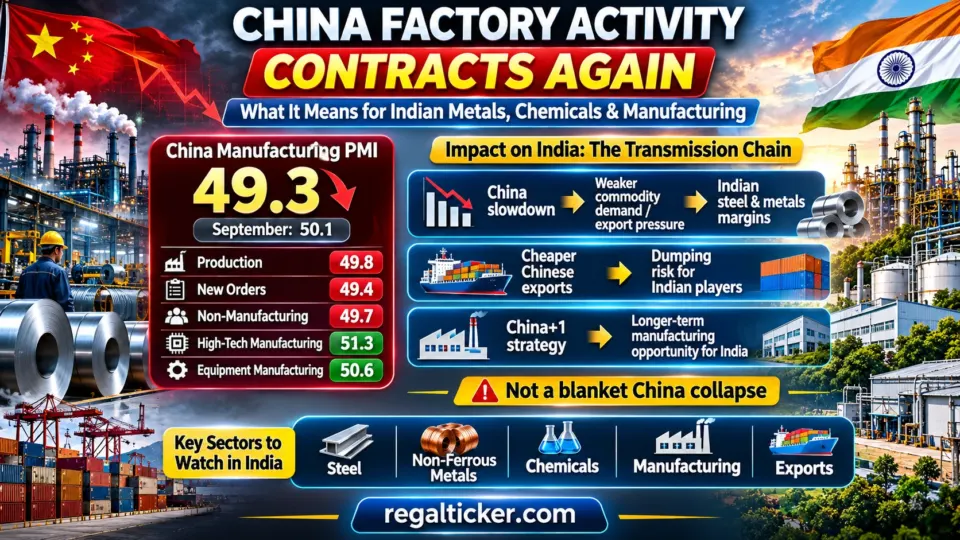
China’s official manufacturing PMI fell to 49.3 in October from 50.1 in September, dropping back below the 50-point line that separates expansion from contraction.
The headline is weak, but the detail matters more. Production fell to 49.8, new orders to 49.4, medium-sized manufacturers to 48.4 and small manufacturers to 47.5. China’s non-manufacturing business-activity index also slipped below 50 to 49.7.
That is a broad loss of momentum after September’s brief return to expansion.
But this is not a simple “China is collapsing” story. China’s high-tech manufacturing PMI remained at 51.3, while equipment manufacturing stayed at 50.6. Aerospace, shipbuilding, computers and communications equipment were among the stronger areas. The weakness was heavier in traditional manufacturing, construction-linked industries and parts of non-ferrous processing.
For India, that creates two opposing forces.
In the short term, weaker Chinese demand can pressure global commodity prices and encourage Chinese producers to push more output into export markets. That can hurt Indian steel, metals and chemical margins.
Over a longer horizon, companies looking to reduce dependence on China can accelerate sourcing and manufacturing diversification into India.
The investor question is therefore not “Is a weak China good or bad for India?” It is which transmission channel dominates for each Indian industry.
⚡ Quick answer
What does China’s October PMI slowdown mean for Indian stocks?
The clearest near-term risk is import and pricing pressure. India’s finished-steel imports rose 29.5% year on year in April–August, with China supplying 31.8% of the total. If weak Chinese domestic demand pushes more steel, chemicals or manufactured goods into export markets, Indian producers can face lower realised prices and tighter margins. The longer-term opportunity is China+1: global buyers continue to diversify supply chains into India, especially in chemicals, electronics, semiconductors and specialised manufacturing. Investors should separate commodity-price exposure from genuine supply-chain relocation.
Key takeaways
China’s official manufacturing PMI fell to 49.3 in October from 50.1 in September.
Production fell to 49.8 and new orders to 49.4, both below the expansion line.
Medium and small manufacturers weakened more sharply than large enterprises.
Non-manufacturing activity also slipped below 50 to 49.7.
High-tech manufacturing remained in expansion at 51.3 and equipment manufacturing at 50.6.
The slowdown is therefore uneven, not a broad collapse across every Chinese industry.
India’s finished-steel imports rose 29.5% year on year in April–August 2026.
China supplied 31.8% of those finished-steel imports, making it India’s largest source.
More aggressive Chinese exports could pressure Indian steel margins even if domestic demand remains healthy.
Indian chemicals face a two-sided impact
China is an important export market, but China+1 can shift global sourcing toward Indian suppliers.
Copper should not be treated as a simple China-slowdown trade because current AI/data-centre demand and tight Chinese inventories are supporting the market.
The longer-term India opportunity lies in supply-chain diversification, not in assuming every Chinese contraction automatically benefits Indian manufacturers.
1. What China’s October PMI is actually telling us
China’s National Bureau of Statistics reported a manufacturing PMI of 49.3 for October, down 0.8 percentage points from September.
The internal data shows weakening on both the supply and demand sides.
The production index dropped to 49.8 from 51.7. New orders fell to 49.4 from 50.5. Large companies remained slightly expansionary at 50.2, but medium and small companies fell to 48.4 and 47.5 respectively.
That suggests the slowdown is not only an export problem. Domestic demand is soft enough to affect smaller manufacturers more severely.
Reuters also noted that some demand had been brought forward into September ahead of the October holiday period, making the month-on-month deterioration look sharper.
The correct interpretation is therefore slower momentum, not a sudden industrial collapse.
2. China’s high-tech economy is still expanding
The most important counterpoint is that advanced manufacturing did not contract with the headline PMI.
China’s high-tech manufacturing PMI stood at 51.3 and equipment manufacturing at 50.6.
The National Bureau of Statistics said railway, shipbuilding, aerospace, computer, communications and electronic-equipment industries continued to show relatively strong production and order activity.
This distinction matters for Indian investors.
China can experience weak property, traditional industrial and consumer demand while still investing heavily in AI, electronics, advanced machinery and strategic manufacturing.
That is why investors should avoid treating one PMI number as a universal signal for every commodity or industry.
RegalTicker’s India semiconductor analysis reaches a similar conclusion from the Indian side: global supply chains are becoming more fragmented and strategic, not simply moving from one country to another overnight.
3. Steel is the clearest near-term risk for India
Steel is where the China-to-India transmission is already visible.
India imported 3.5 million tonnes of finished steel between April and August 2026, up 29.5% year on year. China accounted for 31.8% of those imports, the largest share of any supplying country.
India has already imposed safeguard duties of up to 11.5% on certain steel products and opened anti-dumping investigations covering hot-rolled steel from China, Japan and Russia.
Yet imports have continued to rise.
If Chinese domestic factory activity remains weak, Chinese mills have an incentive to protect utilisation by exporting more aggressively.
For Indian steelmakers, that can mean:
- greater import competition;
- lower domestic pricing power;
- pressure on spreads;
- inventory risk; and
- more dependence on government trade measures.
Domestic infrastructure and automobile demand can cushion that pressure, but they do not eliminate it.
This is why the India container-manufacturing scheme is relevant. Government-backed manufacturing can create new domestic steel demand, but imported finished products can still affect pricing and margins across the wider industrial chain.
4. Lower Chinese demand does not automatically mean lower metal prices
A common shortcut is:
China slows → commodities fall → Indian metal stocks fall.
That relationship is often directionally useful, but it is becoming less reliable.
Copper is a good example.
China’s manufacturing slowdown would normally weaken the demand outlook for copper. Yet copper prices have been trading near record levels because AI data centres, electrification and constrained global supply are creating separate structural demand.
Chinese exchange copper inventories are also unusually low, while import premiums have been elevated.
So investors need to separate metals.
Steel and some aluminium products may face stronger export-pressure risk from China. Copper is currently being driven by a more complicated mix of AI infrastructure, grid spending, inventories, tariffs and mine supply.
The right approach is sector-by-sector rather than using one China macro signal for every metal producer.
5. Chemicals face a genuine two-sided China effect
India’s chemical sector illustrates why the China story cannot be reduced to one direction.
China is an important customer. IBEF data shows China was among the largest destinations for Indian chemical exports, with exports of roughly $618 million during April–June FY27 across the categories tracked.
If Chinese factory demand weakens, Indian exporters can face slower volumes, lower pricing or both.
But China is also India’s biggest strategic competitor and one of the main reasons global companies are diversifying supply chains.
The China+1 opportunity supports Indian specialty chemicals, intermediates, dyes, agrochemicals and contract manufacturing when buyers want a second source outside China.
That creates a tension:
weak China demand can hurt Indian exports today, while supply-chain diversification can create Indian contracts tomorrow.
Investors should therefore focus on customer concentration, product differentiation, contract duration and pricing power rather than buying the entire specialty-chemicals sector on a China+1 narrative.
6. Cheap Chinese exports can delay the China+1 benefit
There is an uncomfortable feature of manufacturing slowdowns.
When domestic demand falls, factories do not immediately shut down. Many try to preserve utilisation by selling more overseas.
That can make Chinese exports more competitive just when investors expect India to benefit from supply-chain relocation.
Indian manufacturers can therefore face a period where:
- long-term sourcing discussions improve;
- new factories are announced;
- customers talk about diversification;
- but Chinese export prices become more aggressive.
The result can be strong volume expectations but weak margins.
This is especially important in commoditised products where Indian companies have little brand or technological differentiation.
China+1 works best for India where customers value reliability, engineering, intellectual property, compliance, geographic diversification or specialised manufacturing—not simply the lowest spot price.
7. Electronics and semiconductors are a different case
China’s high-tech PMI remaining above 50 tells investors something important: China is still competing aggressively in the sectors India wants to build.
India’s semiconductor, electronics and advanced-manufacturing opportunity is therefore not based on China becoming weak.
It is based on governments and companies wanting additional manufacturing locations for strategic resilience.
That is a much stronger thesis.
India can gain semiconductor packaging, electronics assembly, components and power-electronics investment even if Chinese electronics production keeps growing.
The India semiconductor boom feature should therefore be read as a diversification story, not a China-replacement story.
That distinction protects investors from assuming every negative Chinese data point automatically raises Indian semiconductor earnings.
8. What weaker China could mean for Indian exporters
China affects Indian exporters through both demand and competition.
On the demand side, weaker Chinese manufacturing can reduce purchases of raw materials, chemicals and industrial inputs.
On the competition side, excess Chinese production can enter third-country markets at lower prices, forcing Indian exporters to compete harder in Southeast Asia, the Middle East, Europe and other markets.
A company can therefore have little direct China revenue and still be affected by China.
The pressure can arrive through global selling prices.
That is why investors should look beyond geographic revenue disclosure and ask:
- Who sets the global price?
- Is China a major producer?
- Is the product commoditised?
- Can Chinese producers redirect exports quickly?
- Does the Indian company have contracts or differentiated products?
Those questions are more useful than simply measuring direct sales to China.
9. The slowdown can still support India’s manufacturing strategy
The longer-term opportunity remains real.
Global manufacturers are trying to reduce dependence on a single country for critical inputs and production.
India offers scale, domestic demand, improving infrastructure and policy support across electronics, chemicals, semiconductors, logistics and industrial manufacturing.
But supply chains move slowly.
Customers need qualified suppliers, testing, tooling, stable quality, delivery reliability and competitive cost structures.
That means the China+1 benefit should show up gradually in:
- customer wins;
- export growth;
- capacity utilisation;
- better product mix;
- improving margins; and
- stronger cash generation.
The Fundamental Analysis guide is useful here because the investment test remains whether the theme becomes measurable business performance.
10. What investors should watch next
The first signal is China’s next set of PMI and industrial-production data. One weak month can reverse quickly; repeated sub-50 readings would be more meaningful.
Second, watch Chinese export volumes and export prices in steel, chemicals and industrial products.
Third, watch India’s steel-import data. Continued import growth despite safeguard duties would increase pressure on domestic producers.
Fourth, monitor trade-policy responses. Anti-dumping actions, safeguard duties and quality-control rules can materially alter the transmission from China to Indian margins.
Fifth, follow Indian exporters’ management commentary. The strongest evidence of China+1 is not a policy slogan but new customers, multi-year contracts and rising utilisation.
Sixth, separate cyclical commodity weakness from structural industrial opportunity.
Finally, check cash flow. Companies can report strong order books while inventory and receivables absorb cash. RegalTicker’s Cash Flow Statement guide helps test whether manufacturing growth is creating cash or merely consuming working capital.
Investor note
Do not buy “China+1” without checking pricing power
A company can win more orders and still earn poor returns if Chinese competitors cut prices aggressively. Volume growth, gross margins, working capital and return on capital should be read together.
Frequently asked questions
What was China’s manufacturing PMI in October 2026?
China’s official manufacturing PMI fell to 49.3 from 50.1 in September. A reading below 50 indicates month-on-month contraction.
Is China’s entire manufacturing economy contracting?
No. High-tech manufacturing remained in expansion at 51.3 and equipment manufacturing at 50.6. Weakness was concentrated more heavily in traditional manufacturing and construction-linked areas.
Why does weaker Chinese manufacturing matter to Indian steel companies?
Weak domestic Chinese demand can encourage mills to export more aggressively. China already supplied 31.8% of India’s finished-steel imports in April–August 2026, so additional exports can pressure Indian prices and margins.
Does a China slowdown benefit Indian chemical companies?
It can help through China+1 supply-chain diversification, but weaker Chinese demand can also hurt Indian chemical exports and Chinese producers can compete more aggressively in global markets.
Will all metal prices fall if China slows?
No. Commodity markets have different supply-demand structures. Copper, for example, is also being supported by AI data-centre and grid demand, tight inventories and constrained mine supply.
What is China+1?
China+1 is a supply-chain strategy in which companies retain Chinese production but add manufacturing or sourcing capacity in another country to reduce concentration risk.
Which Indian sectors could gain from China+1?
Potential areas include electronics, semiconductors, specialty chemicals, industrial components, pharmaceuticals, textiles and other manufacturing. Actual benefits depend on contracts, cost competitiveness and execution.
What should investors monitor after this PMI release?
Watch future PMI data, Chinese export volumes and prices, India’s import data, trade-policy measures and Indian companies’ order, margin and cash-flow commentary.
Verify through official sources
Official references
- National Bureau of Statistics of China — October 2026 PMI — Official October manufacturing, non-manufacturing and composite PMI readings and sub-indexes.
- National Bureau of Statistics of China — October PMI interpretation — Official explanation of sector-level strength and weakness, including high-tech and equipment manufacturing.
- Reuters — China factory activity shrinks in October — Current reporting on the PMI decline, weak demand, export orders and China’s growth outlook.
- Reuters — India steel ministry and rising cheap imports — Current data on India’s finished-steel imports, China’s 31.8% share and existing safeguard/anti-dumping actions.
- Reuters — Copper at LME Week — Current context on record copper prices, AI/data-centre demand and tight Chinese inventories.
- Reuters — Chinese aluminium producers expand abroad — Current evidence of Chinese industrial capacity moving overseas and potential future aluminium supply pressure.
- IBEF — India Chemicals Industry — India chemical-sector size, China+1 opportunity and current trade context.
- IBEF — Chemicals Exports from India — Current chemical export destinations including China and April–June FY27 export values.
Final takeaway
A weaker China is not automatically a stronger India
China’s October PMI is a warning that traditional factory demand has lost momentum again.
For India, the first effect may actually be uncomfortable. Weak Chinese demand can push more steel, chemicals and manufactured goods into export markets, making competition harder and squeezing margins.
The longer-term opportunity is different. Companies around the world still want more resilient supply chains, and India is one of the few countries with enough domestic demand, engineering capacity and policy support to become a meaningful second manufacturing base.
Those two forces can exist at the same time.
The investor edge is to identify companies that can survive Chinese price competition today while winning diversified global business tomorrow.
Educational disclaimer: RegalTicker provides educational and informational content only. This article is not investment advice or a recommendation to buy or sell any steel, metals, chemicals, manufacturing or export-oriented security. PMI readings are monthly indicators and can reverse quickly. Commodity prices, trade measures, exchange rates, company exposure and global demand can change materially. Verify current company filings, government trade data and exchange disclosures before making financial decisions.


