

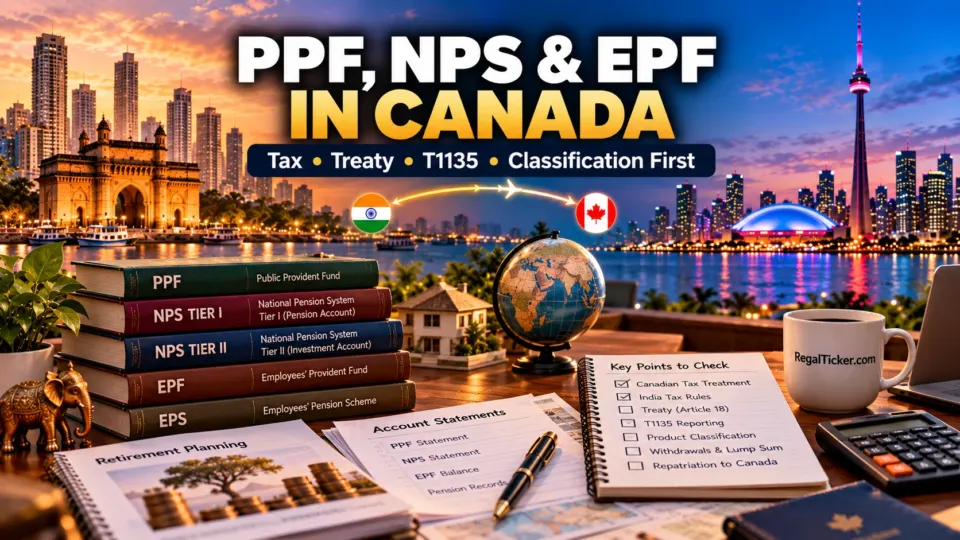
Five Familiar Indian Products Can Become Five Different Canadian Tax Questions
PPF, NPS, EPF and EPS are often discussed together because they all sit somewhere in the long-term savings or retirement conversation in India.
Canada does not automatically treat them as one family.
PPF is a government-backed savings scheme. NPS Tier I is formally an Individual Pension Account. NPS Tier II is expressly an investment account and not a pension account. EPF is an employment provident fund. EPS is a pension scheme.
That distinction matters because the India–Canada tax treaty gives special treatment to pensions arising in India, while Canadian foreign-property reporting has separate exclusions for certain pension or retirement trusts. Neither rule should be applied just because an Indian product has the word “provident”, “pension” or “retirement” in its name.
The safest workflow is therefore:
classify the product first → determine the Canadian tax treatment → test treaty relief → test T1135 separately → then plan the withdrawal or remittance.
⚡ Quick answer
Are PPF, NPS and EPF Tax-Free in Canada?
There is no single answer for all three. Canada’s treaty with India says pensions arising in India are taxable only in India, but the treaty does not turn every Indian tax-favoured savings product or lump-sum withdrawal into pension income. NPS Tier I has a formal pension character, while NPS Tier II is officially an investment account and not a pension account. EPS is a recognised pension scheme under the Canada–India Social Security Agreement, while an EPF lump sum can require separate classification. PPF is a government savings scheme and should not be assumed to fall under the pension article automatically. T1135 also requires a separate legal-structure analysis rather than a blanket “yes” or “no.”
Key takeaways
Classification comes before taxation.
PPF, NPS Tier I, NPS Tier II, EPF and EPS should not be treated as interchangeable.
India’s PPF rules say NRIs cannot open a new PPF account; an account opened while resident can generally continue to maturity on a non-repatriation basis.
NPS Tier I is officially the Individual Pension Account.
NPS Tier II is officially an optional investment account and is not a pension account.
Current NPS guidance says NRIs/OCIs are eligible for Tier I but not Tier II.
The India–Canada treaty says pensions arising in India are taxable only in India.
CRA says foreign pension income is generally reported on line 11500, with a possible line 25600 deduction where a treaty makes the pension tax-free in Canada.
The treaty pension article should not automatically be extended to a PPF balance, NPS Tier II account or every EPF lump-sum withdrawal.
The Canada–India Social Security Agreement specifically coordinates benefits involving India’s Employees’ Pension Scheme (EPS), 1995.
EPF and EPS are related Indian employment-retirement arrangements, but they are not the same benefit.
Canadian T1135 rules exclude certain qualifying foreign pension/retirement trusts, but the exclusion depends on legal structure and conditions.
Canada’s statutory definition of a “foreign retirement arrangement” is narrow and currently prescribes specified U.S. IRA-type arrangements; Indian products should not simply be labelled that way.
Do not assume Indian tax-free accumulation automatically creates Canadian tax deferral.
Keep arrival-date values, contributions, annual statements and withdrawal documents before taking money out.
1. Build the Classification Table Before You Build the Tax Return
The quickest way to make a mistake is to begin with the Indian tax result.
A Canadian resident needs a product map first.
| Product | Indian character | First Canadian question |
|---|---|---|
| PPF | Government savings scheme | Savings/investment treatment; treaty pension status not automatic |
| NPS Tier I | Individual Pension Account | Pension/treaty/trust classification |
| NPS Tier II | Optional investment account | Investment treatment; do not import Tier I treatment |
| EPF | Employment provident fund | Fund/lump-sum classification |
| EPS | Employees’ Pension Scheme | Pension/treaty/social-security treatment |
That table is more useful than asking whether “Indian retirement accounts are tax-free in Canada.”
They are not one account.
2. PPF: A Tax-Favoured Indian Savings Scheme, Not Automatically a Treaty Pension
Official Indian PPF rules say a non-resident Indian is not eligible to open a new PPF account.
If a resident opened the account and later became non-resident during the account’s term, the account can generally continue until maturity on a non-repatriation basis and cannot be extended for another block under the NRI rule.
India treats PPF very favourably: current official tax guidance describes the interest and qualifying withdrawal as exempt in India.
That still does not answer the Canadian question.
PPF is a self-funded government savings arrangement rather than an employment pension paid in consideration of past service. The India–Canada treaty pension article should therefore not be applied simply because PPF is long-term and tax-favoured.
For Canada, the account’s legal structure, income character and foreign-property status need to be reviewed on their own terms.
Investor note
“EEE in India” Is Not a Canadian Tax Category
Indian exemption on contribution, accumulation or withdrawal does not automatically create the same result in Canada. Preserve the PPF statement and legal terms rather than relying on the Indian tax label.
3. NPS Tier I Has the Strongest Pension Character
The Government of India describes NPS as a defined-contribution pension system.
Tier I is formally the Individual Pension Account and carries the retirement restrictions and Indian tax incentives associated with NPS.
Current official guidance says NRIs and OCIs can subscribe to NPS Tier I, subject to eligibility and KYC rules.
That gives Tier I a much stronger argument for pension analysis than PPF or Tier II.
But even here, do not jump directly from “pension account” to “nothing is taxable in Canada.”
A Canadian adviser still needs to determine:
- how the plan is classified under Canadian law;
- whether a payment is a pension for treaty purposes;
- whether a lump sum is treated the same way as a periodic pension;
- whether any trust reporting exclusion applies; and
- how a later annuity is treated.
The Indian product label is strong evidence.
It is not the end of the Canadian analysis.
4. NPS Tier II Must Be Kept Separate From Tier I
Official Indian guidance is unusually clear:
Tier II is not a pension account.
It is an optional investment account linked to an active Tier I account and allows unrestricted withdrawals.
Current guidance also says NRIs and OCIs are not eligible for Tier II.
That means a Canadian resident who still has an old Tier II balance should not simply apply every Tier I treaty or pension conclusion to it.
The legal ownership, underlying investments, income and reporting position need their own review.
This distinction is particularly important for T1135.
A product that is genuinely an investment account can produce a different specified-foreign-property analysis from a qualifying pension or retirement trust.
5. EPF and EPS Are Related — but They Are Not the Same Benefit
Indian employment retirement savings often get compressed into the phrase “PF pension.”
That can hide two different systems.
EPF
The Employees’ Provident Fund is a funded employment provident arrangement. Depending on the employee’s contribution history and Indian rules, a later payment can be a lump-sum provident-fund withdrawal.
EPS
The Employees’ Pension Scheme, 1995 is a pension scheme.
Canada’s official India social-security page specifically recognises EPS for pension coordination under the Canada–India Social Security Agreement.
That agreement can help people combine qualifying periods and receive eligible pension benefits across borders.
It does not automatically convert every EPF lump sum into an EPS pension.
So for Canadian tax purposes, separate:
EPF withdrawal from EPS pension
before looking at the treaty.
6. Article 18 of the India–Canada Treaty Is Powerful — but Only for a Pension
The India–Canada income-tax treaty states:
Pensions arising in a Contracting State shall be taxable only in that State.
For a pension arising in India, that can mean India has the exclusive taxing right.
CRA’s current foreign-pension guidance tells Canadian residents to report foreign pension income on line 11500 and notes that a deduction on line 25600 may be available where a tax treaty makes the foreign pension tax-free in Canada.
That is valuable treaty relief.
The difficult part is identifying whether the payment is actually a pension for treaty purposes.
A periodic EPS pension is much easier to place inside the pension framework than:
- PPF maturity proceeds;
- an NPS Tier II withdrawal;
- an EPF lump sum; or
- a mixed NPS exit containing both lump sum and annuity components.
Do not claim Article 18 from the acronym.
Classify the payment.
7. NPS Exit: Separate the Lump Sum From the Annuity
Indian tax law itself already separates the NPS exit into components.
Current Income Tax Department guidance says:
- yearly return on the NPS corpus is tax-free in India;
- qualifying partial withdrawals receive specified relief;
- up to 60% of the corpus received on closure/opting out is exempt in India; and
- pension or annuity received from NPS is taxable in India.
For a Canadian resident, that split should also trigger separate Canadian questions.
The annuity looks much more like pension/annuity income.
The lump sum may require a different treaty and domestic-law classification.
A good file therefore separates:
- subscriber contributions;
- employer contributions;
- investment growth;
- lump-sum exit amount;
- annuity purchase amount;
- annuity payments; and
- Indian tax actually paid.
Do not record “NPS withdrawal: ₹X” as one undifferentiated line.
8. EPF Lump Sums Need Their Own Classification
Indian tax law can exempt an EPF lump sum when the relevant recognised-provident-fund conditions are satisfied, including qualifying service situations.
Current Income Tax Department guidance also notes TDS on taxable EPF withdrawals before five years of continuous service when the statutory threshold is crossed.
That is the Indian result.
For Canada, the key question remains what the payment represents under Canadian law and the treaty.
A provident-fund lump sum should not be labelled an Article 18 pension merely because part of the Indian retirement system produced it.
Likewise, the fact that India exempts a qualifying EPF withdrawal does not by itself make the same payment exempt in Canada.
This is an area where individual advice is worth more than a generic internet answer.
9. T1135: Do Not Automatically Include or Automatically Exclude the Balance
Canada’s specified-foreign-property rules contain exclusions for certain foreign pension and retirement trusts.
CRA’s current guidance says an interest in a foreign trust can be excluded where it is:
- governed by a foreign retirement arrangement; or
- a qualifying tax-exempt foreign trust principally established to administer or provide pension, superannuation, retirement or employee benefits and meeting the other statutory conditions.
But there is an important technical catch.
The Canadian Income Tax Regulations’ prescribed definition of a foreign retirement arrangement currently points to specified U.S. IRA-type arrangements.
That means an Indian plan should not casually be called a “foreign retirement arrangement” for Canadian purposes.
An Indian NPS or EPF trust may instead need to be tested under the separate qualifying-trust exclusion.
PPF may present a different structure again.
So the correct T1135 answer is:
classify the legal arrangement first, then test the exclusion.
Your live T1135 for Indian Assets guide explains the CAD100,000 aggregate cost test and newcomer exception. This article only deals with whether these retirement/savings products belong in that calculation.
10. Do Not Assume Indian Tax-Free Growth Means Canadian Tax Deferral
This is the area where online articles tend to become too confident.
India can exempt growth inside PPF, NPS and qualifying provident funds.
Canada has its own rules for:
- foreign pensions;
- trusts;
- investment income;
- distributions;
- treaty-exempt pension income; and
- specified foreign property.
Without first identifying which Canadian rule applies, it is unsafe to say either:
“Canada taxes all the annual growth.”
or:
“Canada taxes nothing until withdrawal.”
The plan’s legal structure, contribution source, benefit type and treaty character matter.
For a material balance, the Canadian tax file should contain a written classification position rather than a label copied from a bank or competitor blog.
11. The Canada–India Social Security Agreement Is Not the Tax Treaty
Canada and India also have a Social Security Agreement, effective since August 1, 2015.
Its purpose is different from the income-tax treaty.
The social-security agreement coordinates pension coverage and benefit eligibility. Canada specifically references contributions under India’s EPS, 1995 and explains how qualifying periods can help with Canadian or Indian pension eligibility.
That does not decide:
- whether PPF is taxable in Canada;
- whether an EPF lump sum is treaty-exempt;
- whether NPS Tier II is a pension; or
- whether an account belongs on T1135.
Think of the two agreements separately:
Social Security Agreement → coverage, eligibility, totalisation and pension coordination
Income-tax treaty → which country can tax qualifying income or pension payments
12. Newcomers Should Build the Retirement File on Arrival
Someone moving to Canada with these products should preserve a snapshot before the first Canadian return.
For each account, record:
| Product | What to preserve |
|---|---|
| PPF | Opening date, maturity date, contributions, annual interest, arrival value |
| NPS Tier I | PRAN, contribution history, employer/self contributions, scheme value, arrival value |
| NPS Tier II | Units, underlying scheme, cost history, arrival value |
| EPF | Employer/service history, employee/employer contributions, interest, balance |
| EPS | Pensionable service, pension entitlement, benefit statements |
Also keep:
- Canadian residency start date;
- fair market value in CAD at arrival;
- INR/CAD conversion support;
- Indian tax treatment;
- later withdrawals;
- treaty position used on the Canadian return; and
- T1135 analysis.
The first-year newcomer exception can affect T1135 filing, but arrival values still matter for later foreign-property reporting.
13. A Practical Withdrawal Checklist
Before closing or withdrawing from any of these products, answer the questions in this order.
Product
- Is this PPF, NPS Tier I, NPS Tier II, EPF or EPS?
- Is the payment periodic or lump sum?
- Is there an annuity component?
India
- What is exempt in India?
- What is taxable?
- Will TDS apply?
- What documentation will the institution issue?
Canada
- Is this pension income?
- Does Article 18 apply?
- Is line 11500 reporting required?
- Is a line 25600 treaty deduction available?
- Is any non-pension component taxable differently?
- Does the account remain relevant to T1135 before withdrawal?
Banking
- Where will the payout land?
- Is it repatriable directly?
- Will it move through NRO?
- What source-of-funds documents will Canada/India banks need?
RegalTicker’s NRI Repatriation from India guide covers the Indian remittance routes.
Long-lived retirement records deserve the same discipline as long-lived securities records. RegalTicker’s Demerger Cost Basis Calculator is a useful reminder that a future tax event often depends on documents created years earlier.
Frequently asked questions
Is PPF tax-free in Canada?
Do not assume that the Indian PPF exemption automatically applies in Canada. PPF is a government savings scheme and should be classified under Canadian law rather than automatically treated as a treaty pension.
Can an NRI open a new PPF account?
Official PPF rules say NRIs are not eligible to open a new account. An account opened while resident can generally continue to maturity on a non-repatriation basis, subject to the scheme rules.
Is NPS Tier I a pension account?
Yes. Official Government of India and PFRDA guidance describes Tier I as the Individual Pension Account.
Is NPS Tier II also a pension account?
No. Official guidance explicitly describes Tier II as an optional investment account and says it is not a pension account.
Can NRIs hold NPS Tier II?
Current official guidance says NRIs/OCIs are not eligible for Tier II.
Does the India–Canada tax treaty exempt Indian pensions from Canadian tax?
Article 18 says pensions arising in India are taxable only in India. The key question is whether the particular payment qualifies as a pension for treaty purposes.
How does CRA report a foreign pension that is treaty-exempt?
CRA says foreign pension income is generally reported on line 11500 and a deduction may be available on line 25600 where a treaty makes the amount tax-free in Canada.
Is EPS clearly a pension?
EPS is India’s Employees’ Pension Scheme, and Canada’s official India Social Security Agreement page specifically recognises EPS pension coverage.
Is an EPF lump sum automatically an Article 18 pension?
Do not assume so. EPF is a provident-fund arrangement and a lump-sum withdrawal requires its own Canadian and treaty classification.
Does NPS go on T1135?
There is no safe blanket answer. Canadian law excludes certain qualifying foreign pension/retirement trusts, but the exact NPS legal structure and conditions should be tested before including or excluding it.
Does PPF go on T1135?
PPF should be classified from its actual legal structure. It should not automatically be excluded merely because it is tax-favoured in India, nor automatically included without reviewing the Canadian specified-foreign-property rules.
Is all PPF/NPS/EPF growth taxable annually in Canada?
A blanket answer is unsafe. Canadian current-income treatment depends on how the arrangement is legally classified and whether pension, trust, investment or treaty rules apply.
What happens to NPS at exit in India?
Current Indian guidance generally exempts up to 60% of the corpus on qualifying closure/opting out, while pension/annuity income is taxable in India. Canadian classification should be reviewed separately.
Does the Canada–India Social Security Agreement decide Canadian income tax?
No. It coordinates social-security coverage and pension eligibility. The income-tax treaty and Canadian domestic tax rules determine income-tax treatment.
Verify through official sources
Official references
- Income Tax Department, India — India–Canada Comprehensive Agreement — Article 18 rule that pensions arising in a Contracting State are taxable only in that State.
- Canada Revenue Agency — Line 11500 Other Pensions and Superannuation — Foreign pension reporting and treaty deduction guidance.
- Canada.ca — India Pensions and Benefits — Canada–India Social Security Agreement and EPS pension coordination.
- Canada Revenue Agency — T1 Guide Specified Foreign Property Exclusions — T1135 exclusions for certain foreign pension and retirement trusts.
- Canada — Income Tax Regulations Section 6803 — Prescribed definition of foreign retirement arrangement.
- Department of Financial Services, India — National Pension System All Citizen Model — Official NPS Tier I/Tier II character, NRI eligibility and withdrawal framework.
- PFRDA — NPS All Citizen Model FAQ — Official statement that Tier I is the pension account and Tier II is not a pension account.
- National Savings Institute — Public Provident Fund Scheme — PPF NRI eligibility and continuation rules.
- Income Tax Department, India — Tax-Free Incomes — Current Indian PPF and provident-fund tax treatment.
- Income Tax Department, India — Taxability of Retirement Benefits — Current Indian NPS accumulation, withdrawal and pension-tax treatment.
- Income Tax Department, India — TDS on EPF Withdrawal — Current Indian EPF withdrawal/TDS rules.
- Employees’ Provident Fund Organisation — Social Security Agreement Handbook — Indian international-worker and social-security-agreement framework.
Educational disclaimer: This guide is for investor education and general Canada–India tax awareness. It is not individual Canadian or Indian tax, treaty, pension, T1135, legal or investment advice. PPF, NPS, EPF and EPS treatment can depend on the exact plan, trust structure, employment history, payment type, tax residency, treaty position and tax year. Material balances and withdrawals should be classified professionally before filing.
Final takeaway
Classify the Product Before You Claim the Tax Result
PPF, NPS, EPF and EPS may all sit in the retirement drawer, but Canada does not tax acronyms.
The clean sequence is:
identify the exact product → determine whether it is savings, investment, provident fund or pension → classify the payment → test Article 18 → test T1135 separately → preserve Indian tax records → plan the withdrawal and remittance.
That process is slower than copying a one-line answer from the internet.
It is also much safer.