India’s space story used to be easy to summarise: ISRO built the rockets, launched the satellites and carried the national ambition. That description is no longer enough.
A private Indian company has now put a rocket into orbit from Indian soil. Another is building a hyperspectral Earth-observation business with global customers. A third is working on reusable launch technology. Others are manufacturing satellite platforms, integrating payloads, selling geospatial intelligence or trying to turn space data into commercial services on Earth.
The shift matters because it changes the economic question. India is no longer asking only whether it can build world-class space technology. It is beginning to ask whether Indian companies can sell launches, satellites, data and engineering services repeatedly enough to create durable businesses.
Skyroot Aerospace is the clearest symbol of that transition. Vikram-I reached orbit on 18 July 2026, making Skyroot the first private Indian company to achieve an orbital launch from Indian soil. By September, the company had already moved the first stage for its second Vikram-I mission toward Sriharikota. Around the same time, reports said Skyroot was in discussions for a funding round of roughly $280–300 million at a valuation potentially approaching $3 billion. Those talks are not the same thing as a completed financing, but the size of the proposed round shows how quickly private capital is repricing India’s space opportunity after a successful orbital flight.
The bigger opportunity, however, is not one rocket company. It is the industrial network forming around launches, satellites, sensors, precision engineering, communications, Earth intelligence and defence applications. That is where India’s ambition to build a $40–45 billion space economy will either become real—or remain an impressive target on paper.
India’s space reforms are starting to look like an industry
The July 2026 Vikram-I launch changed the tone of India’s private-space story. Skyroot proved that an Indian startup could build an orbital-class launcher and reach orbit from Sriharikota. Since then, money and activity have begun moving across the ecosystem: Pixxel raised $100 million, Agnikul secured ₹200 crore of government-backed RDI support for reusable launch technology, Dhruva Space deployed another commercial mission and GalaxEye received support for advanced multisensor imaging. The next test is not whether India can produce impressive demonstrations. It is whether these companies can build repeatable launch schedules, recurring data revenue, export customers and profitable supply chains.
⚡ Quick answer
Is India’s private space industry becoming investable?
The industry is becoming more commercially credible, but most of its headline companies—including Skyroot, Pixxel and Agnikul—remain private. For public-market investors, the opportunity is therefore indirect today: precision engineering, space electronics, optics, satellite hardware and related defence technology. The long-term case is supported by India’s stated ambition to grow its space economy from roughly $9 billion to around $40–45 billion over the next seven to eight years, but that target is not a forecast of guaranteed revenue or stock-market returns.
Key takeaways
Skyroot’s Vikram-I reached orbit on 18 July 2026, the first orbital launch by a private Indian company from Indian soil.
Skyroot has already moved hardware for a second Vikram-I mission to Sriharikota, making launch cadence the next credibility test.
Reports say Skyroot is discussing a roughly $280–300 million funding round; the financing has not been publicly confirmed as completed.
Pixxel raised $100 million in September 2026, taking total reported funding to $195 million and expanding beyond hyperspectral satellites into Earth intelligence and sovereign space systems.
The government says India has around 440 registered space-tech startups and wants the domestic space economy to reach roughly $40–45 billion over the next seven to eight years.
The largest economic opportunity may ultimately sit downstream—in data, communications, navigation, geospatial intelligence and applications—rather than in rockets alone.
Skyroot, Pixxel, Agnikul, Dhruva Space and GalaxEye are private; investors should not confuse a compelling industry theme with direct access to these companies.
Listed beneficiaries should be judged on actual space revenue, order books, margins, cash flow and valuation—not on the presence of the word “space” in a presentation.
1. Vikram-I changed the credibility of India’s private-space story
Before July, Skyroot had already achieved something important. Its Vikram-S suborbital mission in 2022 was the first launch of a privately built Indian rocket. But suborbital demonstration and orbital launch are different hurdles.
Vikram-I crossed the more consequential one.
ISRO says the four-stage launcher lifted off from the Satish Dhawan Space Centre on 18 July 2026 and placed two satellites, SCOPE and Grahaa, into low Earth orbit. It was Skyroot’s first orbital attempt. That detail matters commercially because launch customers are not paying for technological ambition; they are paying for a payload to reach the intended orbit.
One successful flight does not make a mature launch business. Reliability in launch services is earned mission after mission, and the economics depend on manufacturing cadence, customer demand, insurance, launch infrastructure and the ability to avoid long gaps between flights. But Vikram-I moved Skyroot from the category of “company building an orbital rocket” into the much smaller category of “company that has reached orbit.”
That reduces one layer of technical uncertainty. It does not eliminate the business risk.
2. The second Vikram-I launch may matter more than the first
A maiden success creates headlines. A second and third successful mission begin to create a track record.
Skyroot’s newsroom says the first stage for its second Vikram-I launch was shipped to Sriharikota in September. The company has also said it wants to build toward more regular launch activity. Its current website presents Vikram-II as the next step in the family, with a stated 2027 target and greater payload capability than Vikram-I.
The important word for investors is not “bigger.” It is cadence.
A rocket manufacturer carries substantial fixed costs: engineering teams, testing facilities, materials, quality systems, launch operations and specialised manufacturing capacity. If launches are infrequent, those costs are spread over very few missions. As cadence rises, utilisation improves and the business has a chance to become more predictable.
That is why Skyroot’s second mission matters. It will test whether July was a singular engineering achievement or the beginning of a repeatable operating system.
The funding story should be read through the same lens. Moneycontrol reported in late September that Skyroot was in advanced discussions to raise roughly $280–300 million from global investors at a valuation of about $2.8–3 billion. The Economic Times subsequently reported discussions around a $300 million round split between Indian family offices and global investors. Until a financing is formally announced, those numbers should be treated as reported negotiations rather than a completed transaction.
Even so, the direction is significant. Rocket companies consume capital long before they produce mature recurring cash flow. A larger balance sheet can help Skyroot invest in manufacturing, testing and launch frequency—but a high private valuation also raises the performance bar. The company will eventually need commercial evidence that justifies the capital being committed.
Investor note
A private valuation is not a public-market price target
Skyroot’s reported private funding valuation cannot be transferred mechanically to listed Indian aerospace or defence stocks. Private rounds reflect negotiated terms, investor rights, dilution and long-duration expectations. Public stocks should still be valued on their own revenue, cash flow, balance sheet and earnings prospects.
3. Pixxel shows why the bigger space business may be data, not rockets
Rockets attract attention because they are visible. The more scalable economics may be in what satellites do after they reach orbit.
Pixxel is a useful example. In September, the Bengaluru- and Los Angeles-based company announced a $100 million Series C round led by Temasek and Seraphim. Pixxel said the financing took its total funding to $195 million and would support a broader platform spanning hyperspectral sensing satellites, Earth-intelligence software, sovereign space systems and satellite manufacturing.
That business model points toward recurring revenue rather than one-off launch events. A satellite constellation can repeatedly collect information that is sold to customers in agriculture, mining, energy, environmental monitoring, insurance, infrastructure, national security and other sectors. The economic value comes from turning raw imagery into decisions.
This is also where India’s strength in software can matter. Satellite hardware is expensive and technically difficult, but the data layer can create higher-margin software, analytics and workflow businesses around the physical asset.
The logic is similar to the broader industrial opportunity described in RegalTicker’s recent India semiconductor analysis: the most valuable ecosystem is rarely one glamorous product. It is the network of components, manufacturing, software, infrastructure and services built around it.
4. Agnikul is attacking the cost problem through reusability
If Skyroot’s immediate challenge is cadence, Agnikul Cosmos is working on another problem that has reshaped the global launch industry: reuse.
In September, the Technology Development Board said it had agreed to provide ₹200 crore of RDI support to Agnikul for development of a fully reusable Agnibaan launch vehicle architecture. The project is intended to advance technology toward higher readiness levels and includes propulsion, orbital insertion, descent and recovery systems.
Agnikul has already demonstrated unusual manufacturing choices. Its Agnilet engine was built as a single-piece 3D-printed engine, and its Agnibaan SOrTeD technology-demonstration flight helped validate parts of the architecture.
The economics of reuse are attractive in theory: recover more of the vehicle, reduce the hardware discarded per mission and increase launch frequency. In practice, reusability is one of the hardest engineering problems in aerospace. Recovery systems add weight and complexity, and the vehicle must survive repeated flights without making refurbishment too expensive.
For India, however, the strategic value is obvious. If private launch providers can eventually lower cost while offering more flexible schedules for small satellites, India can compete for a larger share of a global market that increasingly values speed and mission-specific access to orbit.
5. Dhruva Space and GalaxEye show how quickly the ecosystem is widening
The emerging private-space economy is already much broader than launch vehicles.
Dhruva Space’s LEAP-2 mission was deployed in October aboard SpaceX’s Transporter-18 mission. The company describes itself as a full-stack space-engineering business and handled end-to-end launch integration for the satellite, which carried hosted payloads for international and Indian customers.
That is a different business from building rockets. Dhruva works around satellite platforms, integration and mission delivery—exactly the sort of midstream infrastructure that can become valuable as more organisations want access to orbit without building every subsystem themselves.
GalaxEye is pursuing yet another layer. The Technology Development Board agreed in September to provide ₹63.84 crore of RDI support for a multisensor satellite project combining synthetic-aperture radar and optical imaging. The approved project cost is ₹247.69 crore, with the goal of moving the technology toward commercial readiness.
Taken together, these companies show that “Indian space startup” is becoming too broad a label. Launch providers, satellite manufacturers, imaging companies, communications businesses and downstream software providers can have completely different economics.
6. India now has enough private companies for a real industrial stack
The policy reforms that opened more of the space sector to private participation are beginning to show up in company formation and capital flows.
A government factsheet published in August said India had around 440 registered space-tech startups. It also put the space economy at roughly $9 billion and said private investment had risen from about $100.5 million in 2021–22 to $618.5 million by 31 March 2026, with $187 million recorded during 2026 alone at the time of publication.
Another parliamentary update said more than 1,000 private companies had listed capabilities on the IN-SPACe digital platform. Not every one of those companies is a startup and not every registered startup will survive. That is normal in an emerging deep-tech industry.
What matters is that India is developing enough participants for specialisation. One company can focus on propulsion. Another can build optics. Another can manufacture satellite buses. Another can process Earth-observation data. Another can supply ground systems or secure communications.
That division of labour is how an industry becomes deeper than a collection of isolated missions.
7. The $40–45 billion opportunity is mostly not about rockets
The government’s most recent public framing is ambitious. In October, the Department of Space said India’s space economy—currently around $9 billion—could reach $40–45 billion over the next seven to eight years.
IN-SPACe’s longer-term vision targets about $44 billion by 2033, including roughly $11 billion of exports. The composition of that target is revealing. The original decadal strategy assigns the largest share to downstream activity such as satellite communications, navigation, Earth-observation services and applications. Launch, satellite manufacturing and ground infrastructure are essential, but they are the enabling layer.
That distinction matters for investors.
The visible part of the industry is the rocket leaving the launchpad. The economic value can continue for years after launch through connectivity, weather intelligence, agricultural monitoring, logistics, mapping, disaster response, insurance analytics, mineral exploration, defence surveillance and secure communications.
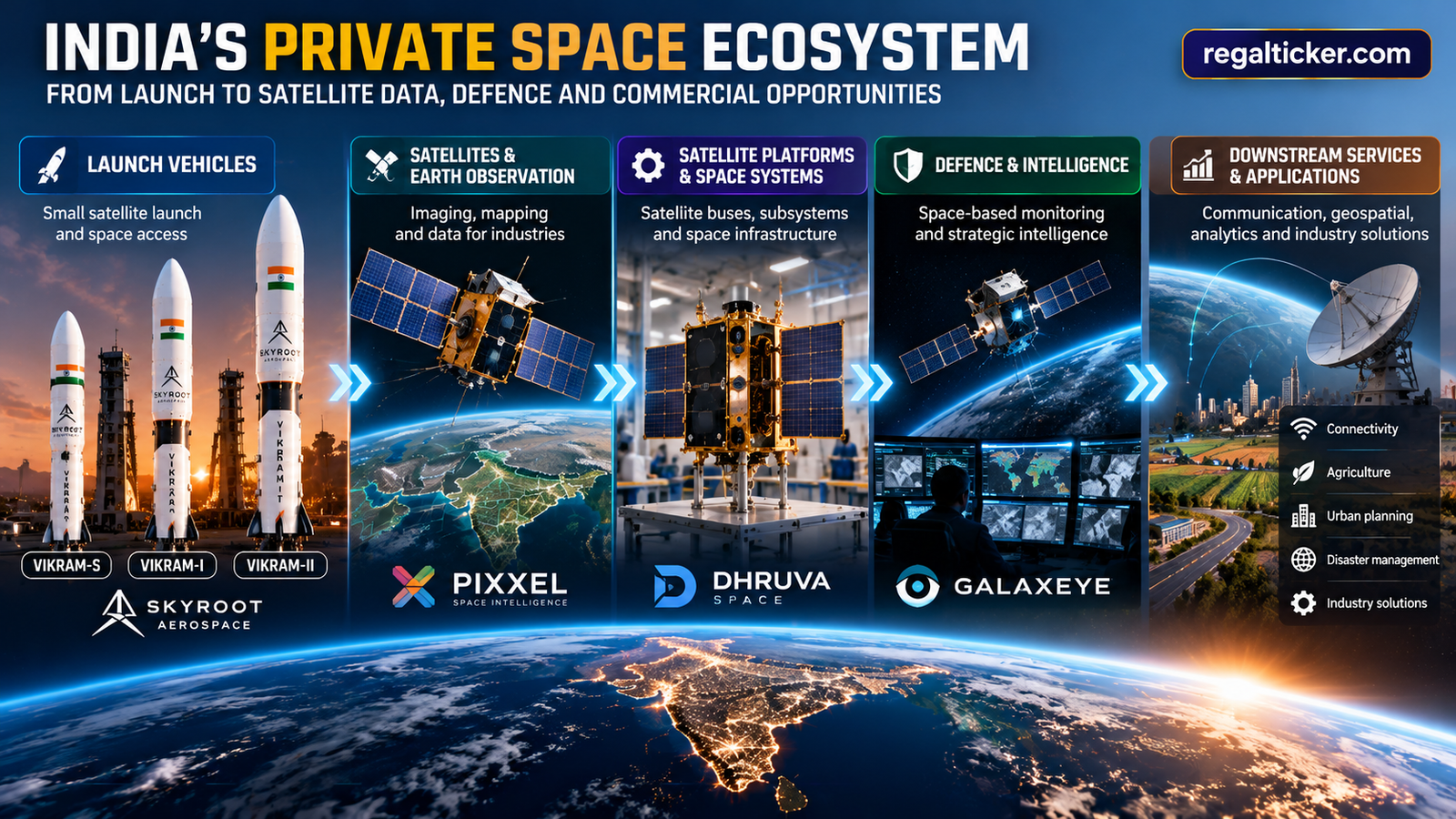
A successful Indian private-space industry therefore does not require Skyroot to become an Indian SpaceX clone. It requires multiple companies to build durable businesses across different layers of the value chain.
8. Defence and strategic demand could become a powerful second engine
Commercial demand is only part of the picture. Space is increasingly strategic infrastructure.
Modern defence systems rely on satellites for communications, navigation, surveillance, weather, missile warning and intelligence. Earth-observation systems can monitor borders, shipping lanes, military infrastructure and changes in terrain. Secure satellite communications can provide resilience when terrestrial networks are unavailable or compromised.
That creates potential demand for Indian suppliers in optics, sensors, RF systems, rugged electronics, propulsion, satellite buses and data processing. It also creates policy reasons for the government to support domestic capability even when the early commercial economics are imperfect.
There is a useful parallel with semiconductors. India’s semiconductor build-out is partly about economics and partly about strategic resilience. Space has the same dual character. Domestic capability can create exports and private enterprise while also reducing dependence on foreign technology in sensitive systems.
That does not mean every defence-space company deserves a premium valuation. Strategic importance and shareholder returns are not the same thing.
9. How listed Indian investors can participate without owning Skyroot
Skyroot, Pixxel, Agnikul, Dhruva Space and GalaxEye are private companies. Retail investors cannot simply open a brokerage account and buy their shares on NSE or BSE.
The listed opportunity is therefore indirect today.
Some public companies already supply technologies used in Indian space programmes. MTAR Technologies says it manufactures liquid-propulsion and cryogenic-engine assemblies, fluid-control systems and other precision hardware for ISRO launch vehicles. Paras Defence & Space Technologies operates in defence and space optics, including large mirrors and other precision optical components. Centum Electronics says its products have flown on satellites since 2002 and cover satellite buses, payloads, launch vehicles and ground equipment.
These are examples of real space exposure, not a ready-made “space index.” The investor still has to ask how much revenue actually comes from space, whether orders are recurring, what margins look like, how capital-intensive the business is and whether the share price already assumes years of growth.
| Listed exposure | Examples | What investors should verify |
|---|---|---|
| Precision propulsion and launch hardware | MTAR Technologies | Space revenue, customer concentration, order conversion, margins and capital intensity |
| Space optics and precision systems | Paras Defence & Space Technologies | Actual space orders versus broader defence exposure, execution and valuation |
| Satellite and launch electronics | Centum Electronics | Revenue mix, customer qualification, export exposure and working-capital requirements |
This is where fundamental analysis matters more than thematic excitement. A company can be in exactly the right industry and still be a poor investment if revenue is small, cash flow is weak or valuation becomes detached from realistic earnings.
10. The biggest risk is confusing technological success with business success
Private space is one of the easiest sectors to romanticise. The machines are extraordinary, the engineering is difficult and national pride is naturally involved.
None of those things guarantees attractive economics.
Launch companies face catastrophic downside from failure. One unsuccessful mission can delay schedules, affect customer confidence and increase insurance or financing costs. Satellite operators face expensive hardware cycles, launch risk, technology obsolescence and the challenge of converting raw data into products customers will pay for repeatedly.
Deep-tech companies also require patient capital. A funding environment that looks generous after a successful mission can tighten quickly if global risk appetite changes or milestones slip.
Then there is valuation. The space theme may become popular with public investors long before listed suppliers see a material increase in earnings. That creates the familiar danger of paying today for revenue that may arrive years later.
The right response is not to avoid the theme. It is to separate industry progress from stock selection. RegalTicker’s risk-management framework is useful here because structural themes can remain correct even while individual stocks experience severe drawdowns.
11. Five things that will tell us whether the boom is becoming durable
The next two years should produce much more useful evidence than another round of startup announcements.
1. Skyroot’s repeat launch record
A second successful Vikram-I mission would reduce reliability risk further. The key metric after that becomes cadence: how quickly can the company manufacture, integrate and fly again?
2. Commercial customers, not only demonstrations
Indian startups need contracts from customers willing to pay commercial prices. International launch bookings, sovereign Earth-intelligence contracts and recurring data subscriptions are stronger signals than technology demonstrations alone.
3. Private investment after the first excitement
Large funding rounds are useful when they finance manufacturing and scale. The more important question is whether investors continue funding the sector after companies begin reporting actual operating performance.
4. Exports
IN-SPACe’s vision includes roughly $11 billion of exports by 2033. Export customers are an important proof that Indian companies are globally competitive rather than dependent only on domestic policy support.
5. Revenue moving downstream
If the ecosystem is working, the value should spread beyond rockets into satellite platforms, communications, geospatial intelligence, logistics, agriculture, climate data and defence applications. That is where a $40–45 billion industry begins to look economically plausible rather than aspirational.
12. India does not need a single “SpaceX moment” to win
The temptation is to ask which Indian company will become the next SpaceX. It is probably the wrong question.
India’s advantage may come from building a network rather than one dominant company: Skyroot and Agnikul in launch systems; Pixxel and GalaxEye in Earth observation and intelligence; Dhruva Space in satellite platforms and integration; established listed suppliers in precision engineering, optics and electronics; and a growing layer of software companies turning space data into services.
That model is less dramatic than one giant champion, but it may be more realistic for the Indian economy.
The July Vikram-I mission was important because it proved something technical. The next phase has to prove something commercial: that launches can repeat, satellites can generate recurring revenue, suppliers can scale and customers outside India will pay for Indian space capability.
If that happens, the $40–45 billion target will not be interesting because of the headline number. It will be interesting because India will have created another high-value industrial ecosystem—one that links advanced manufacturing, software, defence, communications and data.
That is the part investors should watch.
Investor note
Keep the theme separate from your portfolio bookkeeping
Space-sector excitement can influence how you think about a company’s growth prospects, but it does not change the mechanics of corporate actions. If a holding later undergoes a demerger, keep the cost-allocation calculation separate from the investment thesis and use the company’s official allocation with RegalTicker’s Demerger Cost Basis Calculator.
Frequently asked questions
Is Skyroot Aerospace listed on the stock market?
No. Skyroot Aerospace is a privately held company as of October 2026, so ordinary retail investors cannot buy Skyroot shares on NSE or BSE.
What did Skyroot’s Vikram-I achieve?
Vikram-I reached orbit from Sriharikota on 18 July 2026 and placed two satellites into low Earth orbit. ISRO described it as the first orbital launch by a private Indian company from Indian soil.
Is Skyroot’s reported $300 million funding round completed?
Public reports describe the company as being in discussions for a roughly $280–300 million round. Until Skyroot or the investors formally announce a completed transaction, the amount and valuation should be treated as reported negotiations.
How large is India’s space economy expected to become?
The government has recently described a potential $40–45 billion space economy over the next seven to eight years, while IN-SPACe’s decadal strategy targets about $44 billion by 2033. These are strategic targets, not guaranteed outcomes.
How many space startups does India have?
A government factsheet published in August 2026 said around 440 space-technology startups were registered in India.
Which Indian listed companies have genuine space exposure?
Examples include MTAR Technologies in propulsion and precision assemblies, Paras Defence & Space Technologies in space optics and related systems, and Centum Electronics in satellite and launch electronics. Investors should verify the actual revenue contribution and valuation rather than treating every supplier as a pure-play space stock.
Why could downstream space services be larger than the rocket business?
A rocket is used for a launch, while satellite communications, Earth observation, mapping, navigation and analytics can generate services repeatedly over the life of a satellite or constellation. IN-SPACe’s own 2033 vision assigns most of the projected market value to downstream activity.
What is the biggest risk to India’s private-space boom?
Execution. Launch reliability, funding, manufacturing scale, customer demand, export competitiveness and the ability to turn technology into recurring revenue will determine whether today’s momentum becomes a durable industry.
Verify through official sources
Official references
- ISRO — First private orbital launch lifts off from Sriharikota — Official details of Vikram-I’s 18 July 2026 orbital mission and the role of ISRO and IN-SPACe.
- Skyroot Aerospace — Newsroom — Company updates including preparations for the second Vikram-I mission and shipment of first-stage hardware to Sriharikota.
- Skyroot Aerospace — Vikram launch vehicles — Current company information on the Vikram launch-vehicle family and stated Vikram-II plans.
- Moneycontrol — Skyroot funding discussions — Reported $280–300 million fundraising discussions and proposed private valuation; not treated as a completed transaction.
- Economic Times — Skyroot eyes funding boost — Additional reporting on a possible $300 million two-tranche raise; treated as negotiations rather than a completed financing.
- PIB — India’s space economy and private investment — Government data on roughly 440 space startups, the current space-economy size and private investment through 2026.
- PIB — Private-sector participation in space economy — Government data on private companies registered on the IN-SPACe platform and the policy framework enabling end-to-end private space activity.
- PIB — Space economy to reach $40–45 billion — October 2026 government framing of India’s space-economy growth target and private-sector scale-up.
- IN-SPACe — Decadal Vision and Strategy — Official strategy targeting a $44 billion Indian space economy by 2033, including domestic and export opportunities across upstream, midstream and downstream segments.
- Pixxel — $100 million Series C — Official September 2026 funding announcement and expansion into Earth intelligence, sovereign systems and satellite manufacturing.
- Technology Development Board — Agnikul reusable launch support — Official ₹200 crore RDI support and technical objectives for the reusable Agnibaan programme.
- Dhruva Space — LEAP-2 Mission — Official details of the October 2026 LEAP-2 deployment, hosted payloads and end-to-end launch integration.
- PIB — GalaxEye RDI support — Official ₹63.84 crore support for GalaxEye’s multisensor OptoSAR satellite programme.
- MTAR Technologies — Space — Company description of propulsion, cryogenic-engine and precision assemblies supplied to Indian space programmes.
- Paras Defence & Space Technologies — About — Company description of space optics, defence engineering and precision technology capabilities.
- Centum Electronics — Space — Company description of satellite-bus, payload, launch-vehicle and ground-equipment electronics.
Educational disclaimer: This Market News analysis is for investor education and general information only. It is not investment advice or a recommendation to buy, sell or hold Skyroot Aerospace, Pixxel, Agnikul Cosmos, MTAR Technologies, Paras Defence & Space Technologies, Centum Electronics or any other company. Private-company valuations and funding discussions can change before a transaction closes, while public-market prices may move far ahead of actual space-sector revenue. Verify current company filings, exchange disclosures and official announcements before making investment decisions.
Final takeaway
The real milestone comes after the rocket reaches orbit
Skyroot’s Vikram-I launch was a technological milestone. India’s private-space boom becomes an economic milestone only when companies can repeat missions, win paying customers, export services and turn capital-intensive engineering into sustainable cash flow. The strongest investment case is therefore not “India launched a private rocket.” It is that a broader space industrial stack may finally be forming around launch, satellites, data, precision manufacturing and strategic electronics. That is a more durable story—and a much harder one to execute.