A pause is not the same thing as relief
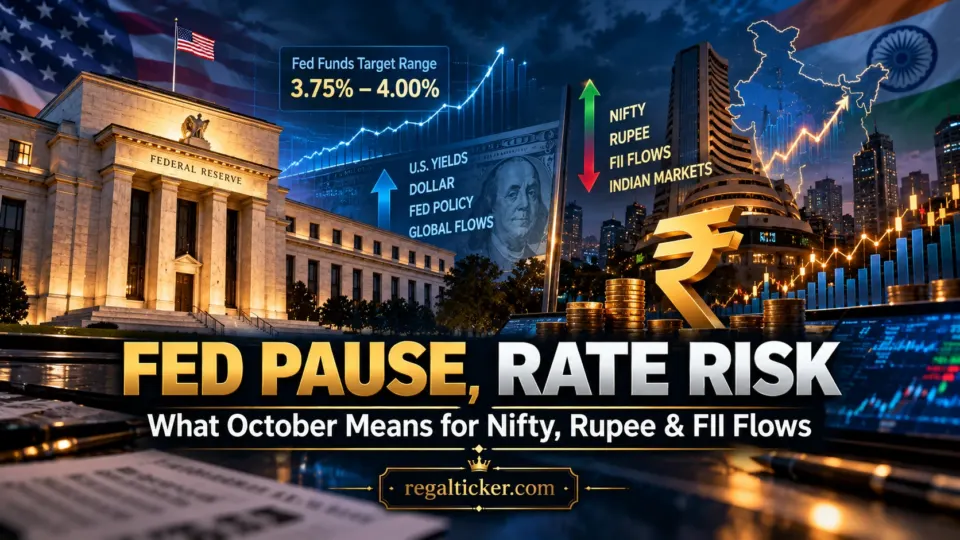
The Federal Reserve's 27–28 October meeting is shaping up as an unusual test for global markets. After raising the federal-funds target range by 25 basis points in September to 3.75%–4.00%, the Fed is widely expected to hold rates steady this month. That sounds supportive for equities at first glance. The complication is that the market does not price only the next meeting; it prices the expected path that follows it.
A Reuters poll conducted from 16–20 October found that 94 of 100 economists expected no change in October, while the respondents still expected another increase in December. But by 22 October, live markets were sending a softer signal: risk-aversion pushed investors into government bonds, Treasury yields fell, the dollar weakened and Reuters reported diminishing expectations for further U.S. rate hikes. That gap between economist forecasts and market pricing is now the most important part of the story.
For Indian investors, this matters through several channels at once. U.S. yields affect the relative appeal of dollar assets, the dollar influences the rupee, currency and rate differentials influence foreign portfolio flows, and those flows can amplify changes in Indian equity valuations. At the same time, the Reserve Bank of India has begun tightening again, which means domestic policy is no longer offsetting global rate pressure as comfortably as it did earlier in the cycle.
The useful question is therefore not simply “Will the Fed hike in October?” It is: what does the Fed's expected path imply for global liquidity, the rupee, foreign flows and the valuation investors are willing to pay for Indian earnings?
⚡ Quick answer
Why can a Fed pause still pressure Indian markets?
Because markets respond to the expected future interest-rate path, not just one meeting. An October hold can still pressure Indian assets if the Fed keeps inflation risks and additional tightening on the table. But if Treasury yields keep falling and the dollar weakens because investors become less convinced about another hike, the transmission can reverse quickly. The key is therefore the post-meeting rate path—not the word “pause.”
Key takeaways
The Fed raised its target range to 3.75%–4.00% on 16 September 2026.
The next FOMC decision is scheduled for 28 October, after a two-day meeting on 27–28 October.
A Reuters poll found 94 of 100 economists expect an October hold, and its economist panel still expected another increase in December; however, live bond and currency markets turned less convinced about further tightening on 22 October.
A Fed pause is therefore not automatically dovish; the statement and forward path matter more than the word “hold.”
India is already dealing with its own tightening cycle: the RBI raised the repo rate to 5.50% in October and has signalled that further action may be required if inflation stays high.
The most important transmission channels for Indian equities are U.S. Treasury yields, the dollar/rupee rate, foreign portfolio flows and valuation multiples.
A stronger dollar can support some exporters' rupee revenue translation, but that does not automatically make IT or pharma shares bullish because global demand, margins and valuation still matter.
Investors should separate a macro-driven change in valuation from a genuine deterioration in company earnings.
1. What exactly is the Fed deciding in October?
The Fed entered the October meeting with its policy rate already in restrictive territory. On 16 September, the Federal Open Market Committee raised the target range for the federal funds rate by 25 basis points to 3.75%–4.00%. The official statement said economic activity remained solid but inflation was still elevated.
The next decision is due on 28 October 2026, with the press conference scheduled after the meeting. The Fed's September projections also showed that policymakers continued to see inflation above the 2% objective in 2026, which is why the market has not treated the October pause expectation as the end of the tightening cycle.
The Reuters economist poll adds an important distinction. Most forecasters expect the Fed to skip an October hike, not to declare victory over inflation. December therefore remains open if inflation and activity stay firm—but the bond and currency moves on 22 October show that traders are already testing a less-hawkish path.
Highlight
“No hike” and “dovish” are not synonyms
A central bank can hold rates steady while keeping policy restrictive and leaving another hike on the table. At the same time, markets can begin pricing fewer hikes before policymakers formally change course. Equity markets often react more to that evolving path than to the current meeting decision.
2. The key tension: economists expect more tightening, markets are less convinced
Financial markets discount the future, but the future path is currently contested. The Reuters economist poll still points to another hike in December, while trading on 22 October moved the other way: government-bond buying pushed Treasury yields lower, the dollar weakened and Reuters described expectations for further U.S. hikes as diminishing.
That divergence matters because neither economists nor one day of market pricing mechanically determines the Fed's next step. If inflation remains sticky, the Fed can keep a December hike alive even after pausing in October. If growth, financial conditions or inflation soften enough, yields and the dollar can fall before the Fed formally changes its guidance. For Indian investors, the relevant variable is the rate path embedded in yields and currencies after the meeting, not a single forecast label.
For Indian equities, this creates a valuation question. A share can report the same expected earnings and still trade at a lower price if investors demand a higher return for holding it.
Consider a simple illustration. If investors were comfortable paying 25 times earnings for a company when global yields were lower, they may become unwilling to pay the same multiple when risk-free dollar yields rise. The earnings have not changed; the discount rate applied to those earnings has.
Readers who want to understand that distinction in company valuation can use RegalTicker's guide to EPS, P/E and PEG ratios. The important point is that P/E can compress because the required return changes even before analysts cut profit forecasts.
3. The four-channel transmission from the Fed to Indian equities
The Fed does not directly set Indian stock prices. Its influence reaches India through several connected markets.
| Channel | What can happen when the Fed stays hawkish | Why India cares |
|---|---|---|
| U.S. Treasury yields | Dollar assets offer higher yields | Raises the hurdle rate for emerging-market assets |
| U.S. dollar | Dollar can remain firm against global currencies | Adds pressure to USD/INR and imported inflation |
| Foreign portfolio flows | Global investors may reduce risk or rebalance toward U.S. assets | Can amplify moves in large-cap Indian equities |
| Equity valuation | Investors may demand a higher return | Expensive growth stocks can face multiple compression |
These channels do not move in a perfectly mechanical sequence. Strong Indian earnings, domestic institutional buying or a weaker dollar can offset part of the pressure. But the framework helps explain why a Fed decision in Washington can affect a stock in Mumbai without changing that company's factories, products or management overnight.
The 22 October move is a useful live example. Global risk aversion pulled money into government bonds, Treasury yields fell and the dollar softened even though the economist consensus still pointed to a later hike. For India, that means the same Fed narrative can produce very different market outcomes depending on how yields and currencies actually reprice.
For a broader monthly view of how global variables interact with Indian indices, sectors and valuation, RegalTicker's Monthly Market Review provides the larger market context.
4. The rupee is one of the fastest transmission channels
Currency markets often react before corporate earnings do.
On 21 October, the rupee strengthened to around ₹94.46 per U.S. dollar, helped by foreign inflows linked to the Jio Platforms IPO and policy support from the RBI. That recovery came after substantial pressure earlier in the year. Reuters has reported that the RBI has used a combination of intervention, liquidity measures and higher domestic rates to stabilise the currency.
The Fed matters because a wider U.S.–India yield differential can change the economics of holding rupee assets. If U.S. yields rise while Indian yields do not keep pace, dollar assets become relatively more attractive at the margin. A stronger dollar also raises the local-currency cost of imported commodities and other dollar-priced inputs.
But a weaker rupee is not uniformly negative for equities. Exporters can receive more rupees for each dollar of revenue. The effect still depends on hedging, overseas costs, client demand and whether the currency move is orderly or disorderly.
For NRIs, currency changes can alter the home-currency value of an Indian investment even when the rupee share price is unchanged. RegalTicker's guide comparing NRI and resident Indian stock investing explains why investment structure, repatriation and currency exposure need to be considered separately.
5. FII flows matter—but they should not be treated as a one-variable formula
The shorthand “Fed hawkish = FII selling” is too simplistic.
Foreign investors compare expected returns across countries after considering growth, valuation, currency risk, liquidity, political risk and hedging cost. Higher U.S. yields can make Indian equities relatively less attractive, but strong earnings or a valuation reset can pull foreign capital back even in a high-rate environment.
The current year shows why this matters. Reuters reported that foreign investors had withdrawn roughly $33 billion from Indian equities in 2026 by mid-October, while the RBI was also defending the rupee against pressure from high U.S. yields, oil prices and capital outflows.
At the same time, the Jio IPO generated large foreign inflows and briefly strengthened the rupee. That is a useful reminder that portfolio flows can be event-driven even during a broader period of risk aversion.
The better approach is to monitor FII flows alongside earnings and valuation rather than using daily foreign buying or selling as a standalone market-timing signal.
6. Which Indian sectors are most sensitive to a hawkish Fed?
Different sectors feel global rates through different mechanisms.
High-valuation growth stocks
Companies priced on distant future cash flows are more sensitive to changes in discount rates. When bond yields rise, the present value of those future earnings can fall even without an immediate earnings downgrade.
Banks and financials
Higher domestic and global rates can support lending yields but may also raise funding costs, pressure bond portfolios and slow credit demand. The outcome depends on asset-liability structure and deposit pricing rather than on the direction of rates alone.
IT services
A weaker rupee can help translation of dollar revenue, but Fed tightening can also slow U.S. corporate spending. Investors therefore need to separate the currency effect from the demand effect.
Rate-sensitive domestic sectors
Real estate, autos and other financed purchases can become more sensitive if domestic borrowing costs rise alongside the global rate cycle.
Commodity and defensive sectors
These may behave differently depending on the driver of inflation. If the Fed is tightening because energy prices are high, input-cost pressure can matter as much as interest rates.
This is where company-level work becomes essential. RegalTicker's Fundamental Analysis hub is the better place to assess earnings quality, balance-sheet strength and cash-flow sensitivity rather than assuming every company in a sector will react the same way.
7. India now has its own tightening cycle to consider
The Fed is not acting in isolation. India's monetary backdrop has also changed.
The RBI raised the repo rate by 25 basis points to 5.50% in October, its first increase in several years, and shifted to a calibrated tightening stance. Minutes released on 21 October showed policymakers were concerned about inflation but also cautious about tightening too aggressively.
Reuters reported September retail inflation at 5.54%, while the RBI projected inflation around 6% for the October–December quarter. At the same time, the central bank raised its growth outlook to 7.1%.
That creates a difficult balance. A higher policy rate can help the rupee and reinforce inflation control, but it can also increase borrowing costs for households and businesses. If the Fed remains restrictive while the RBI continues tightening, Indian equities can face higher discount rates from two directions; if U.S. yields ease instead, part of that external pressure may soften even while domestic rates remain elevated.
The combination matters more than either central bank in isolation.
8. Three scenarios for the October Fed meeting
Investors can prepare for the decision without pretending to know the outcome with certainty.
| Scenario | Possible global reaction | Possible India transmission |
|---|---|---|
| Hold + hawkish language | Yields/dollar remain firm | Rupee and high-valuation equities stay sensitive |
| Hold + softer guidance | Yields may ease; risk appetite improves | Relief for INR and valuation-sensitive sectors |
| Surprise hike | Sharp repricing across bonds and equities | Higher volatility, stronger dollar pressure and potential FII risk-off |
The first two scenarios now deserve equal attention. Markets may initially celebrate a hold and then reverse if the statement keeps December tightening alive. Or yields may continue falling if the Fed validates the softer path already appearing in bond and currency markets.
That is why the article's central distinction matters: a pause can be a timing decision, but it can also become the point where markets start pricing a different policy path before the Fed explicitly says so.
9. What should investors watch immediately after the decision?
The headline policy rate is only one data point. The market's reaction can be read through a small set of indicators.
Checklist before you act
- U.S. Treasury yields: Are two-year and ten-year yields rising or falling after the statement?
- Dollar index: Is the dollar strengthening broadly or is the move limited to a few currencies?
- USD/INR: Is the rupee moving in line with Asia or facing India-specific pressure?
- Foreign portfolio flows: Does the reaction persist beyond one session?
- Nifty valuation: Are expensive sectors de-rating even without earnings changes?
- RBI response: Does the domestic central bank tighten liquidity or signal a stronger rate response?
- Earnings revisions: Are analysts changing profit estimates, or is the move mostly macro/valuation driven?
10. What should an Indian investor do with this information?
A macro event is most useful when it improves the decision process rather than triggering impulsive trading.
The first step is to identify which part of a portfolio is genuinely exposed to higher global rates. A profitable company with low debt and durable cash flow may respond differently from a highly valued business whose expected profits lie far in the future. A bank with stable deposits may respond differently from a lender that depends heavily on wholesale funding.
The second step is to distinguish price volatility from thesis damage. If a stock falls because global discount rates rise but the company's earnings, balance sheet and competitive position remain intact, the investment question is different from a fall caused by a profit warning or balance-sheet deterioration.
The third step is risk control. Do not let a macro view become an oversized directional bet. RegalTicker's Risk Management path explains position sizing, diversification, drawdowns and capital protection, while the Personal Risk-Management Plan can help turn those principles into written limits before volatility arrives.
Investor note
Keep market-rate volatility separate from corporate-action accounting
A Fed decision can change market prices, discount rates and currency levels, but it does not change the acquisition-cost rules used after a corporate demerger. If a portfolio company later completes a demerger, use RegalTicker's Demerger Cost Basis Calculator with the company's official allocation percentages rather than using current market prices to divide the original cost.
11. The key takeaway: watch the path, not the pause
The October Fed meeting may produce no rate change, but that does not make it a low-impact event.
The important signal will be whether the Fed treats the pause as a temporary wait before another hike or validates the softer path that bond and currency markets began pricing on 22 October. That distinction can influence Treasury yields, the dollar, the rupee, foreign portfolio allocation and the valuation multiples investors are willing to pay for Indian equities.
For Indian investors, the most disciplined approach is to separate three layers of evidence:
- Macro: Fed path, U.S. yields, dollar, RBI policy and inflation.
- Market: FII flows, rupee behaviour, index valuation and sector rotation.
- Company: earnings, cash flow, debt, margins and competitive position.
A Fed pause can move all three layers, but it should not replace company analysis. The strongest decisions come from understanding where the macro shock ends and the business fundamentals begin.
Frequently asked questions
When is the October 2026 Federal Reserve meeting?
The FOMC meets on 27–28 October 2026, with the policy decision scheduled for 28 October followed by the Chair's press conference.
What is the current U.S. federal funds target range?
The Fed raised the target range to 3.75%–4.00% on 16 September 2026.
Is the Fed expected to raise rates in October 2026?
Most economists in a Reuters poll expected the Fed to hold rates steady in October and still anticipated another increase in December. However, market trading on 22 October reflected less confidence in further tightening as Treasury yields fell and the dollar weakened. A hold should therefore not automatically be labelled either dovish or hawkish before the statement and market reaction are known.
Why do Fed rate hikes affect the Indian rupee?
Higher U.S. yields can make dollar assets relatively more attractive, support the dollar and increase pressure on emerging-market currencies. The rupee's actual move also depends on oil prices, RBI intervention, Indian rates and capital flows.
Does a hawkish Fed always cause FII selling in India?
No. Higher U.S. yields can reduce the relative appeal of Indian assets, but foreign flows also respond to earnings growth, valuation, currency expectations, liquidity and major events such as large IPOs.
Which Indian stocks are most affected by higher U.S. rates?
High-valuation growth stocks can be sensitive to higher discount rates, while banks, IT, real estate, autos and exporters may react through different funding, demand and currency channels. Company-specific fundamentals remain important.
Can a weaker rupee help Indian IT companies?
It can improve rupee translation of dollar revenue, but that benefit can be offset by weaker overseas demand, wage costs, hedging and valuation changes. Currency alone is not enough to assess an IT stock.
Verify through official sources
Official references
- Federal Reserve — September 2026 FOMC Statement — Official Fed statement raising the target range to 3.75%–4.00% and describing inflation and economic conditions.
- Federal Reserve — October 2026 Calendar — Official schedule confirming the 27–28 October FOMC meeting and 28 October decision/press conference.
- Federal Reserve — September 2026 Economic Projections — Official FOMC projections for inflation, growth, unemployment and the appropriate policy path.
- Reuters — Fed expected to pause in October, hike again in December — Reuters poll of economists conducted 16–20 October 2026, showing a strong October-hold consensus and continued December-hike expectations.
- Reuters — Dollar softens as Treasury yields fall — Current 22 October market evidence showing bond buying, lower Treasury yields, a weaker dollar and diminishing expectations for further U.S. rate hikes.
- Reuters — India rate panel flags more hikes but remains cautious — Current RBI policy, inflation and growth context.
- Reuters — Rupee strengthens on Jio IPO-linked inflows — Current rupee level, foreign inflows and risk context.
- Reuters — RBI widens rupee defence to rates — Context on RBI tightening, foreign equity outflows and currency defence.
Educational disclaimer: This article is for education and general market information only. It is not investment advice, a recommendation to buy or sell any security, or a forecast of a guaranteed market outcome. Interest-rate expectations, currency levels, foreign flows and equity prices can change quickly as new data and policy guidance emerge. Verify material information with official sources and consider your own objectives, liquidity needs, time horizon and risk tolerance before making financial decisions.