


Why This Matters
Open a stock-market app and you may see a share at ₹100. A few seconds later it is ₹100.20, then ₹99.85. Who changed the number? Did the company choose it? Did NSE or BSE calculate it? Did SEBI approve every movement?
A share represents ownership in a company, but its live market price is not printed permanently on that ownership. If you are new to this idea, first read What Is a Share?. The price you see during trading is continuously discovered in the market.
⚡ Quick answer
A listed share’s market price is decided through price discovery. Buyers submit orders showing what they are willing to pay, while sellers submit orders showing what they are willing to accept. NSE or BSE arranges and matches compatible orders under exchange rules. When a trade is completed, its price becomes the latest traded price, or LTP, until another trade occurs. Company results, news, expectations, interest rates, liquidity and sentiment influence the orders investors place, but no company, broker, exchange employee or regulator normally chooses the continuously changing market price by hand.
Key takeaways
Buy and sell orders create the live market price.
Demand and supply matter, but every completed trade still has both a buyer and a seller.
The bid is the best current buying quote; the ask is the best current selling quote.
LTP is the price of the most recent completed trade, not a guaranteed execution price.
The opening price can be discovered through the pre-open auction.
From August 3, 2026, eligible Indian cash-market stocks also use a Closing Auction Session (CAS) for closing-price discovery.
Who Actually Decides the Price of a Share?
No single person or institution continuously decides the price of a listed share.
It is not manually fixed each morning by:
- the company;
- NSE or BSE;
- SEBI;
- your broker; or
- one large investor.
Instead, many market participants submit buy and sell orders at different prices and quantities. The exchange provides the electronic marketplace and matching rules. Market participants provide the orders. The interaction between those orders produces trades and therefore the traded price.
SEBI regulates the securities market and exchanges operate the trading infrastructure, but regulation is different from manually setting the normal market price of every listed company.
Investor note
The exchange sets the rules; orders set the price
Think of the exchange as the organised marketplace, not the shopkeeper setting a sticker price. The exchange decides how valid orders are handled and matched. Buyers and sellers decide the prices at which they are willing to transact.
How Price Discovery Works
Demand and Supply: The Basic Force Behind Share Prices
Demand represents the willingness of market participants to buy a share at different prices. Supply represents the willingness of holders to sell it.
The basic relationship is simple:
- When buyers become more aggressive, they may raise their bids to find willing sellers. The traded price can move higher.
- When sellers become more aggressive, they may lower their asking prices to find buyers. The traded price can move lower.
- When both sides remain relatively balanced, price may trade within a narrower range.
However, the popular phrase “more buyers than sellers” can be misleading. Every completed trade contains one buyer and one seller. The real question is which side is more urgent and at what prices enough quantity is available.
Suppose a share recently traded at ₹100. Sellers near ₹100 are unwilling to sell, while buyers continue increasing their bids to ₹100.10, ₹100.20 and ₹100.30. If a seller accepts one of those higher prices, the next trade can print higher.
The reverse happens when sellers urgently reduce their asking prices until buyers are willing to transact.
Investor note
Every completed trade still has a buyer and a seller
Price moves because willingness changes, not because completed trades somehow contain extra buyers or extra sellers. Stronger demand means buyers are willing to compete more aggressively for available supply; stronger selling pressure means sellers are more willing to accept lower prices.

Bid, Ask and the Order Book
To understand price discovery properly, you need three basic terms:
- Best bid: the highest current price a buyer is offering.
- Best ask: the lowest current price a seller is asking.
- Bid–ask spread: the difference between the best ask and best bid.
Imagine the best available prices are:
| Order-book side | Price |
|---|---|
| Best bid | ₹100.90 |
| Best ask | ₹101.00 |
| Spread | ₹0.10 |
💡 Real example
How an order becomes a trade
A seller places a limit order to sell 200 shares at ₹101. A compatible buyer is willing to buy at ₹101. The exchange matches the orders and executes the trade. ₹101 becomes the latest traded price until another transaction occurs at a different price.

How Does the Exchange Decide Which Order Gets Priority?
The exchange does not randomly select compatible orders.
In the normal order-driven market, price and time are important:
- An order offering the better price receives priority.
- If multiple orders are available at the same price, the earlier order generally receives priority.
This is called price-time priority.
That is why two investors can place apparently similar orders and still receive different execution timing. The price, quantity, order type, available liquidity and time of entry all matter.
What Is the Last Traded Price or LTP?
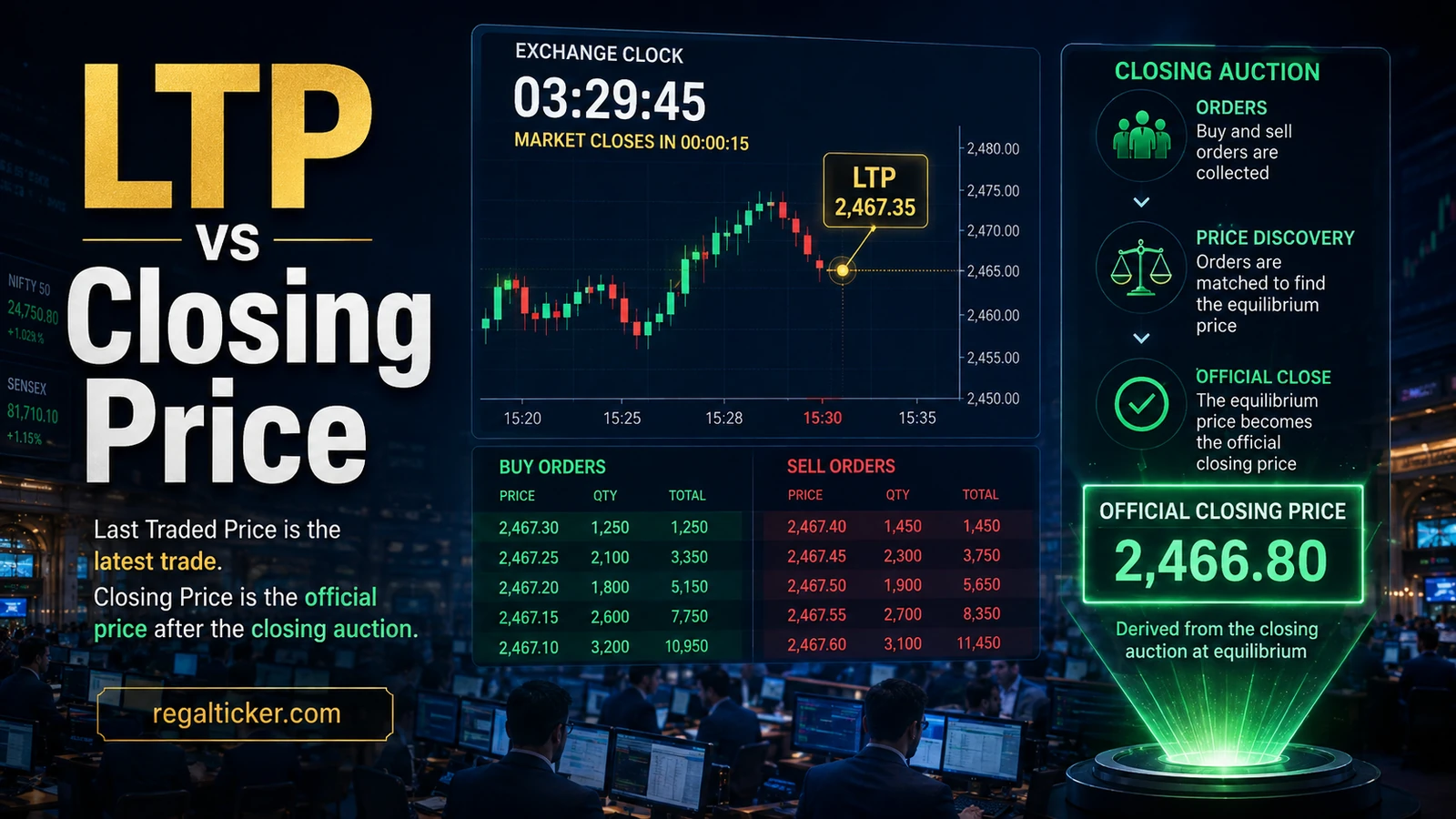
The Last Traded Price (LTP) is the price at which the most recent trade was completed.
If the most recent matched transaction occurred at ₹101, the screen may show an LTP of ₹101. But that does not mean you can definitely buy or sell any quantity at ₹101.
For example, after that trade:
- the best seller may now be asking ₹101.20; and
- the best buyer may be offering ₹100.80.
If you place an immediately executable order, your actual fill depends on the live order book at that moment.
Caution
LTP is not a promised execution price
The LTP records the latest completed trade. Your next order may execute at the bid, the ask or several price levels depending on order type, quantity and liquidity.
Market Order vs Limit Order: Why Order Type Matters
The order instruction you choose affects how you interact with price discovery.
A market order seeks execution against the best available opposite orders. It prioritises execution, but the final price can differ from the LTP—especially when the stock is moving quickly or liquidity is thin.
A limit order lets you set the maximum price you are willing to pay when buying, or the minimum price you are willing to accept when selling. It gives greater price control, but execution is not guaranteed.
This lesson only needs that distinction. For stop-loss orders, stop-limit orders, partial fills and detailed execution behaviour, continue to Market Order, Limit Order, Stop-Loss and Stop-Limit Order.
Opening and Closing Price Discovery
How Is the Opening Price Decided?
The first traded price of a new trading day is not automatically yesterday’s closing price.
For eligible equity securities, Indian exchanges use a pre-open session before normal trading. Orders are collected and the exchange uses a call-auction mechanism to discover an equilibrium price.
The core logic is:
- Buy and sell orders are collected.
- The exchange evaluates the prices at which orders can match.
- The equilibrium price is generally the price at which the maximum quantity can be executed.
- Additional rules resolve ties, including order imbalance and proximity to the previous close or applicable base price.
- The discovered equilibrium price becomes the opening price.
If no equilibrium price is discovered under the applicable process, exchange rules determine how the security moves into normal trading; for the standard NSE equity pre-open framework, the price of the first trade in the normal market can become the open price.
This is why important overnight news can produce a gap up or gap down rather than forcing the stock to reopen exactly where it closed the previous day.

How Is the Closing Price Decided?
The closing price is also not necessarily the same thing as the final LTP you happened to see before the market ended.
A major Indian market-structure change took effect on August 3, 2026: the Closing Auction Session (CAS) was introduced in the equity cash segment.
In Phase 1, NSE states that CAS applies to cash-market stocks on which derivative contracts are available.
For CAS securities, the exchange runs a separate closing-auction process. Orders are collected and an equilibrium price is determined using demand and supply. Broadly, the equilibrium price is the price at which the maximum volume can be executed, with additional rules for order imbalance and proximity to the reference price when multiple prices qualify.
For securities on which CAS applies, NSE’s operational guidelines state that the closing price is determined through the CAS equilibrium-price mechanism. If an equilibrium price is not discovered, the applicable reference-price rules are used. Securities outside CAS continue under the exchange’s existing closing-price methodology.
Investor note
LTP and closing price are different concepts
LTP tells you where the latest completed trade occurred. The official closing price is determined according to the exchange’s applicable closing-price methodology. Since August 3, 2026, that methodology includes CAS for eligible Phase 1 securities.
Why Do Share Prices Keep Changing?
The order book explains how a price changes. Investor expectations explain why buying and selling willingness changes.
Company results
Revenue, profit, margins, debt, cash flow and management commentary can change expectations about the company’s future.
Future growth expectations
Markets are forward-looking. A company can report good current numbers but fall if investors expected even better performance.
Corporate announcements
Acquisitions, major orders, management changes, fund-raising, dividends, bonus issues, stock splits, buybacks and regulatory developments can alter expectations.
Industry conditions
Input costs, competition, demand cycles, technology and regulation can move an entire sector.
Interest rates and the economy
Inflation, interest rates, currency movements, government policy and economic growth can affect profits, borrowing costs and investor risk appetite.
Global events and flows
International markets, commodity prices, geopolitical events and foreign institutional flows can influence Indian stocks.
Sentiment
Fear, optimism, momentum and risk appetite can move prices faster than the company’s underlying business changes in the short term.
Liquidity
A highly liquid stock usually has many orders near the current price. In an illiquid stock, even a modest market order can consume several price levels and create a larger price move.
Why Can a Good Company’s Share Price Fall?
A good business and a rising share price are not the same thing.
A company can report rising profits and still fall because:
- investors expected stronger growth;
- the valuation was already demanding;
- management gives cautious guidance;
- a new risk becomes visible;
- the industry outlook weakens; or
- investors reduce exposure to risky assets generally.
Likewise, a weak company can rise temporarily if the results are less bad than feared or if speculative demand increases.
⭐ Pro tip
Markets react to expectations, not headlines in isolation
A result can be objectively good and still disappoint the market if the price already reflected even better expectations. Always ask: What was the market expecting before the announcement?
Market Price vs Business Value
Market Price, Face Value and Intrinsic Value Are Different
These terms answer different questions.
| Term | What it means | Who/what determines it? |
|---|---|---|
| Market price | Price at which shares are trading | Buy and sell orders in the market |
| Face value | Nominal/accounting denomination of a share | Company’s capital structure and corporate records |
| Intrinsic value | An investor’s estimate of fair economic value | Assumptions about earnings, cash flow, growth and risk |
Does Market Capitalisation Decide the Share Price?
No. Market capitalisation is calculated using the share price:
Market capitalisation = Current market price per share × Outstanding equity shares
Therefore, a company whose share trades at ₹2,000 is not automatically larger or more valuable than one whose share trades at ₹200. You must also know how many shares are outstanding.
This is the natural next lesson in Stock Market Basics: What Is Market Capitalisation? Formula & Examples.
Who Can Influence the Price—and Who Cannot?
Can the Company Control Its Share Price?
A company can influence investor expectations through business performance, disclosures, capital allocation, management decisions and corporate actions.
But it does not normally type a new live secondary-market price into the exchange.
A stock split, for example, can mechanically reduce the quoted price per share because each existing share is divided into more shares, but that is different from manually choosing the market’s future trading price. For that mechanism, read What Is a Stock Split?.
Can a Broker Decide the Price?
A broker provides the interface and transmits your order to the exchange. It does not normally choose the exchange-traded market price for your order.
Your execution depends on:
- the instruction you submit;
- the available opposite orders;
- price-time priority;
- quantity and liquidity;
- market movement; and
- applicable exchange rules.
This is why looking only at LTP is not enough before placing an order.
Why Can the Same Share Have Slightly Different Prices on NSE and BSE?
A company can be listed on both NSE and BSE, but the exchanges maintain separate order books.
At a given moment:
- different buyers and sellers may be active;
- available quantity may differ;
- spreads may differ; and
- one exchange may be more liquid than the other for that share.
Small price differences can therefore occur. Market participants may act on meaningful differences, which usually helps keep prices broadly aligned, but identical prices at every second are not guaranteed.
Common Beginner Mistakes
Mistake 1: Believing the company fixes the live market price
The company influences expectations; the live price is discovered through trading.
Mistake 2: Treating LTP as a guaranteed buy or sell price
The available bid and ask may already be different from the most recent trade.
Mistake 3: Thinking a ₹50 share is automatically cheaper than a ₹500 share
Nominal share price alone says little about valuation. Market cap, earnings, cash flow, debt, growth and risk matter.
Mistake 4: Confusing face value with market value
Face value is a nominal/accounting concept. Market price is produced by trading.
Mistake 5: Assuming good news must make the stock rise
The news may already be reflected in the price, or the result may be weaker than expectations.
Mistake 6: Ignoring liquidity and spread
In a shallow order book, an immediately executable order may fill across several prices.
Investor note
Before you place an order, check these five things
What is the current best bid? What is the current best ask? How wide is the spread? Is your order size large relative to the visible liquidity? Are you using an order type that matches your priority: execution certainty or price control?
A Simple Way to Remember Price Discovery
Think of the process as a continuous chain:
Information changes expectations → expectations change orders → orders enter the exchange → compatible orders match → a trade occurs → a new traded price appears.
Then the process repeats.
The exchange provides the rules and matching system. Market participants provide the willingness to buy and sell.
Investor note
Want to measure what a price move did to your investment?
Price discovery explains why the quoted price changes. If you want to calculate the actual percentage gain or loss on a holding, use the Stock Return Calculator.
Frequently asked questions
Who decides the share price in India?
The market price is discovered through buy and sell orders placed by market participants on exchanges such as NSE and BSE. The exchange matches compatible orders under its rules.
Does SEBI decide share prices?
No. SEBI regulates the securities market but does not normally set the continuously changing secondary-market price of each listed share.
Why does a share price rise if every trade has both a buyer and a seller?
A price tends to rise when buyers are more aggressive and are willing to bid higher to find available sellers. Every completed trade still has both sides.
What is the difference between bid price and ask price?
The bid is the highest current buying quote. The ask is the lowest current selling quote. The difference is the bid–ask spread.
What is LTP in the stock market?
LTP means Last Traded Price—the price of the most recently completed trade. It does not guarantee that your next order will execute at the same price.
How is the opening share price decided?
For eligible securities, the pre-open auction collects buy and sell orders and discovers an equilibrium price, generally based on the price at which maximum executable volume can be matched under exchange rules.
How is the closing price decided after August 3, 2026?
For securities covered by the Closing Auction Session, the closing price is determined through the CAS equilibrium-price mechanism, subject to the exchange’s fallback rules if no equilibrium price is discovered. Non-CAS securities continue under the existing closing-price methodology.
Is a low-priced share automatically cheap?
No. A low nominal share price does not prove undervaluation. Compare the company’s market capitalisation, earnings, cash flows, growth, risks and valuation.
Is market price the same as intrinsic value?
No. Market price comes from actual trading. Intrinsic value is an estimate of fair value based on an investor’s assumptions.
Conclusion
Share prices are not assigned by one authority. They are continuously discovered as buyers and sellers place orders and the exchange matches compatible instructions.
Demand and supply determine the immediate trading interaction, while business performance, expectations, news, the economy, sentiment and liquidity influence the orders behind that demand and supply.
The most useful distinction for a beginner is simple:
A share’s market price tells you where the market is trading the share. It does not, by itself, tell you what the company is worth or whether the share is a good investment.
Once you understand price discovery, the next step is to understand how a share price combines with the number of outstanding shares to produce a company’s market value. Continue to What Is Market Capitalisation? Formula & Examples.
Verify through official sources
Official references
Educational disclaimer: This article is for education and financial awareness only. It is not investment advice. Market prices can change rapidly. Verify exchange rules, trading-session details and corporate information through official sources before making an investment or trading decision.