

Quick answer
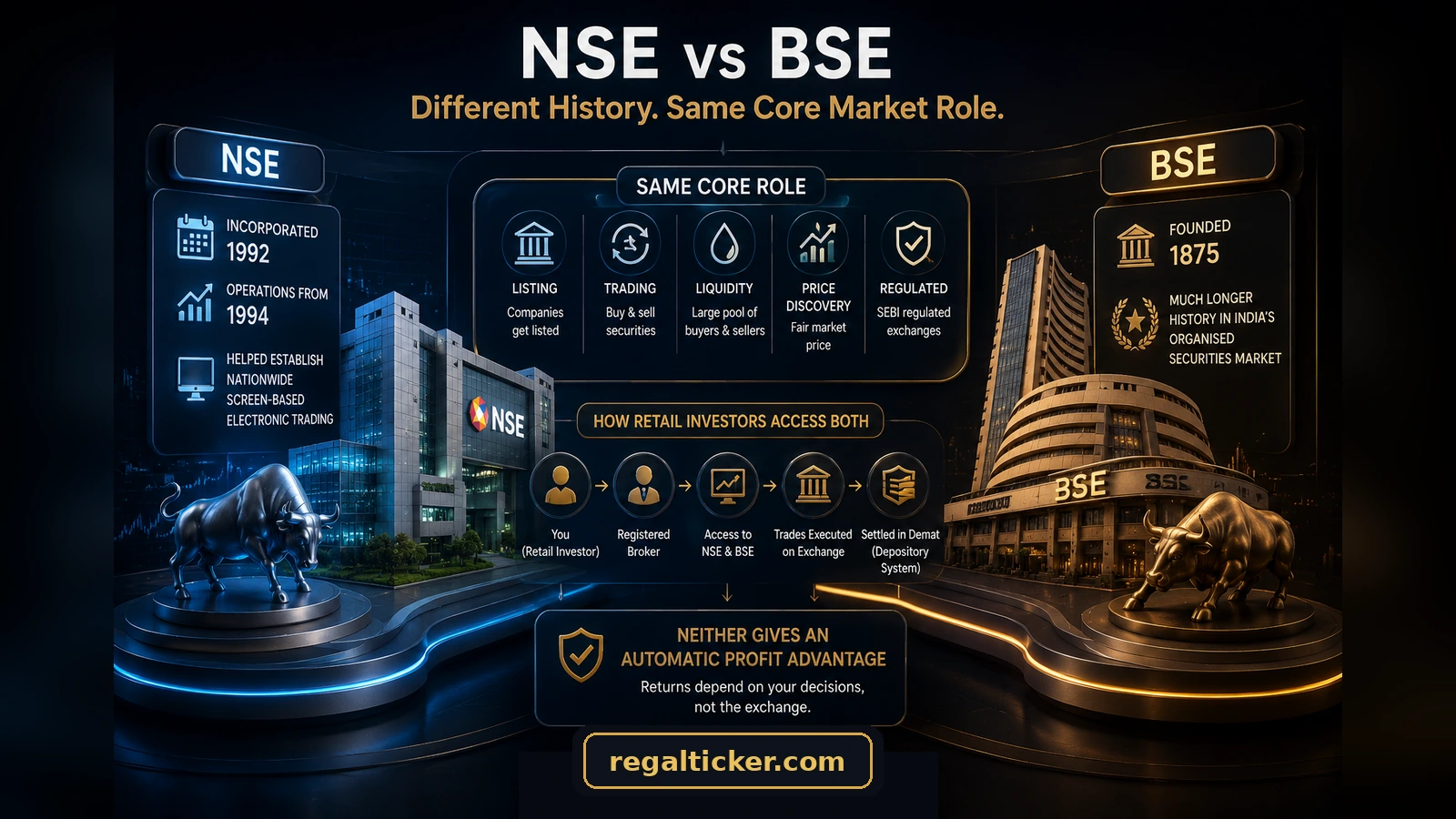
NSE and BSE are two major stock exchanges in India. Both provide regulated electronic marketplaces where eligible securities are listed and traded. NSE was incorporated in 1992 and began operations in 1994, while BSE traces its history to 1875. NSE’s best-known benchmark is the NIFTY 50, while BSE’s benchmark is the SENSEX. For a beginner, neither exchange is automatically better in every situation. The practical choice usually depends on where the security is listed, the available price, liquidity and the broker’s execution.
Key takeaways
- NSE and BSE are exchanges, not brokers or demat accounts.
- BSE has a much longer history, while NSE helped establish nationwide electronic trading at scale.
- NIFTY 50 is NSE’s widely followed benchmark; SENSEX is BSE’s widely followed benchmark.
- Many large companies are listed and traded on both exchanges.
- The same share can show a small price difference on NSE and BSE at the same moment.
- Liquidity and executable price matter more than choosing an exchange only by name.
- Buying on one exchange and later selling on another may be possible for an eligible share held in demat form, subject to the broker and market process.
- Neither exchange guarantees profit, safety from price loss or better investment quality.
What are NSE and BSE?
NSE stands for National Stock Exchange of India Limited, while BSE stands for BSE Limited, historically known as the Bombay Stock Exchange.
Both are stock exchanges. A stock exchange provides an organised and regulated environment where eligible buyers and sellers can trade securities. Exchanges support liquidity, price discovery, trade recording, surveillance and public dissemination of market information.
An exchange is not the same as a broker. A retail investor normally places an order through a registered stockbroker. The broker’s system then sends the order to the selected exchange, subject to the product, instructions and available market.
Investor note
Exchange, broker and demat account are different
The exchange operates the marketplace. The broker gives you access to that marketplace. The demat account holds eligible securities electronically after settlement. One institution does not perform all three jobs.
NSE vs BSE: quick comparison
| Point | NSE | BSE |
|---|---|---|
| Full name | National Stock Exchange of India Limited | BSE Limited |
| Historical beginning | Incorporated in 1992; operations began in 1994 | Founded in 1875 |
| Widely followed benchmark | NIFTY 50 | SENSEX |
| Number of companies in the benchmark | 50 selected companies | 30 selected companies |
| Main function | Listing and trading of eligible securities, liquidity and price discovery | Listing and trading of eligible securities, liquidity and price discovery |
| Retail access | Through a registered stockbroker | Through a registered stockbroker |
| Shareholding record after settlement | Reflected through the depository and demat system | Reflected through the depository and demat system |
| Automatic profit advantage | None | None |
History of BSE
BSE was founded in 1875 and describes itself as Asia’s first stock exchange. Its long history is closely linked with the development of India’s organised securities market and the growth of the country’s corporate sector.
BSE’s well-known location at Dalal Street became strongly associated with the Indian share market. Over time, the exchange moved from traditional floor-based practices to electronic systems and expanded across equity, debt, derivatives, mutual funds and other market platforms.
The age of an exchange is historically important, but age alone does not determine whether an investor will receive a better trade. Modern execution depends on the current order book, price, liquidity and technology.
History of NSE
NSE was incorporated in 1992, recognised as a stock exchange by SEBI in 1993 and commenced operations in 1994. It introduced a nationwide, screen-based electronic trading model that helped improve speed, transparency and access across locations.
NSE became a major venue for cash-market and derivatives activity. Its benchmark NIFTY 50 is widely used to track a selected group of large and liquid Indian companies.
NSE’s newer history compared with BSE does not make it less established. The two exchanges developed in different periods and contributed differently to the evolution of the Indian securities market.
NIFTY 50 vs SENSEX
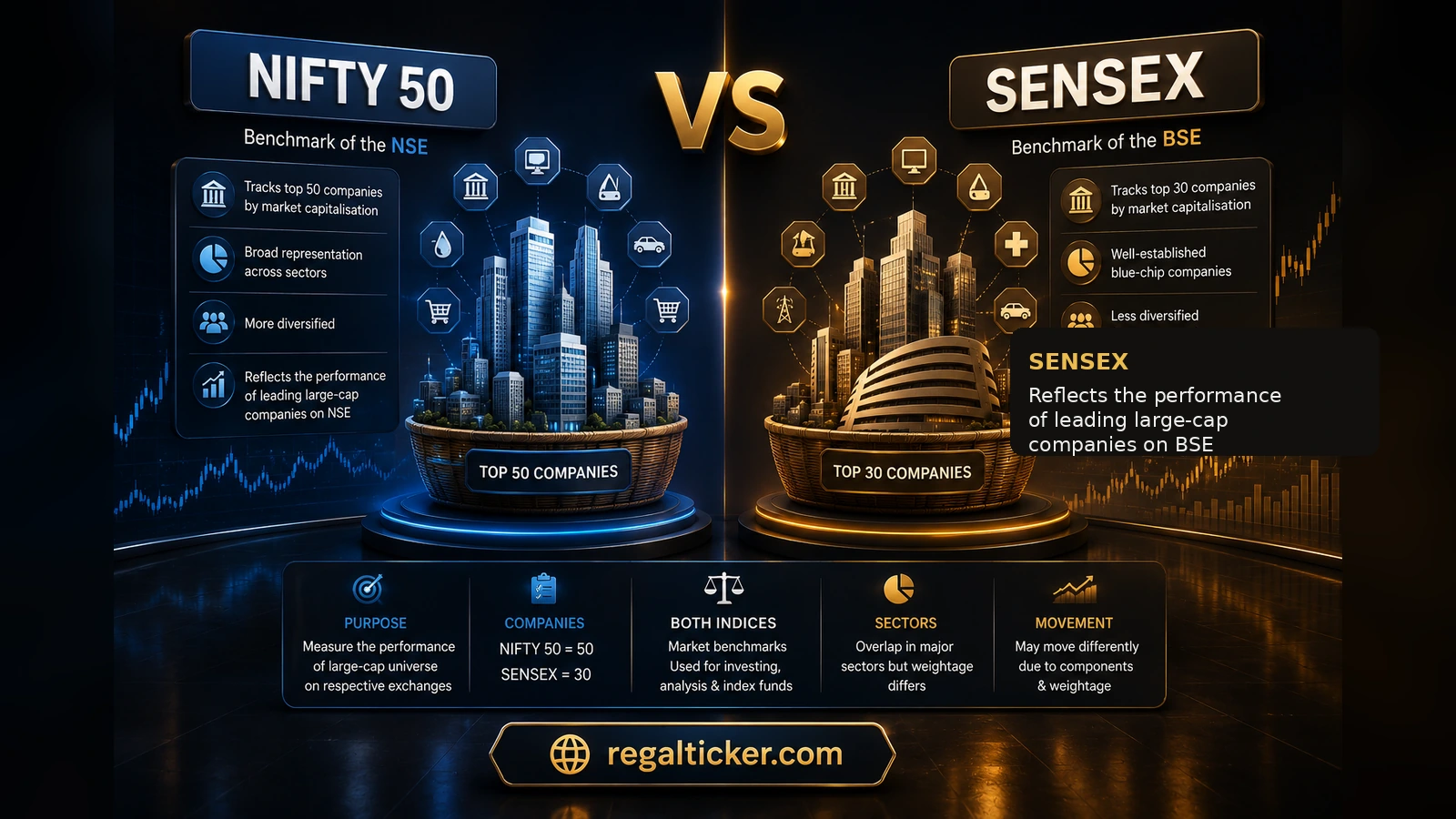
A common beginner mistake is to treat NIFTY 50 and SENSEX as if they were exchanges. They are indices, not exchanges.
| Point | NIFTY 50 | SENSEX |
|---|---|---|
| Associated exchange | NSE | BSE |
| Number of selected companies | 50 | 30 |
| Basic purpose | Measures the performance of a selected large-company basket | Measures the performance of a selected prominent-company basket |
| Is it the entire market? | No | No |
| Can every listed company enter automatically? | No, index eligibility rules apply | No, index eligibility rules apply |
| Can investors get exposure through products? | Index funds, ETFs and derivatives may reference it | Index funds, ETFs and derivatives may reference it |
Worked example
Exchange versus index
NSE is the exchange. NIFTY 50 is an index associated with NSE.
BSE is the exchange. SENSEX is an index associated with BSE.
The difference is similar to a sports stadium and a scoreboard. The exchange is the venue; the index is one selected measure of performance.
Can the same company be listed on both NSE and BSE?
Yes. Many large Indian companies have shares listed on both exchanges. The underlying ownership interest is in the same company and share class, but the order books on NSE and BSE are separate.
Because buyers and sellers place orders independently on each exchange, the visible price can differ slightly at the same moment.

Worked example
Small price difference between exchanges
Assume the same share has these best available sell offers:
NSE: ₹500.10 BSE: ₹500.25
If sufficient quantity is available and all other conditions are similar, the NSE offer appears cheaper by ₹0.15 per share.
For 100 shares:
₹0.15 × 100 = ₹15 apparent price difference
The investor should still consider available quantity, order type, brokerage-related costs, taxes, price movement and whether the quoted order remains available when execution is attempted.
Use the calculator
Compare the Trade Cost, Not Just the Quote
A small NSE-BSE price difference can look attractive, but the final result also depends on brokerage and applicable transaction charges. Use the Brokerage Calculator to estimate the complete trade cost before deciding whether a few paise of exchange-level price difference actually matters.
Why can the price differ on NSE and BSE?
Each exchange maintains its own order book. The buyers, sellers, order quantities and timing may differ.
A small price difference can arise because:
- More buyers are active on one exchange.
- More sellers are offering shares on one exchange.
- Available order quantities differ.
- A large order temporarily changes one order book.
- Market makers or arbitrage participants have not yet eliminated the gap.
- Quotes change before the investor’s order reaches the market.
Professional participants often react quickly to meaningful price differences. This arbitrage activity usually helps keep prices close, but identical prices are not guaranteed at every instant.
The reason is price discovery: NSE and BSE each match their own stream of buy and sell orders, so the executable price can differ slightly at a given moment. Read How Are Share Prices Decided? to understand order matching, demand, supply and how the traded price is formed.
Investor note
The visible price is not always the executable price
A quote can change quickly. A displayed price may be available only for a small quantity. A market order can execute across multiple prices. Beginners should understand bid, ask, quantity and order type before comparing exchanges.
If bid price, ask price, spread, market depth or executable quantity are unfamiliar, read Bid Price, Ask Price, Spread & Order Book Explained before comparing two exchange quotes. It explains how available quantity, price-time priority and order-book depth can affect the price you actually get.
Which exchange has more liquidity?
Liquidity means the ability to buy or sell without causing a large price impact. It can be evaluated using factors such as trading volume, bid–ask spread, order-book depth and available quantity.
NSE often has high activity in many widely traded shares and derivatives, but this does not mean every security is always more liquid on NSE. Some securities may have better activity on BSE, while some may be listed on only one exchange.
| Liquidity sign | What to look for | Why it matters |
|---|---|---|
| Bid–ask spread | Difference between the best buying and selling prices | A narrower spread can reduce execution friction |
| Order-book depth | Quantity available at nearby prices | More depth may support larger orders |
| Trading volume | Number of shares traded | Higher volume can indicate active participation |
| Trade frequency | How often transactions occur | Infrequent trades can make the quoted price less reliable |
| Price impact | How much the price changes for your order size | Lower impact is generally preferable |
Risk warning
High volume does not remove investment risk
Liquidity can make entry and exit easier, but it does not make the company a good investment. A highly liquid share can still be overvalued, volatile or fundamentally weak.
Is NSE better than BSE?
There is no universal answer.
For a retail investor buying a share listed on both exchanges, the better immediate venue may be the one offering:
- A better executable price
- Sufficient quantity
- A narrower bid–ask spread
- More order-book depth
- Reliable access through the broker
For long-term investing, a difference of a few paise may be less important than business quality, valuation, costs and portfolio risk. For a high-frequency or large order, exchange-level liquidity may matter much more.
For a long-term investor, choosing between NSE and BSE is mainly an execution decision; choosing the company itself is an investment decision. Use Fundamental Analysis to evaluate business quality and valuation, and Risk Management to control position size, portfolio concentration and downside risk.
| Situation | Practical consideration |
|---|---|
| Long-term investor buying a small quantity | Compare price and liquidity, but focus mainly on business and valuation |
| Large order | Check depth, spread and likely price impact |
| Thinly traded security | Prefer the exchange with genuine active orders |
| Security listed on only one exchange | Use the exchange where it is listed |
| Intraday or short-term trader | Execution speed, liquidity and spread become more important |
| Index product investor | Confirm whether the product tracks NIFTY, SENSEX or another index |
How do you choose NSE or BSE in a trading app?
Many broker platforms show an exchange label beside the security. The investor may see the same company name with an NSE option and a BSE option.
The exact interface differs by broker, but the basic flow is:
- Search for the company or security.
- Verify the exact share class and symbol.
- Compare the NSE and BSE quotes when both are available.
- Check bid, ask, quantity and volume.
- Select the preferred exchange.
- Choose the order type and quantity.
- Review the order before submitting.

The broker routes the order to the selected exchange. The exchange attempts to match it with a compatible opposite order.
Can I buy on NSE and sell on BSE?
For an eligible share listed on both exchanges and held in dematerialised form, selling through the other exchange may generally be possible after the purchased shares have been settled and credited to the demat account, subject to broker support and the applicable process.
However, a beginner should distinguish this from intraday trading. An intraday position is normally exchange-specific because the buy and sell are intended to offset within the same trading session and product arrangement.
Worked example
Delivery holding versus intraday position
Delivery example: An investor buys a dual-listed share, receives it in the demat account after settlement and later chooses to sell it through another exchange where the same security is listed.
Intraday example: An investor buys on NSE using an intraday product and attempts to sell on BSE. The two positions may not automatically offset because the exchange and product are different.
Broker rules and current market procedures should always be checked.
Are the shares different on NSE and BSE?
When the same company and same class of share are listed on both exchanges, the underlying share ownership is normally the same. NSE and BSE provide different trading venues for that security; they do not create two separate ownership interests in the company.
The key is to verify:
- Company name
- Share class
- ISIN
- Exchange symbol
- Series or trading category
- Corporate-action eligibility
Do not assume two similarly named securities are identical without checking the details.
When similarly named securities appear in a trading app, verify the ISIN, share class, exchange symbol and trading category before placing the order. The Investor Safety hub explains why verification should come before execution.
Do NSE and BSE have different trading hours?
The regular equity market sessions of major Indian exchanges are generally aligned, subject to declared holidays, special sessions and regulatory changes.
Because timings and session structures can change, investors should verify current information through the exchange or broker before relying on a fixed schedule.
The more important beginner concept is that an order placed outside a live session may remain pending, be queued for the next session or be handled according to the broker’s after-market-order process.
Are NSE and BSE regulated by SEBI?
Both exchanges operate within India’s securities-market regulatory framework. SEBI regulates the securities market, while exchanges also perform surveillance and enforce applicable trading and listing requirements under that framework.
SEBI describes stock exchanges as market infrastructure institutions that support trading, liquidity, price discovery, oversight and capital formation.
The existence of regulation does not guarantee that an investor will make a profit or that every listed company is financially strong.
NSE symbol vs BSE code
A company can have a text-based trading symbol on NSE and a numeric security code on BSE.
Worked example
Two identifiers for one listed company
A hypothetical company may appear as:
NSE symbol: ALPHATECH BSE security code: 543210
These are exchange identifiers. Investors should also verify the ISIN, which identifies the security in the depository system.
What are market orders and limit orders?
The order type can matter more than the exchange name.
Market order
A market order seeks immediate execution at the best available prices. The final execution price can differ from the last traded price, especially when liquidity is weak.
Limit order
A limit order specifies the maximum price for a buy or minimum price for a sale. It provides price control but may not execute.
For a complete comparison of execution certainty, price control, stop-loss orders and stop-limit orders, read Market Order vs Limit Order vs Stop-Loss vs Stop-Limit before choosing an order type in your trading app.
Worked example
Why a limit order can help
The best visible sell offer is ₹500.25, but the investor wants to pay no more than ₹500.10.
A buy limit order at ₹500.10 will execute only if a seller becomes available at ₹500.10 or lower. It may remain unexecuted.
Does exchange choice affect corporate actions?
Corporate actions such as dividends, bonus shares and stock splits are generally based on ownership and eligibility conditions, not on whether the original delivery purchase occurred on NSE or BSE.
Once an eligible share is settled in the demat account, the depository record and the company’s applicable entitlement process matter.
For entitlement timing, read Ex-Date vs Record Date before acting on a dividend, bonus issue, stock split, rights issue or other corporate action.
However, investors should always verify:
- Record date
- Ex-date
- Eligibility requirements
- Share class
- Corporate announcement
- Whether the holding has settled in time
Common myths about NSE and BSE
Myth 1: NSE shares are better companies
The exchange name does not determine company quality. A company must be evaluated using its business, financial position, governance, valuation and risks.
Myth 2: BSE is outdated because it is older
BSE’s historical age does not mean it uses an old-style market. Modern BSE trading is electronic.
Myth 3: NIFTY and NSE are the same thing
NSE is the exchange. NIFTY 50 is a benchmark index.
Myth 4: SENSEX includes every BSE-listed company
SENSEX tracks a selected basket, not every listed company.
Myth 5: The cheaper exchange quote always produces the cheaper trade
The quoted quantity may be small, the price can change, and charges or market impact can alter the result.
Myth 6: Buying on one exchange locks the share there forever
A settled dual-listed share held in demat form may generally be sold through another exchange where it is eligible and supported.
Beginner checklist before choosing an exchange
- Confirm the security is listed on the selected exchange.
- Verify the company, share class, symbol and ISIN.
- Compare the best bid and ask.
- Check available quantity and order-book depth.
- Use an appropriate order type.
- Consider all transaction charges, not only the quote.
- Avoid market orders in illiquid securities unless you understand the risk.
- Confirm whether the order is delivery, intraday or another product type.
- Review the complete order before submission.
- Keep the contract note and verify executed trades.
Frequently asked questions
What is the main difference between NSE and BSE?
The main differences include their history, benchmark indices, listings and trading activity. Their core role is similar: both provide organised markets for securities trading.
Which is older, NSE or BSE?
BSE was founded in 1875. NSE was incorporated in 1992 and commenced operations in 1994.
Which index belongs to NSE?
NIFTY 50 is the widely followed benchmark associated with NSE.
Which index belongs to BSE?
SENSEX is the widely followed benchmark associated with BSE.
Is NSE better for beginners?
Not automatically. Beginners should consider where the share is listed, available price, liquidity, quantity and broker support.
Can the same share have different prices on NSE and BSE?
Yes. Separate order books can produce small temporary differences in price and quantity.
Can I buy on NSE and sell on BSE?
A settled delivery holding in a share listed on both exchanges may generally be sold through the other exchange, subject to broker support and current market procedures. Intraday positions are different.
Are NSE and BSE both regulated?
Both operate within SEBI’s securities-market regulatory framework and perform exchange-level oversight and surveillance.
Does buying on BSE give a different dividend from buying on NSE?
For the same eligible share class, dividend entitlement depends on the company’s declaration, eligibility and holding records, not on a permanent exchange-specific ownership difference.
What should I learn next?
The next useful Stock Market Basics lesson is What Are NIFTY 50 and SENSEX? Meaning, Differences and How They Work
Conclusion
NSE and BSE are two major pillars of India’s securities market. BSE has a much longer history, while NSE played a major role in nationwide electronic trading. NIFTY 50 and SENSEX are their best-known benchmark indices, but the exchanges themselves serve the broader function of listing, trading, liquidity and price discovery.
For most beginners, the exchange name should not be the main investment decision. Company quality, valuation, risk and a disciplined process matter far more. When the same share trades on both exchanges, compare the executable price, quantity and liquidity rather than assuming one exchange is always superior.
Verify through official sources
Official references
Educational disclaimer: This article is for investor education and general information only. It does not constitute investment advice, a research recommendation, an invitation to trade, an offer to buy or sell securities, or an assurance of returns. Securities-market investments involve risk. Exchange rules, trading sessions, settlement practices and broker processes can change. Readers should verify current information through official sources and consult an appropriately qualified professional where necessary.