

⚡ Quick answer
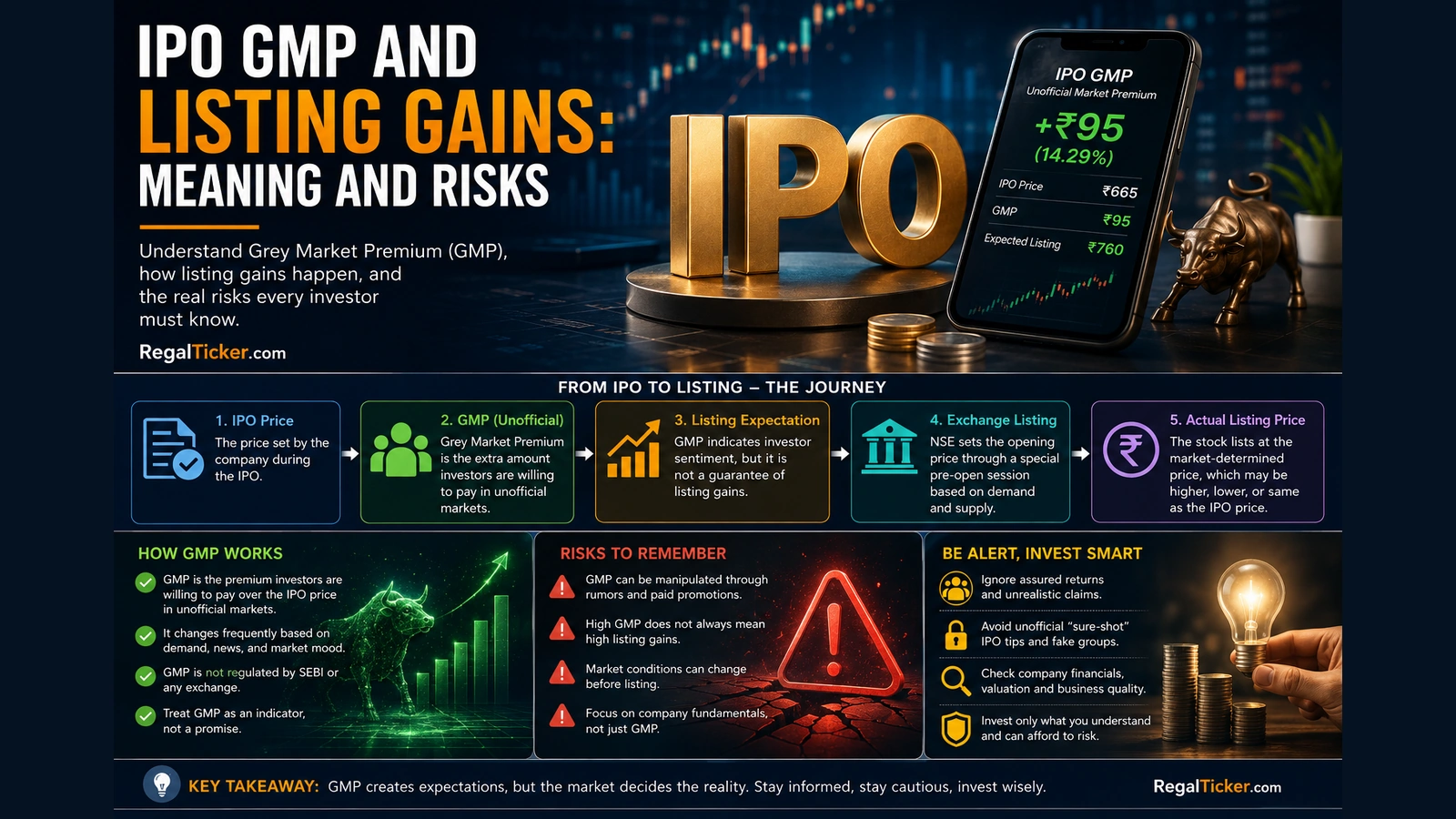
IPO GMP, or grey market premium, is an unofficial pre-listing quote indicating how much market participants informally expect an IPO share to trade above or below its issue price. If the final issue price is ₹300 and the quoted GMP is ₹45, the implied grey-market price is ₹345 and the implied premium is 15%. GMP is not the official listing price and can change sharply before listing. The actual opening price is discovered on the stock exchange through the special pre-open session using eligible buy and sell orders. A listing gain is the percentage increase from the final issue price to the actual listing or sale price.
Investor note
Key Takeaways
GMP is an informal pre-listing indication, not an exchange price. It is generally quoted as rupees per share. Implied grey-market price equals issue price plus GMP. GMP percentage equals GMP divided by issue price. A negative GMP indicates an informal expectation below the issue price. Different sources can report different GMP values. There is no central official grey-market order book. The actual listing price is determined on the recognised exchange. The exchange opening price is based on demand and supply. Subscription and GMP measure different things. High subscription does not guarantee a positive listing. High GMP does not guarantee allotment or listing gains. A low or zero GMP does not prove that the company is poor. SME IPOs can carry additional liquidity and manipulation risks. Social-media claims, assured returns and sure-shot allotment offers should be avoided. Listing gain should use the final issue price, not automatically the cap price. Net profit should include charges, tax and the actual execution price. Business quality and valuation remain more important than informal sentiment.
IPO GMP is one of the most searched numbers during a public issue.
It is also one of the most misunderstood.
A rising GMP can create the impression that institutional demand is guaranteed, the IPO is undervalued and an easy listing profit is almost certain. None of these conclusions is reliable.
GMP is an informal expectation formed before official exchange trading begins. It can reflect sentiment, but it can also reflect a small number of participants, rumours, changing subscription data, market momentum, selective reporting, promotional activity or sudden changes in the broader market.
The official listing price is not decided by a GMP website, messaging group or informal dealer. It is discovered through the recognised exchange’s opening-price mechanism.
This lesson explains what GMP means, how listing gains are calculated and why every pre-listing quote should be treated as uncertain.
Read IPO Allotment Process: How Shares Are Allocated before estimating returns from an application.
What Is IPO GMP?
GMP stands for Grey Market Premium.
It is an informal rupee quote associated with an IPO before the shares begin official exchange trading.
Why Is It Called a Grey Market?
It operates outside the recognised stock-exchange trading system.
The quoted activity is not the same as:
- submitting an IPO application through ASBA;
- buying a listed share through NSE or BSE;
- viewing an official exchange order book;
- receiving an exchange trade confirmation for a listed-market transaction.
The quote commonly circulates through market networks, financial websites, messaging groups, social media and news reports.
Positive GMP
A positive GMP indicates that informal participants expect the share to trade above the issue price.
💡 Real example
Simple example
final issue price: ₹250; GMP: ₹40.
Implied grey-market price:
₹250 + ₹40 = ₹290
Implied premium:
₹40 ÷ ₹250 × 100 = 16%
Negative GMP
A negative GMP indicates an informal expectation below the issue price.
💡 Real example
issue price: ₹500; GMP: −₹30.
Implied grey-market price:
₹500 − ₹30 = ₹470
Implied discount:
₹30 ÷ ₹500 × 100 = 6%
A negative quote does not guarantee a discounted listing.
GMP Is Not an Official Recommendation
The quote does not prove fair valuation, business quality, guaranteed allotment or guaranteed profit.
SEBI has cautioned investors against rumours, misleading social-media content, assured-return claims and unregistered entities.
How IPO GMP Is Calculated and Reported
GMP is normally quoted as an absolute rupee amount per share.
GMP Formula
Implied grey-market price = Final issue price + GMP
💡 Real example
issue price: ₹420; GMP: ₹70.
Implied price:
₹420 + ₹70 = ₹490
GMP Percentage Formula
GMP percentage = GMP ÷ Final issue price × 100
Using the example:
₹70 ÷ ₹420 × 100 = 16.67%
Why Percentage Is More Useful
A ₹50 GMP means 50% on a ₹100 issue price but only 5% on a ₹1,000 issue price.
Always compare the percentage, not only the rupee quote.
Use the Final Issue Price
A price band can be ₹390–₹410. If the final issue price is ₹405, listing-return calculations should use ₹405.
Do not automatically use the cap price when the final price is lower.
Multiple Quotes Can Exist
Different sources can publish ₹50, ₹57 and ₹65 for the same IPO at the same time.
There is no official consolidated exchange order book for GMP. Quotes can depend on source, time, participant, location and informal transaction type.
Kostak and Subject-to-Sauda
Some informal IPO discussions use terms such as Kostak rate and subject to sauda. These relate to arrangements connected with an IPO application or possible allotment and can involve settlement uncertainty, counterparty risk, disputes and lack of exchange protection.
This article does not recommend participating in such arrangements.
GMP vs Subscription, Issue Price and Listing Price
These numbers measure different things.
| Measure | What it represents |
|---|---|
| Issue price | Final price paid by allotted IPO investors |
| Subscription multiple | Shares bid divided by shares available |
| GMP | Unofficial pre-listing premium or discount quote |
| Listing price | Official exchange opening price on listing day |
Subscription Does Not Equal GMP
Subscription measures demand during the public issue. GMP reflects informal pre-listing sentiment.
An IPO can have strong subscription and weak GMP, or strong GMP followed by a poor listing.
Read How to Read IPO Subscription Data for category-wise analysis.
GMP Does Not Equal Listing Gain
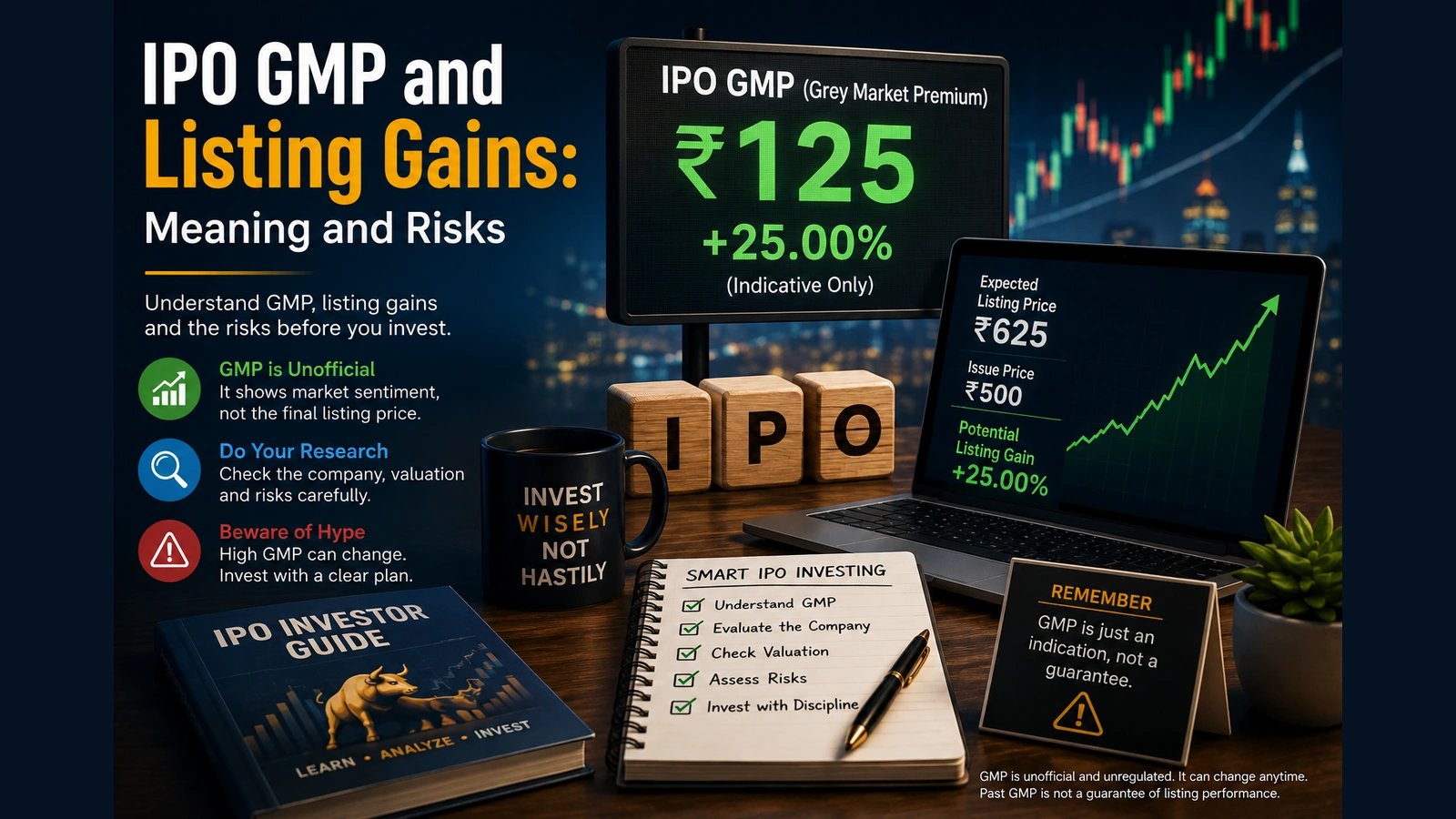
Suppose:
- issue price: ₹300;
- GMP before listing: ₹60;
- implied grey-market price: ₹360;
- actual listing price: ₹332.
Actual listing gain:
₹332 − ₹300 = ₹32 per share
Listing-gain percentage:
₹32 ÷ ₹300 × 100 = 10.67%
The informal quote indicated 20%, but the actual opening gain was 10.67%.
Listing Price Is Not the Sale Price
A stock can list at ₹332 while an investor sells at ₹320, ₹340, ₹375 or ₹290.
Actual return depends on the executed sale price.
Open, High and Close Can Differ
Listing-day price movement can be volatile. Distinguish the opening price, intraday high, intraday low, closing price and actual sale price.
A screenshot of the day’s highest price does not represent every investor’s return.
How the Actual IPO Listing Price Is Determined
The official opening price is discovered on the recognised stock exchange.
Special Pre-Open Session
NSE applies a special pre-open session to IPO securities on their first trading day, including SME IPOs.
The session includes order entry, modification and cancellation during the permitted period, order matching, opening-price determination and transition to normal trading.
Equilibrium Price
The opening price is a single equilibrium price determined through demand and supply.
NSE states that the equilibrium price is primarily the price at which the maximum executable volume is available. When more than one price qualifies, further rules consider minimum order imbalance and closeness to the base price.
Issue Price as Base Price
For an IPO security, the issue price is used as the base price for the special pre-open process.
That does not mean the security must open at the issue price.
Why Listing Price Can Differ from GMP
The official opening book can differ because of actual buy and sell orders, institutional participation, allottees seeking an exit, broader market movement, overnight news, sector sentiment, global markets and available free float.
When Equilibrium Is Not Discovered
Under NSE’s published process, an IPO security can move to the normal market at the base price when an equilibrium price is not discovered.
This is another reason why an informal quote is not an official opening-price commitment.

Factors That Influence GMP and Listing Gains
GMP and actual listing performance can react to similar factors, but not always in the same way.
Valuation
Check the P/E ratio, price-to-book ratio where relevant, enterprise value, revenue multiple, peer comparison and growth assumptions.
An aggressively priced issue can weaken after initial excitement.
Business and Financial Quality
Strong demand can be supported by durable growth, healthy cash flow, low debt, strong margins, credible management and market leadership.
Weak fundamentals can be temporarily hidden by sentiment.
Offer Structure
Review the fresh issue, offer for sale, issue size, promoter holding, public float and use of proceeds.
Read Fresh Issue vs Offer for Sale in an IPO.
Category-Wise Subscription
QIB, small NII, large NII, retail and employee demand can influence sentiment differently.
A headline multiple dominated by one category can be misleading.
Issue Size and Free Float
A small issue can produce large subscription multiples, limited available shares, high volatility and sharp listing moves.
Broader Market Conditions
GMP can reverse when the main market falls, sector stocks weaken, global risk rises or another IPO lists poorly.
News and Rumours
Pre-listing sentiment can react to unverified claims, fake screenshots, fabricated institutional demand and misleading confirmed-listing messages.
Always return to official filings and exchange information.
Major Risks of Relying on IPO GMP
GMP can be used only as a weak sentiment indicator.
No Official Central Price
There is no recognised exchange order book showing one official GMP.
Thin Participation
A quote can be influenced by a limited number of participants, making it easier to distort.
No Guaranteed Settlement
Informal arrangements may not provide exchange clearing, investor-protection mechanisms, standard contract notes or reliable dispute resolution.
Selective Reporting
A website or social-media account can report only rising quotes, update late, use stale figures or copy another source without verification.
Manipulation and Promotion
False excitement can be created through guaranteed-return messages, sure-shot listing claims, fake institutional screenshots, paid groups and fabricated demand predictions.
SEBI has cautioned the public about fraudulent and manipulative securities-market activity on social-media platforms, including false claims of preferential IPO access and sure-shot allocation.
SME IPO Risk
SEBI has separately advised investors to exercise caution in SME-segment companies and avoid relying only on announcements, social-media posts, rumours or tips.
SME IPOs can involve smaller free float, lower liquidity, larger market lots, greater volatility and difficulty exiting.
Market Reversal, Allotment and Execution Risk
A positive GMP can turn negative before listing. The investor may receive no shares, or the stock may fall before a sell order executes.
Behavioural Risk
GMP can trigger fear of missing out, oversized applications, borrowing and ignoring valuation.
Worked GMP and Listing-Gain Examples
The following examples are fictional and for education.
Example 1: GMP Matches Listing
- issue price: ₹200;
- GMP: ₹40;
- implied price: ₹240;
- actual listing price: ₹240.
Implied and actual gain: 20%.
The estimate happened to match, but that does not make GMP reliable for future IPOs.
Example 2: Positive GMP, Lower Listing Gain
- issue price: ₹500;
- GMP: ₹100;
- actual listing price: ₹540.
Implied GMP: 20%.
Actual listing gain:
₹40 ÷ ₹500 × 100 = 8%
Example 3: Positive GMP, Discounted Listing
- issue price: ₹300;
- GMP: ₹25;
- actual listing price: ₹285.
Actual loss:
−₹15 ÷ ₹300 × 100 = −5%
Example 4: Negative GMP, Positive Listing
- issue price: ₹150;
- GMP: −₹5;
- actual listing price: ₹165.
Actual gain:
₹15 ÷ ₹150 × 100 = 10%
Example 5: Listing Price vs Actual Exit
- issue price: ₹400;
- listing price: ₹460;
- investor sale price: ₹438.
Headline listing gain: 15%.
Investor’s gross realised gain:
₹38 ÷ ₹400 × 100 = 9.5%
Example 6: Lot-Level Return
- issue price: ₹325;
- allotted shares: 45;
- sale price: ₹370.
Gross gain per share:
₹45
Gross total gain:
₹45 × 45 = ₹2,025
Gross return:
₹45 ÷ ₹325 × 100 ≈ 13.85%
Use the Stock Return Calculator, Brokerage Calculator and Capital Gains Tax Calculator before treating gross gain as final profit.
A Better Framework Than Following GMP Alone
Use GMP only after completing a full IPO review.
Read the RHP
Use DRHP vs RHP: How to Read IPO Documents to review risk factors, business, financials, litigation, promoters and use of funds.
Understand the Price and Structure
Use IPO Price Band, Lot Size and Issue Size Explained to calculate application amount, implied market capitalisation, fresh issue, OFS and valuation.
Analyse Financial Quality
Check revenue growth, operating profit, net profit, operating cash flow, debt, margins and return ratios.
Read Category Demand
Use subscription data to understand where demand is coming from. Do not use the overall multiple alone.
Define the Objective
The application may be for a listing-day exit, medium-term holding or long-term ownership.
A listing-gain application and a long-term investment require different decision rules.
Set an Exit Plan
Decide before listing whether to sell at open, use a limit order, hold part of the allotment and define the maximum acceptable loss.
Limit Capital Exposure
Do not use emergency money or create excessive concentration. Borrowed applications add financing risk.
Common Mistakes and Investor Checklist
Common Mistakes
- Treating GMP as an official NSE or BSE price.
- Using one website as the only source.
- Ignoring the quote timestamp.
- Confusing subscription with listing gain.
- Ignoring valuation.
- Applying only because GMP is high.
- Using borrowed money without calculating interest.
- Believing assured-return claims.
- Ignoring sale execution and trading costs.
- Ignoring SME liquidity risk.
IPO GMP and Listing Checklist
Before applying, confirm:
- Final issue price
- GMP source and timestamp
- GMP percentage
- Category-wise subscription
- Issue size and free float
- Fresh issue and OFS mix
- Business quality
- Financial performance
- Cash flow
- Debt
- Promoter holding
- Use of proceeds
- Peer valuation
- Broader market conditions
- SME or main-board platform
- Listing objective
- Maximum capital exposure
- Expected charges and tax
- Exit strategy
- Readiness for a discounted listing

Frequently Asked Questions
IPO GMP is an unofficial pre-listing premium or discount quote over the final issue price.
What is the full form of GMP?
Grey Market Premium.
Is GMP an official NSE or BSE price?
No.
How is GMP calculated?
The implied grey-market price equals the final issue price plus GMP.
How do I calculate GMP percentage?
Divide GMP by the final issue price and multiply by 100.
What does negative GMP mean?
It indicates an informal expectation that the share may trade below the issue price.
Does positive GMP guarantee a positive listing?
No.
Can GMP change after the IPO closes?
Yes. It can change until listing and can reverse suddenly.
Why do different websites show different GMP?
There is no official central grey-market order book, and sources can use different participants, times or methods.
What is a listing gain?
It is the increase from the final issue price to the listing or sale price.
How is listing gain calculated?
Subtract the issue price from the listing or sale price, divide by the issue price and multiply by 100.
Is listing price the same as sale price?
No. The investor’s actual execution can occur at a different price.
How is the IPO opening price decided?
It is discovered through the stock exchange’s special pre-open demand-and-supply process.
What is an equilibrium price?
It is the single opening price selected under the exchange’s matching rules, primarily where maximum executable volume is available.
Does high subscription guarantee high GMP?
No.
Does high GMP guarantee allotment?
No.
Is GMP reliable for SME IPOs?
It carries significant risk, especially where liquidity, free float and participation are limited.
What is Kostak rate?
It is an informal term connected with transferring the economic interest in an IPO application before listing. Such arrangements carry counterparty and settlement risks.
What is subject to sauda?
It is an informal arrangement whose payment depends on successful allotment and remains outside the normal recognised-exchange application and trading process.
Should I apply only because GMP is high?
No. GMP should never replace offer-document, valuation, financial and risk analysis.
Final Takeaway
IPO GMP can indicate pre-listing sentiment, but it is not an official market price and cannot predict the listing with certainty.
Use these formulas:
Implied grey-market price = Issue price + GMP
GMP percentage = GMP ÷ Issue price × 100
Listing-gain percentage = (Listing or sale price − Issue price) ÷ Issue price × 100
Then remember:
- informal quotes can be wrong;
- different sources can disagree;
- GMP can reverse quickly;
- subscription and GMP are different;
- allotment is uncertain;
- actual sale price can differ from listing price;
- exchange demand and supply determine the official opening;
- valuation and business quality remain essential;
- SME liquidity and manipulation risks require extra caution;
- assured-return and sure-shot claims should be rejected.
Continue learning:
- What Is an IPO? Meaning, Process and Example
- How Does an IPO Work in India? Complete Process
- IPO Price Band, Lot Size and Issue Size Explained
- DRHP vs RHP: How to Read IPO Documents
- Fresh Issue vs Offer for Sale in an IPO
- Retail, HNI, QIB and Employee IPO Categories Explained
- How to Read IPO Subscription Data
- IPO Allotment Process: How Shares Are Allocated
- Stock Return Calculator
- Brokerage Calculator
- Capital Gains Tax Calculator
- Investor Tools Hub
Official References
- NSE India — Special Pre-Open Session
- SEBI Investor — Book-Building Process
- SEBI — Caution Against Fraudulent or Manipulative Social-Media Activity
- SEBI Investor — Advisory Regarding Investment in SME Segment Companies
- NSE India — New Listings
Educational disclaimer: This article is for general investor education only. It is not investment advice, legal advice, tax advice, a research recommendation, an offer, a solicitation or a guarantee of allotment, listing price or returns. GMP quotes are informal and can be inaccurate, manipulated, stale or unavailable. Verify official IPO details through the RHP, registrar, SEBI and recognised stock exchanges, and use only registered intermediaries for securities-market transactions.