

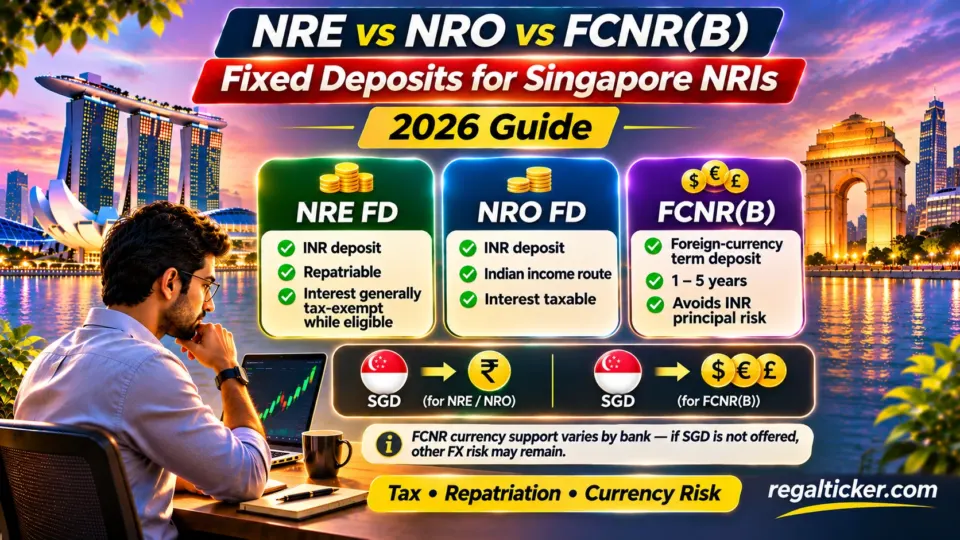
The deposit rate is only one part of the decision
For a Singapore-based NRI, choosing between an NRE fixed deposit, NRO fixed deposit and FCNR(B) deposit is not simply about finding the highest advertised interest rate. The three products differ in tax, repatriation, currency exposure, tenure and what happens when you return to India. A deposit that looks attractive in INR can still deliver a weaker outcome when measured back in SGD.
⚡ Quick answer
Which fixed deposit is best for a Singapore NRI?
There is no single best option. NRE deposits are rupee deposits with repatriable character and generally tax-exempt interest while the statutory eligibility conditions are met. NRO deposits are also rupee deposits, but their interest is taxable in India and capital remittance follows the NRO framework. FCNR(B) is a foreign-currency term deposit, generally repatriable, with tax-exempt interest for eligible non-residents and can reduce INR principal risk.
Key takeaways
NRE FD and NRO FD are denominated in INR.
FCNR(B) is denominated in permitted foreign currency.
NRE balances are generally repatriable.
NRO capital balances follow the applicable NRO remittance framework.
NRE interest remains exempt under the Income Tax Act, 2025 while the qualifying conditions are met.
FCNR interest is also tax-exempt for qualifying non-residents.
NRO interest is taxable in India.
NRE term deposits have a minimum one-year tenor.
FCNR(B) term deposits run from one year up to five years.
Premature withdrawal can reduce or eliminate interest depending on how early the deposit is broken.
FCNR(B) reduces INR principal risk, but if the bank does not offer SGD, a Singapore investor may still hold SGD-versus-USD/EUR/GBP risk.
Investor note
Compare the currency first, the rate second
A 7% rupee deposit is not automatically better than a 4% foreign-currency deposit for someone whose future spending is in SGD. The useful comparison is the final SGD value after interest, tax, exchange-rate movement and conversion cost.
1. NRE fixed deposits: rupee return with repatriable character
An NRE fixed deposit is an Indian-rupee term deposit funded through eligible non-resident money.
RBI treats NRE balances as repatriable. That makes the product attractive when a Singapore NRI wants rupee exposure but still wants eligible principal and interest to retain a clean outward-remittance route.
The main trade-off is currency risk.
Your money is converted from SGD or another foreign currency into INR. If INR weakens materially against SGD during the deposit term, the SGD value of the maturity amount can be lower than the rupee interest rate suggests.
2. NRE interest remains tax-exempt while eligible
The Income Tax Department confirms that the NRE-interest exemption has been retained under the Income Tax Act, 2025.
The exemption depends on the individual remaining a person resident outside India under FEMA or otherwise being permitted by RBI to maintain the account.
That means the tax result can change when your residential status changes.
Do not assume “NRE interest is tax-free forever” regardless of status.
3. NRO fixed deposits: useful for Indian-source rupee money
NRO accounts can be maintained as fixed deposits.
They are commonly used when the money arises in India, such as rent, pension, dividend, interest or other permitted rupee receipts.
NRO is therefore often the more natural deposit route for Indian-source cash that is not intended to preserve full repatriable character.
The important difference is tax: NRO interest is taxable in India.
For the Singapore-specific account comparison: https://regalticker.com/nre-vs-nro-singapore-nri
4. NRO capital is not freely repatriable
NRO current income can be remitted subject to compliance, but NRO capital balances and eligible assets use the applicable remittance-of-assets framework.
For NRIs and PIOs, RBI provides the USD 1 million per financial year facility for eligible balances/assets subject to conditions.
So an NRO FD should not be chosen only on rate without considering what you plan to do with the maturity proceeds.
For the full Singapore remittance guide: https://regalticker.com/repatriate-money-india-singapore-nri
5. FCNR(B): the foreign-currency alternative
FCNR(B) stands for Foreign Currency Non-Resident (Bank) deposit.
Unlike NRE and NRO term deposits, FCNR(B) is maintained in foreign currency rather than INR.
RBI permits FCNR(B) deposits in freely convertible currencies, while each bank decides which currencies it actually offers.
This is important for Singapore residents because not every Indian bank necessarily offers SGD-denominated FCNR(B).
If SGD is not offered and you place the deposit in USD, EUR or GBP, you avoid INR principal risk but may still create another currency mismatch against SGD.
6. FCNR(B) tenure is one to five years
RBI’s current deposit directions specify these FCNR(B) maturity bands:
- one year to less than two years;
- two years to less than three years;
- three years to less than four years;
- four years to less than five years;
- five years.
Banks cannot accept FCNR(B) deposits for more than five years, and recurring deposits are not permitted under the scheme.
This makes FCNR(B) more structured than ordinary rupee savings products.
7. FCNR(B) interest is generally tax-exempt for eligible non-residents
Income Tax Department guidance states that interest on qualifying foreign-currency deposits accepted by an RBI-approved scheduled bank is exempt for a non-resident or qualifying not-ordinarily-resident individual.
Current non-resident guidance also identifies NRE and FCNR interest as tax-exempt.
This can make FCNR(B) useful when the investor wants a bank deposit without creating taxable Indian interest income.
Again, eligibility and residential status matter.
8. Premature withdrawal can be expensive
For FCNR(B), RBI requires banks to allow premature withdrawal, but if the deposit is broken before the minimum stipulated period, no interest is payable.
Banks may also apply penalties according to their disclosed policy.
NRE and NRO term deposits can also carry premature-withdrawal penalties, and RBI allows banks to offer certain non-callable deposit products subject to the applicable rules.
Do not compare only maturity rates if you may need the money early.
Liquidity has a value.
9. NRE vs FCNR: the real question is INR exposure
Suppose a Singapore NRI has SGD savings and wants a three-year bank deposit in India.
NRE FD
Money is converted into INR. You earn a rupee deposit rate and take INR/SGD currency risk.
FCNR(B)
Money remains in an eligible foreign currency. You avoid INR principal risk but take the risk of whatever currency you choose relative to SGD.
If SGD itself is offered by your bank, the currency match can be cleaner.
If only USD is available, the comparison becomes: SGD → USD FCNR(B) → SGD
That still has FX risk, just a different one.
10. NRO vs NRE: source of money matters
A Singapore salary remitted to India may naturally fit an NRE structure when repatriability matters.
Indian rent or other local rupee income often fits NRO more naturally.
Do not move money into a deposit simply to chase a slightly higher rate if doing so makes the ownership, tax or repatriation trail less clean.
The source of funds should remain easy to explain.
11. What happens if you return to India
Residential-status changes matter.
RBI says NRE accounts should be redesignated as resident accounts or transferred to RFC where eligible when the account holder returns to India for employment or otherwise becomes resident.
FCNR(B) deposits may generally continue until maturity at the contracted rate. At maturity, they are converted into resident rupee deposits or RFC, depending on eligibility and the investor’s choice.
This can make FCNR(B) useful for someone who expects a possible move back to India during the deposit term.
12. Singapore tax treatment of foreign interest
IRAS states that foreign-sourced interest is generally not taxable for individuals, subject to exceptions such as partnership income.
That means a normal Singapore-based individual can often receive foreign bank interest without a separate Singapore income-tax charge.
This does not change Indian tax treatment.
For example:
- qualifying NRE/FCNR interest can be exempt in India;
- NRO interest is taxable in India.
13. A practical Singapore NRI comparison
| Feature | NRE FD | NRO FD | FCNR(B) |
|---|---|---|---|
| Currency | INR | INR | Permitted foreign currency |
| Typical use | Overseas money, repatriable route | Indian-source/rupee money | Foreign-currency deposit |
| Interest tax in India | Generally exempt while eligible | Taxable | Generally exempt while eligible |
| Principal repatriability | Generally repatriable | Subject to NRO rules | Generally repatriable |
| INR currency risk | Yes | Yes | No on principal |
| Other FX mismatch possible | Yes vs SGD | Yes vs SGD | Yes if deposit currency is not SGD |
| Typical tenor | Minimum 1 year for term deposit | Bank-determined, minimum can be shorter | 1 to 5 years |
| Premature withdrawal impact | Bank/RBI rules apply | Bank/RBI rules apply | No interest if broken before minimum stipulated period |
The right choice depends on where the money came from, where it will ultimately be spent and how much currency risk you are willing to hold.
14. How to compare the three properly
For each option, estimate:
- original SGD amount;
- currency conversion cost;
- deposit currency;
- gross interest;
- Indian tax;
- maturity value;
- expected repatriation route;
- exit conversion cost;
- final SGD value.
Then compare the after-tax, after-FX SGD outcome, not just the advertised deposit rate.
For the broader currency-risk framework: https://regalticker.com/sgd-inr-currency-risk-singapore-nri
Investor note
Do not confuse deposit safety with currency safety
A bank fixed deposit can reduce market-price volatility, but it does not automatically protect your Singapore purchasing power. A stable INR principal can still change in SGD value.
Frequently asked questions
Is NRE FD interest tax-free in India?
The Income Tax Department confirms that the NRE-interest exemption continues under the Income Tax Act, 2025 while the required FEMA/RBI eligibility conditions are satisfied.
Is NRO FD interest taxable?
Yes. NRO interest is taxable in India.
Is FCNR(B) interest tax-free?
Qualifying FCNR foreign-currency deposit interest is generally exempt for eligible non-residents under Indian tax law.
Does FCNR(B) remove currency risk for a Singapore NRI?
It removes INR principal risk, but not necessarily SGD risk. If the deposit is in USD, EUR or GBP rather than SGD, exchange-rate risk against SGD remains.
How long can an FCNR(B) deposit run?
RBI permits FCNR(B) term deposits from one year up to five years.
Can I break an FCNR(B) deposit early?
Yes, but if it is withdrawn before the minimum stipulated period, RBI rules say no interest is payable. Banks can also apply disclosed penalties.
Which is better, NRE FD or FCNR(B)?
Neither is universally better. NRE gives INR exposure and repatriable character; FCNR(B) keeps principal in foreign currency. The best fit depends on your future spending currency, available deposit currencies and rate difference.
Does Singapore tax interest from an Indian NRI deposit?
IRAS states that foreign-sourced interest received by individuals is generally not taxable, subject to listed exceptions.
Verify through official sources
Official references
- Reserve Bank of India — Foreign Exchange Management (Deposit) Regulations, 2016 — RBI deposit regulations amended through 29 June 2026 covering NRE, NRO and FCNR(B).
- Reserve Bank of India — Interest Rate on Deposits Directions — Current NRE/NRO/FCNR(B) tenor, rate and premature-withdrawal framework.
- Reserve Bank of India — Non-Resident Accounts FAQ — RBI comparison of NRE/NRO repatriability and residential-status changes.
- Income Tax Department — Non-Resident FAQs — Current confirmation that the NRE-interest exemption continues under the Income Tax Act, 2025.
- Income Tax Department — Filing ITR for Non-Residents — Income Tax Department guidance identifying NRE/FCNR interest as tax-exempt and NRO interest as taxable.
- IRAS — Interest — Singapore guidance that foreign-sourced interest is generally not taxable for individuals.
Final takeaway
Pick the deposit that matches the currency of the goal
For a Singapore NRI, NRE, NRO and FCNR(B) deposits solve different problems. NRE is useful for repatriable rupee savings, NRO for Indian-source rupee money, and FCNR(B) when you want to keep the deposit in foreign currency and avoid INR principal risk. The best comparison is not the headline rate—it is the final SGD value after tax, currency movement, penalties and repatriation.
Educational disclaimer: This article is for investor education only and is not personal banking, tax or investment advice. Deposit rates, supported currencies, penalties and bank procedures vary and can change. Confirm the latest product terms with the bank and check current RBI, Indian tax and Singapore tax rules before placing a deposit.