

This launch matters far beyond one successful rocket flight
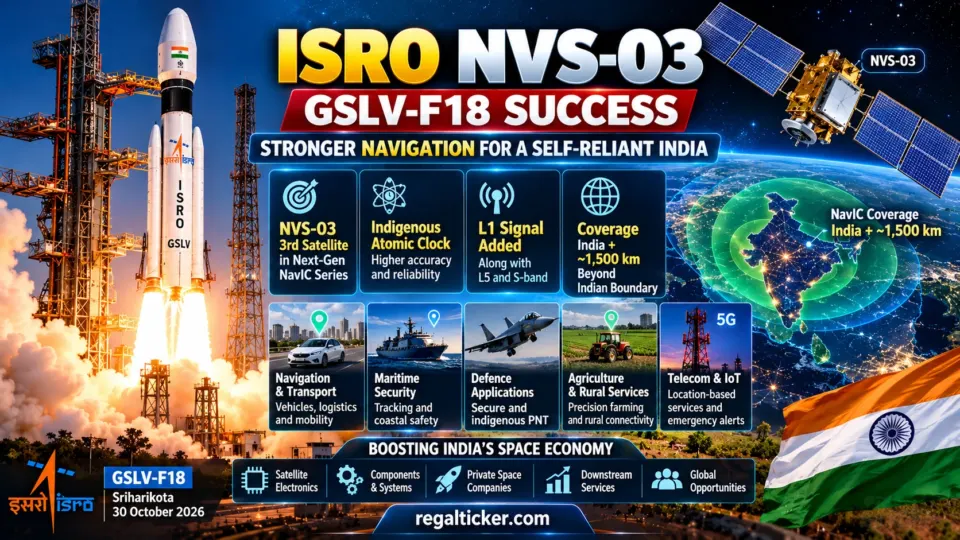
ISRO’s GSLV-F18 successfully placed the NVS-03 navigation satellite into the intended geosynchronous transfer orbit from Sriharikota on 30 October 2026.
It was the 20th flight of India’s Geosynchronous Satellite Launch Vehicle and the third satellite in the next-generation NVS series being built to maintain and strengthen NavIC, India’s independent regional satellite-navigation system.
The technical upgrades matter. NVS-03 carries an indigenous atomic clock alongside procured atomic clocks and adds an L1 navigation signal to the existing L5 and S-band signals. NavIC’s primary service area covers India and extends roughly 1,500 km beyond the country’s boundary.
For investors, the interesting part is not the rocket itself. Navigation satellites create infrastructure that can support transportation, maritime tracking, telecom, emergency response, defence, agriculture, power-grid timing and location-based services for years after launch.
That makes NVS-03 a useful extension of RegalTicker’s India private-space industry analysis: India’s space opportunity is becoming increasingly downstream. Launch vehicles attract attention, but navigation, data, electronics and services are where repeated commercial value can emerge.
⚡ Quick answer
Why is the NVS-03 mission important for India’s space economy?
NVS-03 strengthens the second generation of NavIC by adding the L1 signal, carrying an indigenous atomic clock and improving continuity of India’s independent positioning, navigation and timing infrastructure. That can support strategic applications such as defence and maritime security while also widening civilian adoption in mobile chipsets, transport, rail, agriculture, telecom, power-grid synchronisation and location services. For listed investors, the opportunity is indirect: space electronics, precision engineering, navigation hardware and downstream applications may benefit from a deeper domestic ecosystem, but no listed company should be called an NVS-03 beneficiary without a specific order or supplier disclosure.
Key takeaways
GSLV-F18 successfully placed NVS-03 into the intended geosynchronous transfer orbit on 30 October 2026.
It was the 20th GSLV mission.
NVS-03 is the third satellite in the next-generation NavIC NVS series.
The satellite carries an indigenous atomic clock along with procured atomic clocks.
NVS-03 adds an L1 signal to existing L5 and S-band navigation signals.
NavIC serves India and a region extending about 1,500 km beyond the Indian boundary.
Five second-generation satellites—NVS-01 to NVS-05—are intended to strengthen continuity and reliability.
Government material says NavIC is already being integrated into power-grid synchronisation, train tracking, Aadhaar geotagging and mobile chipsets.
India’s private-space ecosystem has attracted more than $618 million of investment and hundreds of startups.
India’s space economy is currently around $9 billion and the government is targeting roughly $40–45 billion over the next seven to eight years.
The investment opportunity is broader than rockets: navigation electronics, satellite hardware, secure communications, geospatial services, timing and software can all matter.
No listed company should be labelled an NVS-03 supplier or beneficiary without a company or government disclosure.
1. What exactly happened in the GSLV-F18 mission?
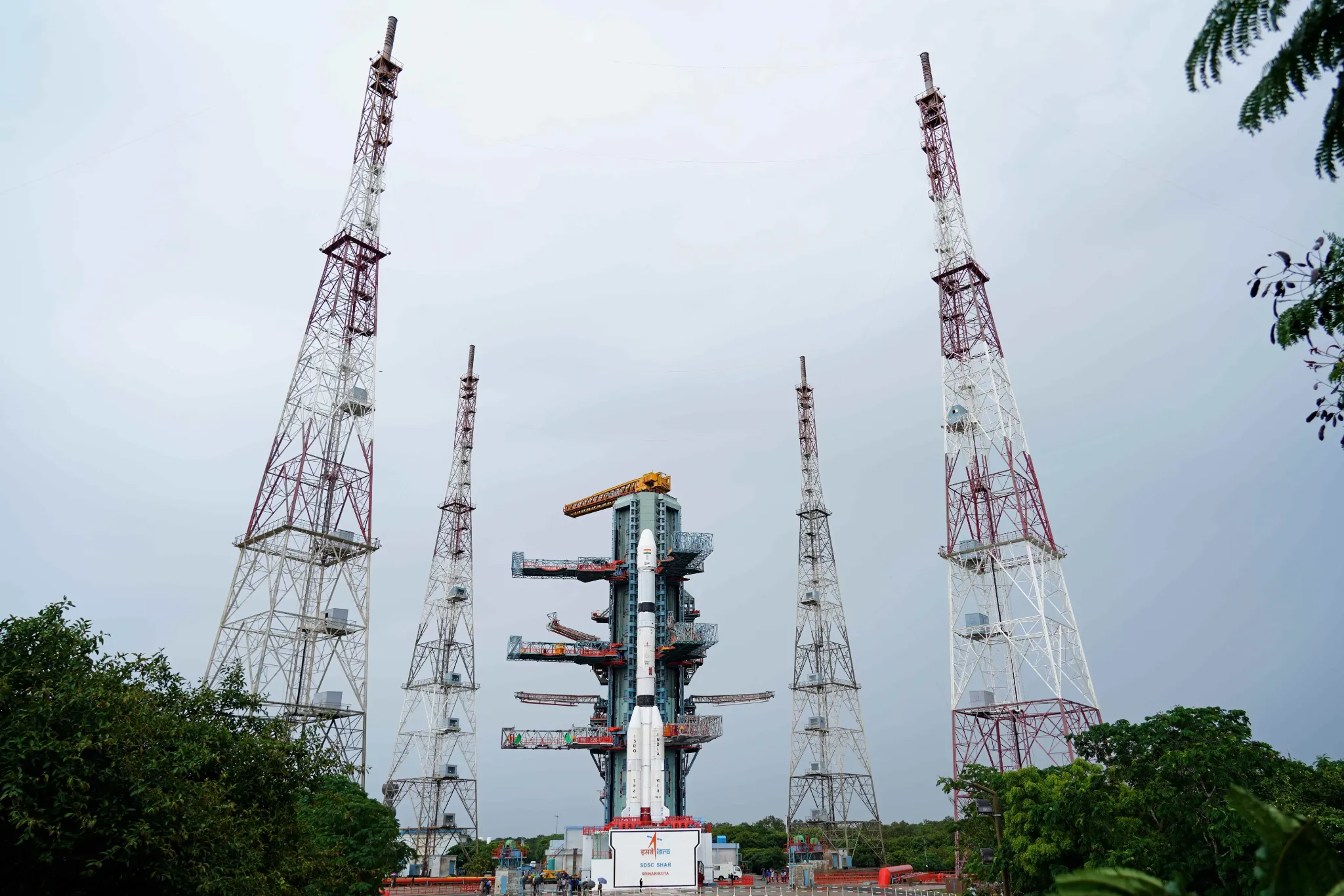
ISRO’s launch records list GSLV-F18/NVS-03 as the 107th launch mission from Sriharikota and the 20th flight of GSLV.
The vehicle successfully inserted NVS-03 into a geosynchronous transfer orbit.
GSLV is designed for heavier geosynchronous-class payloads and uses a three-stage architecture with a solid first stage, liquid propulsion and an indigenous cryogenic upper stage.
For NVS-03, the important mission objective was straightforward: place the navigation satellite accurately into the transfer orbit from which onboard propulsion can raise and circularise its operational orbit.
A launch success is therefore the first step. The satellite still has to complete orbit-raising, in-orbit testing and operational commissioning before it contributes fully to the navigation constellation.
2. NVS-03 is part of the second generation of NavIC
NavIC—Navigation with Indian Constellation—is India’s independent regional satellite-navigation system.
The next-generation NVS series contains five planned satellites: NVS-01, NVS-02, NVS-03, NVS-04 and NVS-05.
Their purpose is to augment and replace older IRNSS/NavIC spacecraft while improving continuity and adoption.
NVS-01 launched in May 2023. NVS-02 launched in January 2025. NVS-03 is now the third satellite in the series.
The strategic logic is redundancy.
Navigation systems need multiple healthy spacecraft, stable clocks and continuous coverage. One successful satellite improves the constellation, but reliable service comes from a network with enough redundancy to handle failures, maintenance and ageing.
3. The indigenous atomic clock is more important than it sounds
Satellite navigation is fundamentally a timing system.
A receiver calculates position by measuring extremely small differences in the arrival time of signals from multiple satellites.
That makes atomic clocks critical.
If the timing reference drifts, the position solution becomes less accurate.
NVS-03 carries an indigenous atomic clock along with procured clocks. ISRO first flew an indigenous atomic clock on NVS-01.
The strategic value is clear: a domestic atomic-clock capability reduces dependence on imported critical technology in a system that supports both civilian and restricted applications.
For India, this is similar to the logic behind semiconductor localisation and defence electronics. The economic value is not only in replacing imports; it is also in building domestic engineering capability that can later feed into other precision-timing applications.
4. L1 makes NavIC easier to integrate into mass-market devices
The addition of the L1 signal is one of the most commercially relevant upgrades in the NVS series.
Earlier NavIC services relied mainly on L5 and S-band signals. Many mass-market global navigation receivers already support L1 because GPS, Galileo and other systems use it extensively.
Adding L1 can therefore make NavIC easier to integrate into:
- smartphones;
- vehicle-navigation units;
- wearables;
- logistics trackers;
- IoT devices; and
- consumer positioning chipsets.
That does not mean every phone will instantly switch to NavIC.
Adoption depends on chipset support, device-maker integration, software, certification and user demand.
But L1 reduces one technical barrier to broader use.
That is where a sovereign navigation system starts becoming an economic platform rather than only a strategic government asset.
5. NavIC has a larger application base than maps on a phone
The most obvious use of satellite navigation is turn-by-turn driving directions.
That is only one application.
Government material says NavIC is being integrated into:
- power-grid synchronisation;
- real-time train tracking;
- Aadhaar geotagging;
- mobile chipsets; and
- other positioning and timing services.
Maritime users can use navigation for vessel tracking and coastal safety.
Agriculture can use precise positioning for field surveying, precision farming and machinery guidance.
Telecom networks depend on accurate timing.
Emergency services can improve location and response.
Logistics fleets can track vehicles, routes and delivery performance.
Defence applications require secure and independent positioning, navigation and timing.
The economic value therefore sits across multiple industries rather than one “navigation market.”
6. Navigation autonomy has strategic value even when GPS is available
India already has access to global navigation systems such as GPS.
So why maintain an independent system?
The answer is resilience and control.
A sovereign navigation constellation gives India more control over critical positioning and timing services during emergencies, conflict, sanctions or technical disruption.
That matters for:
- military operations;
- border surveillance;
- missile and weapon systems;
- maritime security;
- critical infrastructure; and
- national timing.
The restricted NavIC service provides strategic functionality separate from open civilian positioning.
This is why navigation infrastructure belongs in the same strategic category as secure communications, semiconductors and domestic launch capability.
7. The commercial opportunity is downstream
The launch industry is visible because rockets are dramatic.
Navigation services are quieter but potentially more recurring.
A satellite-navigation system can support years of:
- device hardware;
- modules and antennas;
- mapping software;
- fleet management;
- geospatial analytics;
- emergency services;
- secure timing;
- telecom synchronisation; and
- defence applications.
This is one reason RegalTicker’s private-space industry article argues that downstream services may ultimately be larger than launch itself.
A rocket creates one event.
A navigation constellation creates infrastructure used every day.
That distinction matters for the economics of India’s $40–45 billion space ambition.
8. Which listed Indian companies could benefit?
The safest answer is: companies with genuine space-electronics, precision-engineering or navigation exposure could benefit from a deeper domestic space ecosystem—but NVS-03-specific supplier exposure must be verified.
Existing listed companies with broader Indian space exposure include examples such as:
- MTAR Technologies in precision propulsion and launch hardware;
- Paras Defence & Space Technologies in optics and precision systems; and
- Centum Electronics in satellite and launch electronics.
These companies were already discussed in RegalTicker’s broader private-space analysis.
But investors should not assume that any of them supplied NVS-03 unless the company or ISRO discloses that relationship.
That is an important distinction.
A growing industry theme can support future demand without making every supplier a direct beneficiary of one mission.
Investor note
Do not convert a successful ISRO mission into an unverified stock tip
Space missions often trigger speculative lists of “beneficiary stocks.” Verify actual customer relationships, order books and revenue contribution before connecting a listed company to NVS-03 or NavIC.
9. India’s private-space ecosystem makes NavIC more commercially important
India’s space reforms have changed who can build and sell space technology.
Government data says private investment in the Indian space sector has crossed $618.5 million, while hundreds of startups are now active across launch, satellites, propulsion, Earth observation, communications and downstream services.
That matters for NavIC because the value of navigation infrastructure grows when private companies build applications on top of it.
A government constellation can become the base layer for:
- logistics platforms;
- geospatial startups;
- precision agriculture;
- vehicle telematics;
- maritime tracking;
- drone navigation;
- secure communications; and
- industrial timing.
The ecosystem therefore has two sides.
ISRO builds strategic national infrastructure.
Private companies turn parts of that infrastructure into products and services.
The stronger the interface between those two layers, the more commercially valuable the navigation system becomes.
10. India’s space economy target makes downstream adoption the real test
The government currently values India’s space economy at around $9 billion and says it could reach $40–45 billion over the next seven to eight years.
That target cannot be reached by launch revenue alone.
It requires growth across:
- satellite manufacturing;
- communications;
- navigation;
- Earth observation;
- geospatial intelligence;
- defence;
- ground infrastructure; and
- downstream applications.
NavIC fits directly into that model.
If Indian mobile devices, transport networks, logistics companies, telecom operators, maritime users and government systems increasingly use NavIC, the system becomes an economic asset rather than only a sovereign capability.
The key metric is therefore adoption, not simply the number of satellites launched.
11. What investors should watch after the launch
NVS-03’s successful insertion is the beginning of the next phase, not the end.
Watch for:
Orbit raising and commissioning: ISRO needs to complete in-orbit testing and operationalisation.
NVS-04 and NVS-05: the remaining second-generation satellites are important for constellation continuity.
Chipset adoption: more smartphones, vehicles and IoT devices need native NavIC support.
Government use cases: rail, grid, maritime and emergency-service deployments can create scale.
Private applications: logistics, mapping, agriculture, drones and geospatial startups can turn navigation signals into recurring services.
Listed-company disclosures: actual space/navigation orders matter more than speculative theme association.
Exports: NavIC-related hardware, timing and geospatial services could eventually become part of India’s broader space-export strategy.
The Fundamental Analysis path remains useful when a space theme reaches listed companies: industry growth matters only when it converts into revenue, margins, cash flow and return on capital.
12. The bigger milestone is navigation independence becoming usable infrastructure
India has already demonstrated that it can build and launch navigation satellites.
The next challenge is making NavIC difficult to ignore.
That means stronger constellation reliability, broad chipset support and integration into civilian and strategic systems.
NVS-03 contributes to all three.
Its indigenous atomic clock deepens domestic capability.
Its L1 signal improves compatibility with mass-market receivers.
Its place in the next-generation constellation strengthens service continuity.
The investment story therefore sits one level above the mission.
A stronger NavIC can support a larger domestic market for electronics, timing, tracking, software and space-based services.
That is where a successful launch becomes an economic platform.
Frequently asked questions
When was NVS-03 launched?
ISRO’s launch records show GSLV-F18/NVS-03 launched successfully on 30 October 2026 from Sriharikota.
What is NVS-03?
NVS-03 is the third satellite in India’s next-generation NVS navigation-satellite series, designed to strengthen and maintain NavIC services.
What is new in NVS-03?
It carries an indigenous atomic clock and includes an L1 navigation signal in addition to the existing L5 and S-band signals.
What area does NavIC cover?
NavIC’s primary service area covers India and extends roughly 1,500 km beyond the Indian boundary.
Why is an atomic clock important?
Satellite navigation depends on extremely precise timing. Atomic clocks provide the stable timing reference required for accurate position and navigation calculations.
Why does the L1 signal matter?
L1 is widely supported by mass-market navigation receivers. Adding L1 can make NavIC easier to integrate into smartphones, vehicles, trackers and other consumer devices.
Which industries can use NavIC?
Transport, railways, maritime services, telecom, agriculture, logistics, defence, emergency response, power-grid timing and location-based services can all use satellite positioning and timing.
Which Indian stocks benefit from NVS-03?
No listed company should be called an NVS-03 beneficiary without a specific supplier or order disclosure. Investors can study broader space-electronics and precision-engineering exposure, but mission-specific claims must be verified.
How large could India’s space economy become?
The government says the current roughly $9 billion space economy could reach around $40–45 billion over the next seven to eight years.
Verify through official sources
Official references
- ISRO — GSLV-F18/NVS-03 Mission — Primary mission source confirming successful orbital insertion, 20th GSLV flight, indigenous atomic clock, L1 signal and NavIC coverage.
- ISRO — GSLV Launch List — Primary ISRO record confirming the 30 October 2026 launch date.
- ISRO — Launch Missions — Primary mission registry showing GSLV-F18/NVS-03 as the 107th Sriharikota launch mission.
- ISRO — NVS-03 Mission Brochure — Primary mission specifications including GTO parameters, payload mass and satellite details.
- PIB — PM congratulates ISRO on NVS-03 — Government confirmation that the mission strengthens NavIC and navigation self-reliance.
- PIB — NavIC and India space capabilities — Government background on NavIC applications, NVS series and integration into grid timing, rail tracking and mobile chipsets.
- PIB — Private space investment — Government data on private investment and private-sector authorisations in India’s space ecosystem.
- PIB — India space economy outlook — Government estimate of the current space economy and $40–45 billion medium-term ambition.
Educational disclaimer: RegalTicker provides educational and informational content only. This article is not investment advice or a recommendation to buy or sell any aerospace, defence, electronics or space-related security. The NVS-03 mission is a national infrastructure development and does not by itself create guaranteed revenue for any listed company. Verify company filings, exchange disclosures and official supplier information before connecting a stock to NavIC or this mission.
Final takeaway
NVS-03 turns a successful launch into a larger navigation-infrastructure story
The successful GSLV-F18 mission matters because NVS-03 strengthens something India intends to use every day: its own navigation and timing infrastructure.
The indigenous atomic clock deepens technological self-reliance. The L1 signal makes wider device adoption more practical. The next-generation constellation improves continuity.
For investors, the opportunity is not to guess which stock supplied one satellite.
The more durable theme is the ecosystem that can grow around a stronger NavIC: navigation electronics, tracking, telecom timing, geospatial software, defence applications and downstream space services.
That is how one launch can matter long after the rocket disappears from view.


