

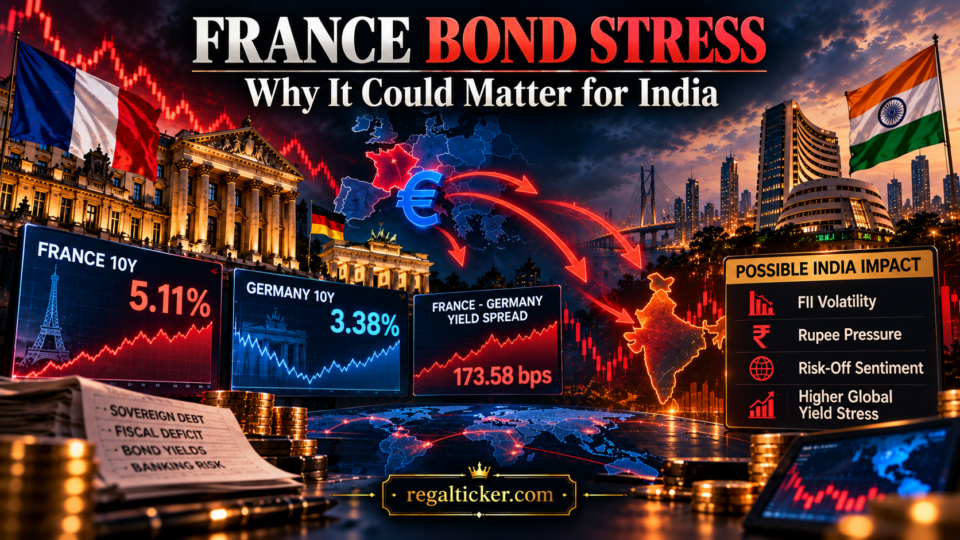
France has suddenly become one of the most important bond markets in the world to watch.
On 22 October, the country's benchmark 10-year government-bond yield rose to 5.11%, after touching 5.1415% intraday. The move attracted attention because French borrowing costs are now sitting at levels not seen since 2002. But the number that deserves even more attention is the gap with Germany: the French 10-year yield premium over the German Bund widened to 173.58 basis points, the largest spread since November 2011.
For anyone who lived through the euro-area debt crisis, that comparison is uncomfortable. It is also easy to misuse. France is not Greece in 2011, and today's European banking system is better capitalised and more tightly supervised than it was then. The real story is subtler: investors are charging France a visibly higher price for fiscal and political uncertainty, and that extra price can travel through banks, currencies and global risk appetite.
That is where India enters the picture.
A French bond selloff does not mechanically push Nifty lower. But if the stress spills into European banks, weakens the euro or tightens global financial conditions, Indian investors can feel it through foreign portfolio flows, the rupee, valuation multiples and demand from European customers. We already covered the political and street-level backdrop in Europe Unrest: Impact on European and Indian Stock Markets. This article focuses on the part that is now becoming more important: the bond market itself.
⚡ Quick answer
Why this matters to an Indian investor
France is a large euro-area borrower and one of Europe's biggest economies. If its borrowing costs remain high, the immediate concern is not a French default; it is a gradual tightening of financial conditions across Europe. That can affect bank funding, the euro, global risk appetite and ultimately the price investors are willing to pay for Indian equities.
Key takeaways
France's 10-year yield rose to 5.11% on 22 October after touching 5.1415% intraday.
The France-Germany 10-year spread widened to 173.58 bps, the widest since November 2011.
France's government debt stood at 119.1% of GDP at the end of Q2 2026, according to Eurostat.
The problem is not only the debt stock; higher refinancing costs can make future deficit reduction harder.
Today's euro area is institutionally stronger than it was during the 2011 crisis, so a historical comparison should be treated as a stress gauge, not a forecast.
For India, the main channels are FII risk appetite, the rupee, global discount rates and European demand for Indian exporters and IT services.
The number to watch is not 5.11% by itself
A 5.11% French 10-year yield is dramatic, but an absolute yield can rise for many reasons. Inflation expectations can change. Central banks can remain restrictive. Governments can issue more debt. Global bond markets can sell off together.
The spread over Germany tells us something more specific.
Germany's Bund is the benchmark safe asset inside the euro area. When French yields rise while German yields remain lower, investors are effectively asking for extra compensation to hold French government debt. At 173.58 basis points, that premium has moved into territory associated with past periods of severe European stress.
That is why the spread is a cleaner signal than the headline French yield. If global yields rise but the French-German gap stays stable, the problem is more likely to be broad. If the French premium keeps widening, the market is saying something about France itself.
Reuters also reported wider spreads in other euro-area markets on the same day. That does not establish contagion, but it is exactly the type of behaviour investors should monitor. When one country's fiscal stress starts changing how investors price neighbouring sovereigns, the story is no longer purely domestic.
For a broader market context rather than a single-event snapshot, the RegalTicker Market section is useful because daily and periodic reviews help separate one-session volatility from a trend that is building across several markets.
Why France is being charged a higher risk premium
France's fiscal problem has been visible for some time. What has changed is the market's patience.
Eurostat reported gross government debt at 119.1% of GDP at the end of Q2 2026. The European Commission has also projected a 2026 budget deficit of roughly 5.1% of GDP. Those figures matter because a heavily indebted government becomes more sensitive to the interest rate at which old debt is refinanced and new debt is issued.
A country does not refinance all of its debt overnight, so today's 5% yield does not instantly become the interest rate on the entire French debt stock. The effect arrives gradually. That is precisely why prolonged high yields can be more important than a one-day spike.
The Commission expects interest expenditure to rise as a share of GDP. If borrowing costs stay elevated, the government has less room to spend elsewhere while also trying to bring the deficit down. Political fragmentation makes that task harder because fiscal repair usually requires choices that are unpopular somewhere: lower spending, higher taxes, delayed programmes or slower growth in public expenditure.
Markets can live with high debt when they believe there is a credible path forward. They become less comfortable when higher interest costs and political difficulty begin reinforcing each other.
This is serious, but it is not 2011 all over again
The spread comparison with 2011 is useful because it gives scale. It should not be turned into a prediction.
The euro area has changed. European banks generally hold more capital, supervision is more centralised and crisis-management mechanisms are stronger than they were in the early years of the sovereign-debt crisis. Banks are also less concentrated in their own governments' bonds than they were in that period.
France is different from the smaller economies that sat at the centre of the earlier crisis. It has a larger economy, deeper capital markets and a central place in the euro project.
None of that makes the current move harmless. It simply changes the question.
The question today is less about an imminent inability to borrow and more about whether high financing costs can persist long enough to damage growth, bank funding and fiscal credibility. A slow deterioration can still be painful even without a dramatic crisis moment.
That distinction is important for investors because fear tends to compress all historical episodes into the same story. Good analysis does the opposite: it identifies what is similar, and then asks what is different.
Why banks are the bridge between sovereign stress and the real economy
Government debt is embedded throughout the banking system. Banks hold sovereign bonds for liquidity, collateral and investment. Sovereign yields also influence the price at which banks themselves borrow.
This creates what economists often call the sovereign-bank loop.
If government-bond prices fall, banks can face valuation pressure or weaker investor confidence. If bank funding becomes more expensive, lending can tighten. Tighter credit can slow the economy. Slower growth then makes fiscal consolidation more difficult, which can put fresh pressure on the sovereign.
That feedback loop was central to the European crisis of the early 2010s. The protections are stronger today, but the mechanism has not disappeared.
For Indian investors, this is the point where a French story can become a global one. The risk is not that an Indian company owns French government bonds directly. The risk is that financial conditions in Europe tighten enough to affect investment, borrowing and corporate spending.
That matters particularly for Indian businesses with meaningful European customer exposure. Rather than assuming damage from the headline alone, investors should examine client geography, contract structure and margin sensitivity using the same discipline described in RegalTicker's Fundamental Analysis framework.
How the shock can reach Indian markets
The first channel is risk appetite.
Large global investors do not evaluate each market in isolation. When sovereign or banking stress rises in a major developed economy, portfolio managers can reduce exposure to riskier assets elsewhere. Emerging markets can then face selling even when their domestic fundamentals have not changed materially.
The second channel is the currency market. A weaker euro can strengthen the dollar on a relative basis, while broad risk aversion can increase demand for dollar assets. That can add pressure to emerging-market currencies, including the rupee.
The third channel is valuation. Higher global bond yields increase the return investors can earn from relatively safer assets. When the risk-free alternative becomes more attractive, expensive equities often face a tougher valuation test.
The fourth channel is European demand. Indian IT services, auto-component makers, chemicals, industrial exporters and other businesses with European customers can eventually feel the effect if tighter financial conditions turn into lower corporate spending or weaker orders.
None of these channels guarantees the same outcome. A domestic Indian company with little overseas exposure can fall during a global selloff and still report stable earnings. That is why market price and business value should be separated. RegalTicker's Risk Management guide is especially relevant during events like this because it focuses on portfolio exposure rather than headline prediction.
Indian IT deserves attention, but not a blanket downgrade
Indian IT is an obvious place to look because Europe is a major customer region for several large services companies.
The temptation is to jump from "European stress" to "Indian IT earnings problem." That is too quick.
A multinational client's bond market has no direct relationship with every IT contract. The actual effect depends on whether European companies delay discretionary projects, slow hiring, reduce cloud or transformation budgets, or demand more cost savings from vendors. Some IT spending can even remain resilient during periods of pressure because automation and efficiency projects become more valuable.
Currency moves also matter. Revenue may be earned in euros, dollars or pounds while much of the cost base sits in rupees. Hedging policies can change the reported impact again.
So the useful questions are company-specific: How much revenue comes from Europe? Which industries are those clients in? How much of the work is discretionary? Are deal pipelines slowing? Is utilisation changing? Are margins holding?
That is the kind of evidence that turns a macro story into an investment conclusion. Until then, "Europe exposure" is a research flag, not an earnings forecast.
What would tell us that the problem is spreading
The next move in the French 10-year yield matters less than the combination of signals around it.
I would watch five things.
First, whether the France-Germany spread keeps widening. A sustained move higher would suggest the market is charging France an increasingly distinct risk premium.
Second, whether French bank shares and bank funding costs deteriorate at the same time. Sovereign stress becomes more dangerous when the banking system starts transmitting it into credit conditions.
Third, whether other euro-area spreads begin widening persistently rather than briefly. That would be stronger evidence of contagion.
Fourth, whether the euro weakens alongside safe-haven flows. Currency markets often reveal whether the concern remains local or is becoming a broader confidence problem.
Fifth, whether France produces a credible fiscal response. Markets do not require perfection, but they do require a path that looks politically and financially achievable.
For readers who follow charts closely, the Technical Analysis section can help identify whether yield, currency and equity moves are becoming persistent trends. But technical signals should complement the fiscal and banking evidence, not replace it.
What would make the story less dangerous
There is also a clear stabilisation path.
If the OAT-Bund spread narrows, bank shares stop underperforming, other sovereign spreads remain contained and budget negotiations begin producing a credible medium-term plan, the market may start treating this episode as a repricing rather than the beginning of a systemic crisis.
The absolute French yield could remain high even in that scenario. What matters is whether the risk premium stops accelerating.
This is an important distinction because markets rarely wait for perfect news. They tend to turn when the rate of deterioration slows.
That is also why a daily headline should not be confused with a portfolio signal. A better approach is to review how the evidence changes over several sessions and then compare it with the broader picture in the Monthly Market Review.
What an Indian investor should do with the information
The practical response is not to predict the next French bond auction or trade every move in the euro.
Start with your own exposures.
If you hold Indian exporters with large European revenue, check whether management has disclosed any weakness in orders or project decisions. If your portfolio is concentrated in highly valued growth stocks, recognise that rising global yields can pressure valuation even before earnings estimates change. If you invest internationally or earn in euros, think about currency exposure separately from equity exposure.
Most importantly, avoid treating a falling share price as proof that the business has deteriorated—or as proof that it has become cheap. Both conclusions require more work.
A global macro shock is usually most useful as a stress test for an existing investment thesis. Ask which assumptions depend on cheap capital, stable currencies, strong European demand or uninterrupted foreign flows. Those are the assumptions that deserve closer attention first.
Investor note
Keep market risk separate from corporate-action accounting
A sovereign-bond shock can move share prices and portfolio values, but it does not alter the accounting logic used to allocate original cost after a corporate demerger. If a holding completes a demerger, use the company's official allocation percentages and RegalTicker's Demerger Cost Basis Calculator rather than trying to infer cost from volatile market prices.
The bottom line
France's 5.11% 10-year yield makes the headline. The 173.58 bps spread over Germany tells the more important story.
Investors are demanding much more compensation to hold French debt than German debt inside the same currency union. That does not make a French default imminent, and it does not mean the 2011 crisis is repeating. It does mean the market is questioning how long France can carry high debt, large deficits and political fragmentation while refinancing costs rise.
For Indian investors, the sensible approach is to follow the transmission rather than the drama: European banks, the euro, foreign portfolio flows, the rupee, global discount rates and company-level demand from Europe.
If those channels remain contained, this can stay a European repricing story. If they begin reinforcing one another, France's bond problem will matter far beyond Paris.
Frequently asked questions
What is France's 10-year government-bond yield?
Reuters reported the benchmark French 10-year yield at 5.11% on 22 October 2026 after an intraday high of 5.1415%.
What does the France-Germany spread mean?
It is the difference between France's 10-year government-bond yield and Germany's 10-year Bund yield. A wider spread means investors are demanding more compensation to hold French debt relative to the euro area's benchmark safe sovereign asset.
Why is the 173.58 bps level important?
Reuters reported it as the widest France-Germany 10-year spread since November 2011. It is useful as a stress indicator, but it does not mean the 2011 crisis will repeat.
Is France in a sovereign-debt crisis now?
The bond market is showing serious stress, but a high yield and wide spread are not the same as insolvency or loss of market access. France still has deep capital markets and operates within a stronger euro-area institutional framework than existed in the early 2010s.
Can this affect Indian IT companies?
Potentially, if tighter European financial conditions reduce discretionary corporate spending or delay projects. The actual impact depends on each company's client mix, contract structure, billing currency and hedging.
Could French bond stress cause FII selling in India?
It could contribute to risk-off positioning, but foreign flows are driven by several factors including Indian valuations, earnings, the rupee, global rates and alternative opportunities. One French yield move does not determine FII behaviour by itself.
What should investors watch next?
The France-Germany spread, French bank funding and equity performance, other euro-area sovereign spreads, the euro and progress on France's fiscal plan are more useful together than any single headline number.
Verify through official sources
Official references
- Reuters — French debt risk premium reaches euro-zone crisis levels — Current 22 October French 10-year yield, intraday high, OAT-Bund spread and wider euro-area spread moves.
- Eurostat — Government debt at 88.8% of GDP in euro area — Official Q2 2026 government-debt ratios, including France at 119.1% of GDP.
- European Commission — Economic forecast for France — Official 2026 growth, deficit, debt and interest-expenditure outlook for France.
- European Commission — 2026 France country report — Official assessment of France's fiscal sustainability risks and consolidation challenge.
- Reuters — Bond selloff revives debate about euro-zone banks' doom loop — Current analysis of sovereign exposure, bank capital buffers, domestic-debt concentration and funding-risk transmission.
- Reuters — ECB's Lagarde says bond selloff will slow inflation — ECB context on how tighter long-term financing conditions can slow euro-area growth.
- Reuters — Moody's sees no quick resolution of French political fragmentation — Current sovereign-rating and budget-governance context ahead of the 2027 election.
Educational disclaimer: This article is for education and general market information only. It is not investment advice, a recommendation to buy or sell any security, or a forecast that France will enter a sovereign-debt crisis. Government-bond yields, currency levels, bank funding conditions and equity prices can change quickly. Verify material information with official sources and consider your own objectives, liquidity needs, time horizon and risk tolerance before making financial decisions.


