


Quick answer
A share is a unit of ownership in a company. When you buy an eligible equity share, you become a shareholder and own a small financial interest in that business. The value of your holding can rise or fall, and shareholder rights may include voting on specified matters, receiving a declared dividend, participating in certain corporate actions and selling the share through an available market. These rights depend on the share class, applicable law and the company’s terms.
Key takeaways
- A share represents a fractional ownership interest in a company.
- Owning one eligible equity share can make you a shareholder, even when your percentage ownership is extremely small.
- A shareholder may receive voting rights and eligible corporate benefits, but no dividend or return is guaranteed.
- Face value, market price and book value are different concepts.
- Share prices move because buyers and sellers respond to business performance, expectations, risk and market conditions.
- A good company can still be a poor investment when purchased at an unreasonable price.
- Share ownership involves the possibility of capital appreciation as well as partial or substantial loss.
What is a share?
A share is one unit into which a company’s ownership capital is divided. A person who owns shares is called a shareholder. In everyday market language, the words share, stock and equity are often used interchangeably, although their technical meaning can vary by context.
Suppose a fictional company divides its equity into 10,00,000 equal shares. Each share represents one of those ownership units. A person who buys 1,000 shares owns a small fraction of the company, while a person who owns 2,00,000 shares holds a much larger fraction.
The share itself is not a physical piece of the company’s building, machinery or bank balance. It represents a legal and financial ownership interest in the company as a whole, subject to the rights attached to that security.
Investor note
A share is ownership—not merely a changing number
A market app displays a share price, but the price is attached to an underlying business. Before buying, an investor should understand what the company does, how it earns money, what risks it faces and why the market may be valuing it at the current price.
How does share ownership work?
Ownership percentage can be estimated by dividing the number of shares you own by the total number of issued shares and multiplying the result by 100.
Simple calculation
Basic ownership formula
Ownership percentage = Shares you own ÷ Total issued shares × 100
If a company has issued 10,00,000 shares and Ravi owns 1,000 shares:
1,000 ÷ 10,00,000 × 100 = 0.10% ownership

Worked example
Ravi’s 0.10% ownership
Ravi is a shareholder because he owns 1,000 shares. However, his percentage ownership is only 0.10%. He participates in the economic result attached to those shares, but he does not control the company merely because he is a shareholder.
If the company later changes the number of issued shares, Ravi’s ownership percentage may also change unless his holding changes proportionately.
Why do companies issue shares?
Companies require money for business activities such as building factories, developing products, acquiring technology, expanding distribution, reducing debt or strengthening working capital. One method of raising long-term capital is to issue shares to investors.
When a company issues new equity shares, investors contribute capital and receive ownership units. Unlike a normal loan, equity capital generally does not require the company to repay a fixed principal amount on a scheduled date. However, issuing shares can dilute the ownership percentage of existing shareholders.
When a company first offers shares to public investors, that fundraising process can take place through an initial public offering
Worked example
How issuing shares can raise capital
A fictional company issues 20,00,000 new shares at ₹50 each.
20,00,000 × ₹50 = ₹10 crore gross issue amount
This is a simplified illustration before issue expenses and other adjustments. The company obtains capital, while the new shareholders obtain ownership units carrying the applicable rights and risks.
What does owning a share mean?
Owning a share may provide economic and governance-related rights. It also exposes the investor to the company’s business risk and to changes in market value.
A shareholder is a part-owner, but that does not mean the shareholder can personally use company assets, withdraw company money or direct employees. The company is a separate legal entity managed through its board and management structure.
Possible benefits of share ownership
- Capital appreciation: The market value may rise above the purchase price.
- Dividend income: An eligible shareholder may receive a dividend when it is properly declared.
- Voting rights: Eligible shareholders may vote on specified company matters.
- Corporate-action participation: Shareholders may be affected by rights issues, bonus issues, stock splits, buybacks and mergers.
- Transferability and liquidity: Listed shares can generally be bought or sold through the market, subject to availability, rules and liquidity.
Responsibilities of a sensible shareholder
- Read official company and exchange disclosures.
- Keep contact, bank and nomination information updated with the relevant intermediary.
- Protect demat and trading-account credentials.
- Understand taxes, charges and corporate-action dates.
- Avoid acting only on rumours, unsolicited tips or guaranteed-return claims.
- Review whether the original reason for owning the share remains valid.
What rights can a shareholder have?
Shareholder rights vary with the class of share, the company’s constitutional documents and applicable law. The following are common concepts for equity shareholders, not a promise that every share carries identical rights.
| Possible right | What it can mean | Important limitation |
|---|---|---|
| Voting | Eligible equity shareholders may vote on specified resolutions and company matters | Voting power usually depends on the number and class of shares |
| Dividend | Eligible holders may receive a dividend after it is declared and applicable conditions are met | A company is not required to pay a dividend every year |
| Rights issue participation | Existing holders may receive an opportunity to apply for additional shares in proportion to holdings | Participation is optional and non-participation can lead to dilution |
| Company communications | Shareholders may receive notices, reports and corporate communications through applicable channels | Investors must keep their registered details updated |
| Transfer or sale | Eligible listed shares may generally be sold through the market | A buyer, liquidity and an executable price are not guaranteed |
| Corporate-action entitlement | Eligible shareholders may receive benefits arising from specified corporate actions | Eligibility depends on dates, terms and regulatory requirements |

Risk warning
Ownership does not guarantee income or control
A shareholder is exposed to business and market risk. Dividends can be reduced or omitted, the market price can fall, and a small shareholder normally has limited influence over company decisions. Rights also differ between equity shares, preference shares and other securities.
Is one share enough to become a shareholder?
Owning one eligible equity share can generally make a person a shareholder of that company. However, ownership percentage and practical influence may be extremely small.
Worked example
One share in a very large company
Assume a company has 500 crore issued shares. An investor owns one share.
1 ÷ 500 crore × 100 produces an ownership percentage so small that it is practically negligible. The investor is still a shareholder, but the single share does not provide meaningful control over the company.
Share, stock and equity: what is the difference?
The terms overlap, but this simple distinction is useful for beginners.
| Term | Beginner-friendly meaning | Example |
|---|---|---|
| Share | A specific unit of ownership in a particular company | 25 shares of Company A |
| Stock | A general term for ownership investments or a collective holding | An investor owns banking and technology stocks |
| Equity | The ownership interest in a business after considering liabilities in the accounting sense; also commonly used for company shares | Equity shareholders participate in business ownership |
| Shareholder | A person or entity that owns shares | Ravi owns 100 equity shares |
| Share capital | Capital represented by shares issued by the company | Paid-up equity share capital reported by a company |
Equity shares vs preference shares
Beginners usually encounter equity shares when discussing listed stocks. Preference shares are a different class of security and can carry preferential terms relating to dividends or repayment of capital, subject to their conditions.
| Point | Equity shares | Preference shares |
|---|---|---|
| Ownership participation | Represents ordinary ownership participation | Represents ownership with specified preferential terms |
| Voting | Generally carries voting rights on applicable matters | Voting rights can be limited and depend on terms and law |
| Dividend | Dividend is variable and not guaranteed | May carry a stated preferential dividend rate, still subject to conditions |
| Capital appreciation | Can participate significantly in business growth and market revaluation | Market behaviour may be influenced more by stated terms |
| Risk | Higher business and market participation | Different risk profile; not equivalent to a risk-free deposit |
| Common market usage | Usually what people mean by listed shares or stocks | Less commonly traded by retail investors |
Investor note
Read the security name and terms
Do not assume every security issued by a company carries the same rights. Equity shares, preference shares, partly paid shares, rights entitlements, convertible securities and depository receipts can behave differently.
Face value, market price and book value
These three values are often confused, but they answer different questions.
| Value | Meaning | What it does not tell you |
|---|---|---|
| Face value | A nominal value assigned to a share in the company’s capital structure | It is not the current trading value |
| Market price | The price at which buyers and sellers currently transact in the market | It does not by itself prove that a share is cheap or expensive |
| Book value per share | An accounting measure derived from shareholder equity divided by an applicable share count | It does not automatically equal liquidation value or fair market value |
| Issue price | The price at which shares are offered in a particular issue | It need not remain equal to the market price after listing |

Worked example
The same share can have several values
A company’s share may have:
Face value: ₹10 Book value per share: ₹82 Market price: ₹240
These numbers serve different purposes. The market price being ₹240 does not mean the face value has become ₹240. Similarly, a market price above book value does not automatically make the share overvalued; investors may be pricing future profitability, brand value, growth or risk.
How is the market price of a share decided?
In exchange trading, share prices emerge from buy and sell orders. A trade occurs when compatible orders are matched under the market’s rules.
A price can rise when more buyers are willing to pay higher prices than the prices at which sellers are offering shares. It can fall when sellers accept lower prices because buying demand is weaker.
Factors that can influence a share price
- Revenue, profit, cash flow and debt.
- Management quality and corporate governance.
- Industry conditions and competition.
- Interest rates, inflation and economic growth.
- Regulations, taxes and government policy.
- New products, contracts, acquisitions or litigation.
- Dividends, buybacks, rights issues and other corporate actions.
- Market liquidity and investor sentiment.
- Expectations about future performance.
Worked example
Why good results may not always lift the price
A company reports a 20% increase in profit. That sounds positive. However, investors had expected a 35% increase, and management gives cautious future guidance. The share price may fall because the actual result was below market expectations.
This example shows why market prices respond to the difference between reality and expectations—not only to whether a number is positive or negative.
How can a shareholder earn a return?
The two most familiar sources are capital appreciation and dividends.
Capital appreciation
A capital gain may arise when the selling price is higher than the purchase price, before applicable costs and taxes.
Simple calculation
Price appreciation example
An investor buys 50 shares at ₹200 each.
Initial cost = 50 × ₹200 = ₹10,000
The investor later sells the 50 shares at ₹245 each.
Sale value = 50 × ₹245 = ₹12,250 Gross gain = ₹12,250 − ₹10,000 = ₹2,250
Actual net return depends on the execution price, brokerage-related charges, statutory levies and taxes.
Dividend income
A company may distribute an approved dividend to eligible shareholders.
Simple calculation
Dividend example
An investor holds 300 eligible shares. The company declares a dividend of ₹3 per share.
300 × ₹3 = ₹900 gross dividend
The dividend is not guaranteed merely because the company paid one previously.
Estimate other holdings and dividend amounts with the Dividend Calculator.
Use the calculator
Measure the Return From Your Share Holding
Use the Stock Return Calculator to combine purchase value, current or sale value, dividends and holding period to estimate profit or loss, total return and annualised return.
How can a shareholder lose money?
A share can lose value when the business performs poorly, expectations decline, debt becomes difficult to manage, governance concerns emerge or the wider market falls.
| Risk | Simple example | What a beginner should understand |
|---|---|---|
| Business risk | Sales decline and costs rise | Ownership participates in weak business outcomes |
| Valuation risk | A good company is bought at an excessively optimistic price | Company quality and purchase price are separate questions |
| Market risk | A broad market decline pulls down many shares | Diversification cannot remove all market risk |
| Liquidity risk | Few buyers are available near the quoted price | The displayed price may not be achievable for the desired quantity |
| Governance risk | Disclosures are unreliable or management acts against shareholder interests | Governance can materially affect value |
| Concentration risk | Most capital is placed in one company | One adverse event can damage the entire portfolio |
| Information risk | The investor acts on fake news or a manipulated tip | Verify information through official sources |
Risk warning
A lower price is not automatically a bargain
A share that has fallen from ₹500 to ₹200 is not necessarily cheap. The company may have suffered a permanent deterioration in earnings, balance-sheet strength or governance. Percentage decline alone cannot establish fair value.
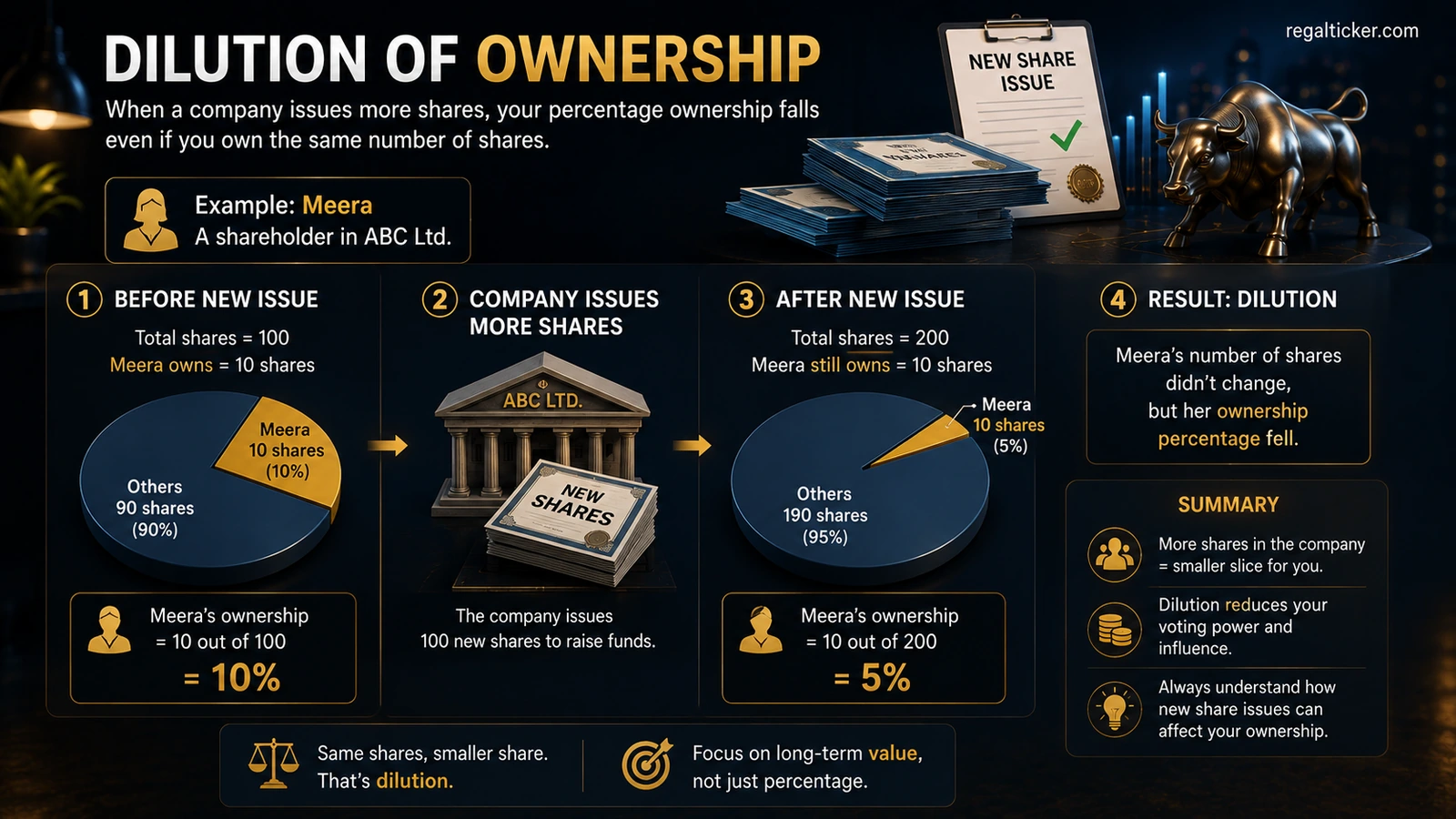
What is dilution?
Dilution occurs when a company issues additional shares and an existing shareholder’s percentage ownership falls because the shareholder does not increase the holding proportionately.
Worked example
Dilution in simple numbers
A company initially has 100 shares. Meera owns 10 shares, so she owns 10%.
The company issues another 100 shares to other investors. The total becomes 200 shares, while Meera still owns 10.
10 ÷ 200 × 100 = 5% ownership
Meera continues to own 10 shares, but her percentage ownership has fallen from 10% to 5%.
A rights issue may give eligible existing shareholders an opportunity to apply for additional shares and potentially maintain their proportional ownership, subject to the issue terms.
You can model entitlement, funding requirement and potential dilution with the Rights Issue Calculator
How do corporate actions affect shares?
Corporate actions can alter the number of shares, the price structure, cash received by shareholders or ownership percentages.
| Corporate action | What may happen | What beginners often misunderstand |
|---|---|---|
| Dividend | Eligible shareholders may receive cash | The share price can adjust and the dividend is not free money |
| Bonus issue | Additional shares are allotted in a stated ratio | More shares do not automatically multiply total wealth |
| Stock split | Each share is divided into a larger number of lower-face-value shares | The company does not become more valuable merely because the share count rises |
| Rights issue | Eligible holders may apply for additional shares | Ignoring the issue can lead to dilution |
| Buyback | The company offers to repurchase shares under specified terms | Acceptance and benefit are subject to the buyback method and conditions |
| Merger or demerger | Holdings may be reorganised according to an approved scheme | Value depends on the terms and future performance |
Listed shares vs unlisted shares
A listed share is admitted to trading on a recognised stock exchange. An unlisted share is not normally available through the same public exchange-trading process.
| Point | Listed share | Unlisted share |
|---|---|---|
| Trading venue | Traded through an exchange when orders are available | Usually transferred through private arrangements or specialised platforms |
| Price visibility | Market quotations and traded prices may be publicly visible | Price discovery can be less transparent |
| Liquidity | Can be relatively liquid, but varies widely | Often substantially less liquid |
| Disclosure framework | Subject to applicable listed-company disclosure requirements | Disclosure access and frequency can differ |
| Risk for beginners | Market and company risk remain | Additional liquidity, valuation and transfer risks may arise |
Investor note
“Pre-IPO” does not mean guaranteed listing profit
An unlisted company may never list, may list much later than expected, or may list at a disappointing valuation. Transfer restrictions, limited information and weak liquidity can make unlisted shares especially difficult for inexperienced investors.
Where are shares held?
Modern listed shares are generally held electronically in a demat account. The trading account is used to place buy and sell orders, while the demat account records eligible securities held through the depository system.
A bank account supports the movement of funds. These accounts perform different functions even when a broker offers an integrated interface.
Learn the resident-investor account structure in the Demat & Trading hub. If you are an NRI or OCI, use the separate NRI Investing in the Indian Stock Market Guide, because banking, Demat, KYC and repatriation arrangements can differ.
Basic journey of a purchased share
- The investor places a buy order through a registered broker.
- The order is matched when a suitable seller and price are available.
- Clearing and settlement processes are completed.
- The purchased shares are credited to the investor’s demat account.
- The investor can monitor holdings and applicable corporate actions.
How can a beginner examine a share?
Before buying, a beginner can start with these basic questions:
- What does the company sell, and who are its customers?
- How does the company earn revenue and profit?
- Is debt manageable?
- Is cash flow consistent with reported profit?
- Has the company diluted shareholders frequently?
- What do promoter and public shareholding patterns show?
- Are there pledges, governance concerns or major litigation?
- Why is the market valuing the business at the current price?
- What event could make the investment thesis wrong?
- Is the investment appropriately sized for the risk?
Useful share information to recognise
| Item | What it means | Why it matters |
|---|---|---|
| Ticker symbol | Short exchange identifier for the security | Helps identify the correct listed instrument |
| ISIN | Unique securities identifier | Distinguishes one security from another |
| Face value | Nominal value in the capital structure | Relevant for some corporate-action ratios and disclosures |
| Market capitalisation | Market price multiplied by applicable outstanding shares | Indicates the market value assigned to the company’s equity |
| Shareholding pattern | Distribution of holdings among categories of shareholders | Helps track ownership structure and changes |
| Corporate announcements | Official disclosures made through exchange channels | Essential for verifying market-sensitive information |
| Volume | Number of shares traded during a period | Offers context about trading activity and liquidity |
These questions form the foundation of Fundamental Analysis, where business quality, financial statements, valuation, debt, cash flow and governance are examined in greater depth.
Common myths about shares
Myth 1: A low-priced share is cheaper than a high-priced share
A ₹20 share can be more expensive on a valuation basis than a ₹2,000 share. Share price alone ignores the number of shares, earnings, assets, debt, growth and risk.
Myth 2: More shares always mean more wealth
A bonus issue or stock split increases the number of shares but usually adjusts other values proportionately. The investor should examine total economic value, not only the count of shares.
Myth 3: A famous company is automatically a good investment
A strong brand can still be a poor investment when future expectations are already priced too aggressively or when the business faces hidden risks.
Myth 4: A dividend-paying share cannot fall
Dividend-paying companies can experience declining profits, reduced payouts and falling share prices.
Myth 5: Buying one share provides control
One share may provide shareholder status, but control requires a meaningful proportion of voting power and is affected by the company’s ownership structure.
Beginner checklist before buying a share
- Understand the company’s business in plain language.
- Verify the exact security, ticker and exchange.
- Read recent official announcements and financial statements.
- Compare market price with business performance and risk.
- Decide why you are buying and what could invalidate that reason.
- Avoid investing money required for near-term essential expenses.
- Limit exposure so one mistake cannot destroy the portfolio.
- Do not use leverage before understanding its risks.
- Keep records of the purchase reason, expected outcome and review date.
- Reject guaranteed-return claims and unsolicited tips.
Frequently asked questions
What is a share in simple words?
A share is a small ownership unit in a company. Buying an eligible equity share makes the buyer a shareholder and exposes the buyer to the company’s potential growth and risks.
Is one share enough to own part of a company?
Yes. One eligible share can represent a very small ownership interest, although the percentage and voting influence may be negligible.
Does owning shares mean I own company property?
You own an interest in the company, not direct personal ownership of its individual offices, vehicles, cash or machinery. The company is a separate legal entity.
Is a share the same as a stock?
The terms are often used interchangeably. A share usually refers to a specific unit in a company, while stock can be used as a broader collective term.
Does every equity share provide voting rights?
Ordinary equity shares generally carry voting rights, but exact rights depend on the share class, company terms and applicable law. Investors should verify the security details.
Does every shareholder receive a dividend?
No. A dividend must be declared, and the investor must meet the applicable eligibility conditions. Companies can reduce, skip or stop dividends.
What happens if a company issues more shares?
Existing shareholders may experience dilution when their holdings do not increase proportionately. Their number of shares may remain unchanged while their percentage ownership falls.
Can the value of a share become zero?
A share can lose most or nearly all of its value if the company fails or equity value is severely impaired. Equity investment therefore involves the possibility of substantial loss.
Why is market price different from face value?
Face value is a nominal capital-structure value. Market price is determined by trading demand and supply, expectations and risk. They serve different purposes.
Are bonus shares free profit?
No. Bonus shares increase the number of shares held, but the market price generally adjusts. The total economic value does not automatically increase merely because more shares are credited.
Conclusion
A share is the basic ownership unit at the heart of the stock market. It can give an investor participation in a company’s growth, specified voting rights and eligibility for declared corporate benefits. At the same time, it exposes the investor to business failure, valuation mistakes, market volatility and permanent loss.
The most useful beginner habit is to look beyond the share price. Ask what percentage of a real business the security represents, what rights are attached to it, how the company creates value, why the market price may change and what could cause the investment to fail.
Continue with NSE vs BSE: What Is the Difference? to understand how India’s major stock exchanges differ, how NIFTY 50 and SENSEX fit into the market structure, and how brokers connect investors to those exchanges.
Verify through official sources
Official references
- SEBI Investor — Understanding Shares
- SEBI Investor — How to Invest in the Securities Market
- SEBI Investor — Understanding Investment Asset Classes
- SEBI Investor — Beginner’s Guide to the Capital Markets
- SEBI Investor — Share and Debenture Holders
- SEBI Investor — Rights Issue of Shares
- BSE — Booklet on the Securities Market
- NSE — First-Time Investor: Getting Started
Educational disclaimer: This article is for investor education and general information only. It does not constitute investment advice, a research recommendation, an invitation to trade, an offer to buy or sell securities, or an assurance of returns. Securities-market investments involve risk. Readers should verify current information through official sources, conduct independent research and consult an appropriately qualified professional where necessary.