

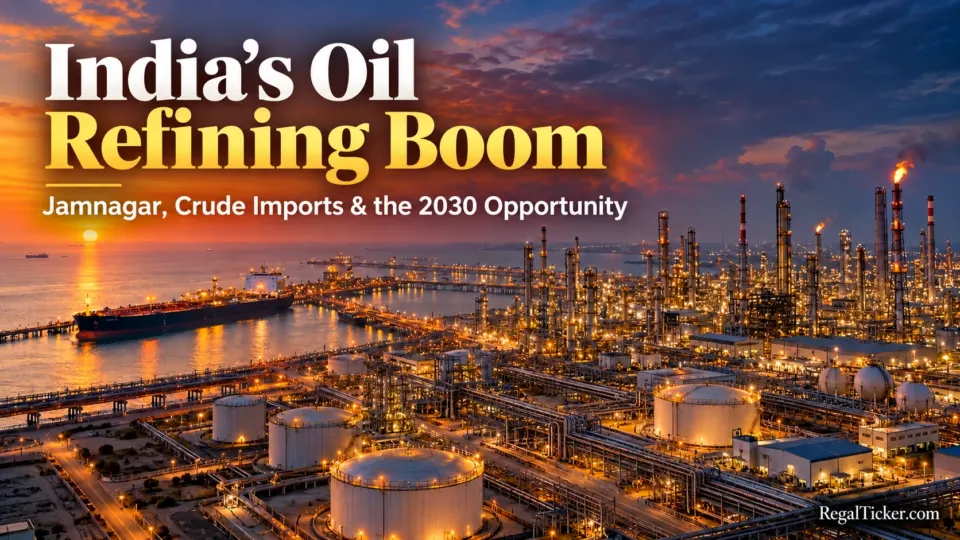
India’s refining strength is growing even as crude dependence deepens
India’s oil story is easy to misunderstand. The country does not produce enough crude oil for its own needs, and its dependence on imported crude has actually increased over the past decade. Yet at the same time, India has become one of the world’s largest refining centres, capable of turning imported barrels into petrol, diesel, aviation fuel, petrochemical feedstock and other products for both domestic use and export.
That apparent contradiction is the real story.
In 2014, India already had a sizeable refining industry. It was not starting from zero. Installed capacity was about 215.1 million metric tonnes per annum (MMTPA), and large private complexes such as Reliance Industries’ Jamnagar site were already globally significant. What has changed since then is the scale of domestic demand, the sophistication of the refining system and the strategic importance of being able to process many different crude grades.
By 2026, India had 258.1 MMTPA of operational refining capacity across 22 refineries, while PPAC’s April 2026 nameplate table totals 267.1 MMTPA after including newer capacity. Domestic petroleum-product consumption reached 243.2 million tonnes in FY2025-26. The government is targeting roughly 309.5 MMTPA of refining capacity by 2030.
But there is a catch: the latest full-year measure of crude-oil import dependence is 88.2%, up from 77.6% in 2013-14. India has become better at refining oil while becoming more dependent on the rest of the world for the crude itself.
That is why Jamnagar matters. It is not merely a very large refinery. It shows what India’s refining opportunity could look like if the country competes on complexity, flexibility and value addition rather than trying to compete on crude ownership.
⚡ Quick answer
Can India become a global oil-refining powerhouse?
Yes—but the opportunity is not simply about building more refining capacity. India’s advantage is its large domestic fuel market, complex refineries, access to multiple crude grades, petrochemical integration and export position. Jamnagar shows how a refinery can create value even when the country imports most of its crude. The strategic weakness remains clear: India’s crude-oil import dependence reached 88.2% in FY2024-25. The 2030 opportunity therefore depends on converting imported crude more efficiently and profitably, while managing supply, shipping, margin and energy-transition risks.
Key takeaways
India was already a major refining country in 2014; the current story is expansion, sophistication and a much larger domestic market—not a new industry appearing from zero.
Operational refining capacity is about 258.1 MMTPA in 2026, while PPAC’s April 2026 nameplate table totals about 267.1 MMTPA; the government is targeting roughly 309.5 MMTPA by 2030.
Crude-oil import dependence rose from 77.6% in FY2013-14 to 88.2% in FY2024-25, so more refining capacity does not automatically mean greater energy independence.
Jamnagar’s real advantage is scale plus complexity and crude flexibility: Reliance reports about 1.4 million barrels per day of processing capability, a complexity index of 21.1 and experience with more than 216 crude grades.
For investors, the key variables are refining margins, product cracks, crude sourcing, petrochemical integration, utilisation, marketing economics and capital discipline—not the crude price alone.
Investor note
India’s edge is refinery complexity, not crude ownership
India cannot remove its crude-import dependence simply by building more refineries. The investment case is stronger when a refinery can buy a wider range of crude, convert more of each barrel into higher-value products, run at high utilisation and move output efficiently into domestic and export markets.
India was already a refining country in 2014
A useful starting point is to remove one misconception. India did not suddenly become a refining nation after 2014.
PPAC data show installed refining capacity of about 215.1 MMTPA as of April 2014. The country processed roughly 222.4 million tonnes of crude during FY2013-14. Reliance’s two Jamnagar units, IOC’s large network, MRPL, BPCL, HPCL and other refiners were already central to the system.
What was different was the scale of the domestic market. Petroleum-product consumption in FY2013-14 was about 158.4 million tonnes. By FY2025-26, it had risen to 243.2 million tonnes — an increase of more than half in a little over a decade.
That changes the role of refining. A refinery system that once had a much larger surplus over domestic consumption increasingly has to serve a much bigger home market while preserving the ability to export.
The numbers show the transition clearly:
| Measure | Around 2014 | Latest comparable figure | What changed |
|---|---|---|---|
| Installed refining capacity | 215.1 MMTPA | 258.1 MMTPA operational in 2026 | Capacity expanded |
| PPAC nameplate capacity | 215.1 MMTPA | 267.1 MMTPA as of 1 April 2026 | New capacity is entering the system |
| Petroleum-product consumption | 158.4 MMT in FY2013-14 | 243.2 MMT in FY2025-26 | Domestic demand grew much faster |
| Crude-oil import dependence | 77.6% in FY2013-14 | 88.2% in FY2024-25 | External dependence increased |
| Crude production in India | 37.8 MMT in FY2013-14 | below the 2014 level in recent full-year data | Domestic supply did not keep pace |
| Petroleum-product exports | 67.9 MMT in FY2013-14 | 61.5 MMT in FY2025-26 | More production is being absorbed at home |
The most important line in that table is not refinery capacity. It is consumption.
India has been adding refining capability into a market whose appetite for transport fuel, LPG, aviation fuel, petrochemical feedstock and industrial products has expanded rapidly. That gives new capacity a substantial domestic demand base even before exports are considered.
The uncomfortable part: India still needs foreign crude
A larger refining industry does not automatically make India energy independent.
In FY2013-14, crude import dependence was 77.6%. The latest full-year figure published for FY2024-25 is 88.2%. Put differently, the refining machine has become bigger while the domestic crude feedstock feeding that machine has become relatively less important.
For investors, this distinction matters because crude prices affect India in two different ways.
At the economy level, expensive imported crude can pressure the trade balance, the rupee, inflation and fuel-marketing economics. At the refinery level, however, what matters is not just the absolute crude price. Refiners care about the spread between the cost of their feedstock and the value of the products they sell.
A complex refinery may still earn healthy margins during a period of expensive oil if diesel, jet-fuel, gasoline or petrochemical cracks are strong enough. The reverse can also happen: crude can become cheaper while product margins collapse.
That is why the current oil shock should be separated from the longer-term refining thesis. RegalTicker’s crude-oil and Hormuz analysis looks at the immediate transmission of high oil prices into Indian stocks. The refining question is different: can India build an enduring advantage in processing, converting and trading crude even when the crude itself is mostly imported?
Jamnagar is where that argument becomes tangible
Reliance Industries describes Jamnagar as the world’s largest and most complex single-site refining complex. PPAC lists 33 MMTPA for the domestic-tariff-area refinery and 35.2 MMTPA for the SEZ refinery, giving the site 68.2 MMTPA of nameplate capacity.
Reliance also reports about 1.4 million barrels per day of crude-processing capacity and a complexity index of 21.1. The company says the site has processed more than 216 different crude grades.
“Best refinery in the world” is too subjective to use as a serious investment claim. Largest, highly complex and unusually flexible are much more useful descriptions.
Why does complexity matter? Because crude oil is not one uniform commodity. Some grades are light and relatively easy to process. Others are heavy, high in sulphur or otherwise difficult. The harder crude is to process, the more likely it is to trade at a discount when buyers have limited capability to handle it.
A sophisticated refinery can potentially buy a wider basket of crude and choose feedstock based on economics rather than being tied to one narrow quality range. It can then use conversion units to turn lower-value parts of the barrel into higher-value products.
That is the strategic advantage Jamnagar represents.
The Venezuelan crude discussion shows why flexibility has value
Jamnagar has returned to the centre of the global oil conversation in October 2026 because of renewed discussions around Venezuelan crude.
During his India visit, U.S. Secretary of State Marco Rubio said Washington wanted to encourage Reliance to refine more Venezuelan crude and potentially participate more deeply in Venezuela’s oil sector. Reliance subsequently said its leadership discussed the global energy landscape and the convergence of energy and digital infrastructure with Rubio.
The political relationship can change. Sanctions policy can change. Shipping economics can change. The commercial lesson is more durable: a refinery that can handle ultra-heavy or otherwise difficult crude has more sourcing choices when one part of the global market becomes attractive.
This is not a guarantee of cheap feedstock. Discounts can disappear, freight can erase an apparent bargain, sanctions can close routes and product margins can move against the refiner. But optionality itself has value.
Jamnagar’s advantage is not that it knows which country will always offer the cheapest oil. Its advantage is that it can evaluate more crude grades than a simpler refinery and change the mix when economics justify it.
India’s next refining phase is about value per barrel
The next decade should not be judged only by how many MMTPA India adds.
The government expects national refining capacity to reach roughly 309.5 MMTPA by 2030. At the same time, it expects the petrochemical intensity of public-sector refineries to rise materially as expansion projects are completed.
That points toward a broader transformation: refinery projects are increasingly being evaluated as integrated refining-and-petrochemical systems rather than as machines built mainly to produce petrol and diesel.
This matters because the long-term demand picture is changing.
Electric vehicles can reduce the growth rate of road-fuel demand. Ethanol blending reduces the quantity of neat petrol required for a given volume of motor fuel. Efficiency standards continue to improve. None of these forces makes oil disappear overnight, especially in a large, growing economy, but they do change which products are likely to carry the most attractive long-term growth.
Petrochemicals, aviation fuel, speciality products, lubricants and other higher-value outputs can become more important. A refinery that can move further down the value chain may have a better chance of earning attractive returns than one that simply adds crude-distillation capacity.
This is the real meaning of “oil refining powerhouse”. It is not about processing the largest possible number of barrels. It is about extracting more economic value from each barrel while keeping the product slate flexible.
The 2014-to-2030 story is bigger than one government or one company
Energy infrastructure takes years to plan, finance, build and stabilise. India’s refining system reflects investment decisions made across multiple decades by both public and private companies.
That is important when looking at the 2014 versus 2026 comparison. The useful question is not which year “created” the industry. The useful question is what changed in the economic structure.
Around 2014, India had roughly 215 MMTPA of refining capacity against petroleum-product consumption of about 158 MMTPA. The system had a large buffer that supported exports.
By FY2025-26, domestic consumption had climbed to 243.2 million tonnes. Operational capacity was around 258.1 MMTPA, leaving much less headroom if viewed only against annual domestic consumption. Yet India still exported 61.5 million tonnes of petroleum products because refinery throughput, product mix, imports of some products and exports of others all interact.
Looking toward 2030, the 309.5-MMTPA capacity target would create additional room. But whether that becomes a high-return expansion will depend on utilisation, product margins, project costs and how quickly domestic demand evolves.
Capacity is not the same thing as profitability.
Where the opportunity could become much larger
There are four areas worth watching.
1. More flexible crude sourcing
A refiner that can process a broader basket of crude has a better chance of capturing temporary discounts. India’s access to Middle Eastern, Russian, African, Latin American and other crude sources creates commercial optionality, although geopolitics can rapidly change which barrels are available.
2. Petrochemical integration
The closer refining is integrated with petrochemicals, the more ways a company has to shift molecules toward the most attractive end products. This does not eliminate cyclical risk — petrochemical margins can be weak for long periods — but it can create a broader earnings engine than fuel refining alone.
3. Export logistics
Large coastal refineries with deep-water access can receive large crude carriers and export products efficiently. Jamnagar’s marine infrastructure is a major part of its competitive position, not a side feature.
4. Digital optimisation
Refining is increasingly a data and optimisation business. Crude selection, unit utilisation, energy consumption, maintenance, inventory, freight and product blending involve thousands of decisions. Reliance has spoken about a longer-term ambition to make Jamnagar increasingly autonomous using digital and AI systems. Investors should treat this as a developing capability rather than a completed transformation, but even incremental optimisation can matter at refinery scale.
What could go wrong with the India refining thesis?
A good structural story still needs a risk section.
The first risk is obvious: India’s crude dependence. If geopolitical disruption raises delivered crude costs, the country can face macroeconomic pressure even if individual complex refiners benefit from stronger product cracks.
The second is overcapacity. If India and other Asian refiners add capacity faster than global product demand grows, refining margins can compress. A refinery can be technologically excellent and still earn disappointing returns in an oversupplied market.
The third is the energy transition. Petrol and diesel are unlikely to vanish suddenly, but their growth rates can change as EV adoption, efficiency, CNG, ethanol and alternative fuels expand. New refining projects therefore need product flexibility and petrochemical integration rather than relying on one demand forecast.
The fourth is project execution. Large refinery and petrochemical expansions demand heavy capital expenditure. Cost overruns, delays and weak utilisation can destroy the economics of an otherwise attractive project.
Finally, there is policy risk. Export rules, fuel pricing, taxes, sanctions and environmental standards can all influence refinery economics.
The strategic case may be strong while the investment case for a particular company is weak. Those are different questions.
What Indian equity investors should actually track
For listed refiners and integrated energy companies, refinery capacity alone is a poor investment filter.
A more useful checklist includes:
- Gross refining margin (GRM): how much value the refinery earns from converting crude into products before broader corporate costs.
- Crude slate: whether the refinery can process discounted heavy or sour grades without sacrificing throughput or product quality.
- Capacity utilisation: a large refinery that frequently runs below capacity may not earn the expected return on its assets.
- Product mix: diesel, petrol, ATF, LPG, naphtha and petrochemicals have different margin cycles.
- Petrochemical integration: whether the business can shift value from fuels toward chemicals when economics change.
- Marketing exposure: PSU oil marketing companies can have refinery profits and retail-fuel losses at the same time.
- Capital expenditure and debt: expansion creates opportunity only if returns exceed the cost of capital.
- Exchange-rate exposure: crude is largely priced in dollars while many revenues and costs are rupee-linked.
- Policy and sanctions: access to discounted crude can disappear for reasons unrelated to refinery engineering.
Investors analysing Reliance Industries, Indian Oil, BPCL, HPCL, MRPL or Chennai Petroleum should therefore avoid treating them as interchangeable “oil stocks”. Their refining complexity, marketing exposure, petrochemical mix, balance sheets and capital-allocation choices differ substantially.
If you are learning how to compare businesses rather than simply react to a headline, RegalTicker’s Fundamental Analysis learning path provides the broader framework for reading margins, cash flow, debt and return on capital.
Can India really become a global refining hub?
In one sense, India already is one.
The country is the world’s fourth-largest refiner, operates some of the most sophisticated plants globally and remains a major exporter of petroleum products. Jamnagar is already a benchmark for single-site scale and complexity.
The more interesting question is whether India can deepen that position over the next decade.
The answer depends on whether new capacity is more than just new distillation. If expansion brings greater crude flexibility, deeper petrochemical integration, stronger port infrastructure, digital optimisation and efficient capital allocation, India can become more important even without producing much more crude at home.
That is a different model from an oil-producing superpower.
Saudi Arabia, the UAE or the United States can derive strategic power from owning large hydrocarbon resources. India’s opportunity is more like advanced manufacturing: import a raw material, process it through sophisticated infrastructure, meet a huge domestic market and export higher-value output.
Jamnagar is the clearest demonstration that the model can work.
The paradox investors should remember
India’s refining story has improved considerably since 2014, but the improvement is not the same as energy independence.
Refining capacity rose from roughly 215.1 MMTPA in 2014 to more than 258 MMTPA of operational capacity in 2026. Domestic petroleum demand grew even faster. The country is planning another substantial increase toward 309.5 MMTPA by 2030.
At the same time, crude import dependence increased from 77.6% to 88.2% on the latest full-year measure.
Those two lines should be read together.
India’s vulnerability is the crude barrel. Its opportunity is what it can do with that barrel after it arrives.
If the next generation of projects looks more like Jamnagar — complex, flexible, export-capable and integrated with higher-value products — India does not need to become a major crude producer to become more important to the global oil system.
For investors, that makes refinery quality, feedstock flexibility and capital discipline more important than a headline capacity number.
Investor note
Keep the refining thesis separate from corporate-action bookkeeping
A refinery theme can change a company’s earnings outlook, but it does not change how acquisition cost should be allocated after a demerger. If a holding undergoes a demerger, use the company-announced allocation and RegalTicker’s Demerger Cost Basis Calculator to maintain the tax-cost record separately from the investment thesis.
Frequently asked questions
Is Jamnagar the world’s largest refinery complex?
Reliance describes Jamnagar as the world’s largest single-site refining complex. PPAC lists 68.2 MMTPA of nameplate capacity across Reliance’s two Jamnagar refineries.
Is Jamnagar the best refinery in the world?
“Best” is subjective. A more defensible description is that Jamnagar is one of the world’s largest, most complex and most flexible refining complexes, with unusually broad crude-processing capability and strong export logistics.
How much refining capacity does India have in 2026?
The government has cited about 258.1 MMTPA of operational refining capacity, while PPAC’s 1 April 2026 nameplate table totals about 267.1 MMTPA after including newer capacity entering the system.
How has India’s refining position changed since 2014?
Installed capacity was about 215.1 MMTPA in April 2014. Capacity has grown since then, but domestic petroleum-product demand has risen faster, so more refinery output is being absorbed by the Indian economy.
Has India become less dependent on imported crude?
No. Crude-oil import dependence rose from 77.6% in FY2013-14 to 88.2% in FY2024-25 on the latest full-year measure used in this analysis. Refining strength and crude self-sufficiency are different issues.
What is India’s refinery-capacity target for 2030?
The government has discussed a national refining-capacity target of roughly 309.5 MMTPA by 2030. It is a target, not an achieved capacity figure.
Can refiners make money when crude oil prices are high?
Yes, depending on product cracks, feedstock discounts, utilisation and operating costs. Refiners earn on the spread between crude inputs and the value of products, so a high absolute crude price does not by itself determine profitability.
What should investors track in Indian refinery companies?
Useful measures include gross refining margin, crude slate, capacity utilisation, product mix, petrochemical integration, marketing exposure, capital expenditure, debt, exchange-rate exposure and policy or sanctions risk.
Verify through official sources
Official references
- Petroleum Planning & Analysis Cell — Installed Refining Capacity — Official refinery-by-refinery capacity table as of 1 April 2026.
- Press Information Bureau — India’s refining surplus capacity — Operational capacity, FY2025-26 domestic consumption and petroleum-product exports.
- Press Information Bureau — Government expands refining capacity — 309.5-MMTPA capacity target and public-sector petrochemical-intensity outlook.
- Petroleum Planning & Analysis Cell — September 2014 oil and gas snapshot — FY2013-14 crude production, petroleum consumption and crude import-dependence baseline.
- Petroleum Planning & Analysis Cell — April 2014 refinery capacity snapshot — 215.1-MMTPA installed capacity and FY2013-14 crude throughput.
- Reserve Bank of India — Bulletin analysis of oil import dependence — Comparison of crude import dependence from 2013-14 to 2024-25.
- Reliance Industries — Refining & Marketing — Jamnagar scale, complexity, crude-grade flexibility and logistics claims.
- Reuters — Rubio to encourage Reliance to refine more Venezuelan oil — October 2026 context on Venezuelan crude and Reliance.
- Reuters — Reliance says Ambanis and Rubio discussed global energy — Follow-up on the Jamnagar visit and energy/digital-infrastructure discussions.


