
Quick answer
A trading account is an account opened with a SEBI-registered stock broker to place buy and sell orders in securities-market segments made available by that broker. It acts as the investor’s order interface with a recognised stock exchange. The trading account does not replace a bank account or demat account: the bank account handles money, the trading account sends and records orders, and the demat account holds eligible securities after settlement.
Investor note
Key Takeaways
A trading account is used to place market orders through a registered stock broker. Investors cannot normally send orders directly to a stock exchange without an authorised trading member. The trading account connects operationally with a registered bank account and, for delivery securities, a demat account. Placing an order, executing a trade and settling the trade are three different stages. A Unique Client Code identifies the client in the broker and exchange process. Investors should review contract notes, exchange alerts and trading-ledger statements. Brokerage, statutory levies and service charges must be checked before trading. A convenient app does not remove market risk, operational risk or the need to verify the intermediary.
What is a trading account?
A trading account is the account through which an investor gives instructions to buy or sell securities in an exchange-traded market.
The account is opened with a stock broker, also called a trading member, that is registered for the relevant exchange and market segment. The broker provides the website, mobile application, dealer-assisted service, telephone facility or other authorised channel through which orders are placed.
In simple words:
- The trading account is the order-control account.
- The bank account is the money account.
- The demat account is the securities-holding account.
SEBI’s investor material describes a trading or broking account as an account with a SEBI-registered stock broker of a recognised stock exchange, used to buy and sell securities on stock exchanges.
Risk warning
A trading account is infrastructure, not a profit system
Opening a trading account gives you access to market transactions. It does not identify suitable investments, prevent losses or guarantee that an order will execute at your preferred price.
Why do investors need a trading account?
A recognised stock exchange operates through authorised members and technology systems. A retail investor does not ordinarily connect directly to the exchange’s matching engine.
The registered stock broker provides the bridge by:
- Registering the investor as a client.
- Assigning a client identifier or Unique Client Code.
- Providing approved order-entry channels.
- Applying risk checks before forwarding an order.
- Routing valid orders to the selected exchange and segment.
- Sending confirmations, contract notes and account statements.
- Maintaining the client’s trading ledger and applicable margin records.
- Supporting settlement and grievance processes within its role.
The broker may also provide research, charts, screeners or educational tools. These additional services should not be confused with the core role of executing client orders.
How is a trading account different from a broker app?
The mobile application or website is only an interface. The legal and operational relationship is the trading account opened in the investor’s name with the registered broker.
An investor may use:
- A mobile trading app
- A browser platform
- A desktop terminal
- A call-and-trade facility
- A branch or authorised dealer channel
- An application programming interface where permitted
Different interfaces can connect to the same underlying trading account. Deleting the app does not close the account, and reinstalling it does not create a new legal account unless the broker’s process says so.
The three-account system
To participate in delivery-based investing, a beginner usually works with three connected accounts.
| Account | Main purpose | Typical provider | What it records |
|---|---|---|---|
| Bank account | Sends and receives money | Bank | Cash balance and banking transactions |
| Trading account | Places buy and sell orders | Registered stock broker | Orders, trades, ledger and segment access |
| Demat account | Holds eligible securities electronically | Depository Participant connected to NSDL or CDSL | Securities balances and demat transactions |
Who can provide a trading account?
A trading account should be opened only with a stock broker registered for the relevant market and exchange membership.
Before opening the account, verify:
- The broker’s legal name.
- SEBI registration details.
- Exchange membership and active status.
- Official website and application links.
- Investor grievance contact details.
- Tariff sheet and account terms.
- The segments you are actually enabling.
Investor note
Verify before downloading an app
Fraudulent applications and social-media links can imitate legitimate brokers. Reach the broker through official SEBI or exchange directories and compare the domain, developer name and contact details before entering PAN, bank or OTP information.
How does a trading account work?
The trading account receives an instruction, validates it through the broker’s systems and routes an eligible order toward an exchange.
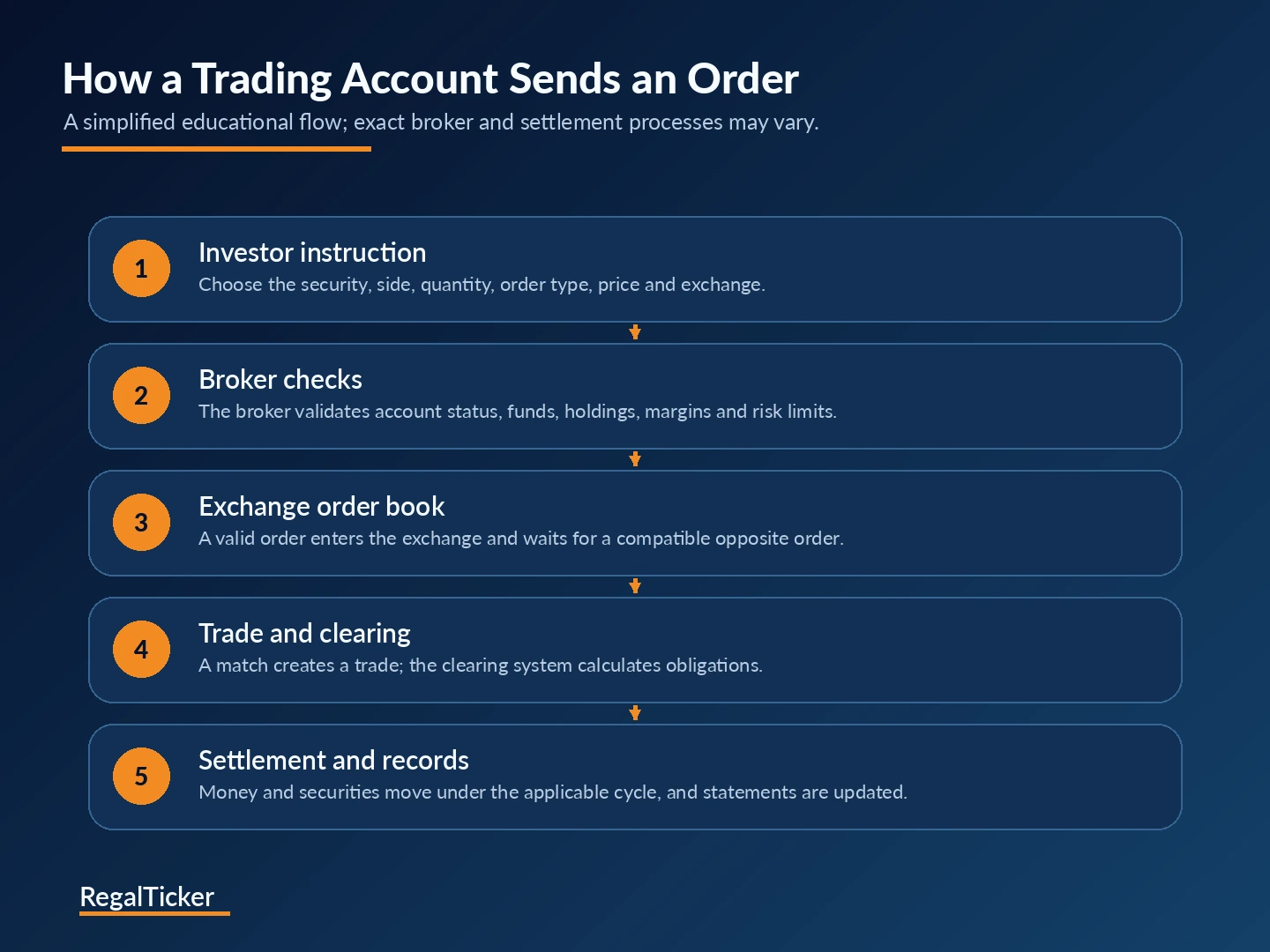
Simplified order flow
- The investor selects a security, quantity, order type and exchange.
- The broker checks account status, segment access, funds, holdings, margins and risk limits.
- A valid order is transmitted to the exchange.
- The exchange places it in the order book and tries to match it with a compatible opposite order.
- When matching conditions are met, a trade is executed.
- The clearing and settlement systems calculate obligations.
- Funds and securities move through the applicable settlement process.
- The investor’s bank, trading ledger and demat holdings are updated according to the transaction.
The exact path can vary by product, market segment, broker setup and settlement type.
Order placement, trade execution and settlement are different
Beginners often treat these three events as one. They are not.
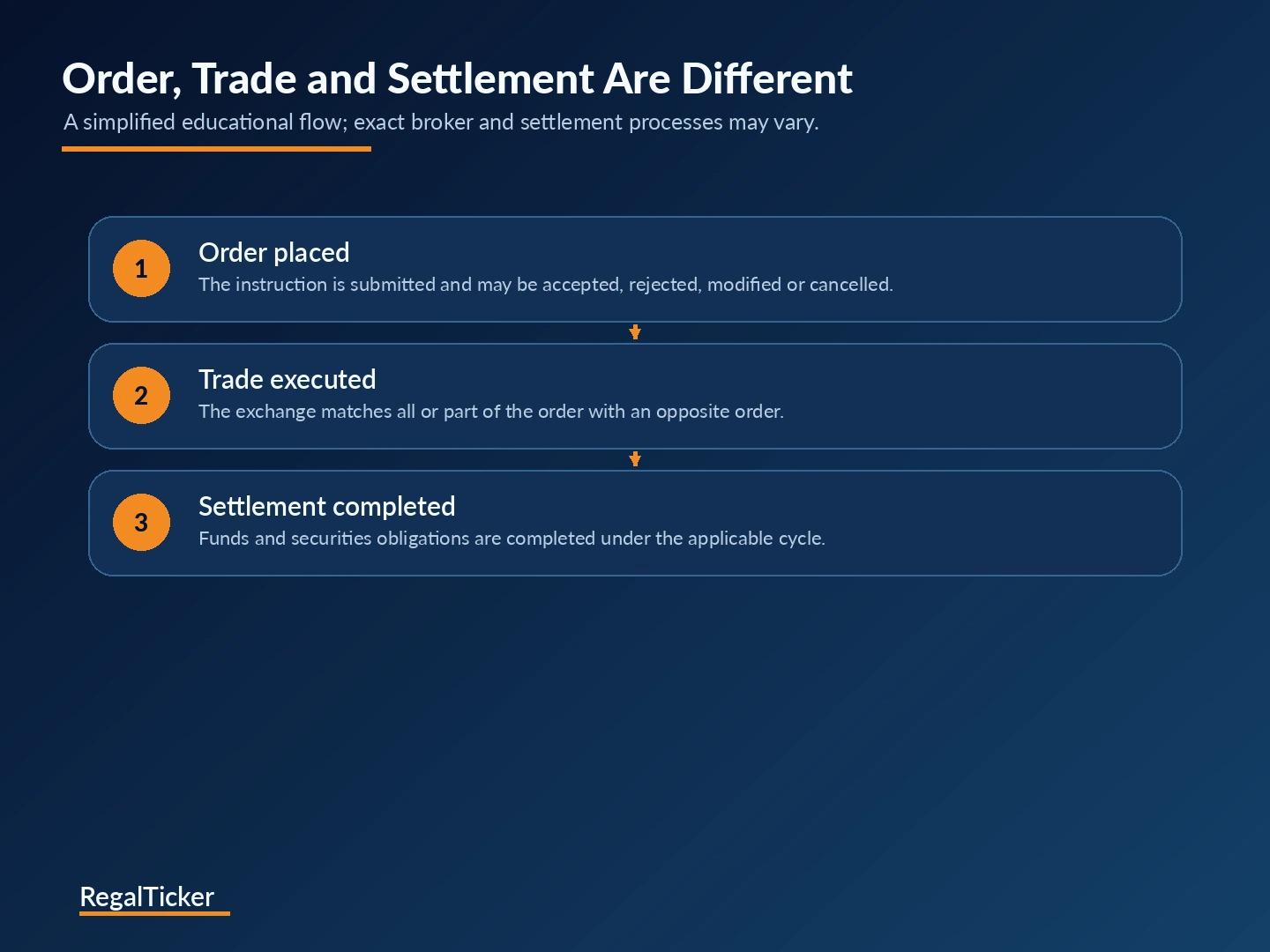
| Stage | What happens | Possible outcome |
|---|---|---|
| Order placement | The investor sends an instruction | Accepted, rejected or pending |
| Order execution | The exchange matches all or part of the order | Fully executed, partly executed or not executed |
| Settlement | Money and securities obligations are completed | Funds/securities credited or debited under the applicable cycle |
Order placed but not executed
A limit order may remain unexecuted when no opposite order is available at the specified price.
Partly executed order
An order for 100 shares may execute for only 40 shares if sufficient matching quantity is unavailable. The remaining 60 may stay pending, be modified, expire or be cancelled according to the order conditions.
Executed but not yet settled
An executed delivery trade creates obligations. The final movement of money and securities follows the applicable settlement process. NSE currently publishes both T+1 and eligible T+0 settlement arrangements; availability and operating rules should be verified through current official exchange and broker information.
What happens when you buy shares?
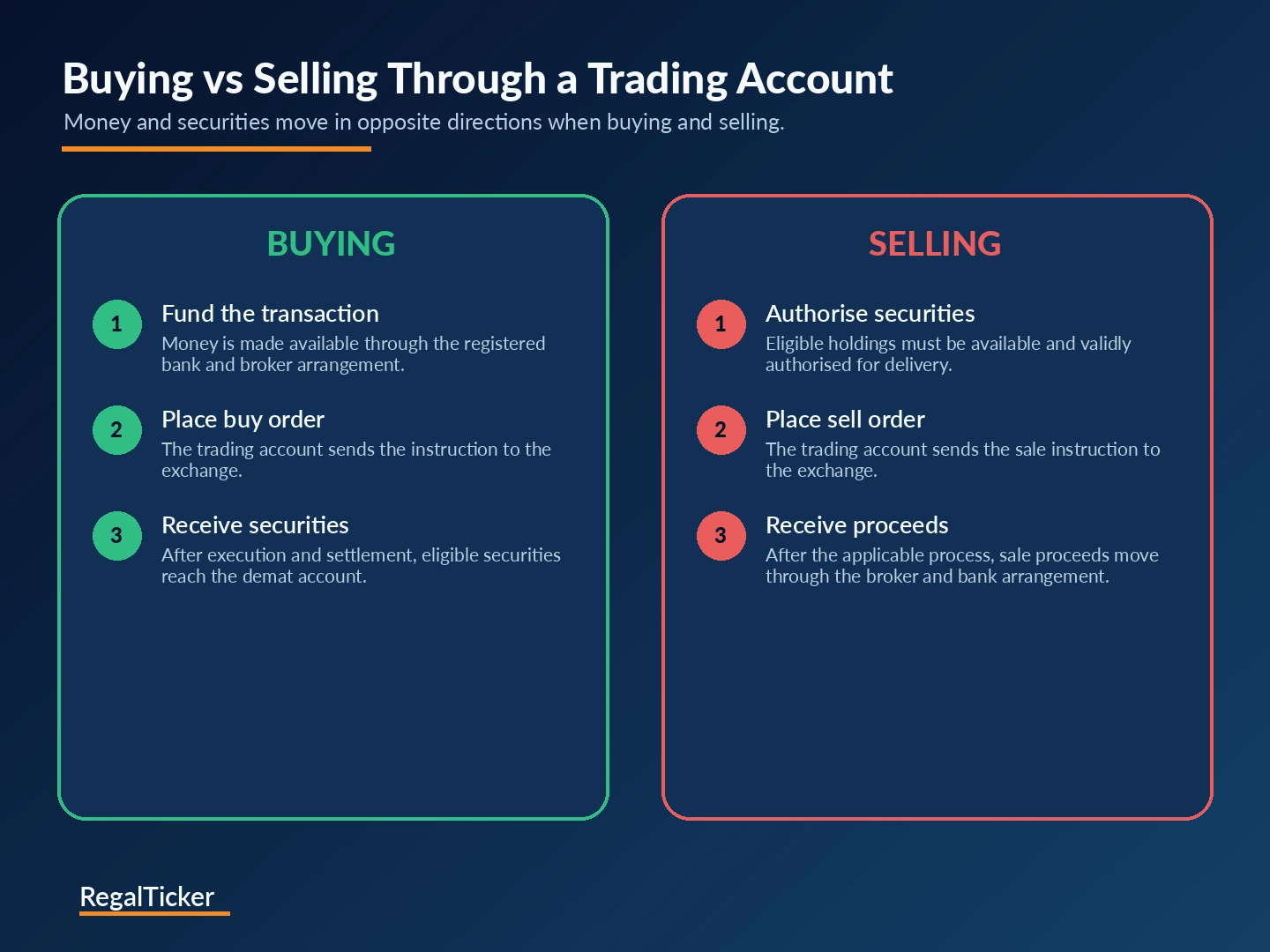
A simplified delivery purchase works like this:
- You make money available through the registered bank and broker arrangement.
- You place a buy order through the trading account.
- The broker sends the valid order to the exchange.
- The exchange matches the order when a suitable seller is available.
- The trade appears in your order and trade records.
- Funds are used for the settlement obligation.
- Eligible securities are credited to your demat account after the applicable process.
Worked example
Buying 20 shares with a limit order
Meera places a limit order to buy 20 shares at ₹500 each.
If sellers are available at ₹500 or lower under the exchange’s matching rules, the order may execute. If only 8 shares are available, the order may be partly executed for 8. If the market stays above ₹500, the order may remain unexecuted. Brokerage, taxes and other charges can make the final debit higher than ₹10,000.
The example shows why an order value is not always the same as the final contract-note amount.
What happens when you sell shares?
For a delivery sale:
- You place a sell order through the trading account.
- The broker checks whether the account has the necessary holdings or valid authorisation.
- The order is transmitted to the exchange.
- The exchange matches the order with a buyer.
- The relevant securities are delivered through the demat and settlement process.
- Sale proceeds are reflected through the broker ledger and registered bank arrangement according to the applicable process.
The investor may need to authorise the securities debit using an approved mechanism. The exact method can depend on the broker, depository arrangement and account permissions.
Risk warning
Do not share OTPs or authorise unknown debits
An authorisation request should correspond to a transaction you initiated. Verify the security, quantity and purpose before approving any demat debit, pledge or login request.
What can be traded through a trading account?
The available products depend on the broker’s memberships, the segments activated for the client and the investor’s eligibility.
Possible segments can include:
- Equity cash market
- Exchange-traded funds
- Equity derivatives
- Currency derivatives
- Commodity derivatives through the relevant arrangement
- Sovereign gold bonds or government-security platforms where supported
- Mutual-fund order platforms
- Public offers or related facilities provided through the platform
Opening an account does not automatically activate every segment. Derivative or leveraged segments may require additional disclosures, financial information or proof of income under current rules.
Investor note
Activate only what you understand
Do not enable derivatives, margin or complex products merely because the app displays them. Each segment can have different risk, margin, settlement and loss characteristics.
What is a Unique Client Code?
A Unique Client Code, commonly called a UCC or client code, identifies the investor in the broker and exchange transaction process.
The investor should check that:
- The code belongs to the correct legal name.
- PAN and contact details are accurate.
- Trades reported by the exchange match instructions.
- No unknown segment or account is activated.
The code is not the same as a demat account number, bank account number or application login password.
What is a trading ledger?
The trading ledger is the broker’s record of financial entries relating to the client account.
It may show:
- Funds transferred to the broker arrangement
- Purchase and sale obligations
- Brokerage and statutory charges
- Margin debits and credits
- Payouts or withdrawals
- Adjustments and reversals
- Running-account settlements
A positive figure in an application should not be assumed to be freely withdrawable without checking settlement, margin and withdrawal status.
What is a contract note?
A contract note is the formal trade confirmation issued by the stock broker. SEBI and exchange investor guidance emphasise receiving a valid contract note for executed trades, generally within 24 hours of execution.
A contract note can include:
- Client and broker details
- Trade date
- Exchange and segment
- Security or contract details
- Buy or sell side
- Quantity and price
- Order and trade identifiers
- Brokerage
- Applicable taxes and levies
- Net amount payable or receivable
The investor should compare the contract note with the order history and exchange messages.
Risk warning
A screenshot is not a contract note
An app screenshot or social-media confirmation is not a substitute for the official contract note and exchange-generated trade alerts.
What alerts and statements should you review?
Responsible account use includes checking records from more than one source.
- Broker order and trade confirmation
- Digitally signed contract note
- Exchange SMS or email alert
- Trading-ledger statement
- Funds and securities balance communication
- Demat debit or credit alert
- Bank debit or credit record
If the records do not match, contact the broker through official channels without delay.
What charges can apply?
Charges vary by broker, product, transaction value and account plan.
| Charge type | What it may relate to |
|---|---|
| Brokerage | Broker’s charge for executing or facilitating the trade |
| Securities Transaction Tax | Statutory tax on specified securities transactions |
| Exchange transaction charges | Exchange-related transaction fees |
| SEBI turnover fees | Regulatory turnover-related fee |
| GST | Tax on specified service charges |
| Stamp duty | Duty applied according to the transaction framework |
| Demat debit charge | DP-related charge when eligible securities are debited |
| Call-and-trade or platform fee | Optional service charge under the broker’s tariff |
| Interest or delayed-payment charges | Can apply where permitted funds or margin obligations are not met |
How do you open a trading account?
The process can be digital or assisted, depending on the broker and investor category.
- Select and verify a registered stock broker.
- Review account type, charges, services and grievance channels.
- Complete KYC and account-opening information.
- Provide PAN, identity, address, bank and contact details as required.
- Complete verification through the supported process.
- Select exchanges, segments and services carefully.
- Review mandatory and voluntary documents.
- Read the tariff sheet, risk disclosures and policies.
- Make a nomination choice where applicable.
- Receive the client code and account welcome information.
- Set a strong password and security controls.
- Verify bank and demat links before the first trade.
KYC requirements and accepted documents can change. Use current official instructions from SEBI, exchanges and the chosen intermediary.
Mandatory and voluntary permissions
Account-opening documents can contain both required terms and optional services.
Optional choices may include:
- Running-account authorisation
- Electronic contract notes
- Call-and-trade facilities
- DDPI or other specified debit/pledge authorisations
- Margin trading or additional products
- Research and communication preferences
Do not treat every preselected box as mandatory. Ask the broker to explain the purpose, scope, charges and cancellation method.
What is DDPI and how is it connected to trading?
DDPI means Demat Debit and Pledge Instruction. It can authorise specified demat debit or pledge actions for defined purposes, subject to applicable rules and the document’s scope.
DDPI is not permission for the broker to make investment decisions on your behalf. Investors should review:
- The exact purposes covered
- Whether it is optional for the service chosen
- How it can be revoked
- Alternative electronic authorisation methods
- Whether any pledge or debit is visible in depository alerts
Can you have more than one trading account?
An investor may be able to maintain accounts with multiple brokers, subject to current KYC and intermediary requirements.
Possible reasons include:
- Different platform features
- Separate investing and active-trading workflows
- Access to different products or services
- Operational backup
Possible disadvantages include:
- More statements and passwords
- Inactivity or maintenance charges
- Fragmented tax and performance records
- Greater risk of overlooking unauthorised activity
More accounts do not create more investment skill.
How should you choose a stock broker?
Compare the complete service, not only the headline brokerage rate.
| Factor | Questions to ask |
|---|---|
| Registration | Is the legal entity registered and active for the required exchange and segment? |
| Charges | What is the full tariff, including DP, platform, call-and-trade and interest-related charges? |
| Platform reliability | Are order status, contract notes and statements accessible during normal use? |
| Risk controls | How are orders, margins and suspicious logins handled? |
| Customer support | Is there an official escalation and grievance process? |
| Demat arrangement | Which DP and depository are used, and what are the debit charges? |
| Segment control | Can unnecessary segments be disabled? |
| Data handling | How are personal and financial details protected? |
| Exit process | How can funds, holdings and account closure be managed? |
Trading account safety checklist
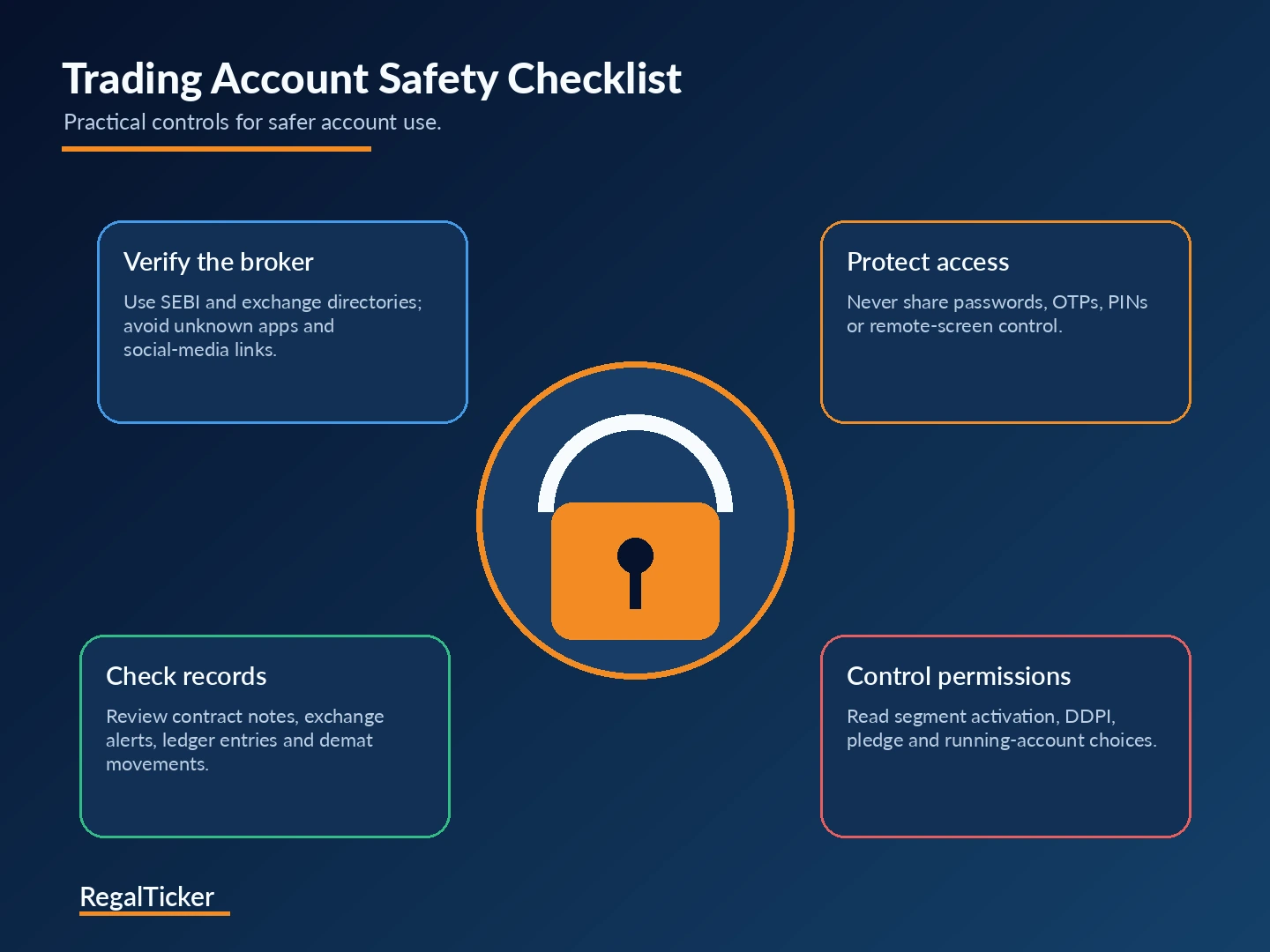
- Deal only with registered intermediaries.
- Use the broker’s official application and website.
- Never share passwords, PINs, OTPs or remote-screen access.
- Do not allow another person to trade through your login.
- Review exchange messages for every trading day.
- Check contract notes within the prescribed period.
- Compare the broker ledger with bank and demat records.
- Read DDPI, pledge, PoA and running-account permissions.
- Keep mobile number, email and bank details current.
- Disable unused segments where possible.
- Avoid assured-return schemes and unsolicited tips.
- Escalate unknown trades immediately.
What happens if the broker stops operating?
The response depends on whether the issue involves securities holdings, client funds, unsettled trades, open positions or service continuity.
Delivery securities recorded in the demat system are operationally distinct from the trading account, although the same organisation may provide both broking and DP services. Investors should preserve:
- Demat holding statements
- Trading-ledger statements
- Contract notes
- Bank records
- Client master and UCC information
- Exchange and depository alerts
Follow official exchange, depository and SEBI instructions for transfer, claims, complaints or account migration. Do not rely on unofficial agents offering to “recover” funds or holdings for an advance fee.
Common trading-account mistakes
Mistake 1: Confusing account opening with investing readiness
The technology may be activated before the investor understands valuation, risk or order types.
Mistake 2: Ignoring the tariff sheet
Low brokerage can coexist with other charges.
Mistake 3: Treating available margin as personal cash
Margin can create obligations and losses larger than the amount initially expected.
Mistake 4: Sharing login access
The account holder remains exposed to financial and compliance consequences.
Mistake 5: Not checking exchange alerts
Independent alerts can reveal unknown trades or mismatched quantities.
Mistake 6: Believing every order will execute
Price, quantity, liquidity and order conditions affect execution.
Frequently asked questions
Frequently asked questions
What is a trading account in simple words?
It is an account with a registered stock broker that allows an investor to place buy and sell orders on recognised stock exchanges.
Is a trading account the same as a demat account?
No. The trading account places orders; the demat account holds eligible securities electronically.
Does a trading account hold money?
It can show a broker ledger balance, but it does not replace a bank account. Money is transferred and settled through the registered banking and broking arrangement.
Can I open a trading account without a demat account?
The exact setup depends on the products and services used. For normal delivery-based holding of listed shares, a demat account is generally needed.
Can I have multiple trading accounts?
Multiple accounts may be permitted, but each should be monitored and can involve separate charges, statements and security controls.
What is a UCC?
A Unique Client Code identifies the investor in the broker and exchange transaction process.
Why was my order rejected?
Possible reasons include insufficient funds or margin, unavailable holdings, invalid price or quantity, segment restrictions, exchange controls or broker risk checks.
Is an order complete when I press Buy or Sell?
No. The order must be accepted, matched and executed, and delivery trades must then complete settlement.
What document proves my trade?
The broker-issued contract note is the formal trade confirmation. Exchange alerts and account statements provide additional verification.
What should I read next?
Read Demat Account vs Trading Account vs Bank Account to understand how the three accounts work together.
Continue learning in Demat & Trading
Conclusion
A trading account is the operating bridge between an investor and the exchange-traded securities market. It allows orders to be placed through a registered stock broker, but it does not hold securities in the same way as a demat account or replace the banking system used for money.
The complete beginner model is:
- Bank account: money
- Trading account: orders and trade records
- Demat account: eligible securities
Safe use requires more than learning where the Buy button is. Investors should verify the broker, understand order stages, review charges, examine contract notes and alerts, protect credentials and activate only the products they genuinely understand.
Verify through official sources
Official references
- SEBI Investor — What You Need to Start Investing
- SEBI Investor — Do’s and Don’ts of Investing
- SEBI — Investor Charter for Stock Brokers, February 2025
- NSE — Opening an Account
- NSE — How to Connect to NSE
- NSE — Advisory for Investors
- NSE — Equity Market Settlement Cycle
- NISM — What Is Trading Account and Demat Account?
Educational disclaimer: This article is for investor education and general information only. It is not investment advice, a research recommendation, a trading strategy, an invitation to trade or an assurance of returns. Account-opening rules, KYC requirements, settlement arrangements, charges, market segments and intermediary processes can change. Verify current information through SEBI, recognised exchanges, depositories and your registered intermediary before acting.