
Learn the stock market in simple language. This guide explains what the stock market means, how it works, why companies issue shares, and what beginners should understand before investing.
“`
Quick Answer: What is Stock Market?
The stock market is a regulated marketplace where shares of listed companies are bought and sold. When you buy a share, you buy a small ownership part in a company.
The stock market may look confusing for beginners because prices keep moving every day. But the basic concept is simple: companies use the stock market to raise money, and investors use it to participate in the growth of those companies.
In India, popular stock exchanges include NSE and BSE. These exchanges provide a platform where listed company shares are traded through registered brokers.
Stock Market Meaning in Simple Words
A stock market connects companies and investors. Companies need money for growth, expansion, debt reduction, or business development. Investors buy shares because they want to participate in the growth of those companies.
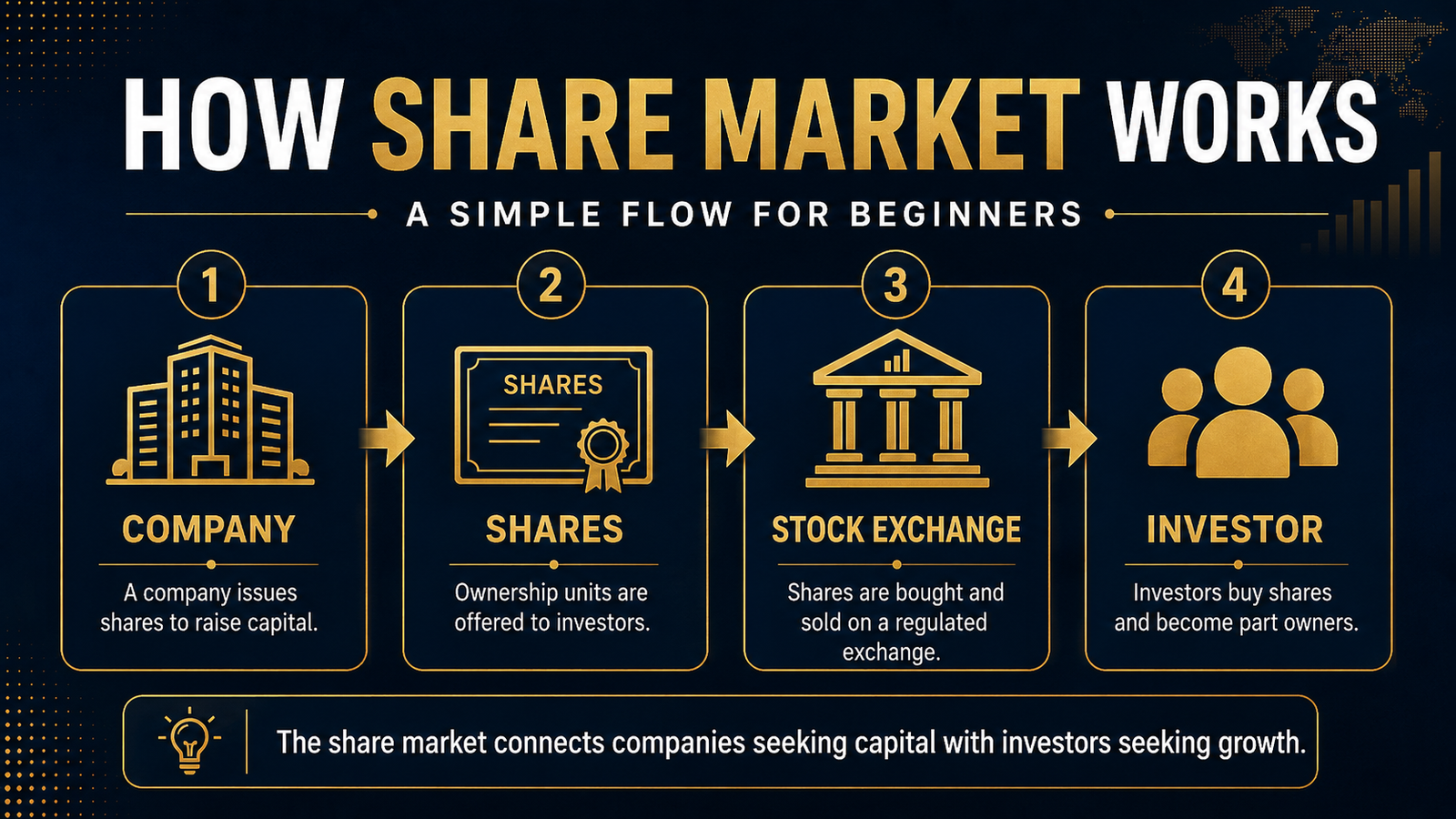
Company
A company lists its shares on a stock exchange to raise money from the public.
Stock Exchange
The exchange provides a regulated platform where shares are bought and sold.
Investor
An investor buys shares and becomes a small owner of the company.
Simple Example of Stock Market
Suppose ABC Limited is a listed company and its share price is ₹100.
“`| Details | Example |
|---|---|
| Share price | ₹100 |
| Shares bought | 10 shares |
| Total investment | ₹1,000 |
| If price becomes ₹120 | Value may become ₹1,200 |
| If price falls to ₹80 | Value may become ₹800 |
This example shows that the stock market has both opportunity and risk. Prices can move up or down.
“`Why Do Companies Enter the Stock Market?
Companies enter the stock market mainly to raise capital. This capital can be used for business expansion, technology improvement, debt repayment, new projects, or future growth.
Companies may use stock market money for:
- Expanding business operations
- Launching new products or services
- Reducing debt
- Opening new branches or factories
- Improving technology and infrastructure
When a company sells shares to the public for the first time, it is called an IPO, or Initial Public Offering.
Why Do People Invest in the Stock Market?
People invest in the stock market to build wealth, earn dividends, and participate in the growth of good companies. However, stock market investing is not guaranteed. It requires learning, patience, and risk management.
| Reason | Simple Meaning |
|---|---|
| Wealth creation | Investors may grow money over the long term if companies perform well. |
| Dividend income | Some companies share a part of profit with shareholders. |
| Ownership | Buying shares means owning a small part of a company. |
| Inflation protection | Long-term investing may help money grow better than idle cash. |
Stock Market vs Share Market
Many beginners use stock market and share market as the same term. In daily language, this is common. But technically, stock market is a broader term.
| Term | Meaning |
|---|---|
| Share Market | Mainly refers to buying and selling company shares. |
| Stock Market | A broader market that may include shares, ETFs, bonds, derivatives, and other securities. |
Important Stock Market Terms for Beginners
Beginner Glossary
“`Share: A small ownership unit in a company.
Stock Exchange: A regulated platform where shares and other securities are traded. NSE and BSE are major stock exchanges in India.
Investor: A person who buys shares or assets for long-term wealth creation.
Trader: A person who buys and sells frequently to benefit from short-term price movement.
IPO: Initial Public Offering. It is the first public sale of a company’s shares.
Dividend: A part of company profit that may be distributed to shareholders.
Index: A group of selected stocks used to track market performance. Sensex and Nifty are popular Indian stock market indices.
“`How Does the Stock Market Work?
The stock market works through buyers, sellers, brokers, exchanges, clearing corporations, depositories, and regulators.
Simple process
- A company lists its shares on a stock exchange.
- Investors place buy or sell orders through a broker.
- The exchange matches buyers and sellers.
- The trade is executed.
- Shares are credited or debited in the demat account.
- Money is debited or credited through the trading account.

Is Stock Market Safe for Beginners?
The stock market is regulated, but every investment has risk. Share prices can rise or fall because of company performance, market conditions, interest rates, global news, government policy, and investor sentiment.
Beginners should be careful about:
- Fake stock tips
- Unregistered advisers
- Telegram and WhatsApp trading calls
- Guaranteed return promises
- Overtrading
- Borrowing money to trade
- Putting all money in one stock
Stock Market vs Gambling
The stock market is not gambling when someone invests with knowledge, research, patience, and risk management. But it can become gambling when someone buys and sells without understanding the company, price, risk, or reason for investing.
A beginner should not enter the market with a quick-money mindset. The better approach is to understand the basics, start small, and avoid emotional decisions.
Common Mistakes Beginners Make
1. Starting without learning
Many beginners open a trading account and start buying shares without understanding basic terms.
“`2. Following tips blindly
Buying shares only because of a social media post, YouTube video, or WhatsApp message can be risky.
3. Expecting quick profit
The stock market can create wealth over time, but it does not guarantee quick profit.
4. Ignoring risk
Every investment has risk. Beginners should not invest money needed for urgent expenses.
5. Putting all money in one stock
Investing everything in one company increases risk. Diversification is important.
“`Good Habits for Stock Market Beginners
- Learn basic stock market terms first
- Start with small amounts
- Avoid tips and rumours
- Read official company announcements
- Understand risk before investing
- Keep emergency savings separately
- Think long term
- Avoid emotional decisions
- Use trusted official sources for learning
Useful Official Sources for Beginners
Beginners should learn from reliable and official sources. For Indian investors, these official websites are useful:
“` “`Final Words
The stock market is a place where shares of listed companies are bought and sold. For beginners, the most important thing is to understand that the stock market is not a shortcut to quick money.
It is a financial marketplace where knowledge, patience, discipline, and risk management matter. Before investing, learn the basics, understand the risks, avoid fake tips, and use official sources for important information.
FAQs on Stock Market
“`What is stock market in simple words?
The stock market is a marketplace where shares of listed companies are bought and sold. It allows investors to buy ownership in companies and allows companies to raise money from the public.
What is the difference between stock market and share market?
In common language, both terms are used similarly. Share market usually refers to buying and selling company shares, while stock market is a broader term that may include shares and other listed securities.
Can beginners invest in the stock market?
Yes, beginners can invest in the stock market, but they should first learn basic terms, risk, demat account, trading account, exchanges, and safe investing practices.
Is stock market risky?
Yes, the stock market has risk. Share prices can rise or fall due to company performance, market conditions, economy, and investor sentiment.
What should a beginner learn first in stock market?
A beginner should first learn what shares are, how stock exchanges work, what a demat account is, what Sensex and Nifty mean, what risk means, and how to avoid fake stock tips.
Disclaimer
RegalTicker is for educational and informational purposes only. We do not provide investment advice, stock recommendations, target prices, trading calls, or portfolio advice. Please consult a qualified financial adviser before making investment decisions.